

TL;DR
A digital marketing agency is an outsourced team that plans, builds and runs your SEO, paid media, content and social campaigns so you do not have to hire that team in-house. The global marketing agency market reached USD 452.96 billion in 2025 (roughly R7.43 trillion) and is forecast to hit USD 473.57 billion in 2026 (roughly R7.77 trillion), with digital services now more than 61% of that spend (Mordor Intelligence, 2026). The right agency match comes down to service fit, proof of results and communication style, not the lowest quote.
Key takeaways
- Agencies win on speed to competent execution, not just cost: an established team runs your campaign type from week one.
- Organic search is rated the top ROI channel by 49% of marketers; Google Ads averages an 8x return (200% ROI).
- South African search ads averaged a cost per click of R88.97 and a cost per lead of R1,294.70 in 2026 (Juicy Designs).
- Specialist agencies average 30% net margins vs a 13% generalist average, usually reflecting deeper channel expertise.
- Choose on evidence: relevant case studies with real numbers, references, and agreed KPIs before signing, never on price alone.
Global marketing agency revenue hit USD 452.96 billion in 2025 (roughly R7.43 trillion) and is projected to grow to USD 473.57 billion in 2026 (roughly R7.77 trillion), a 4.55% compound annual growth rate, with digital marketing services alone accounting for 61.58% of that spend (Mordor Intelligence, 2026). That is not a niche industry. It is the default way most businesses, from single-location retailers to national insurers, now build and defend their online presence.
A digital marketing agency is a team you hire to run some or all of your online marketing: search visibility, paid advertising, content, social media, and increasingly, how your brand shows up in AI answers like Google's AI Overviews and ChatGPT search. This guide covers what these agencies actually do, what they cost, the mistakes that sink most agency relationships, and a practical framework for choosing one.
We work inside this industry daily at Juicy Designs, running SEO, paid media and brand strategy for clients across insurance, automotive, retail and entertainment. The advice below reflects what actually moves results, and where it is useful we have grounded it in our own first-party research rather than recycled global averages.
Note on currency: global figures in this guide are sourced in US dollars and converted to rand at approximately R16.40 to the dollar, the mid-market rate in late June 2026. Exchange rates move; treat the rand figures as directional, not exact.
What is a digital marketing agency?
A digital marketing agency is a company that plans, builds and manages a business's online marketing across one or more digital channels, typically on a retainer or project basis rather than as in-house hires.
Agencies exist because building a full in-house marketing function is expensive and slow. A single senior SEO specialist, paid media manager, content writer and social media strategist can easily cost more in salary than a mid-sized agency retainer, and finding, hiring and retaining all four takes months most businesses do not have.
Agencies fall into two broad categories:
- Full-service agencies run multiple channels under one roof, coordinating strategy across SEO, paid ads, content and social so campaigns reinforce each other.
- Specialist agencies focus on one discipline, such as SEO or PPC, and go deeper on that single channel than a generalist team usually can.
Neither model is inherently better. The right choice depends on how many channels you need running at once and how much internal marketing capability you already have. Search engine optimisation (28% of agency service revenue), social media marketing (35%) and search engine marketing (22%) make up the bulk of what agencies actually sell (Business Research Insights, 2026), which tells you where most of the industry's expertise and case-study depth is concentrated.
Why the agency model still makes sense in 2026
The strongest argument for hiring an agency instead of building in-house is not cost. It is speed to competent execution. A new in-house hire needs onboarding, tooling and time to reach the output an established agency team delivers from week one, because that team has already run the same campaign type for other clients.
The data backs the channel-level case for outsourcing specific tactics. Organic search remains the highest-rated channel for return on investment: 49% of marketing professionals rank it as their best-performing channel overall, and 27% of B2B marketers name their website, blog or SEO programme as their single top revenue driver (HubSpot State of Marketing, 2026). On the paid side, Google Ads delivers an average 8x return on spend, a 200% ROI benchmark that has held for several years, the same multiple whether that spend is in dollars or rand.
That ROI only shows up with consistent execution, though. SEO in particular compounds over 6 to 12 months rather than delivering instant results, and a business without a dedicated in-house SEO function typically cannot sustain that consistency without outside help. This is exactly the gap agencies are built to fill.
The industry itself is consolidating around specialisation. Agencies that narrowed their service offering to a focused niche averaged 30% net margins and 13% revenue growth in 2025, against a 13% net margin and 7.5% revenue growth industry average for generalist agencies (Promethean Research, 2026). For a client, that usually means a specialist agency has deeper, more current expertise in its one channel than a broad generalist spreads across five.
Core services digital marketing agencies offer
Most agencies build their offering around a common core, then differentiate on depth, industry focus, or how the channels are integrated.
Search engine optimisation (SEO)
SEO improves how a website ranks in organic search through four connected workstreams: keyword research, on-page optimisation, technical SEO (making sure engines can crawl and index the site), and off-page work, mainly earning backlinks from credible sites. It has changed meaningfully since 2024: Google's AI Overviews and AI Mode now run on the same core ranking systems as traditional search, so optimising for AI answers is not a separate discipline from good SEO. 73% of agency leaders say AI has fundamentally disrupted how SEO is practised (RevenueMemo, 2026), largely because ranking well now also means being quotable, not just findable.
Paid media (PPC and paid social)
Pay-per-click advertising puts a business in front of buyers immediately, in exchange for a fee each time someone clicks. Agencies manage Google Ads and PPC through keyword selection, ad copywriting, bid strategy and ongoing analysis, because an unmanaged account bleeds budget fast. At a 200% average ROI (Google economic impact research, 2026), paid media pairs well with SEO rather than competing with it: ads fill the visibility gap while organic rankings build over months.
Social media marketing
Social media agencies manage brand presence across Facebook, Instagram, TikTok and LinkedIn, covering content creation, community management, paid social and reporting. 43% of agencies now name TikTok their highest-ROI platform, ahead of both Facebook and Instagram (RevenueMemo, 2026), a shift that has forced most social teams to rebuild their content approach around short-form video rather than static posts.
Content marketing
Content marketing creates and distributes material, blog posts, guides and video, that attracts an audience and builds trust over time rather than buying attention directly. It costs meaningfully less than outbound marketing while generating more qualified leads, which is why most full-service agencies treat it as the connective layer between SEO and social rather than a standalone service.
Digital advertising beyond search
Beyond search and social ads, agencies plan and manage display advertising, video ads and increasingly connected TV (CTV) placements, which 15% of agencies now flag as an emerging growth channel (RevenueMemo, 2026). These formats work best for brand awareness rather than direct response, layered on top of a working SEO and PPC foundation.
Ecommerce marketing
Ecommerce-focused agencies combine SEO, paid media and email marketing with conversion rate optimisation, tuning product pages, checkout flow and retargeting specifically to turn traffic into completed purchases rather than just visits.
Brand strategy
Brand strategy work defines what a business stands for and how it communicates that consistently: positioning, visual identity, messaging and the customer experience that reinforces it. It is less measurable in the short term than a PPC campaign, but it is what makes every other channel's output recognisably yours rather than interchangeable with a competitor's.
Specialist vs full-service agencies
Choosing between a specialist and a full-service agency is really a question of how many moving parts you need coordinated at once.
A specialist agency, one that does SEO and nothing else for example, typically brings deeper channel-specific expertise, more current knowledge of that channel's algorithm changes, and a sharper case-study library in that discipline. A full-service agency trades some of that depth for coordination: your SEO content strategy, paid campaigns and social calendar are planned together rather than by three separate vendors who never talk to each other.
There is a real cost to running multiple specialist agencies in parallel without a coordinating layer: campaigns work against each other, reporting does not reconcile, and nobody owns the overall result. For a business running two or more channels seriously, a full-service agency or a specialist with a strong project-management layer usually outperforms an uncoordinated multi-vendor setup. Neither model suits every business, though: a company that only needs PPC managed, with strong in-house content and social already, is better served by a PPC specialist than by paying a full-service agency for channels it does not need.
What digital marketing agencies actually cost
Agency pricing varies by service, scope and market, but a few benchmarks help set expectations. Marketing budgets overall have been under pressure: companies allocated 7.7% of total revenue to marketing in 2024, the lowest share since 2021 (CMO Survey, 2026), and of that spend, agencies capture roughly 23.3% of the total marketing budget, behind paid media (25.6%), martech (25.4%) and labour (24.6%).
Pricing typically follows one of three models:
- Retainer: a fixed monthly fee for an agreed scope of ongoing work, most common for SEO, social and content, where results build over months.
- Project-based: a fixed fee for a defined deliverable, such as a website rebuild or a one-off campaign, with a clear start and end date.
- Performance-based: fees tied to results, most common in PPC, where the fee scales with ad spend or agreed outcomes.
The billing model itself is shifting. 38% of US digital agencies moved at least one service line from hourly billing to retainer-plus-performance or fully outcome-based pricing in 2026, driven largely by client pushback on hourly rates as AI tools compress the time agencies need to produce the same output (RevenueMemo, 2026). If your prospective agency still bills hourly with no performance component, it is worth asking why. Cheapest is rarely best value: agencies that specialise earn 30% net margins against a 13% industry average by charging appropriately for depth (Promethean Research, 2026), and that pricing discipline usually correlates with the quality of the work you will actually receive.
What South African businesses actually pay for search ads
South African search advertising is a useful case study in why agency pricing benchmarks need to be local, not global. Averages pulled from US or European data do not hold up in the South African market, where currency, competition levels and ad inventory all differ substantially.
Our 2026 South African Search Advertising Benchmarks study, analysing 1,224 real South African search campaigns running from July 2025 to June 2026, put the average cost per click at R88.97, average click-through rate at 6.64%, average conversion rate at 8.18% and average cost per lead at R1,294.70 (Juicy Designs, 2026). Cost per lead was the standout mover, up 33.28% year over year, largely concentrated in industries exposed to import tariffs such as car sales, retail and insurance.
Industry variation is wide enough that a single national average is close to useless on its own. Insurance carried both the highest cost per click (R195.52) and the highest cost per lead (R2,454.36) of the 24 industries studied, while Arts & Entertainment posted the lowest cost per click (R30.36) and the highest click-through rate (12.79%), and Animals & Pets returned the highest conversion rate at 16.22% (Juicy Designs, 2026). A business benchmarking against "the average" without checking its specific industry row is comparing itself to the wrong number entirely.
The silver lining in a rising cost-per-lead market is that conversion rate actually improved for 75% of industries studied in 2026 (Juicy Designs, 2026), meaning the clicks businesses pay more for are also converting more reliably, provided the landing experience holds up its end. Across our own client base, sharper audience targeting combined with organic search work has cut cost per lead by 45% on average, and landing page improvements alone have lifted client conversion rates by 56% on average.
| Metric | 2026 average | Change vs 2025 |
|---|---|---|
| Click-through rate (CTR) | 6.64% | -0.35% |
| Cost per click (CPC) | R88.97 | +3.05% |
| Conversion rate (CVR) | 8.18% | +8.78% |
| Cost per lead (CPL) | R1,294.70 | +33.28% |
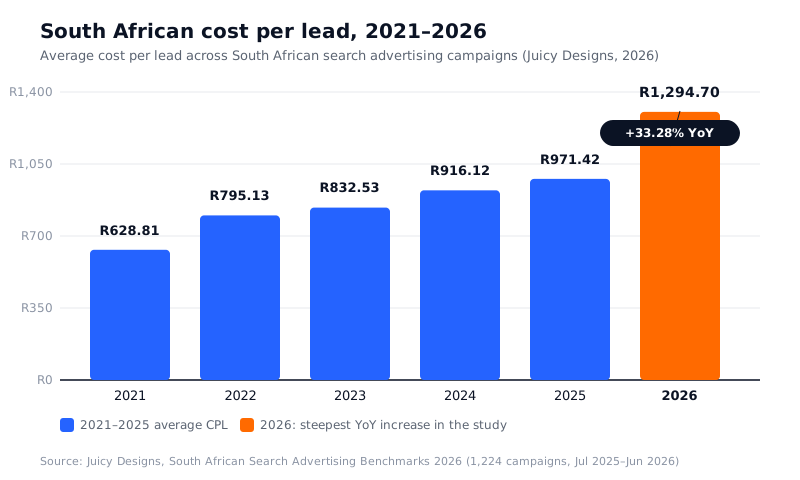
For businesses selecting an agency in this market, the data points to a practical filter: ask any South African agency you are evaluating for its cost-per-lead and conversion-rate numbers against your specific industry benchmark, not a generic promise of "lower costs" or "more leads." An agency that cannot answer that with real numbers usually is not tracking the right things in the first place.
How to choose the right agency
Start by defining what you actually need before you start evaluating agencies, not after. A business that needs SEO and content is shopping for a different agency than one that needs paid media managed at scale, even though both might call themselves "digital marketing agencies." Once scope is clear, work through this sequence:
- Check the portfolio for relevant proof, not just any proof. A case study needs a stated challenge, what the agency did, and a measurable result. "We helped grow their social following" is not a case study. "We took organic traffic from 4,000 to 22,000 monthly sessions in nine months, driven by 40 new ranking keywords" is.
- Ask how they will communicate, specifically. Get the cadence, the format (call, written report, live dashboard) and who your actual point of contact will be, not just the account executive who ran the pitch.
- Confirm the scope matches the price. A retainer that seems cheap for the promised scope usually means understaffing or unrealistic promises. Ask directly how many hours or people are allocated to your account.
- Read reviews outside the agency's own website. Google reviews and direct references from current clients tell you more than curated testimonials on the agency's homepage.
- Check cultural and communication fit. An agency that pushes back on weak ideas and explains its reasoning is a better long-term partner than one that says yes to everything.
- Compare specialisation against your actual need. If you need deep SEO work, a specialist with 10 detailed case studies usually outperforms a full-service agency where SEO is one of six listed services.
Referrals remain the dominant way good agencies win new clients, the primary new-business source for 75% of agencies (RSW/US 2025 Agency Survey), so asking your network directly, not just searching "best digital marketing agency," is a legitimate and underused research step.
Common mistakes when hiring an agency
Choosing on price alone. The cheapest quote in a retainer model usually buys the fewest hours, the most junior staff, or both. 93% of marketing and professional services firms say their own new-business pipeline is not strong enough (RSW/US, 2025), a useful reminder that agencies compete hard on price precisely because differentiation is difficult; a rock-bottom quote is a signal, not a bargain.
Skipping the reference check. A polished pitch deck says nothing about how an agency behaves six months into a real engagement, when a campaign underperforms and something has to be explained honestly. Ask for two client references in your industry or of your size, and actually call them.
Ignoring team stability. Most agencies are small: 87% of North American agencies employ fewer than 50 people (Promethean Research, 2026), so your account team is often two or three people. Ask who specifically will work on your account and how long they have been there; high turnover on your account is a leading cause of inconsistent output.
Expecting SEO results in weeks. SEO is a compounding channel, not a paid one. An agency promising first-page rankings within a month is either inexperienced or not being straight with you.
No agreed way to measure success before work starts. If the KPIs are not defined before the first invoice, they will not be enforced after it either. Agree on the numbers that matter before signing.
How agencies measure success
Agencies typically report against a core set of KPIs, weighted by the channel and the business goal behind it:
- Return on investment (ROI), comparing revenue generated to marketing spend, is the metric that ultimately justifies the retainer.
- Conversion rate, the percentage of visitors who complete a desired action, shows whether traffic is actually turning into business.
- Organic traffic and keyword rankings track SEO progress specifically, since these move independently of paid spend.
- Cost per click and cost per acquisition measure paid media efficiency channel by channel.
- Engagement rate is the standard social media health metric, though it should never be the only one reported, since engagement does not guarantee revenue.
The most reliable agency relationships agree on which of these matter most before the engagement starts, rather than letting the agency choose whichever metric looks best at reporting time.
Where the industry is heading
AI is compressing execution time, not replacing strategy. Roughly 85% of digital marketing's operational tasks are now automatable with AI tools (Incremys, 2026), and the median mid-market team's AI tool spend nearly tripled between Q1 2025 and Q1 2026, from USD 1,200 to USD 3,400 per month (roughly R19,700 to R55,800) (Promethean Research, 2026). The agencies adapting fastest use that time saving to spend more hours on strategy and less on production, not to cut headcount and call it efficiency.
Search itself now includes AI answers. Generative AI tools passed 2.42 billion monthly active users in 2025, nearly doubling in a year (Foursets, 2026), and a meaningful share of research and comparison shopping now happens inside ChatGPT, Perplexity and Google's AI Overviews before a user ever clicks a traditional blue link. Agencies that treat this as an extension of SEO, not a separate discipline, are better positioned than ones still optimising purely for the old ten blue links.
Retainers are getting shorter, results-linked and more scrutinised. With 38% of agencies already shifting billing towards outcome-based pricing, expect the "fixed monthly retainer, vague reporting" arrangement that defined the last decade to keep losing ground to agreements with clearer, contractual performance benchmarks.
Getting started
The lowest-friction first step is not requesting five agency pitches at once. It is writing a one-page brief: your current traffic or lead numbers, your target numbers, your budget range and your timeline. This single document filters out agencies that are not a realistic fit before you spend hours in discovery calls.
From there, shortlist three agencies whose case studies match your industry or business size, not just the ones with the flashiest homepage, and ask each the same questions from the framework above so answers are comparable. Finally, start with a smaller, defined project where possible, an SEO audit or a single campaign, before committing to a long-term retainer. It is the fastest way to see how an agency actually works before your budget is locked in for a year.
Frequently asked questions
What does a digital marketing agency actually do?
A digital marketing agency plans and runs a business's online marketing across channels like SEO, paid advertising, content and social media, typically on an ongoing retainer. Most agencies also handle reporting and strategy, not just execution, so the client is not left interpreting raw data alone.
How much does a digital marketing agency cost?
Costs vary widely by scope and channel, but agencies typically capture around 23.3% of a company's total marketing budget on average. Retainers for a single channel like SEO or social often start in the low thousands per month, while full-service, multi-channel retainers run considerably higher.
How long does it take to see results from an agency?
Paid media can show results within days to weeks, since ad spend produces immediate traffic. SEO typically takes 6 to 12 months to show meaningful ranking and traffic gains, because it depends on search engines re-crawling and re-evaluating a site over time, not a one-off action.
Is a specialist agency better than a full-service agency?
Neither is universally better. A specialist agency usually has deeper expertise in its one channel, while a full-service agency coordinates multiple channels under one strategy. Businesses running two or more channels seriously typically get more consistent results from a full-service or well-coordinated setup than from several disconnected specialist agencies.
How do I know if an agency is credible?
Check for detailed case studies with a stated challenge, action and measurable result, not vague testimonials. Verify claims through Google reviews, third-party platforms and direct reference calls with current clients in your industry.
Can a small business afford a digital marketing agency?
Yes. Many agencies offer scaled retainers or single-channel engagements for smaller budgets, focusing on the highest-impact tactic, often local SEO or targeted PPC, rather than running every channel at once.
What is the difference between an internet marketing company and a digital marketing agency?
The terms overlap heavily in practice, but "internet marketing company" historically implied a narrower, channel-specific focus such as email or display ads, while "digital marketing agency" more often signals a broader, multi-channel or full-service offering.
What does search advertising actually cost in South Africa?
South African search ads averaged a cost per click of R88.97 and a cost per lead of R1,294.70 in 2026, based on Juicy Designs' analysis of 1,224 local campaigns run between July 2025 and June 2026. Costs vary widely by industry, from R30.36 CPC in Arts & Entertainment to R195.52 CPC in Insurance, so compare your numbers to your specific sector rather than the national average.
The bottom line
The agency market is worth nearly half a trillion dollars globally because outsourcing digital marketing consistently outperforms building the same capability in-house, provided the agency is chosen on evidence, not price alone. Define your scope, check real case studies and references, agree on KPIs before signing, and treat the relationship as a partnership you will actively manage, not a service you switch on and forget.
If you are evaluating agencies for SEO, paid media or full-service marketing support in South Africa, Juicy Designs works across automotive, insurance, retail and entertainment clients and is happy to walk through your specific goals. For the underlying data behind the South African benchmarks in this guide, see the full South African Search Advertising Benchmarks 2026 study.