
Marketers: Start A/B Testing Landing Pages With Headline and CTA
Practical A/B testing for marketers: start with headline and primary CTA, set sample size and track lead quality guardrails.
Run a hypothesis-driven A/B test that starts with your headline or CTA, precompute your sample size before launch, and track a lead-quality guardrail alongside your primary conversion metric.


TL;DR: Quick Answer
Practical A/B testing for marketers: start with headline and primary CTA, set sample size and track lead quality guardrails.
Run a hypothesis-driven A/B test that starts with your headline or CTA, precompute your sample size before launch, and track a lead-quality guardrail alongside your primary conversion metric. Success looks like a validated lift in form conversion rate or demo requests that holds up when you check it against lead-to-opportunity rate in your CRM. Your first move: record your baseline conversion rate now and open a test registry or visual editor.
TL;DR:
- Small businesses with low traffic should focus on high-impact changes like headlines and main CTAs, running tests for at least six weeks to reach significance.
- Testing only one element at a time is critical, especially with limited traffic, to accurately measure which change drives improvement.
- Pre-registering the primary and guardrail metrics, expected sample size, and segmentation rules ensures reliable results and prevents goalpost shifting.
- Confirm all tracking fires correctly across devices and browsers before launching tests, and use both visual and server-side testing for accuracy.
- Regularly revisit tests that hit significance, analyse results across segments, and document learnings to build continuous improvement in landing page performance.
What is A/B testing for landing pages, and where do you start?
A/B testing landing pages means showing two versions of a page (A and B) to separate visitor segments and measuring which one drives more of a defined action. This isn't a new idea, but most marketers still test the wrong elements first. Landing page A/B testing improves conversion rates and reduces bounce rate by replacing gut-feel design choices with data, and the elements worth testing first are the ones every single visitor actually sees.
Here's the priority order, ranked by reach and impact per visitor:
- Headline, the first thing anyone reads; a weak one kills momentum before the pitch even starts.
- Primary CTA, button copy, colour, and placement change intent-to-click more than almost anything else.
- Hero layout and offer, how you frame the value proposition above the fold.
- Social proof, testimonials, logos, review counts, positioned near the decision point.
- Form length, every extra field is a reason to abandon.
- Images and supporting visuals, often overrated, but worth testing once the above are locked.
Practitioner data backs this ranking: headline and CTA tests return the highest learning per visitor because 100% of your traffic sees them, unlike a form that only engaged visitors reach.
A few concrete hypotheses to steal:
- Change a feature-led headline to a benefit-led one ("Save 3 hours a week" instead of "Automated scheduling software").
- Swap a generic CTA ("Submit") for an outcome-specific one ("Get My Free Quote").
- Cut a 9-field form down to 4 fields and measure both submissions and lead quality.
Pro Tip: If your traffic is limited, resist the urge to test five things at once. Isolate one element per test, or you won't know which change actually moved the number.
How do you write a testable hypothesis for a landing page?
A hypothesis without structure is just a guess with extra confidence. Use this template every time:
"Because [insight], changing [element] to [variant] will [increase/decrease] [metric] for [segment]."
Once you have a backlog of hypotheses, you need a way to rank them. Two frameworks do the job well:
- ICE (Impact, Confidence, Ease): score each 1 to 10, multiply, and test the highest scorers first.
- PXL: a more rigorous scoring model that weights visibility and evidence strength, useful once you're running several tests a month.
Before you launch anything, pre register these four things in writing:
- Primary metric (the one number that decides win or lose).
- Guardrail metric (the number that must not get worse).
- Sample size and expected runtime.
- Segmentation rules (device, source, new vs returning).
This discipline matters more for B2B pages, where traffic is thinner and sales cycles are longer. A Hypothesis, Design, Run, Decide pipeline with pre registration built in stops you from moving the goalposts once you see early results. If you're short on hypothesis ideas, tools like AI writing assistants for marketers can help generate variant copy quickly, though the hypothesis and measurement plan still need to come from you.
What do you need to set up before launching the test?
A test built on shaky tracking gives you confident answers to the wrong question. Before you flip the switch, work through this checklist:
- Confirm every conversion event fires correctly and syncs to your analytics platform and CRM.
- QA both variants across desktop, mobile, and at least two browsers.
- Verify the randomisation split is actually 50/50 (or whatever ratio you set).
- Keep a holdout control group if you're testing a major structural change.
- Double check that mobile rendering matches desktop intent, not just desktop layout.
Delivery method matters too. Client-side testing through visual editors is faster to set up but can cause a brief flicker as the original page loads before the variant swaps in. Server-side testing eliminates that flicker entirely, but it needs engineering time to implement properly, since visual editors and experiment platforms handle most landing-page tests while server-side setups require more technical lift.
You'll generally need four tool categories working together: a visual editor for building variants, an experiment platform for traffic splitting and significance tracking, an analytics tool like GA4 for behavioural data, and a CRM integration so lead quality data flows back into your decision. HubSpot's own process for running a page test walks through this exact prepare, set up, run, review sequence.
Pro Tip: Test your tracking on a staging URL first. A broken conversion pixel can run silently for two weeks before anyone notices the data looks wrong.
How long should you run a landing page test?
Long enough to reach your pre calculated sample size, and never based on a gut feeling that "it looks like B is winning." Sample size depends on three inputs: your baseline conversion rate, the minimum detectable effect (MDE) you care about, and your desired statistical power (usually 80%).
As a rough guide:
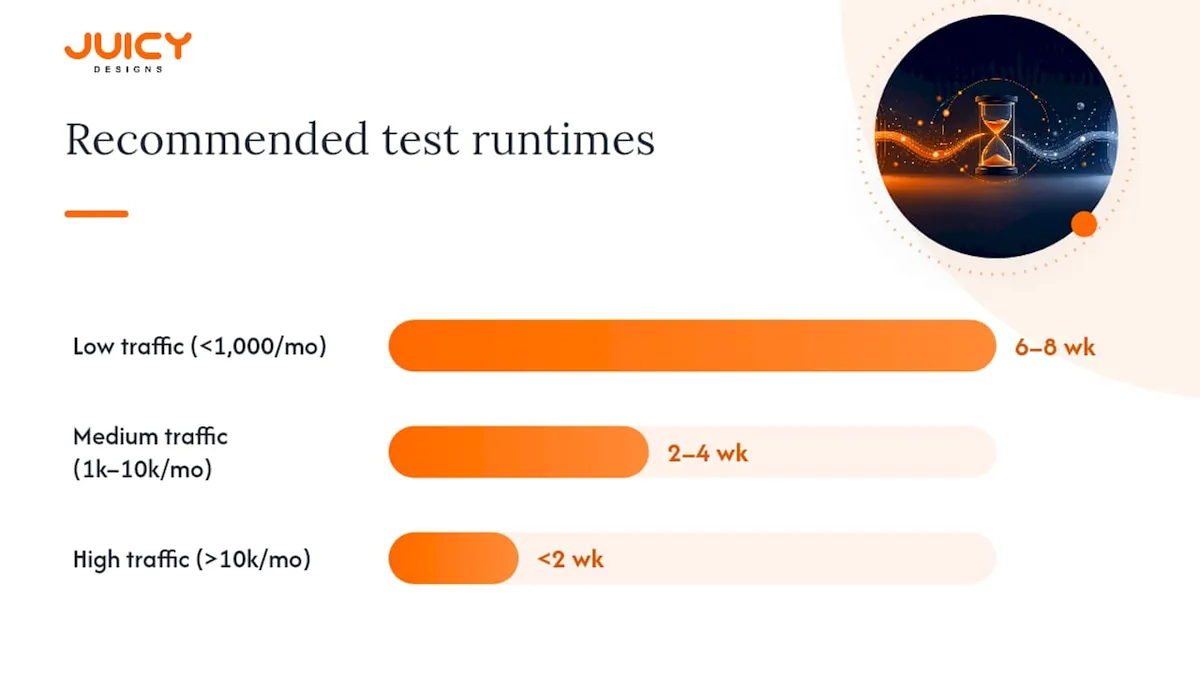
- Low traffic (under 1,000 visitors a month): expect to run tests for 6 to 8 weeks, and only test bold changes with a large expected effect.
- Medium traffic (1,000 to 10,000 visitors a month): 2 to 4 weeks is usually enough to detect a moderate lift.
- High traffic (over 10,000 visitors a month): you can often reach significance in under two weeks, even for smaller effects.
Common pitfalls: peeking at results daily and stopping early when a variant looks ahead, running underpowered tests that never reach significance, and mistaking a novelty effect (a temporary bump because the page is different, not better) for a real winner. Calculating sample size in advance and running the test across a full business cycle protects you from all three.
Run tests across full weekly cycles, since weekday and weekend behaviour differs. If your traffic is too low to reach significance in a reasonable window, lean on directional signals: qualitative feedback, session recordings, and bandit allocation tools that shift traffic towards the better-performing variant automatically rather than waiting for a clean 50/50 split. Our own guide to statistical significance and test runtime breaks down the sample size maths in more detail.
How do you read the results and turn them into action?
A winning variant means nothing if it damaged lead quality. Work through results in this order:
- Check statistical significance on your primary metric first, not before your pre set sample size is reached.
- Look at the confidence interval, not just the point estimate. A "12% lift" with a wide interval is a weaker signal than a "6% lift" with a tight one.
- Cross check the guardrail metric. A guardrail tied to CRM outcomes like lead-to-opportunity rate catches variants that boost form fills but attract lower-quality leads.
- Segment the result by device and traffic source before rolling out to everyone. A mobile win can hide a desktop loss.
- Decide: ship, kill, or iterate. Don't leave a test running indefinitely once it's reached significance either way.
Pro Tip: Keep a one-page learning log with four columns: hypothesis, result, segment, next test. This is the real compounding asset. A single win fades; a shared log of what you've already learned keeps every future test smarter than the last.
If a form-length test wins, revisit your broader form optimisation approach before assuming the same logic applies to every other form on your site.
Why most testing programmes stall after the first win
Most businesses run one good test, celebrate the lift, and then stop. That's the real failure mode, not bad statistics. Testing earns its place as an ongoing investment once you have enough traffic and average customer value to justify the runtime, and enough leadership buy-in to protect a weekly review cadence rather than letting it get deprioritised the moment a campaign needs attention. A short learning log, reviewed weekly, is what turns isolated wins into a compounding advantage.
, Cobus
How Juicy Designs runs and scales landing-page testing for you
If you'd rather hand this off, Juicy Designs is the alternative to hiring a full internal CRO team for South African businesses that want agency-level testing without the overhead of building it in-house. We handle landing-page A/B testing, CRO, Google Ads management, and full tracking and CRM integration, so every test you run is tied to real lead quality, not just a vanity conversion number. Juicy Designs clients average a 4.8x return on ad spend, nearly double the industry standard.
A free audit gets you a clear view of what's underperforming on your current landing pages and which tests would move the needle fastest, no long-term contract required. Request your free Google Ads and landing page audit or explore our Google Ads management services in Pretoria to see where a founder-led team can pick up the testing work you don't have time to run yourself.
Where to learn more about A/B testing landing pages
For deeper reading beyond this guide, Contentful's guide to landing page A/B testing covers the core elements worth testing in more depth. HubSpot's walkthrough for running a page test is a solid reference for the setup and review workflow. For B2B teams specifically, the B2B SaaS A/B testing framework covers pre registration and prioritisation in more detail than most general guides.
Closer to home, our own beginner's guide to A/B testing and landing page best practices walk through local execution examples if you want a South African-specific starting point.
Sources
FAQ
How do you A/B test a landing page?
Define one hypothesis, pick a primary metric and guardrail, calculate your sample size, then split traffic evenly between the original and variant until you hit that sample size before deciding a winner.
Can ChatGPT build a landing page?
AI tools can help draft headline and copy variants quickly, but you still need to design the test, wire up tracking, and validate results yourself. A tool speeds up variant creation; it doesn't replace the testing discipline.
What is a landing page, with an example?
A landing page is a standalone web page designed around a single conversion goal, such as a "Get a Free Quote" page linked from a Google Ads campaign, with no navigation menu to distract visitors from that one action.
What are examples of A/B testing?
Common examples include testing two headline versions, two CTA button colours or copy, a short form against a long form, or a hero image against a product demo video, each isolated as a single-variable test.
How much traffic do you need to A/B test a landing page?
There's no fixed minimum, but low-traffic sites (under 1,000 visitors a month) should test bold, high-impact changes and expect 6 to 8 week runtimes, while higher-traffic pages can reach significance in under two weeks.
Recommended
- Anatomy of a High-Converting Landing Page
- Landing Page Best Practices for South Africa (2026)
- A/B Testing: A Beginner's Guide for SA Businesses
- CRO Process: How to Run a Conversion Test