
Bing Copilot Optimisation for SEOs: DIY with IndexNow, Know When to Hire
Learn how content creators and SEOs can improve Bing Copilot citations with crawlable pages, direct answers, IndexNow, citation checks, and agency support.
Bing Copilot Optimisation for SEOs: DIY with IndexNow, Know When to Hire ! SEO consultant checking a page in Bing Copilot The fastest way to get cited by Bing Copilot is to make the page crawlable, lead with a short, direct answer block, and submit the URL through IndexNow so Bing can find the update quickly.


TL;DR: Quick Answer
Learn how content creators and SEOs can improve Bing Copilot citations with crawlable pages, direct answers, IndexNow, citation checks, and agency support.
Key takeaways
- Very cheap quotes (under R5,000) almost always exclude copywriting, SEO, custom design and post-launch support
- On-page SEO built into the website at launch costs a fraction of what it costs to retrofit after the site is live
- Hosting, SSL, domain and maintenance add R3,000-R10,000 per year on top of build cost
- E-commerce adds significant cost due to payment gateway integrations, product data, security requirements and checkout UX
- Timeline and client responsiveness directly affect cost: slow feedback rounds extend agency hours

The fastest way to get cited by Bing Copilot is to make the page crawlable, lead with a short, direct answer block, and submit the URL through IndexNow so Bing can find the update quickly. From there, watch the AI Performance dashboard in Bing Webmaster Tools to confirm citations actually happen. Being eligible for citation is necessary, but it does not guarantee it: relevance, structure, and freshness all compete for the same spot.
TL;DR:
- Copilot can exclude indexed pages after safety checks, while relevance, freshness, accurate cached content, and clear structure affect whether a passage survives grounding.
- A stray NOARCHIVE or NOCACHE directive can block grounding; schema helps only when it matches visible page content and does not guarantee citation.
- The AI Performance dashboard reports citation counts and grounding queries, not visits, so confirm results with live Copilot prompts and referral data.
- Revise indexed high intent pages that rarely earn citations before publishing new ones; answer first rewrites take weeks, while sustained gains take months.
What changed and why GEO and AEO matter for Copilot
Copilot now sits inside Bing, Edge, and several Microsoft 365 surfaces, which means a page that never ranks on page one can still get quoted directly inside a chat answer. That shift is why generative engine optimisation (GEO) and answer engine optimisation (AEO) have become their own discipline, distinct from classic blue-link SEO.
Ranking and citation reward different things. Ranking rewards authority and relevance across a results page. Citation rewards a passage the model can lift cleanly and attribute without ambiguity. A page can rank on page one and still never get cited, because it buries the answer under three paragraphs of scene-setting.
The practical takeaway for content creators is simple:
- Write for extraction, not just for scrolling.
- Keep each page focused on one question so the model has one clear passage to pull.
- Treat verbose, keyword-padded pages as a liability rather than a safety net.
How Copilot and Bing choose web content to ground and cite
Copilot Studio retrieves candidate web content through Bing Custom Search, then applies grounding and provenance checks before the retrieval-augmented pipeline hands a passage to the model for summarisation, according to Microsoft's Copilot Studio guidance. The sequence runs roughly as follows: the query gets enriched with context, Bing Custom Search pulls a results set, the top candidates go through provenance and grounding checks, and only then does the system summarise and attribute.
A handful of signals decide whether a page survives that filter:
- Relevance to the enriched query, not just the original keyword.
- Freshness, since outdated pages are weaker grounding candidates.
- Index accuracy, meaning the cached version matches what is live.
- Engagement and structural clarity that make extraction easier.
Even a well-indexed page can be excluded at the final gate. Copilot Studio applies safety and moderation checks, and content flagged as harmful or abusive is dropped from grounding regardless of how well it otherwise ranks, per the same Copilot Studio guidance. That is worth remembering before assuming a citation gap is purely technical: sometimes it is a trust or moderation issue, not an indexing one.
Technical checklist: make sure Bing can discover and index the pages you want cited
Copilot relies on the same indexing foundation as traditional Bing search, so standard crawlability and indexability rules stay mandatory for AI discoverability, as the Bing Webmaster Guidelines make clear. Work through these steps in order:
- Enable IndexNow or call the Bing URL submission API so new and updated pages reach the index within minutes instead of days.
- Keep sitemaps current with accurate lastmod values, and consolidate duplicate URLs with canonical tags and clean parameter handling.
- Avoid NOARCHIVE and NOCACHE directives on any page you want Copilot to quote, since these tags block Bing from using the cached content for grounding, per the Bing Webmaster Guidelines.
- Allow full rendering of JavaScript-heavy pages, or set up dynamic rendering, so the content Bing sees matches what a visitor sees.
- Trim low-value URLs, fix server errors, and use robots.txt deliberately so crawl budget goes to the pages that matter.
Pro Tip: Audit meta directives before you invest in new schema or FAQ content: a single stray NOARCHIVE tag can quietly disqualify a page from grounding no matter how well it is written.
Editorial formats and writing tactics that make your content more citable
Structure decides whether a model can lift a clean answer or has to stitch one together from scattered sentences. Start every page meant for citation with a short, explicit answer in the first few lines, then expand with context, caveats, and supporting detail. That answer-first habit is the single biggest lever most writers underuse.
A few formatting choices consistently help:
- Keep each URL focused on one primary question rather than covering five loosely related topics.
- Use clear H2 question headings followed by a direct, quotable answer.
- Add a labelled FAQ section, a table with headers, or a numbered list for any fact worth quoting on its own.
- Skip directives that block snippet use; reach for
data-nosnippetonly on the specific span you genuinely need to withhold, not the whole page. - Back claims with visible, inline citations so both readers and the model can verify what you are asserting.
Structured, answer-led formats like FAQs, short answer paragraphs, and labelled tables improve machine readability and raise a page's eligibility for grounding, according to the Bing Webmaster Guidelines, though the markup still has to match what a visitor actually sees on the page.
Industry guidance increasingly frames this work as machine-readable answer design rather than traditional copywriting: write the answer first, label it clearly, and let the retrieval system extract it without deep parsing. For a deeper walk-through of this writing pattern, our guide on optimising content for Perplexity and Bing Copilot covers sentence-level tactics that complement the structural advice here.
Structured data and meta directives: a practical do and don't checklist
Schema helps the model confirm what a page is about, but it never substitutes for accurate, visible content. Use it to clarify, not to decorate.
- Add FAQPage, HowTo, or Article schema only when it mirrors content a visitor can actually read on the page.
- Treat schema as a clarity layer, not a citation guarantee: inaccurate markup can do more harm than no markup at all.
- Avoid NOARCHIVE and NOCACHE on pages built for citation, since both limit or block Bing's ability to ground answers in that content, per the Bing Webmaster Guidelines.
- Reserve
data-nosnippetfor the narrow span that truly needs protecting, never the primary answer block. - Keep title tags, meta descriptions, and canonical tags aligned with the visible answer, so there is no mismatch for the model to stumble over.
How to measure and validate AI citations
Bing Webmaster Tools introduced an AI Performance dashboard in 2026 that shows how often, and on which pages, your content gets cited inside AI-generated answers, including total citations and grounding queries. Put it to work with a short routine:
- Check total citations and the grounding queries tied to each page, then use those queries as seed phrases for future answer-led rewrites.
- Remember that citations are not clicks: the AI Performance report measures citation frequency, not traffic, so treat it as a prioritisation signal rather than a direct performance metric.
- Run manual Copilot or Bing Chat prompts tied to your target queries, trace which URLs get cited, and cross-check referrer data for confirmation.
- Flag pages that are indexed but rarely cited, and rework those first since they represent the clearest, lowest-effort upside.
The highest-return move for most teams is converting existing high-intent landing pages into answer-led formats rather than publishing new ones, since an already-authoritative URL has a head start towards becoming a cited source, per the same AI Performance analysis.
Applied example: putting the checklist into practice
A realistic before-and-after for a service page usually follows the same arc: fix indexability issues first (sitemap, canonical, rendering), rewrite the opening into an answer-first block, add a labelled FAQ and matching schema, submit through IndexNow, then watch AI Performance for grounding queries tied to the new structure.
As a Pretoria-based digital marketing agency, we apply this exact sequence across our own GEO and AEO, technical SEO, and content restructuring work:
- We work founder-led, with no account managers between you and the person doing the audit.
- We report an average return on ad spend of 4.8x across managed accounts, and a premium Pretoria dealership group saw qualified leads rise 312% from a full-funnel programme across paid search, social, SEO and lead generation (see our portfolio).
- Our SEO services page outlines the technical and content work this playbook draws from.
Those figures describe outcomes we have produced for specific clients, not a universal result every page should expect.
What to fix first, and realistic timelines
Fix crawlability and remove blocking directives this week: that is a one-day audit with no excuse to delay. Answer-first rewrites and FAQ additions take a few weeks per page cluster. Sustained citation growth, tracked through AI Performance, tends to show over a few months of consistent publishing and monitoring.
Bring in outside help once you are maintaining dozens of pages, juggling multiple rendering setups, or seeing indexed pages that never get cited despite a clean technical audit. Either way, keep iterating against the dashboard rather than guessing.
, Cobus
How we can help with your Bing Copilot optimisation
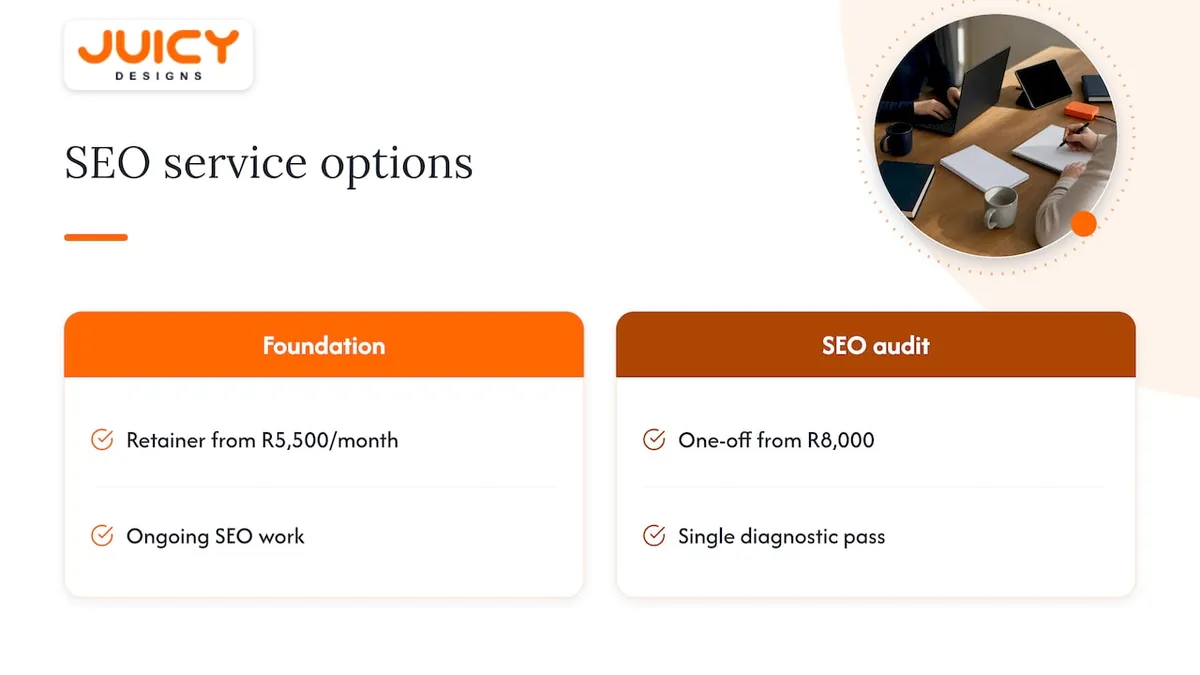
If working through indexability fixes, answer-first rewrites, and schema cleanup sounds like more than your week allows, we handle exactly this kind of work as part of our generative engine optimisation service. We price our SEO retainers from R5,500 a month on the Foundation plan, with a once-off SEO audit available from R8,000 for teams that want a single diagnostic pass before committing further. Every engagement is founder-led, with no long-term contract locking you in.
Get in touch through our contact page and we will walk through which pages are the strongest candidates for citation work first.
FAQ
What is Bing Copilot optimisation?
Bing Copilot optimisation is the practice of structuring and technically preparing web content so Microsoft Copilot can retrieve, ground, and cite it inside chat-based answers. It combines standard Bing indexing requirements with answer-first writing, structured data, and FAQ formatting aimed at machine extraction rather than just ranking.
How does Bing Copilot decide which pages to cite?
Copilot Studio pulls candidate pages through Bing Custom Search, then runs grounding and provenance checks before a passage gets summarised and attributed, according to Microsoft's own guidance. Relevance, freshness, index accuracy, and clear structure all factor into whether a page survives that filter, and safety checks can exclude a page even if it is indexed.
Does IndexNow actually help with Copilot citations?
Yes. IndexNow shortens the lag between publishing an update and Bing detecting it, which matters for time-sensitive content that Copilot might otherwise cite in an outdated form, per Bing's own AI Performance announcement. Submitting through IndexNow alongside an updated sitemap is one of the fastest technical wins available.
Can schema markup guarantee a Copilot citation?
No single piece of markup guarantees a citation. Schema such as FAQPage or Article improves how clearly a page communicates its content, but it has to match what is visibly on the page, and citation still depends on relevance, structure, and the grounding checks described in the Bing Webmaster Guidelines.
How do I know if my pages are actually being cited by Copilot?
Check the AI Performance dashboard inside Bing Webmaster Tools for citation counts and grounding queries tied to your pages, as outlined in Bing's public preview announcement. Pair that with manual tests, running real prompts through Copilot or Bing Chat and tracing which URLs come back cited, to confirm what the dashboard shows.
Sources
- Webmaster Guidelines - Bing Webmaster Tools
- Use public websites to improve generative answers - Microsoft Copilot Studio | Microsoft Learn
- Introducing AI Performance in Bing Webmaster Tools Public Preview
- Bing Webmaster Tools AI Performance report (analysis), Search Engine Land
Recommended
- How to Optimise Content for Perplexity and Bing Copilot
- How Do I Do a Basic SEO Audit of My Own Website?
- Optimise for Google AI Mode & AI Overviews
- DIY SEO: What You Can and Can't Do Yourself