
Brand Positioning Examples: 4 South African Brands, One Framework
Compare four South African brand positioning examples, map Absa, Capitec, MTN, and NIVEA to one framework, then apply a fill in the blank template.
Brand Positioning Examples: 4 South African Brands, One Framework ! Campaign examples arranged for brand positioning comparison Here are four recent, measurable brand positioning examples and the exact steps you can copy to write a positioning statement for your own brand.


TL;DR: Quick Answer
Compare four South African brand positioning examples, map Absa, Capitec, MTN, and NIVEA to one framework, then apply a fill in the blank template.
Key takeaways
- Very cheap quotes (under R5,000) almost always exclude copywriting, SEO, custom design and post-launch support
- On-page SEO built into the website at launch costs a fraction of what it costs to retrofit after the site is live
- Hosting, SSL, domain and maintenance add R3,000-R10,000 per year on top of build cost
- E-commerce adds significant cost due to payment gateway integrations, product data, security requirements and checkout UX
- Timeline and client responsiveness directly affect cost: slow feedback rounds extend agency hours

Here are four recent, measurable brand positioning examples and the exact steps you can copy to write a positioning statement for your own brand. We've chosen cases from banking, telecoms and skincare, each with a different repositioning challenge: rebuilding trust, shifting a category, and launching a digital-first offer. Alongside each one, we map the approach to the classic four-component framework and give you a template to apply it.
TL;DR:
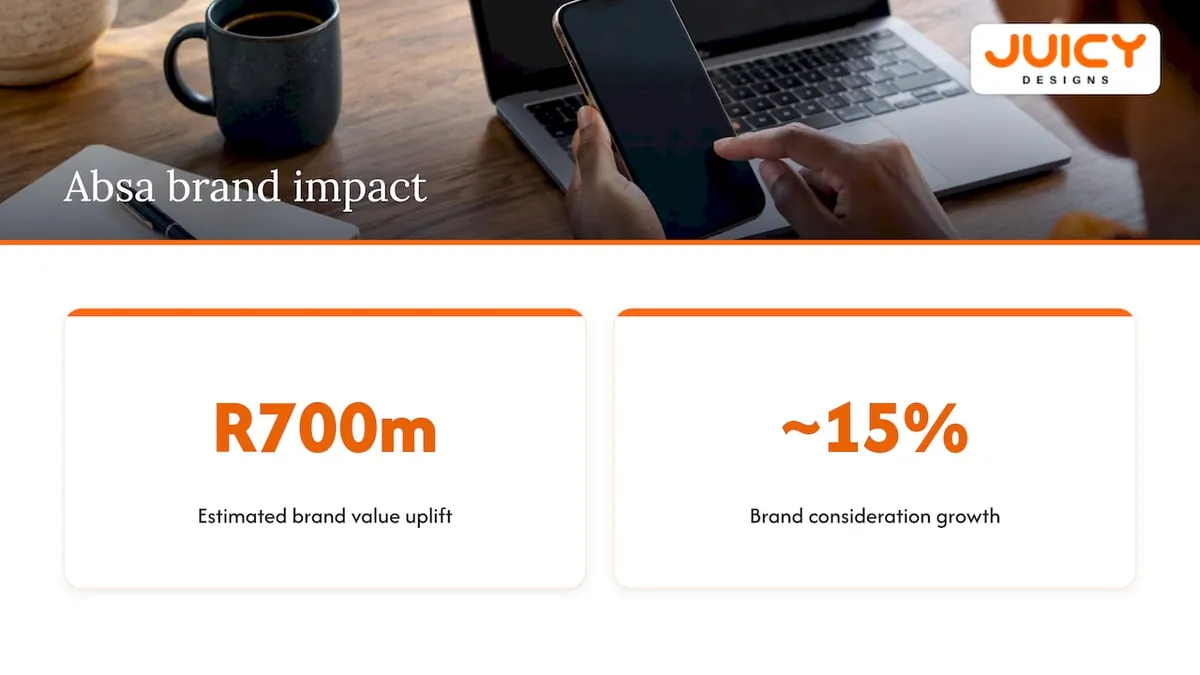
- Absa's "Your Story Matters" platform was associated with an estimated R700 million in brand value uplift and nearly 15% growth in brand consideration.
- Build positioning around a competitive frame, one defensible difference, category expectations you must meet, and an internal mantra of three to five words.
- Test your proposed difference with five existing customers; if they cannot restate it clearly, sharpen the claim and compare it with a direct competitor's positioning.
- MTN Pi's digital first subscription positioning required changes to pricing, delivery, and the product itself; marketing cannot sustain a promise operations do not keep.
- Stalled consideration or growth despite consistent spending, especially after competitor or buyer shifts, calls for review; if the core claim still resonates, sharpen execution.
Why these examples matter and how we picked them
We selected cases with public, measurable outcomes rather than campaigns that only look good on a reel. Each one comes from a different industry, so you can see the same framework working under different pressures.
- The impact had to be traceable to a metric, a market shift or a documented operational change.
- The campaign had to be recent enough to reflect current consumer expectations.
- We prioritised cases where the brand changed something real (service, pricing or product), not just the tagline.
Watch for four things in each case: the point-of-difference they claimed, the brand mantra behind it, the channels they used, and whether their operations actually backed up the promise.
4 recent brand positioning examples worth studying
1. Absa: human-centred banking that moved brand value
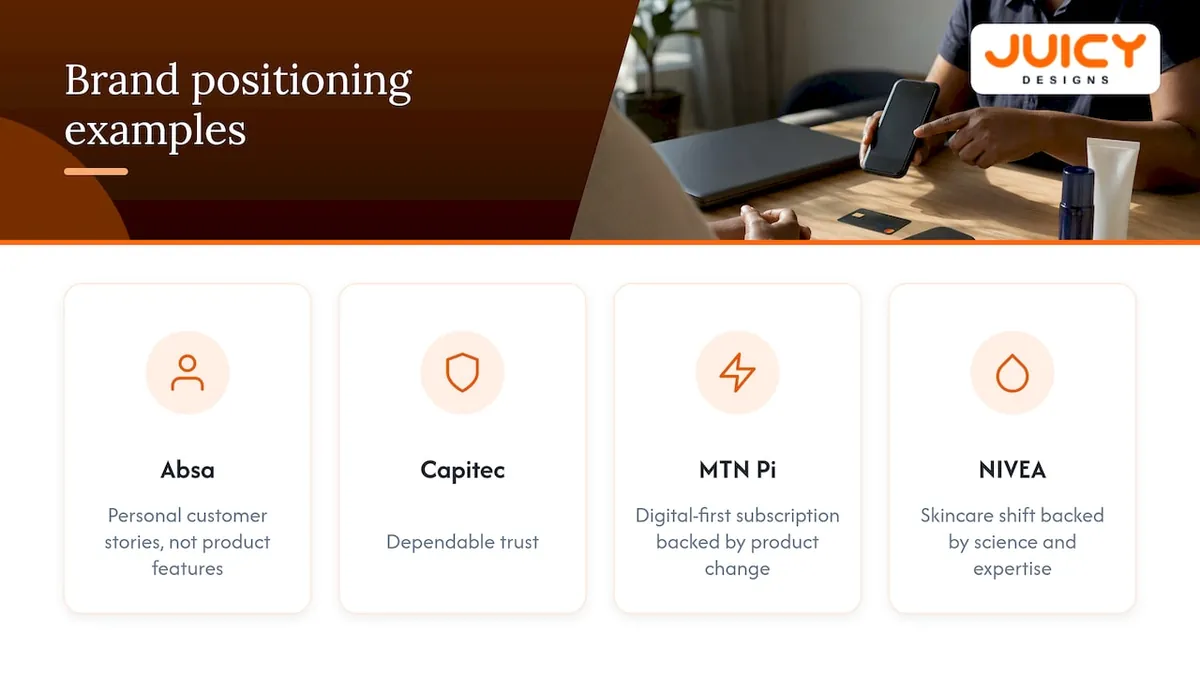
Absa's "Your Story Matters" platform repositioned the bank around individual customer narratives rather than product features. The approach leaned on real client stories across channels, aiming to make a large institution feel personal.
The brand value uplift was estimated at R700 million, alongside close to 15% growth in brand consideration over the period reported. That kind of movement in brand metrics rarely comes from a tagline alone: it usually signals that service experience and messaging were pulling in the same direction.
Lesson to copy: a human-centred frame works when the stories you tell match what customers actually experience when they walk into a branch or open the app.
2. Capitec: trust built on real client stories
Capitec's "Bank on better" campaign follows a similar instinct but sharpens it towards reliability. The positioning uses real client stories to build trust and foregrounds consistency of service over flashy claims.
What stands out is restraint: rather than claiming to be everything to everyone, the messaging stays close to a single idea, that banking should feel straightforward and dependable.
Lesson to copy: pick one emotional territory (trust, simplicity, speed) and let every story reinforce it instead of spreading across multiple claims.
3. MTN Pi: a digital-first repositioning backed by product change
MTN's Pi launch is a useful example because it shows positioning that had to be matched by real product work. The brand positioned Pi as a digital-first, subscription-style offering, which meant pricing, delivery and the underlying product had to change alongside the marketing.
Practitioner commentary on the launch notes that brands often invest heavily in identity while under-investing in the strategic thinking behind it, recommending a check against customers, competitors and company capability before finalising a positioning claim.
Lesson to copy: a digital-first or category-shifting claim only holds up when the operational side (pricing model, delivery, support) is rebuilt to match it. Marketing can't carry a promise the product doesn't keep.
4. NIVEA Derma Control: shifting a category, not just a product
NIVEA's Derma Control case is the clearest category-shift example here. Rather than compete as "another deodorant," the brand repositioned underarm care as a skincare category, using an experiential launch built around science-led storytelling and expert credibility.
That combination matters: a category shift asks consumers to reclassify a familiar product, and that kind of reframing needs proof, not just a new label. Experiential activations and expert panels gave the claim something to stand on.
Lesson to copy: when you're trying to move a product into a new category in the buyer's mind, pair the claim with expert or experiential proof, not advertising alone.
Mapping the examples to the four components of positioning
A positioning statement commonly rests on four components: the competitive frame of reference, points-of-difference, points-of-parity, and a brand mantra of three to five words.
- Frame of reference: who you compete with in the customer's mind. Absa and Capitec both frame themselves against impersonal, transactional banking rather than against each other directly.
- Points-of-difference: the one or two claims that set you apart. MTN's Pi staked its difference on a digital-first, subscription model; NIVEA staked its difference on treating underarm care as skincare.
- Points-of-parity: the baseline expectations you still must meet. A bank repositioning around warmth still has to be secure and reliable; a skincare reposition still has to work as well as the deodorant it replaced.
- Brand mantra: a short internal phrase that keeps execution consistent. "Your story matters" and "bank on better" both work as mantras because they're short enough to guide a call-centre script or a branch redesign, not just a poster.
The same research notes that the hardest decision in positioning is choosing what to leave out: a single, feasible claim beats a long list of attributes every time.
How to write your own positioning statement
Use this process to turn a vague sense of "what we stand for" into something your whole team can execute against.
- Define your competitive frame. Name who you serve and which alternatives they'd choose instead of you, not just your obvious rivals.
- Pick one primary point-of-difference. State the single claim you can defend, then list the reasons to believe it (a guarantee, a process, a result).
- Check your points-of-parity. List the baseline expectations of your category that you must meet even though they won't differentiate you.
- Distil a brand mantra and statement. Compress your positioning into three to five words, then write one or two sentences combining frame, difference and proof.
Worked example: say you run a mid-sized accounting firm. Frame of reference: small business owners choosing between a traditional accountant and cloud bookkeeping apps. Point-of-difference: a dedicated accountant who replies within four hours, backed by a published response-time guarantee. Point-of-parity: SARS-compliant filings, done accurately and on time. Mantra: "accounting that answers."
Pro Tip: Test your point-of-difference on five existing customers before you commit budget. If they can't repeat it back in their own words within a sentence, it's not sharp enough yet.
For a longer walkthrough with local examples, our brand positioning guide covers the same process in more depth, and our brand positioning glossary entry breaks down the terminology if you need a refresher.
How we apply positioning at Juicy Designs
We run every positioning project founder-led, which means the person defining your frame of reference is the same person accountable for the campaign results, not an account manager relaying briefs.
- Our average reported return on ad spend is substantially higher than the typical industry benchmark, which we treat as a direct test of whether a positioning claim is landing with the right audience.
- A dealership client saw a significant increase in qualified leads after we tightened their point-of-difference and matched it to the channels where their actual buyers were searching.
- We treat brand personality as part of the same exercise: a sharp position needs a brand personality consistent enough to recognise across every touchpoint.
When to reposition versus sharpen what you already have
A full reposition is warranted when your metrics stall despite good execution, or when the market has shifted underneath you (new competitors, a changed buyer expectation). If your numbers are soft but your core claim still resonates, sharpening execution is usually the cheaper, faster fix.
- Falling consideration or stalled growth despite consistent spend is a signal worth investigating.
- A reposition only earns its budget when operations (service, pricing, delivery) can change alongside the message.
- Before committing budget, validate the new claim with a small group of real customers and check it against at least one direct competitor's current claim.
, Cobus
Juicy Designs: how we help brands define and activate positioning
We help businesses turn a vague sense of identity into a positioning statement that actually drives leads, working directly with leadership rather than through layers of account management. That means the person shaping your frame of reference and point-of-difference is the same person accountable for the campaign.
If you're starting from scratch, our branding and identity package begins from R15,000 once-off and covers the strategic work behind a new position, not just the visual identity. If you already have a position but aren't sure it's working, our once-off SEO audit from R8,000 once-off shows you how your current messaging performs in search before you spend on a full campaign. Get in touch through our contact page to talk through which starting point fits your brand.
FAQ
What are some examples of brands with strong positioning?
Absa's "Your Story Matters" and Capitec's "Bank on better" both use human-centred storytelling to build trust in banking, while MTN's Pi and NIVEA's Derma Control show repositioning backed by real product or category change. Each example pairs a clear claim with evidence, whether that's a brand-value metric or an experiential launch.
What are the four components of a brand positioning statement?
A positioning statement typically rests on four components: the competitive frame of reference, your points-of-difference, your points-of-parity, and a short brand mantra of three to five words that keeps execution consistent. Leaving out any one of these usually produces a vague or unfocused statement.
What is the brand positioning of Coca-Cola?
Public commentary generally describes Coca-Cola's positioning around shared moments of happiness and universal refreshment rather than a specific product feature. Definitions of its exact statement vary by source, so treat any single wording as a paraphrase rather than an official claim.
What is the purpose of brand positioning?
Brand positioning gives a business a single, defensible claim to own in the customer's mind, which guides messaging, product decisions and service delivery so they all point the same direction. Without it, campaigns tend to compete on price or generic attributes instead of a distinct reason to choose you.
How do I know if my current positioning needs changing?
Stalled consideration or lead growth despite consistent marketing spend is usually the clearest signal, especially alongside a shift in competitor claims or buyer expectations. If the core claim still resonates with customers, sharpening execution is often more effective than starting a full reposition.
Sources
- Absa - 'Your Story Matters' first anniversary media statement
- Core reading: Brand positioning (Harvard-style overview / teaching PDF)
- The NIVEA Derma Control experience, Matriarch case study
- Capitec launches brand positioning campaign | Modern Marketing
- Pi by MTN campaign details, Ads of the World
Recommended
- Brand Positioning Explained: How to Stand Out in SA
- Top Brands in South Africa and What Makes Them Work
- Brand vs Performance Marketing: SA Guide
- What Is Brand Strategy? A Guide for SA Businesses