
Call tracking for ads: how to link calls to campaigns
Discover how call tracking for ads links calls to campaigns, helping you optimise your ad spend and boost revenue with precise data insights.
Call tracking for ads connects every phone call back to the exact campaign, ad group, or keyword that generated it, turning calls into verified conversion signals your bidding algorithms can act on.


TL;DR: Quick Answer
Discover how call tracking for ads links calls to campaigns, helping you optimise your ad spend and boost revenue with precise data insights.
Call tracking for ads connects every phone call back to the exact campaign, ad group, or keyword that generated it, turning calls into verified conversion signals your bidding algorithms can act on. Once you know which ads drive calls (not just clicks), you can calculate real cost-per-call, feed that data into Smart Bidding, and stop guessing at what's actually driving revenue.
TL;DR:
- Using dynamic number insertion is essential for accurate multi-channel attribution, especially when running multiple paid campaigns simultaneously, to prevent data corruption.
- Proper setup and testing of call tracking in Google Ads ensure that unique session-specific numbers are functioning, and conversion thresholds are appropriately calibrated to distinguish genuine leads.
- Integrating call data with your CRM and assigning value to verified, longer-duration calls maximises the effectiveness of Smart Bidding and improves ROAS.
- Compliance with RICA and POPIA laws requires clear caller notifications, consent documentation, and secure storage, which vendors should support through configurable retention rules.
- Inaccurate or noisy call data sources include shared numbers across platforms, spam, misconfigured forwarding, and missed calls, all of which can be resolved with targeted troubleshooting.
What is call tracking and how does it work?
Call tracking assigns unique phone numbers to your ads, keywords, or web sessions so every incoming call can be traced back to its source. Without it, a call is just a call. With it, you know it came from a specific Google Ads keyword on a Tuesday afternoon, and you can price that lead accordingly.
There are three main approaches, and picking the wrong one for your traffic volume is the single most common mistake we see South African advertisers make.
- Dynamic number insertion (DNI) swaps in a session-specific tracking number for each visitor, tying that call back to the campaign, ad, or keyword level that brought them to your site. This is the standard for anyone running multiple paid channels who needs granular attribution.
- Static tracking numbers stay fixed to a single channel, print ad, or offline placement. They're cheaper and simpler, but they can't tell you which of five Google Ads keywords triggered the call.
- Click-to-call tracks the tap on a mobile ad's call button directly, which Google Ads counts natively as "calls from ads." This differs from "calls from website," where a visitor lands on your site first and then dials a number shown on the page.
The mechanical difference matters for your reporting. DNI relies on session-level mapping, usually a cookie or a temporary session ID, to hold that visitor's assigned number long enough to capture the call and pass attribution data back before the session expires. Static numbers skip that complexity entirely, which is fine for low-volume channels but useless for a business running five or six concurrent ad campaigns competing for the same product line.
If you're running Google Ads and Meta simultaneously, use DNI with separate number pools for each channel. Mixing them into one shared pool is the fastest way to corrupt your attribution data before you've even started measuring it.
How do you set up call tracking in Google Ads?
Getting call conversions working properly in Google Ads takes a few sequential steps, and skipping the testing phase is where most setups quietly fail.
- Enable call reporting in your Google Ads account and choose which conversion actions apply, whether that's calls from ads, calls from your website, or imported call conversions from uploads.
- Install dynamic number insertion on your website so each ad session gets a unique forwarding number. Most call tracking platforms provide a JavaScript snippet for this.
- Test the setup using Google Tag Assistant or an equivalent tag-debugging tool, confirming that the swapped number displays correctly and that the call event fires back to Google Ads.
- Set your conversion threshold. Decide whether a call counts only past a minimum duration (60 seconds is a common starting point) or whether you'll layer in call-scoring to filter genuine leads from spam and wrong numbers.
- Configure conversion value rules so higher-intent calls (longer duration, confirmed booking) carry more weight in your bidding data than a 12-second hang-up.
- Set up CRM import for offline-confirmed conversions, uploading verified sales outcomes back into Google Ads on a recurring schedule rather than relying on call duration alone.
Pro Tip: Don't count every click-to-call tap as a conversion. Clicks aren't conversations, and inflating your conversion count with unanswered or seconds-long calls will quietly wreck your Smart Bidding data within a few weeks.
If you'd rather have this instrumented properly the first time, our guide on setting up Google Ads conversion tracking for calls walks through the account-level settings in more detail.
How do you integrate call tracking with your CRM?
Call data only becomes useful once it's connected to what actually happened after the phone rang. A call that gets logged but never linked to a sale tells you nothing about return on ad spend.
The typical flow syncs call attributes (source, campaign, timestamp, duration, and disposition) into your CRM, where a sales rep tags the outcome: sold, booked, no-show, or not interested. That outcome then needs to travel back into Google Ads as a conversion value.
- API-based imports run automatically and are the most reliable option for businesses processing more than a handful of calls weekly.
- Automation tools like Zapier can bridge platforms that don't have native integrations, at the cost of some setup complexity.
- Manual CSV uploads work for smaller volumes but introduce delay and human error risk.
- Verification matters. Cross-check call IDs before import to avoid double-counting a conversion that already fired automatically through duration-based tracking.
Mapping call outcomes to specific rand values, rather than treating every call as equal, is what lets Smart Bidding actually optimise towards revenue instead of call volume.
Which call metrics actually predict ROI?
Not every call is worth the same, and treating them that way is why so many advertisers underestimate what their phone leads are really worth.
Five metrics matter most: call volume, answered rate, average call duration, first-time caller rate, and missed call rate. Of these, duration is the one to build your conversion rules around. A common threshold is 60 seconds; calls shorter than that rarely represent a genuine sales conversation, and counting them as conversions dilutes your data with noise.
Phone calls convert at 10 to 15 times the rate of web form leads, according to BIA Advisory Services, which is exactly why treating them as a second-tier signal behind form fills is a costly mistake.
Google's own platform can analyse recordings for lead quality in countries where that feature is enabled, but where it isn't, duration thresholds and ad interaction data become your fallback. This is precisely why external call-scoring, whether AI-based or a human reviewing a sample of calls weekly, still earns its place even for advertisers on Google's platform.
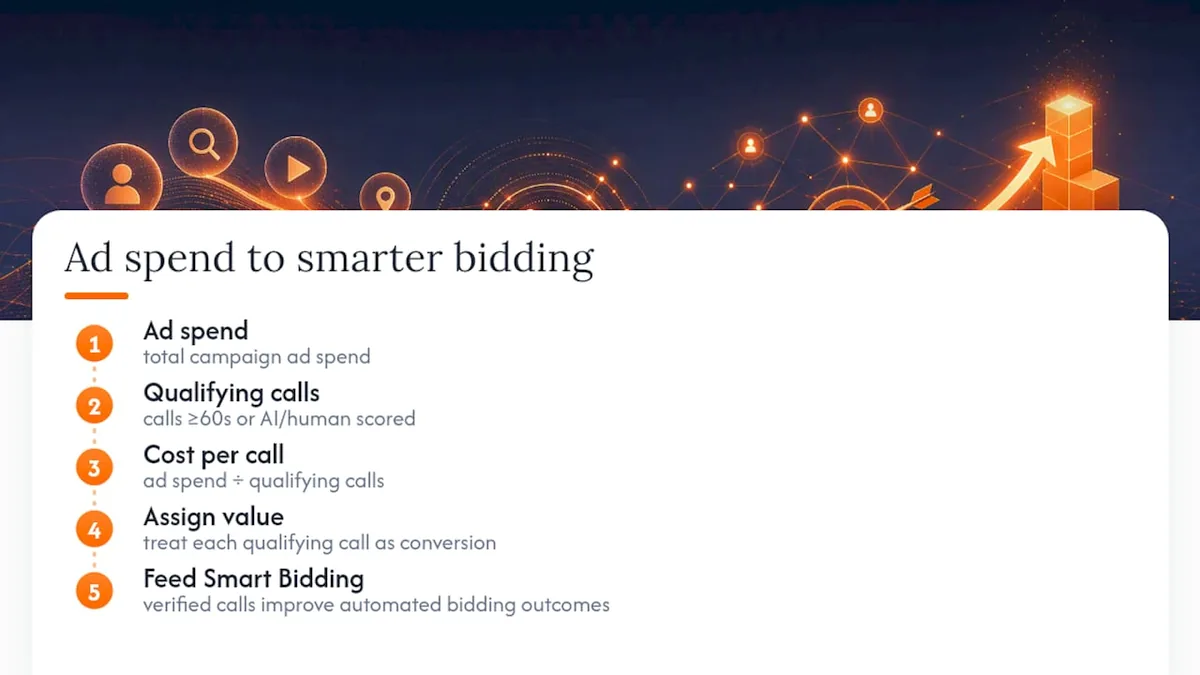
To calculate true cost-per-call, divide ad spend for a campaign by the number of qualifying calls, not total calls. Fold that figure into your existing ROAS calculation by treating each qualifying call as a conversion with an assigned value, the same way you'd value a completed purchase. Verified calls that feed back into Smart Bidding consistently improve automated bidding outcomes over raw click data, because the algorithm is now optimising towards people who actually picked up the phone and stayed on the line.
What are the RICA and POPIA rules for recording calls?
South African businesses recording sales or support calls need to satisfy two separate laws, and confusing them is where most compliance gaps start.
RICA governs whether you're allowed to record a conversation at all. If you're a party to the call, you may record it, but unlawfully intercepting or distributing a recording carries penalties of up to R2 million or imprisonment. POPIA governs what happens to that recording once it exists, meaning storage, processing, and access. Non-compliance here can trigger administrative fines of up to R10 million, which makes this far more than a paperwork exercise.
Build your compliance process around these steps:
- Play an IVR announcement notifying callers that the conversation may be recorded.
- Document a lawful basis for each call type you record, whether that's consent, contract performance, or legitimate interest.
- Set a retention schedule by call type and delete recordings once that period lapses.
- Encrypt stored recordings and restrict playback access by role.
- Keep a process ready for handling data-subject access or deletion requests.
- For outbound marketing calls, section 69 of POPIA requires recorded proof of consent before you cold-call a prospect.
Pro Tip: When choosing a call tracking vendor, ask specifically whether they offer per-call retention rules and exportable consent logs. That single feature can remove most of your POPIA compliance workload before you've even started.
Why is my call tracking data wrong or noisy?
Bad call data usually traces back to one of a handful of predictable causes, and most are fixable within a day of diagnosis.
- Non-unique numbers mixing attribution. If your Google Ads and Meta campaigns share the same number pool, you'll never know which platform actually drove the call. Assign separate DNI pools per channel.
- Spam and short-call volume inflating conversion counts. Set a minimum duration threshold and layer in a spam filter at the tracking-platform level to strip out junk calls before they hit your reports.
- Misconfigured forwarding breaking the attribution chain. If the forwarding number silently fails or points to the wrong destination, calls vanish from your funnel entirely. Test monthly with Tag Assistant or a live call.
- Missed calls going unanswered. No amount of tracking fixes a phone that rings out. Review staffing and routing rules, and enable voicemail capture so even missed calls generate a follow-up lead record.
If your spend is climbing but calls aren't following, our breakdown on Google Ads spending without calls covers the diagnostic checklist in more depth.
What does a working agency setup for call tracking look like?
Juicydesigns is a Pretoria-based digital marketing agency, and call tracking sits at the centre of how we prove Google Ads spend is actually working. Juicy Designs clients average a 4.8x return on ad spend, nearly double the industry standard.
The process is consistent: DNI across every paid channel, call-scoring to separate genuine buyers from browsers, CRM import to confirm sales outcomes, and verified conversions fed straight into Smart Bidding. If you're vetting an agency for this work, ask for deliverables in writing, request direct access to your own call and conversion data, and confirm they can show proof of POPIA-compliant handling before you sign anything.
Beyond DNI: other call tracking methods worth knowing
DNI gets most of the attention, but it isn't the only method worth understanding, and some situations call for something simpler or more layered.
Session-based tracking ties a caller to their specific browsing session rather than a persistent identifier, which is useful for privacy-conscious setups where you want attribution without long-term tracking cookies. It's less durable than DNI for repeat visitors but adequate for single-visit attribution.
Call whisper plays a short audio message to your sales team before connecting the call, announcing which campaign or keyword the caller came from. This lets a rep tailor their opening line on the spot, referencing the exact offer the caller saw, which measurably improves close rates on paid traffic.
Call logging is the simplest layer: a straightforward record of call metadata (time, duration, source number) without the dynamic swapping that DNI relies on. It's a reasonable starting point for a small business testing a single campaign before investing in a full DNI setup.
Most mature setups combine these. DNI handles the attribution heavy lifting, call whisper improves the sales conversation itself, and logging provides the audit trail you'll need if a POPIA data request ever lands on your desk. Choosing among them comes down to call volume and how many concurrent channels you're running, not personal preference.
How do you turn call data into campaign optimisation?
Raw call logs are worthless until you know what to look for. Start by segmenting calls by campaign and keyword, then compare qualifying-call volume against spend to surface which keywords generate conversations versus which ones just generate clicks.
Look for patterns in call duration by time of day and day of week. A campaign that generates five-minute calls on weekday mornings but thirty-second hang-ups on weekend evenings is telling you something about audience intent, not ad quality. Adjust ad scheduling accordingly rather than assuming the ad itself needs a rewrite.
Cross-reference first-time caller rate against repeat-caller rate to spot whether a campaign is generating new demand or just recycling your existing customer base through paid clicks they'd have made anyway. That distinction changes how you value the campaign entirely.
Finally, feed qualifying-call data back into Google Ads as conversion value rules, weighting longer or CRM-confirmed calls higher than short ones. This is the step that actually closes the loop: your bidding algorithm starts favouring the keywords and audiences that produce real conversations, not just cheap clicks that never convert. Review this weekly for the first month of any new campaign, then move to a monthly cadence once the data stabilises.
How does call tracking fit into multi-channel attribution?
A phone call rarely happens in isolation. Someone sees a Meta ad, searches your brand name on Google a week later, and finally calls after reading a review. Attributing that call entirely to the last click ignores the channels that built the intent.
Closing that gap requires syncing call data with your broader attribution model, whether that's a data-driven model in Google Ads or a dedicated attribution platform. The practical steps: tag every call with the full click path where possible, not just the last touchpoint, and store that path in your CRM alongside the sale outcome.
Weight assisted conversions rather than dismissing them because they didn't generate the final click. A display ad that seeded awareness three weeks before a branded search call deserves partial credit, not zero. Analytics-driven attribution generally produces better return on marketing investment than last-click models precisely because it captures this kind of multi-touch behaviour.
Keep your call tracking platform and analytics tool on the same customer ID or session key wherever your tech stack allows it. Fragmented IDs across tools are the single biggest reason multi-channel attribution efforts stall halfway through implementation. If your CRM and ad platforms can't share a common identifier, prioritise fixing that before investing further in attribution modelling itself.
What does a successful call tracking rollout look like?
The dealership case referenced earlier is a useful template. Before call tracking, the client measured success by leads submitted through a web form, missing the majority of buyers who preferred to call and ask about a specific vehicle before visiting the lot.
Once DNI was live across their Google Ads campaigns, call volume data revealed that a meaningful share of high-intent buyers were calling directly from mobile search ads rather than filling out forms. Feeding those verified calls back into Smart Bidding as conversions, weighted by call duration and CRM-confirmed test drives, shifted budget towards the keywords producing real showroom visits.
The pattern holds beyond automotive. Any business where the buying decision benefits from a real conversation (insurance, professional services, healthcare bookings) tends to see outsized returns from call tracking simply because the phone channel was previously invisible to the ad platform. The lesson isn't that calls matter more than clicks everywhere; it's that ignoring calls entirely means optimising your ad spend against incomplete data.
An honest read on where call tracking actually pays off
Most guides on this topic treat call tracking as a technical checkbox: install DNI, connect it to Google Ads, done. That undersells the real work. The part that actually moves ROAS is deciding what counts as a real conversion, and that decision lives in your duration thresholds and call-scoring rules, not in your tracking software's default settings.
The conventional advice to "just track calls" misses that raw call volume is often a vanity metric. A campaign generating hundreds of 15 second calls looks impressive until you realise none of them were sales conversations. Prioritise getting your qualifying threshold right before you worry about which platform to buy.
South African businesses face an extra layer most international guides skip entirely: RICA and POPIA aren't optional compliance theatre, they carry real financial exposure. Get the legal basics sorted first, then build your optimisation strategy on top of a system you're not going to have to unwind later.
, Cobus
Get call tracking implemented properly with Juicydesigns
Reading through all of this, you can probably see where the real bottleneck sits: it's not knowing that call tracking matters, it's finding the time to configure DNI correctly, set sane conversion thresholds, and stay POPIA-compliant while you're also trying to run a business. Juicydesigns handles that entire build for you, with founder-level oversight rather than a junior account manager reading from a script, and no long-term contract locking you in if your needs change.
We manage Google Ads campaigns for South African businesses with call tracking, scoring, and CRM import built into the setup from day one, feeding verified conversions straight into Smart Bidding the way this article describes. If phone leads are a meaningful part of your sales pipeline and you're not yet measuring them properly, get in touch for a quote and we'll show you exactly what a proper setup would look like for your ad spend.
Sources
- POPIA non-compliance (POPIA checklist)
- South Africa recording laws: RICA and POPIA at a glance (2026) | Recording Law
- About phone call conversion tracking - Google Ads Help
- Click-to-Call Ads and Call Tracking - CallTrack
FAQ
How does call tracking work in marketing?
Call tracking assigns unique or session-specific phone numbers to ads, keywords, or channels, so an incoming call can be traced back to the exact source that generated it and reported as a conversion in platforms like Google Ads.
How much does call tracking cost?
Pricing varies by provider and call volume, with most South African businesses paying a monthly subscription plus per-number or per-minute fees on top of their existing Google Ads spend. Juicydesigns includes call tracking setup and management within its Google Ads service packages rather than charging it as a separate line item.
What are the best call tracking platforms?
The right platform depends on your call volume and whether you need DNI, call whisper, or simple logging, but any platform you choose should support Google Ads conversion imports and POPIA-compliant retention controls. Ask about per-call retention rules and exportable consent logs before signing up with any vendor.
How do I track another phone call?
To track a call, route it through a dynamic or static tracking number tied to your ad campaign, then confirm the call event fires into Google Ads as a conversion using Tag Assistant or your call tracking platform's own testing tool.
What call duration should count as a real conversion?
A common starting threshold is 60 seconds, since calls shorter than that rarely represent a genuine sales conversation and inflate your conversion count with spam or wrong numbers.
Recommended
- How to Set Up Google Ads Conversion Tracking for Calls and Enquiries | Juicy Designs
- How Do I Track Where My Leads Are Actually Coming From? | Juicy Designs
- Why Am I Spending on Google Ads but Getting No Calls? | Juicy Designs
- Call Tracking & DNI for South African Businesses | Juicy Designs