
Car dealership ROAS benchmarks: 2026 South Africa guide
Discover essential car dealership ROAS benchmarks for 2026 in South Africa. Learn to optimise campaigns using gross-profit for better results.
South African dealers should measure gross-profit ROAS (front-end gross profit from campaign deals ÷ campaign ad spend) as their primary key performance indicator, not revenue ROAS.


TL;DR: Quick Answer
Discover essential car dealership ROAS benchmarks for 2026 in South Africa. Learn to optimise campaigns using gross-profit for better results.
South African dealers should measure gross-profit ROAS (front-end gross profit from campaign deals ÷ campaign ad spend) as their primary key performance indicator, not revenue ROAS. Revenue ROAS inflates results on high-ticket vehicles because it ignores cost of goods sold entirely. According to Diablo AI's dealership ROAS framework, the correct formula is total gross profit from campaign deals divided by campaign ad spend. With MSXi benchmark data showing declining return on assets and rising expense pressure across South African dealerships, and WesBank finance volumes reflecting ongoing affordability constraints, your ROAS targets need to be grounded in real margin math, not vehicle sale prices.
Here are the four action bands every dealer should know:
- Below 1x: Stop or pause the campaign immediately. You are spending more than you earn in gross profit.
- 1-2x: Diagnose before cutting. Check lead quality, response time, and attribution gaps.
- 2-5x: Optimise. This is the working range for most South African dealerships. Push towards the upper end.
- 5x+: Scale with discipline. Validate attribution before increasing budget significantly.
Juicydesigns has achieved an average client ROAS in the strong-performing range for South African dealerships, with some local dealerships reporting significant uplifts in qualified leads after full-funnel campaign restructures.
Key takeaways
| Point | Details |
|---|---|
| Use gross-profit ROAS | Divide total gross profit from campaign deals by ad spend, not vehicle sale price. |
| Target 2x to 5x for most channels | This is the strong-performing range for South African franchised dealers across Google and Meta. |
| Fix lead response first | Responding within 30 minutes materially improves close rates before any creative or budget change. |
| Include F&I in your model | Adding R6,000, F&I gross per deal can shift a marginal ROAS into the acceptable range. |
| Juicydesigns benchmark | Juicydesigns delivers an average 4.8x gross-profit ROAS for South African dealership clients. |
How do you calculate ROAS correctly for a car dealership?
Most dealers calculate ROAS the wrong way. They divide total vehicle revenue by ad spend and get a number that looks impressive but tells you almost nothing about profitability. Those are very different decisions.
The correct formula:
Worked example in ZAR
When to include F&I and backend revenue:
- Include F&I gross when your CRM reliably captures it per deal and you can attribute it to the originating campaign.
- Exclude it when attribution is uncertain or when comparing campaigns across different finance penetration rates, since it distorts channel-to-channel comparisons.
- Aftersales revenue (service, parts) is generally excluded from campaign-level ROAS but matters for overall dealer profitability modelling.
Pro Tip: The most common calculation error is attributing gross profit from walk-in deals to a digital campaign because the customer also clicked an ad. Use CRM source-of-sale fields to confirm the campaign originated the lead, not just touched it.
What ROAS benchmarks should South African dealers target?
South Africa's retail automotive environment adds specific pressure to standard ROAS targets. MSXi's performance trends report documents declining return on assets and compressed retained profit margins across franchised dealers. That context matters when you set your floor.
| ROAS band | Assessment | Recommended action |
|---|---|---|
| Below 1x | Loss-making on gross profit | Pause campaign; audit lead quality and attribution |
| Below 1x to 2x | Marginal; covers ad spend but not overhead | Diagnose: check CPL, close rate, and creative relevance |
| 2x to 5x | Acceptable for prospecting campaigns | Optimise creative, tighten audiences, improve lead response |
| 2x to 5x | Strong; target range for most SA dealers | Maintain and test incremental budget increases |
| 5x+ | High-performing; validate before scaling | Confirm attribution accuracy, then scale with budget |
The MSXi SA Financials benchmark report cites an aftersales absorption norm of approximately 65% for South African franchised dealers. When aftersales absorption is strong, your new-vehicle advertising ROAS target can be slightly lower because the business is not entirely dependent on front-end gross to cover costs. When absorption drops, the pressure on advertising ROAS increases.
Benchmark signal: An aftersales absorption rate near two-thirds is typical in the South African industry. Dealers below this rate carry more overhead risk and should set a higher minimum ROAS threshold for new-vehicle campaigns.
F&I contribution adds a variable amount per deal in gross profit for South African dealers, depending on the finance product mix, but specific figures vary widely.
What ROAS should you expect from each advertising channel?
Channel performance varies significantly based on buyer intent. Branded search captures buyers who already know your dealership; TikTok reaches people who may not be in-market yet. Mixing their ROAS expectations is one of the most common budget allocation mistakes in dealership digital marketing.
These ranges are illustrative and drawn from WordStream's 2025 Google Ads benchmarks and platform-level data, adapted for South African CPL conditions. Your actual numbers will shift based on brand desirability, pricing flexibility, and how well your sales team handles incoming leads.
Attribution caveats to keep in mind:
- Meta uses a default 7-day click / 1-day view attribution window. View-through conversions inflate reported ROAS significantly for prospecting campaigns. Switch to click-only attribution when comparing Meta to Google.
- Performance Max reports blended results across Search, Display, YouTube, and Shopping. Branded search often dominates the mix, making the channel look stronger than it is for new prospecting.
- TikTok's attribution window defaults to 7-day click / 1-day view. For dealerships, a 28-day click window is more realistic given the vehicle purchase cycle.
For social ad format guidance specific to prospecting versus remarketing, the format choice matters as much as the channel.
How do you measure ROAS accurately across your campaigns?
Correct measurement requires CRM integration and offline conversion import into Google Ads. Without this, you are optimising towards form fills, not closed deals, and your ROAS figures are disconnected from actual gross profit.
Step-by-step tracking setup:
- Tag your website with Google Tag Manager. Fire conversion events for lead form submissions, call clicks, and chat initiations.
- Enable offline conversion imports in Google Ads. Map your CRM's deal-closed stage back to the originating Google click ID (GCLID).
- Set up call tracking with a dedicated number per campaign. Record call dispositions in your CRM (qualified lead, appointment set, sale).
- Apply UTM parameters consistently across all ad URLs. Use a naming convention that includes channel, campaign type, and vehicle category.
- Map lead to sale to gross profit in your CRM. Every closed deal should carry the originating campaign source and the front-end gross profit figure.
- Import gross profit values as the conversion value in Google Ads. This allows Smart Bidding to optimise towards actual margin, not just lead volume.
Pro Tip: Set a 72-hour maximum response time SLA in your CRM and track it. Dealers who respond to digital leads within 30 minutes close at significantly higher rates than those who respond after 24 hours. The same campaign, handled faster, produces a materially better ROAS.
The recommended attribution model for most South African dealers is data-driven attribution in Google Ads, provided you have sufficient conversion volume (50+ conversions per month per campaign). Below that threshold, use last-click with a 30-day window. Google Ads conversion tracking documentation covers the technical setup in detail.
Lead-to-ROAS flow:
Ad click → Website lead / call → CRM entry (source tagged) → Sales follow-up → Deal closed → Gross profit recorded → Offline conversion uploaded → ROAS calculated in Google Ads.
For a deeper look at measuring digital marketing effectiveness beyond ROAS, the measurement framework matters as much as the metric itself.
What are the highest-impact levers to improve your dealership ROAS?
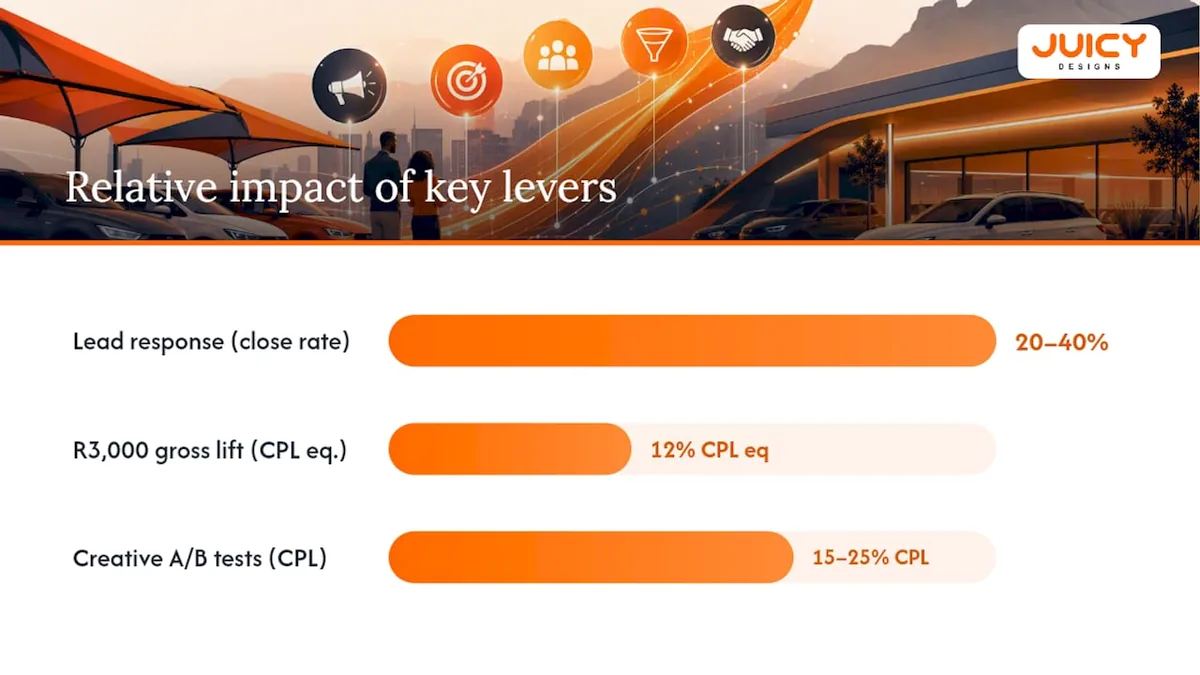
Everything else is secondary.
Priority action list:
- Fix lead response time first. Respond to every digital lead within 30 minutes during business hours. Set an automated SMS acknowledgement for after-hours leads. This single change often improves close rates by 20-40% without touching ad spend.
- Align ad creatives to in-stock vehicles. Advertising a model you have 12 units of beats advertising one you have two of. Pull live inventory into your ad feed using a Google Merchant Center vehicle listing or a dynamic Meta catalogue.
- Prune low-ROAS prospecting campaigns. Any prospecting campaign below 1.5x gross-profit ROAS after 45 days of data should be paused or restructured. Reallocate that budget to branded search or retargeting.
- Improve front-end gross before increasing ad spend. A R3,000 improvement in average gross profit per deal has the same effect on ROAS as a 12% reduction in CPL. Work with your sales manager on pricing discipline first.
- Run A/B tests on offer framing. Test "R2,999 per month" versus "R0 deposit" versus a specific model benefit. Small creative changes often shift CPL by 15-25% without changing targeting.
Creative and audience dos and don'ts:
- Do use vehicle-specific creative with price, monthly instalment, and a clear call to action.
- Do build separate retargeting audiences for website visitors who viewed a specific model page.
- Don't run broad prospecting audiences without an interest or behavioural filter for in-market car buyers.
- Don't use the same creative for prospecting and retargeting. The message needs to match the buyer's stage.
Pro Tip: Run a 14-day A/B test on your lead form length. The volume gain usually outweighs the quality dip when your follow-up process is strong.
For a full breakdown of effective dealership marketing strategies in 2026, the tactical detail goes deeper than what fits here.
What does a real South African dealership result look like?
A South African franchised dealership approached Juicydesigns with a common problem: significant monthly ad spend across Google and Meta, but no reliable way to connect that spend to closed deals or gross profit. Lead volumes looked acceptable in the platform dashboards, but the sales team reported that most leads were low quality or unresponsive.
The interventions:
- Rebuilt CRM tagging to capture campaign source per deal and front-end gross profit per sale.
- Implemented offline conversion imports into Google Ads, replacing form-fill optimisation with gross-profit-value optimisation.
- Restructured Meta campaigns to separate prospecting (broad, awareness) from retargeting (model-page visitors, past enquirers).
- Introduced a 30-minute lead response SLA with automated SMS acknowledgement for after-hours submissions.
- Aligned Google Search creative to the dealership's highest-margin, highest-stock models.
Steps other dealers can replicate:
- Audit your CRM for source-of-sale data gaps before touching ad creative or budget.
- Upload at least 90 days of historical closed deals as offline conversions to seed Smart Bidding.
- Set a response time SLA and measure it weekly, not monthly.
How does the South African market change your ROAS targets?
Macro and retail finance conditions in South Africa compress front-end margins and raise the importance of aftersales and F&I when evaluating whether a campaign is truly profitable.
WesBank, one of South Africa's largest vehicle finance providers, tracks finance application volumes and average financed values that reflect real affordability pressure in the market. MarkLives DataLens automotive data shows how brand popularity and finance activity interact with inventory decisions at dealer level. When average financed values are high relative to disposable income, close rates on prospecting campaigns tend to fall, pushing CPL up and ROAS down.
MSXi's SA performance benchmarks document rising expense ratios and declining asset activity across franchised dealers, which means the margin available to absorb advertising cost is thinner than it was three years ago.
Practical implications for your ad strategy:
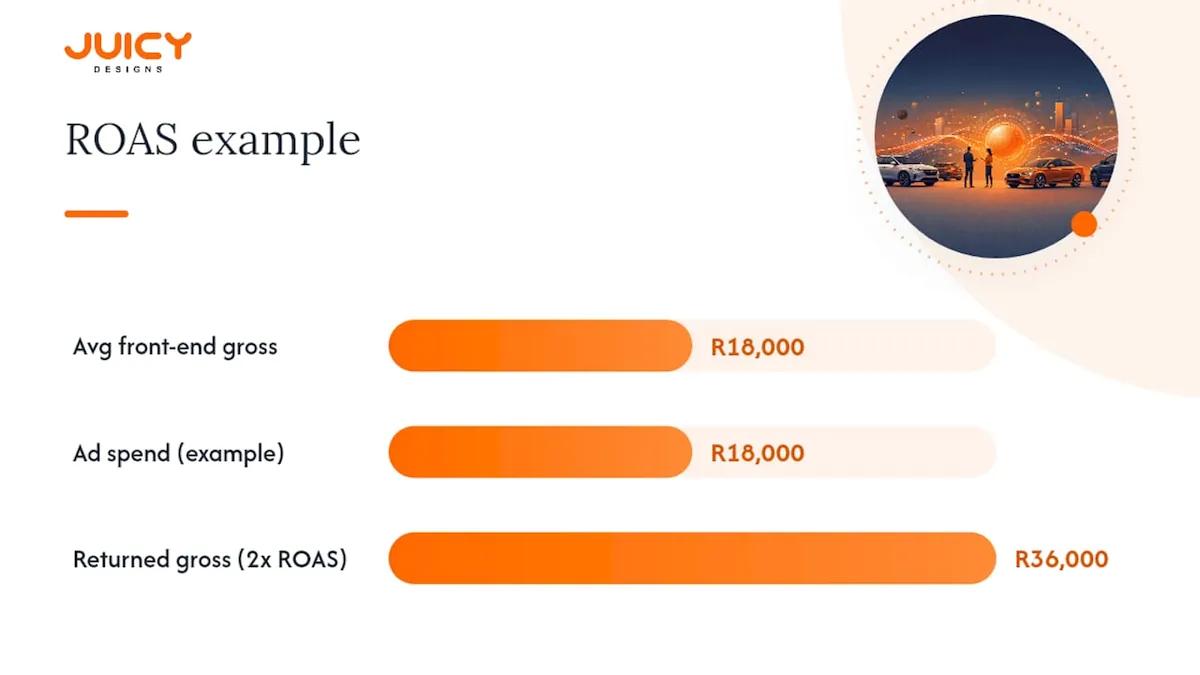
- Hold a larger gross profit buffer per deal before setting your ROAS floor. If your average front-end gross is R18,000, a 2x ROAS target only returns R36,000 in gross per R18,000 in ad spend, which may not cover your overhead contribution.
- Adjust CPL expectations upward for entry-level and high-volume models where finance approval rates are lower due to affordability constraints.
- Plan for ROAS dips in January and July, when inventory cycles and consumer spending patterns typically reduce vehicle purchase intent in South Africa.
- Weight your budget towards retargeting and branded search during low-season months, and shift to prospecting during peak periods (March, May, September, November).
The 2026 dealership digital marketing strategy guide covers budget allocation by season in more detail.
What most dealers get wrong about ROAS measurement
Most dealerships I work with in South Africa are measuring the wrong number and drawing the wrong conclusions from it. The danger is that the inflated revenue ROAS prevents the dealer from asking the right questions: Is the close rate good enough? Is the CPL sustainable? Is the sales team handling leads fast enough?
The other pattern I see consistently is dealers cutting Meta spend because the reported ROAS looks weak, without realising that Meta's view-through attribution is inflating the number for some campaigns and that click-only attribution would actually show a stronger result for retargeting. Attribution settings matter more than most marketing managers realise.
The dealers who improve fastest are the ones who fix their measurement before they fix their creative. Once you can see gross-profit ROAS by channel, by campaign, and by model, the right decisions become obvious.
Get a free ROAS audit for your dealership
Juicydesigns works directly with South African dealerships to rebuild campaign measurement, identify attribution gaps, and restructure ad spend around gross-profit ROAS rather than vanity metrics.
There are no long-term contracts and no account managers between you and the founders. You get direct access to the people doing the work. Request a free Google Ads proposal and we will audit your current campaigns, identify where gross profit is leaking, and show you exactly what a restructured campaign would look like for your dealership.
Sources
- MSXi Performance Trends (NADA) PDF
- ROAS for Dealerships: The Only Metric That Actually Matters | Diablo AI | Diablo AI
- WordStream: 2025 Google Ads benchmarks
- Google Ads support, offline conversion imports
FAQ
What is a good ROAS benchmark for a car dealership?
Is a 4x ROAS good for automotive advertising?
Yes.
What KPIs should car dealerships track for digital advertising?
The primary KPIs are gross-profit ROAS, cost per lead (CPL) by channel, lead-to-sale close rate, and response time to digital leads. Secondary metrics include cost per vehicle sold and F&I gross contribution per campaign deal.
How do you improve ROAS for a dealership in 2026?
What is the difference between revenue ROAS and gross-profit ROAS for dealers?
Revenue ROAS divides total vehicle sale value by ad spend and produces a misleadingly high number on expensive vehicles. Gross-profit ROAS divides only the gross profit earned from campaign deals by ad spend, giving a realistic picture of whether advertising is actually profitable.
Recommended
- Digital Marketing for Car Dealerships in South Africa
- Performance marketing for car dealerships | Juicy Designs
- South African Search Advertising Benchmarks 2026 | Juicy Designs
- Vehicle inventory ad formats explained for SA dealers | Juicy Designs