
CTV Ads in South Africa: Costs, Reach and How to Start
What CTV ads cost in South Africa in 2026, who you can reach, where inventory sits and how to plan a first campaign without wasting budget.
CTV Ads in South Africa: Costs, Reach and How to Start ! South African couple watching a television advertisement Connected TV (CTV) advertising means video ads served over the internet to a television screen: a smart TV, or a TV linked to a streaming device.


TL;DR: Quick Answer
What CTV ads cost in South Africa in 2026, who you can reach, where inventory sits and how to plan a first campaign without wasting budget.
Key takeaways
- Very cheap quotes (under R5,000) almost always exclude copywriting, SEO, custom design and post-launch support
- On-page SEO built into the website at launch costs a fraction of what it costs to retrofit after the site is live
- Hosting, SSL, domain and maintenance add R3,000-R10,000 per year on top of build cost
- E-commerce adds significant cost due to payment gateway integrations, product data, security requirements and checkout UX
- Timeline and client responsiveness directly affect cost: slow feedback rounds extend agency hours

Connected TV (CTV) advertising means video ads served over the internet to a television screen: a smart TV, or a TV linked to a streaming device. In South Africa you can buy it today, and the published September 2026 DStv Media Sales rate card shows what it costs. Packages run from R67,000 to R240,000, at R300 to R383 per thousand impressions. The market is young, the inventory is fragmented, and a small, well-measured test beats a big, blind commitment.
TL;DR
- CTV is TV-style video delivered over the internet, with digital-style targeting and reporting. It is not the same as buying linear TV spots.
- DStv's CTV packages on the September 2026 rate card cost between R300 and R383 per thousand impressions, with bundles from R67,000 to R240,000.
- South Africa is not a CTV-first market yet, and inventory access changes often. Plan for calibration, not set-and-forget.
- Start with one clear goal, a defined audience and a test budget. Measure beyond impressions.
- Smaller advertisers often get faster returns by sequencing CTV after search and social are working.
What CTV advertising is, and what it is not
CTV ads are TV-like video ads delivered over the internet to a television screen, usually a smart TV or a TV connected to a streaming device such as a gaming console. Think of the ad breaks inside streaming apps and free ad-supported channels.
It is easy to confuse with three other things:
- Linear TV advertising: spots booked on a broadcast schedule across channels such as SABC, e.tv and DStv. You pay for a slot, and reach is estimated.
- Online video on phones and laptops: YouTube pre-roll or short-form clips. Similar creative, different screen and viewing context.
- Subscription streaming without ads: you cannot buy these. Many South Africans moved to subscription platforms, and advertising largely disappeared from that viewing, which is the gap CTV inventory is now filling.
If you want the wider picture on how video, search and social fit together, our streaming advertising guide for South Africa and our explainer on connected TV advertising go deeper.
Why South African brands are looking at CTV
The appeal is a mix of two things. Viewers sit back and pay attention, as they do with traditional TV, while advertisers get granular targeting, impression-level reporting and frequency management. Linear TV rarely offered that proof.
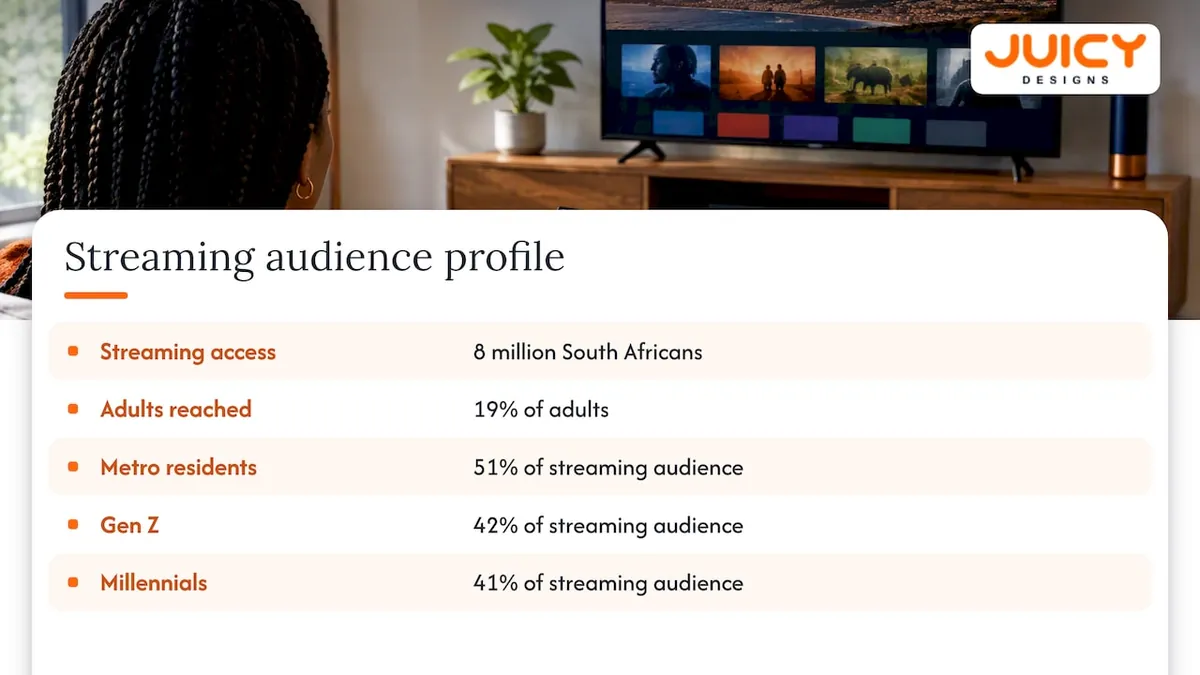
The audience is real but still a minority. 2023 MAPS data puts streaming access at 8 million South Africans, about 19% of adults. Around 51% of them live in metro areas, and they skew towards Gen Z (42%) and Millennials (41%). That makes CTV a good fit for brands selling to urban, younger households, and a poor fit for a business whose customers are mostly rural or older.
CTV also reaches people outside the living room. Analysts point to premium, tech-savvy audiences, including travellers in hospitality venues and urban households moving away from linear broadcast. If you are weighing how audiences and advertising are changing around hybrid habits, the hybrid work model in advertising is a useful angle on why attention is spreading across more places.
What CTV ads cost in South Africa
The most concrete public figures come from DStv Media Sales. Its September 2026 rate card lists CTV streamer packages with these anchor points:
| Package size | Cost | Impressions | Effective CPM |
|---|---|---|---|
| Smallest bundle cited | R67,000 | 175,000 | about R383 |
| Largest bundle cited | R240,000 | 800,000 | R300 |
The card puts CPMs between R300 and R383 depending on bundle and audience segment. CPM means cost per thousand impressions, so a budget translates into reach quickly. For example, R30,000 at those CPMs buys roughly 78,000 to 100,000 impressions. That is our arithmetic, not a quoted package, and actual minimums differ by seller.
Two cautions when reading these numbers:
- An impression is not a person. Frequency matters. If the same household sees your ad six times, your unique reach is a fraction of the impression count.
- Rate cards move. Treat any figure as a snapshot and confirm current pricing before you commit.
For comparison across other formats, see our guide to programmatic and DOOH advertising costs in South Africa.
Where CTV inventory sits in South Africa
There is no single, stable map of CTV inventory here. Platforms, smart TV manufacturer inventory and free ad-supported channels change their access models often, and inventory that was available six months ago may behave differently today.
In practice you will meet these routes:
- Broadcaster-owned CTV packages: audience bundles such as the DStv ones above, sold with clear impression counts.
- Streaming and video platforms: viewing across Showmax, YouTube and similar apps on smart TVs, phones and tablets, as described by The Media Online.
- Smart TV manufacturer and free channel inventory: often bought programmatically, with more variable quality.
- Hospitality screens: hotels and venues, relevant if your customers travel or dine out.
Analysts also say South Africa is not yet a CTV-first market and often lags global shifts by two to three years. Their advice is to treat CTV as a managed ecosystem: programmatic for efficiency, direct deals for premium context.
Is CTV right for your business?
CTV suits you when most of these are true:
- Your customers are urban and likely to stream.
- You already have video creative, or can make it.
- You have search and social working, so people who see your TV ad can find you and convert.
- You can fund a test long enough to learn, and you can measure beyond views.
It probably does not suit you yet if you have no website that converts, no tracking in place, or a monthly budget that is only enough for one channel. A dealership, a property developer or a national retailer with urban customers has a stronger case than a local service business covering one suburb. For the local business, Google Ads and social usually deliver leads sooner.
How to plan a first CTV campaign
- Set one goal. Brand reach, store visits, enquiries or search lift. Each calls for different measurement.
- Define the audience. Use the MAPS-style profile above as a start: metro, younger, streaming households. Then narrow by province, interest or behaviour.
- Choose a buying route. A direct package gives premium context and predictable delivery. Programmatic gives flexibility and efficiency. Many brands blend both.
- Prepare creative for the lean-back screen. Fifteen to thirty seconds, clear branding in the first seconds, one offer, and a simple way to follow up (a short URL or a branded search term).
- Fix your landing pages and tracking. A TV ad that sends people to a slow page wastes the whole spend.
- Run, review, recalibrate. Insiders favour ongoing calibration over set-and-forget plans. Review delivery weekly in the first month.
Measuring what CTV actually did
Impressions and completed views are the easy numbers. Better signals for a South African advertiser:
- Branded search growth in the weeks of the flight.
- Direct and organic traffic from the targeted provinces.
- Cost per qualified lead across all channels, not only the CTV line.
- Frequency and unique reach, so you know whether you are over-serving the same households.
CTV often works as an assist, warming audiences who later click a search ad or a social ad. Judge it on the whole funnel. That is also why we like to see search and paid social tuned first, as in our guide to advertising in South Africa.
Our perspective
We see CTV as a good channel for the right advertiser at the right moment, and a distraction for everyone else. The mistake we see most is a brand buying a big awareness flight before its basics convert. If your Google Ads, SEO and social are not turning attention into enquiries, TV impressions will not fix it. They will just send more people to a leaky funnel.

Our approach is full-funnel and in-house, and you work directly with the founders, not an account manager. For CTV that means three things. We check whether your audience really streams, we test small before scaling, and we tie the spend to leads and revenue rather than impressions. Programmatic, AI-driven advertising is part of what we offer, and it is the natural route for flexible CTV buying alongside direct deals.
We would rather tell you to wait six months than sell you a flight you are not ready for.
, Cobus
Where Juicy Designs can help
If you want CTV to work, the groundwork matters. Search is where TV viewers go next, so we usually start there. Google Ads management with us starts with Local at R6,000 per month, Growth from R9,500 per month and Competitive at R15,000 per month. If you would like a view of your current account first, an account audit starts from R3,500 once-off. For organic visibility, our SEO plans begin with Foundation at R5,500 per month. There are no long-term contracts.
Tell us your goal and budget through our site and we will say honestly whether CTV, or something cheaper, should come first.
FAQ
How much does it cost to advertise on CTV in South Africa?
On the DStv Media Sales September 2026 rate card, CTV packages run from R67,000 for 175,000 impressions to R240,000 for 800,000 impressions. That works out at roughly R300 to R383 per thousand impressions. Other routes, such as programmatic buying, have their own minimums, so confirm current pricing with the seller.
What are examples of CTV advertising?
Examples are video ads inside streaming apps on a smart TV, ads on free ad-supported channels, and ads on platforms such as YouTube watched on a television. Broadcaster audience bundles, such as DStv's CTV streamer packages, are another example. All are delivered over the internet rather than through a broadcast schedule.
Where do you see CTV ads?
You see them on smart TVs and on TVs connected to streaming devices or consoles. They appear inside apps and channels that carry advertising. They can also appear on hospitality screens, according to African media strategy commentary.
Is CTV better than traditional TV advertising for small businesses?
Often, yes, because you can target geography and audience and see impression-level reporting. But CTV still needs a budget large enough to learn from, and many small businesses see faster returns from search and social first. Start with the channel closest to a customer's decision to buy.
Sources
- DMS Rate Card September 2026, pages 18 to 19
- TV Advertising Just Got Smarter, Media Update
- 5 steps to run your CTV campaign in Africa, Nex Media
- Is South Africa ready for the connected TV tipping point?, The Media Online
- Is South Africa ready for the connected TV tipping point?, Nex Media
- CTV Advertising: The Basics, Global Landscape, and Opportunities in Africa
Recommended
- Streaming Advertising South Africa: CTV Guide
- Social media ads in South Africa: a practical guide
- TikTok Advertising in South Africa 2026
- Social media advertising costs in South Africa