
60 Day Dealership SEO Audit: Google Profile, VDP Schema and Feed
Run a 60 day SEO audit to fix GBP ownership, VDP schema, and inventory feed sync and lift calls and qualified leads. Includes a reproducible checklist and...
Prioritise your Google Business Profile and clean up your vehicle detail page inventory feed first.


TL;DR: Quick Answer
Run a 60 day SEO audit to fix GBP ownership, VDP schema, and inventory feed sync and lift calls and qualified leads. Includes a reproducible checklist and...
Prioritise your Google Business Profile and clean up your vehicle detail page inventory feed first. Those two levers drive the fastest, most measurable lift in dealership visibility and lead generation. Before touching blog content or backlinks, run a GBP and VDP ownership and accuracy audit. Confirm who controls your profile, verify your primary category, and check that vehicle schema on every listing matches your DMS feed.
TL;DR:
- Prioritise optimising your Google Business Profile by verifying ownership, updating categories, and encouraging frequent reviews to boost local visibility and engagement.
- Ensure each vehicle detail page has unique, structured content with accurate schema markup, fresh inventory feeds, and clear calls to action to improve search ranking and user experience.
- Maintain fast mobile site speeds under 2.5 seconds and clean inventory pagination to prevent traffic loss during site migrations or large VDP inventories.
- Focus on content that targets research-stage buyers, such as comparison guides and trade-in explanations, to capture early-stage search traffic.
- Track real sales and leads through dedicated metrics like calls, bookings, and CRM data instead of vanity page views to measure the true impact of SEO efforts.
Dealership SEO strategies for on-page structure and VDP hygiene
Your site architecture either helps buyers find the exact car they want or buries it under three menu clicks. Structure your site in a clear hierarchy: homepage, then make, then model, then individual VDPs, with service and financing sitting as parallel top-level branches rather than sub-pages of inventory.
Every VDP needs unique, structured content. Templates that pull only VIN, price, and a stock photo produce thin, duplicate-feeling pages that Google struggles to differentiate. Build your title tag from year, make, model, trim, and price, and let your H1 mirror it in plain language rather than a compressed SEO string.
VDP fields that need to stay unique and current:
- Title template combining year, make, model, and trim, not just a generic "New Inventory" tag
- VIN, price, mileage, and condition displayed above the fold and in the page's structured data
- A distinct meta description referencing the specific vehicle, not a boilerplate dealership blurb
- Clear calls to action: "Schedule a test drive," "Check availability," "Get financing pre-approval"
- Internal links from the VDP to related models, trade-in tools, and financing pages
Sold or on-hold vehicles create a common trap. Do not delete the page instantly. Redirect sold VDPs to the closest matching in-stock model, or apply a temporary noindex tag if you expect to restock the same trim soon. Permanently removing pages without redirects wastes the backlinks and crawl equity they've already earned.
Pro Tip: Set a 48-hour rule: if a vehicle sells and no replacement of the same trim arrives within two days, redirect the VDP instead of leaving a "vehicle no longer available" dead end.
Internal linking should push traffic towards your highest-converting pages, not just your newest inventory. Link service and financing pages from every VDP footer, and feature your fastest-moving models on the homepage above the fold.
Technical SEO: schema, feeds, and mobile speed that Google actually checks
Vehicle schema tells Google exactly what it's looking at instead of guessing from page text. Follow Google's structured data guidelines and mark up these properties on every VDP:
- Price and availability, updated automatically from your DMS, not manually edited
- VIN and model year, which help match vehicle cards to specific search queries
- Mileage and condition, particularly for used inventory where buyers filter aggressively
- Images, ideally five or more per vehicle, tagged with descriptive file names
Inventory feeds that sync your DMS to Google can surface vehicle cards directly in Maps and knowledge panels, putting your stock in front of buyers before they ever land on your website. A feed that updates once a week instead of daily means Google is showing stale prices and sold units, which erodes trust the moment a buyer calls about a car that's gone.
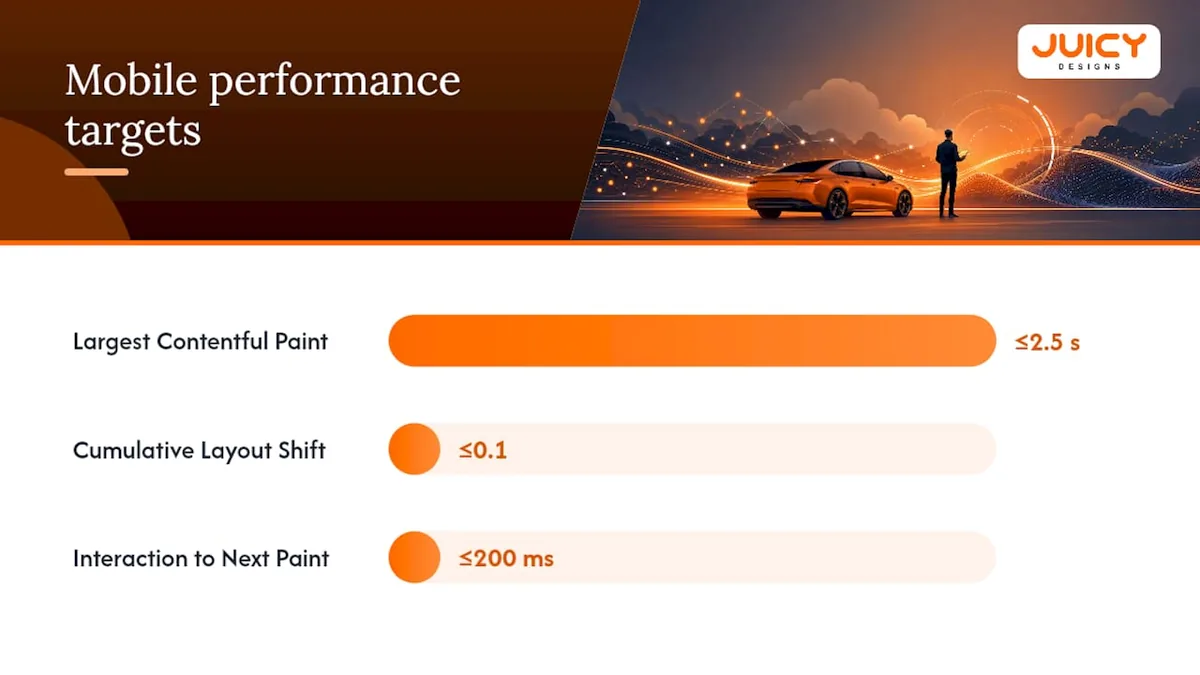
On mobile performance, aim for a Largest Contentful Paint under 2.5 seconds and a Cumulative Layout Shift below 0.1. Interaction to Next Paint under 200 milliseconds keeps filters and image galleries feeling responsive on a mid-range phone at a dealership's shared Wi-Fi speed.
For sites with 500+ VDPs: paginate inventory listing pages cleanly, canonicalise filtered URLs back to the base model page, and block faceted search parameters from crawling. Before any site migration, export your full VDP URL list and set up redirects in advance. Skipping that step is the single most common cause of a post-migration traffic collapse.
Local SEO and Google Business Profile as a revenue asset
Treat your Google Business Profile as a digital storefront, not a directory listing you set up once and forget. Profiles that post weekly and stay active see 2 to 5 times more profile interactions than dormant ones, and dealerships with a large number of photos consistently earn more direction requests and calls.
Start with ownership. Confirm your dealership, not a former agency or a departed employee, holds admin access to the profile. Audit the user list quarterly and remove anyone who's left the business.
Your primary category is the single most influential field for map-pack ranking, so choose it deliberately (typically "Car dealer" rather than a vaguer alternative) and layer in accurate secondary categories for used cars, financing, and service. If your service department handles walk-in customers who never buy a vehicle there, consider a separate service-specific profile.
| Timeline | Focus | Key actions |
|---|---|---|
| Days 1 to 10 | Audit | Verify ownership, check category accuracy, list all active users |
| Days 11 to 25 | Critical fixes | Correct hours, categories, and broken links; remove duplicate listings |
| Days 26 to 40 | Activation | Launch weekly posting cadence, upload photos, respond to all reviews |
Link each GBP call-to-action to the specific page that matches intent. Send "Shop inventory" clicks to your VDP-rich inventory page, and route service bookings to your appointment scheduler rather than your homepage, which forces the customer to hunt for what they already clicked to find.
Pro Tip: Schedule GBP posts regularly to capture peak shopper activity periods. Monday captures people planning weekend shopping trips; Friday catches impulse browsers heading into the weekend with cash in hand.
Content that meets research-stage buyers where they're searching
Buyers researching a purchase rarely land straight on a VDP. They search "best used sedans under R250,000" or "Toyota Hilux vs Ford Ranger fuel economy" weeks before they're ready to talk price. Content built around those questions captures them early and funnels them towards inventory once they've decided.
Turn every notable inventory arrival into a short post: a rare trim, a low-mileage trade-in, a fleet vehicle with full service history. These pieces link directly to the VDP and give Google fresh, dated content to crawl.
Content types worth building into your editorial calendar:
- Local landing pages combining directions, current inventory snapshots, and financing options for each service area you cover
- Model comparison guides answering "which trim" and "which competitor" questions buyers type into Google
- Trade-in value explainers that capture people mid-research, before they've committed to a dealership
- FAQ blocks with schema markup answering financing, warranty, and service scheduling questions
- Assign one team member ownership of the editorial calendar, even part-time
- Reuse GBP posts as short blog entries and vice versa, cutting content production time roughly in half
- Refresh evergreen guides (financing explainers, trade-in pages) every quarter rather than letting them go stale
A partner tool for AI-assisted content production can help a small team keep pace with inventory turnover without hiring a dedicated writer.
Turning reviews into local search fuel
Reviews influence AI-driven local recommendations as much as they influence human buyers scrolling Google Maps. Profiles with fresh reviews and photos are favored by AI recommendation systems, and review content spanning sales, financing, and service tends to carry more weight than reviews clustered around a single stage of the buying journey.
Build review requests into your existing workflow rather than treating them as an afterthought:
- Send a review request text within two hours of delivery, while the excitement is still fresh
- Follow up service visits with a separate request tied to the service experience specifically
- Respond promptly to every review, positive or negative, to maintain profile engagement
- Escalate any review mentioning a specific staff member or unresolved complaint straight to operations, not just marketing
Pro Tip: A one-line response like "Thanks for choosing us, [name], enjoy the new Ranger" takes ten seconds and signals to Google that your profile is actively managed.
Cultivate reviews touching financing clarity and service reliability specifically. These themes reassure the next buyer that you're straightforward on price and dependable after the sale, which are the two objections that kill deals.
Measurement: connecting SEO work to actual sales
Vanity metrics like page views tell you nothing about revenue. Track calls, bookings, and CRM-sourced sales instead if you want a number your GM will actually believe.
Build your reporting stack around:
- VDP views and time on page, segmented by new versus used inventory
- GBP-sourced calls and direction requests, tracked separately from website form submissions
- Service booking volume attributed to organic search versus paid or walk-in
- Form leads and test-drive requests tagged with source and matched to CRM outcomes
Use a dedicated tracking number for GBP and organic listings, separate from any paid campaign number, and apply consistent UTM parameters to every link you place in a post or profile field. The most common mistake here is letting different team members create ad hoc UTM tags. Standardise the format in a shared document before anyone builds a link.
Realistic expectations: most dealerships see measurable movement in GBP interactions and call volume within 60 days, with organic ranking and lead-quality improvements becoming clearer around the 120-day mark as fresh content and cleaned-up VDPs accumulate authority.
The 60-day audit checklist that ties it all together
- Days 1 to 10: Audit GBP ownership, category accuracy, and VDP schema across a sample of 20 listings
- Days 11 to 25: Fix broken VDP redirects, correct meta templates, and rebuild the inventory feed sync
- Days 26 to 40: Launch weekly GBP posting, backfill photos, and clear the review response backlog
- Days 41 to 60: Measure call and direction request lift, refresh landing pages, and report against baseline
Assign clear ownership: the dealership typically owns GBP posting and review responses day to day, while a technical vendor handles schema, feed integration, and page speed fixes.
- That same engagement sits within an average 4.8x return on ad spend across Juicydesigns' client base
What I'd fix first with a one-person marketing team
If you're running dealership marketing alone, skip the blog for now. Fix GBP ownership and category accuracy first, clean your top twenty VDPs second, and reply to every outstanding review third. Those three moves cost nothing but time and produce the fastest visible change.
Bring in outside help once technical work (schema, feed integration, site speed) outpaces what you can learn in a weekend, or once you need reporting that ties SEO directly to CRM-sourced sales.
, Cobus
How Juicy Designs helps dealerships turn visibility into sales
There is an alternative to a traditional agency for dealership SEO: no long-term contracts, direct access to the founders handling your account, and pricing built for local dealership budgets rather than a global retainer template. Our team runs the exact audit outlined above, GBP ownership, VDP schema, inventory feed sync, and review workflow, then builds the tracking that proves it worked.
Juicy Designs clients average a 4.8x return on ad spend, nearly double the industry standard. If you're weighing whether to hire an agency at all, that gap between a generic retainer and founder-led, results-tracked work is exactly where Juicy Designs operates.
Book a free SEO audit through our Pretoria-based team and expect a first call covering your current GBP health, VDP sample review, and a realistic 60-day plan. No obligation, no lock-in contract, just a clear look at what's costing you leads right now.
Sources
- GBP Optimisation for Dealerships: The Complete Guide | Hrizn
- Google Business Profile for car dealers: Maps, Reviews and Calls
- Introduction to structured data, Google Developers
FAQ
What are the top SEO strategies for a car dealership?
The highest-impact actions are Google Business Profile governance, VDP schema and content uniqueness, mobile page speed, inventory feed freshness, and a structured review response process.
What is automotive SEO?
Automotive SEO is search optimisation tailored to dealership websites, focusing on vehicle detail pages, local search visibility, inventory feeds, and buyer-intent content like model comparisons and financing guides.
How can a dealership get more customers through search?
Keep your Google Business Profile active with weekly posts and photos, respond to every review, and make sure VDP pages load quickly and carry accurate, unique vehicle data. Juicydesigns' dealership marketing overview covers the full approach for South African dealers.
Recommended
- Automotive Lead Generation: Dealership Playbook 2026
- Lead Generation for Car Dealerships: A Practical Playbook
- Digital Marketing for Car Dealerships in South Africa
- How Car Dealerships Win at Local SEO