
Entertainment brand paid ads strategy: 2026 guide
An entertainment brand paid ads strategy is a plan for buying attention across video-first and connected media channels, matched to how audiences actually discover shows, events and artists.
In 2026 that means short-form video creative, tight audience segmentation, and measurement that follows a viewer across screens rather than stopping at the click.



TL;DR:
- Targeted, video-first advertising campaigns enhance entertainment brand visibility and engagement across connected media channels.
- Implementing mobile-focused, culturally relevant video ads and integrating paid, owned, and earned media amplify overall performance and reach.
An entertainment brand paid ads strategy is the deliberate use of targeted, video-centric advertising campaigns across connected media channels to maximise brand visibility and audience engagement. The Arts & Entertainment sector achieves an average Facebook Ads CTR of 2.64%, with video ads pulling 3.1% CTR compared to 2.2% for static images. That gap is not a coincidence. It reflects how entertainment audiences consume content: fast, mobile, and emotionally driven. South Africa’s digital video ad market is projected at $212.48 million in 2026, with 75% of video consumed on mobile devices. If your paid media plan does not start with video and mobile, you are already behind.
What does an effective entertainment brand paid ads strategy require?
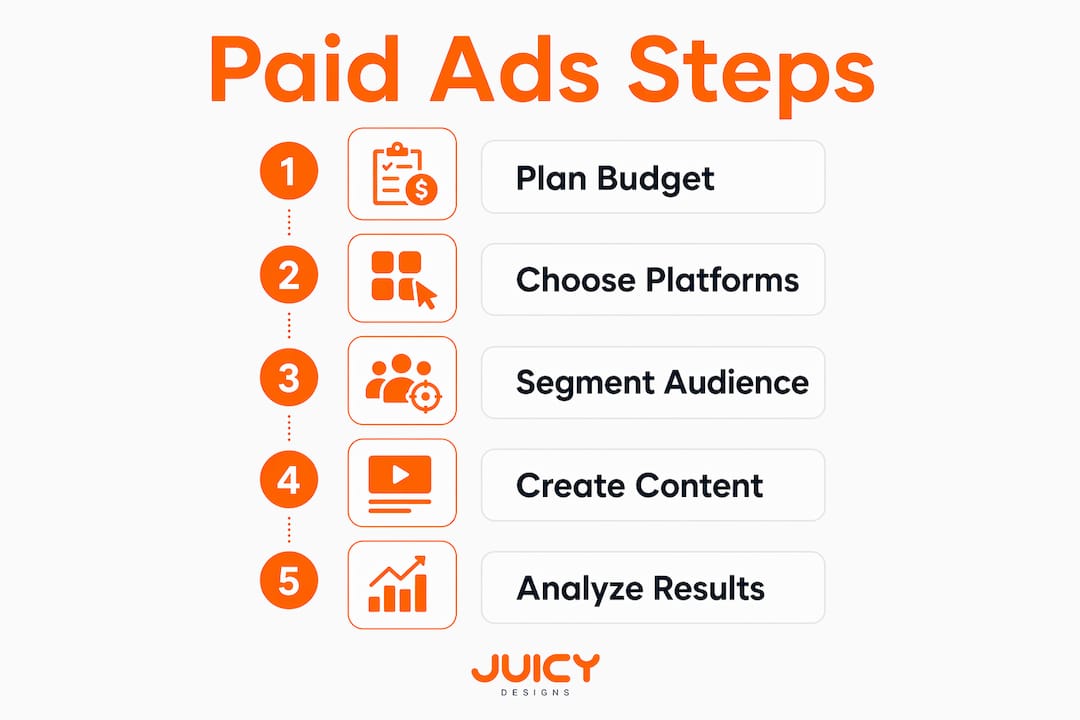
Before you spend a rand on ads, you need the right foundations in place. Budget, platform selection, audience data, and brand safety all determine whether your campaigns build real momentum or burn through spend.

Budget context in South Africa
60% of South African organisations spend less than R10,000 per month on social media ads, while only 16% exceed R50,000. That spread matters because your budget tier determines which platforms and formats are realistic. At R10,000 per month, you can run focused social video campaigns on one or two platforms. At R50,000 and above, you can layer in premium video publishers, connected TV (CTV), and YouTube.
Platforms to prioritise
- Social video platforms: Facebook, Instagram, and TikTok for broad reach and event promotion
- Premium video publishers: Trusted editorial environments like news sites and streaming platforms for brand safety
- Connected TV and YouTube: Growing fast in South Africa as linear TV viewership shifts to on-demand
- Google Display and Video 360: For programmatic placements with audience targeting controls
Audience segmentation and cultural relevance
Generic targeting wastes budget. South African entertainment audiences are diverse, and cultural fluency in your messaging directly affects engagement. Segment by genre preference, language, location, and device type. Mobile-first audiences in townships behave differently from suburban streaming households, and your creative must reflect that.
Pro Tip: Place ads in trusted editorial environments rather than relying solely on algorithmic placements. Contextual targeting in trusted environments reduces brand safety risk and improves return on ad spend compared to generic programmatic buys.
How to design high-impact video ad campaigns for entertainment brands
Video is the core format for entertainment brand promotion. The process below builds campaigns that perform from the first second to the final call to action.
-
Start with a creative strategy rooted in storytelling. Entertainment audiences respond to narrative, not product features. Lead with a human moment, a cultural reference, or an emotional hook that connects to your brand’s world. 62% of consumers distrust fully AI-generated content in 2026, so human-centric storytelling is not optional. It is your primary competitive advantage.
-
Design for mobile reality. Attention spans have shrunk to 8.2 seconds for mobile video. That means your value proposition must land in the first three seconds. Use vertical format (9:16 ratio), bold text overlays, and sound-off-friendly visuals. Professionally produced video drives 60% higher recall than amateur content, so production quality still matters even at short lengths.
-
Choose placements deliberately. Premium video inventory on editorial sites outperforms generic programmatic placements for brand recall. For social media ads specifically, in-feed video and Stories formats consistently outperform banner placements in entertainment categories.
-
Build event promotion campaigns as a priority. Event promotion campaigns outperform general awareness campaigns by 35% in engagement. A film premiere, a live show, or a streaming launch all create urgency that general brand awareness campaigns cannot replicate. Allocate a dedicated budget line for event-driven pushes.
-
Run A/B tests on creative elements continuously. Test thumbnail images, opening frames, headline copy, and call-to-action text. AI-powered optimisation tools can accelerate this process by identifying winning variants faster than manual review. Platforms like Valiz provide data on video ad effectiveness versus image ads, which helps you allocate creative budgets with confidence.
-
Address access friction directly. Access friction is a larger barrier than awareness in South African entertainment marketing. Every ad must include a clear “where to watch” path. A viewer who wants to engage but cannot find the content quickly will not try again.
Pro Tip: Integrate user-generated content (UGC) clips into your paid video ads. UGC signals authenticity and social proof, which increases trust and click-through rates, especially for younger South African audiences.
How does integrating paid, owned, and earned media improve ad performance?
Siloed budgets for paid social, TV, and digital are a legacy approach that limits results. The most effective entertainment brands manage paid, owned, and earned media as one connected system.
The shift matters because each channel amplifies the others. A paid video ad drives viewers to your owned social page, where organic content builds community. That community generates earned media through shares and reviews, which reduces your cost per acquisition over time. Managing these channels separately means you miss the compounding effect.
Creator marketing has become a core channel within this integrated model. Creator marketing boosts conversions by 8% and watch time by 41% compared to brand-only content. South African creators with mid-tier followings (10,000 to 100,000) often deliver stronger engagement rates than macro-influencers, and their audiences trust their recommendations more.
| Approach | Traditional siloed planning | Integrated media system |
|---|---|---|
| Budget management | Separate TV, social, and digital budgets | Unified budget allocated by audience behaviour |
| Attribution | Channel-level metrics only | Cross-channel attribution with unified reporting |
| Creator marketing | Treated as a PR add-on | Core paid channel with dedicated budget |
| Discovery optimisation | SEO and traditional search only | Includes GEO for AI-powered search platforms |
| Measurement | Vanity metrics (views, likes) | Brand recall, engagement rate, and conversion |
Generative Engine Optimisation (GEO) is now a real discipline for entertainment brands. AI-powered search platforms like Perplexity and ChatGPT are becoming discovery channels. Brands that optimise their content for AI citations gain visibility that paid ads alone cannot buy.
What common mistakes hinder entertainment brand paid ads?
Most entertainment brand campaigns underperform for predictable reasons. Recognising these patterns early saves significant budget.
- Chasing reach over relevance. A scattergun approach to placements inflates impressions but delivers low engagement. Prioritise contextual placements in trusted editorial environments over the cheapest available inventory.
- Ignoring mobile-first behaviour. Designing ads for desktop and adapting them for mobile produces weak results. South Africa’s 75% mobile video consumption rate means mobile must be the primary design brief, not an afterthought.
- Relying on vanity metrics. Views and likes do not pay for campaigns. Brand awareness at 69% remains the top reported benefit of social media ads in South Africa, but brands that stop there miss conversion and revenue attribution entirely.
- Fragmented teams and budgets. When TV, social, and digital teams operate independently, you lose cross-channel alignment and duplicate spend. A unified campaign brief and shared reporting dashboard fixes this.
- Over-automating creative. AI tools accelerate production, but fully synthetic content erodes trust. Keep human storytelling at the centre of every campaign.
Pro Tip: Run a quarterly budget audit across all paid channels. Compare cost per engagement and cost per conversion by placement type. You will almost always find budget that can shift from low-performing programmatic placements to higher-performing editorial or creator-driven inventory.
How to measure and optimise your paid ads for ongoing success
Measurement is where most entertainment brand campaigns lose momentum. The right KPIs and a consistent review cadence keep campaigns improving over time.
| Optimisation step | What to do |
|---|---|
| Set primary KPIs | Track brand recall, engagement rate, video completion rate, and cost per conversion |
| Use trusted data sources | Prioritise first-party data and editorial environment reporting over third-party aggregators |
| Apply AI budget allocation | Use platform AI tools to shift spend towards top-performing ad sets in real time |
| Monitor CTV growth | Add YouTube CTV placements as connected TV viewership grows in South Africa |
| Refresh creative regularly | Rotate ad creative every four to six weeks to prevent audience fatigue |
| Audit access paths | Confirm every ad links directly to a working “where to watch” destination |
South Africa’s media measurement environment is changing. The rollout of new TV measurement currency (TVM) and the rise of CTV are reshaping how brands attribute reach across screens. Brands that build flexible measurement frameworks now will adapt faster than those locked into legacy reporting tools. For a deeper look at video marketing in South Africa, the mobile-first trends shaping 2026 are worth reviewing in full.
Key takeaways
An entertainment brand paid ads strategy built on video-first creative, contextual placements, and integrated media management consistently outperforms siloed, reach-focused approaches in the South African market.
| Point | Details |
|---|---|
| Video outperforms static ads | Video ads achieve 3.1% CTR versus 2.2% for static images in Arts & Entertainment. |
| Mobile is the primary design brief | 75% of South African video consumption happens on mobile; design for mobile first. |
| Event campaigns drive engagement | Event promotion campaigns outperform general awareness campaigns by 35% in engagement. |
| Integration beats siloed budgets | Managing paid, owned, and earned media together improves attribution and reduces wasted spend. |
| Access friction kills conversions | Every ad must include a clear “where to watch” path to close the awareness-to-action gap. |
What I have learned about paid ads for entertainment brands in South Africa
The brands I see struggling most are not the ones with small budgets. They are the ones still planning campaigns the way they did five years ago. They split their TV, social, and digital budgets into separate silos, brief three different agencies, and then wonder why the numbers do not add up at the end of the quarter.
The South African market has shifted faster than most brand managers expected. Mobile consumption is not a trend anymore. It is the default. And the attention window is genuinely short. Eight seconds is not a creative challenge. It is a structural constraint that changes how you write a brief, how you produce a video, and how you measure success.
What I find most encouraging is that cultural fluency is a real differentiator here. South African audiences respond to stories that reflect their lives. Brands willing to invest in authentic, locally grounded creative consistently outperform those running adapted international campaigns. That is an advantage that no budget size can fully replace.
The other shift I would urge you to take seriously is GEO. AI-powered discovery is not a future concern. It is already changing how audiences find entertainment content. Brands that optimise for AI citations alongside traditional paid placements are building a discovery advantage that compounds over time.
Do not wait for your measurement framework to be perfect before you act. Build it as you go, review it quarterly, and stay willing to shift budget towards what the data shows is working.
, Cobus
How Juicy Designs supports entertainment brands with paid advertising
Juicy Designs works with entertainment brands and media companies across South Africa to build paid advertising campaigns that produce measurable results. The team manages Google Ads campaigns and social media advertising with a full-funnel approach, from creative strategy through to conversion tracking. Every campaign is handled directly by the founders, with no account managers in between. Clients see an average ROAS of 4.8x, nearly double the industry standard. If you are ready to build a paid media strategy that reflects the realities of the South African market, contact Juicy Designs for a consultation.
FAQ
What is an entertainment brand paid ads strategy?
An entertainment brand paid ads strategy is a structured approach to running targeted, video-centric paid campaigns across social, digital, and connected TV channels to grow brand visibility and audience engagement. It prioritises contextual placements, mobile-first creative, and integrated media management.
How much should South African entertainment brands spend on paid ads?
60% of South African organisations spend less than R10,000 per month on social media ads. A focused video campaign on one or two platforms is achievable at that level, while R50,000 per month opens access to premium video publishers and connected TV.
Why do video ads outperform static ads for entertainment brands?
Video ads achieve a 3.1% CTR compared to 2.2% for static images in the Arts & Entertainment sector. Professionally produced video also drives 60% higher recall, making it the most effective format for brand promotion in entertainment.
What is the biggest mistake entertainment brands make with paid ads?
The most common mistake is chasing broad reach over relevant context. Placing ads in trusted editorial environments with contextual targeting consistently outperforms cheap programmatic inventory for both brand safety and return on ad spend.
What does GEO mean for entertainment brand advertising?
Generative Engine Optimisation (GEO) is the practice of optimising content so that AI-powered search platforms like Perplexity and ChatGPT surface your brand in their responses. For entertainment brands, it is an emerging discovery channel that works alongside, not instead of, traditional paid advertising.