
From R8,000: Local Entity SEO, Google Profile, Schema & POPIA
Practical steps to make your local business search ready: configure Google Business Profile, publish JSON-LD schema, and stay POPIA compliant. Audits from...
Entity SEO for local means making your business a clear, machine-readable node so search engines connect your brand, place and services.


TL;DR: Quick Answer
Practical steps to make your local business search ready: configure Google Business Profile, publish JSON-LD schema, and stay POPIA compliant. Audits from...

Entity SEO for local means making your business a clear, machine-readable node so search engines connect your brand, place and services. When your signals are consistent, you improve your odds of showing up in the local pack, on maps and in knowledge panels. This article walks through what an entity is, why it matters, and the exact steps to set yours up correctly.
TL;DR:
- Consistent and accurate name, address, and phone number signals across all platforms are essential to improve local search visibility and trust.
- Properly configuring your Google Business Profile with the correct business type and categories directly influences your appearance in local packs, maps, and knowledge panels.
- Implementing schema markup with JSON-LD on location and service pages helps search engines understand your entity, but it requires validation through tools like Google's Rich Results Test.
- For service-area businesses, setting specific geographic areas and hiding your address ensures compliance and improves local relevance.
- Collecting and using customer data for marketing demands strict adherence to privacy laws, including obtaining and documenting explicit consent before outreach efforts.
What is an entity in modern search?
An entity is a distinct thing that a search engine can recognise and model: a person, a place, an organisation, a product. Google does not just match keywords anymore. It builds a knowledge graph, a network of nodes connected by relationships, so it can tell your dental practice apart from another business with a similar name three suburbs over.
That graph is how search engines disambiguate and connect the dots between your brand, your address and the services you offer. For a local business, this plays out in a few concrete ways:
- Your business itself becomes a LocalBusiness node, tied to a name, address and category.
- A staff member with public credentials can become a Person entity, linked to your organisation.
- Each service you offer can become its own node when it has a dedicated page with clear markup.
Once search engines can model these pieces correctly, they can match your business to the right queries instead of guessing.
Why entity SEO matters for local search and Google Business Profile
Entity signals feed directly into whether you show up in the local pack, where you land on Maps, and whether you earn a knowledge panel at all. Two things drive this: notability (how well known and well documented your business is) and relatedness (how clearly your entity connects to the right location and category).
A few practical levers raise both:
- Matching your name, address and phone number exactly everywhere they appear builds trust in the data.
- Choosing accurate categories and earning mentions from authoritative local sources strengthens notability.
- Configuring your profile correctly as a storefront, service-area or hybrid business changes what searchers actually see, and getting it wrong can hide you from the right audience.
Google's own guidelines for representing your business stress consistent real-world representation and recommend using the fewest categories that genuinely describe your core business, rather than stacking on extras to appear broader.
How to implement entity SEO for your local business
Getting your entity signals right is mostly a matter of sequencing. Here's the order that tends to produce results without wasted effort:
- Audit your existing signals. Pull your business name, address and phone number from your website, Google Business Profile, directories and social profiles, and fix any mismatch in formatting or spelling.
- Build topic-focused pages. Create pages that connect a specific service to a specific location, with internal links tying staff, services and locations together.
- Add structured data. Place JSON-LD LocalBusiness markup on location and service pages, including openingHours, address, telephone and serviceArea.
- Configure Google Business Profile properly. Pick the correct business type (storefront, service-area or hybrid), set precise categories, and keep your phone number and website consistent with your site.
- Earn authoritative local mentions. Local press coverage, chamber of commerce listings and industry directories all add weight to your entity when they reference you accurately.
- Track your signals over time. Watch Google Business Profile insights, review volume and sentiment, knowledge panel appearances, and Search Console performance for your location pages.
If you run a service-area business with no public storefront, Google's service-area guidance requires you to set areas by city, postal code or region rather than relying on a simple radius, and to hide your address since you are not staffing a walk-in location. Our service area business SEO guide walks through the setup in more detail, and our local SEO primer covers the broader concepts if you want the fuller picture.
Pro Tip: Fix your Google Business Profile category and service area before investing in content. A wrong category quietly suppresses your visibility no matter how good the rest of your entity signals are.
Technical checklist: schema, JSON-LD and structured data
Correct markup is what lets search engines read your entity instead of guessing at it. Here is what a local business page needs at minimum:
- A schema.org LocalBusiness type (or a more specific subtype, such as Restaurant or Dentist) with name, telephone, address as PostalAddress, openingHoursSpecification and serviceArea where relevant.
- JSON-LD published in the page head or through your site template, not buried as inline microdata that is easy to break.
- A unique canonical URL per location, each with its own structured-data block, so search engines do not merge two branches into one entity.
- A sameAs property linking your social profiles, plus clear internal links between related pages, so the graph around your entity is unambiguous.
- Person schema for staff where it genuinely adds context, such as a practitioner's credentials on a service page.
Schema.org's LocalBusiness documentation sets out these properties and gives JSON-LD examples you can adapt directly. Structured data alone will not carry you, though: Google still weighs web mentions, links and authoritative references to build notability and relatedness around your markup.
Validation matters as much as the markup itself. Run every page through Google's Rich Results Test and a schema validator after publishing, and check back periodically, since a broken tag can quietly drop your structured data from consideration without any obvious symptom on the page itself.
Privacy and compliance for entity-driven local marketing
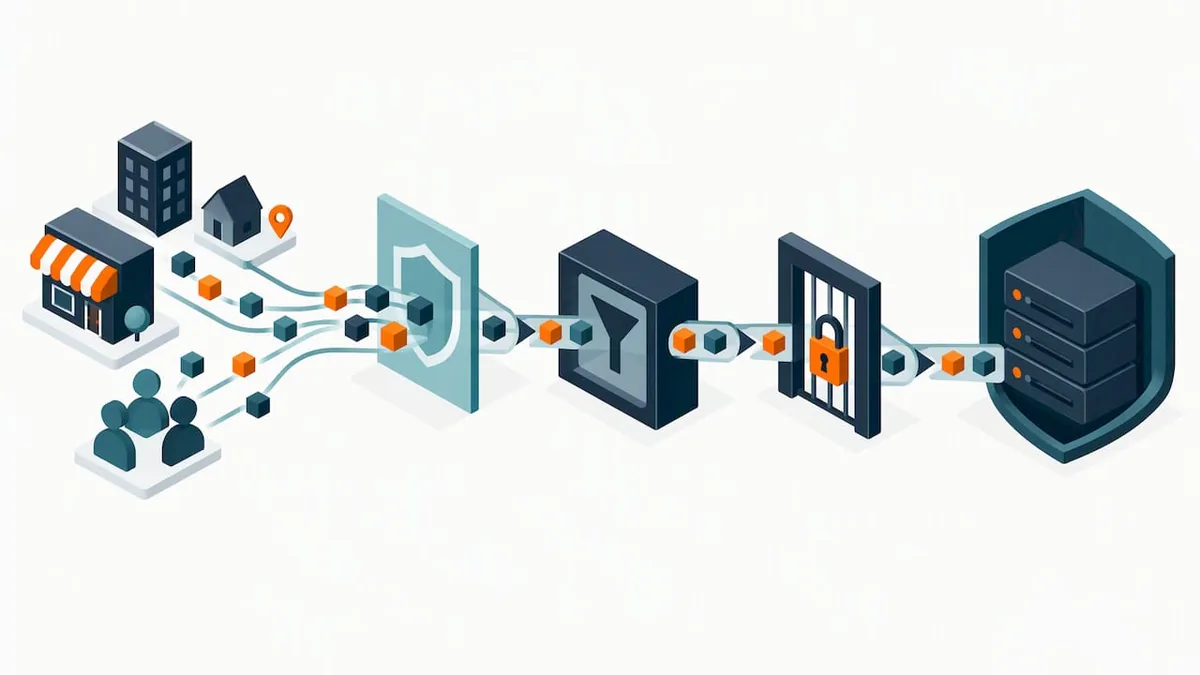
Collecting and using customer contact details for marketing comes with legal obligations you cannot skip. Under the Protection of Personal Information Act, section 69 requires written consent before you use someone's details for direct electronic marketing, including email and SMS.
A few practical rules follow from this:
- Get and document written consent, using the format in POPIA's Form 4, before adding anyone to an email or SMS marketing list.
- Never harvest or repurpose contact details collected for one reason (like a service enquiry) for ongoing marketing without separate consent.
- If you use third-party tools for reviews, email or SMS campaigns, confirm they have proper data-processing terms and that consent records travel with the data.
Our guide to POPIA and email marketing covers the consent flow and recordkeeping in more depth.
A practitioner's take on entity SEO
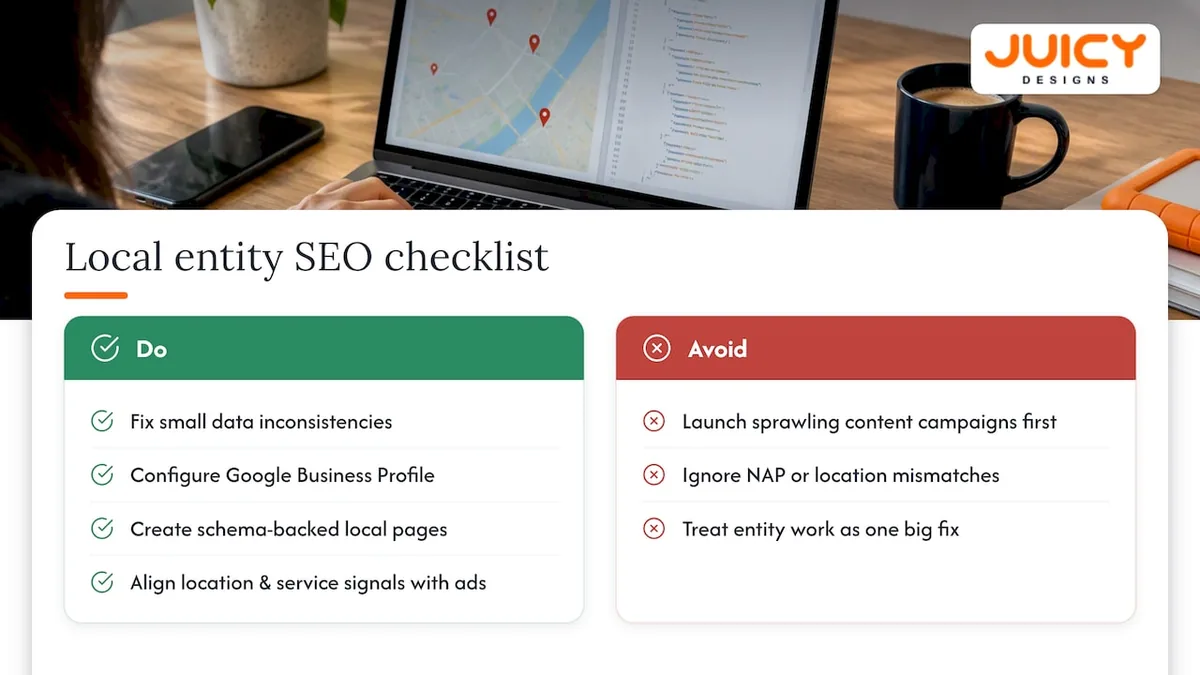
We're a founder-led digital marketing agency based in Pretoria, and entity work makes up a steady share of what we do across Juicy Designs. Our services span AEO, GEO AIO SEO, SEO, Google Ads and social media marketing, and the pattern across clients is consistent: entity signals rarely fail because of one big mistake. They fail because of a dozen small inconsistencies nobody caught.
Our average client ROAS sits at a strong multiple, and one local dealership saw a large increase in qualified leads after we tightened their location and service signals alongside paid media. The lesson we keep relearning is that most local gains come from a correctly configured Google Business Profile plus a handful of well-built, schema-backed local pages, not from a sprawling content campaign.
, Cobus
How we help you build out your entity SEO
If you want a second set of eyes on where your entity signals stand, we offer a few starting points depending on what you need. A once-off SEO audit gives you a clear diagnostic without a monthly commitment, and our Foundation and Authority SEO packages cover ongoing implementation once you know what needs fixing.
- A once-off SEO audit (from R8,000) pinpoints exactly which entity signals are missing or inconsistent.
- Our Foundation package at a competitive monthly rate suits a business needing steady, ongoing local optimisation.
- Our Authority package at a higher monthly investment fits businesses that want a broader, more aggressive push across SEO, schema and citations.
Engagements typically move from audit to a prioritised plan, then implementation, then reporting, so you always know what changed and why. If you'd rather talk it through first, visit our SEO services and pricing page to see current packages or get in touch directly.
FAQ
Can I do local SEO myself?
Yes, much of entity SEO for local search is within reach for a business owner willing to spend time on it: setting up a correct Google Business Profile, matching your name, address and phone number everywhere, and adding basic schema markup. It takes longer without technical help, and mistakes in categorisation or service-area setup can be hard to spot without guidance.
What does entity mean in SEO?
In SEO, an entity is a distinct thing a search engine can recognise and model as a node in its knowledge graph, such as a business, a person or a service. Search engines connect entities through relationships rather than relying purely on keyword matching, which is why consistent, structured information about your business matters.
What is considered local SEO?
Local SEO is the practice of optimising your online presence so your business appears in geographically relevant search results, including the local pack, Maps and knowledge panels. It covers Google Business Profile management, local citations, location-specific content and structured data that ties your business to a place.
How much should I pay for local SEO?
Pricing depends on scope: a once-off local SEO audit starts at competitive rates, while ongoing monthly retainers for local-focused SEO work begin at corresponding monthly fees. What you need depends on whether you're fixing foundational issues or maintaining and growing an already solid entity presence.
Sources
- Guidelines for representing your business on Google - Google Business Profile Help
- Protection of Personal Information Act 4 of 2013 | South African Government
- LocalBusiness - Schema.org usage examples (Google / schema.org)
Recommended
- Local SEO and Google Business Profile in South Africa
- Local SEO: How to Rank in Google Maps in South Africa
- Local SEO South Africa | Google Business Profile
- Google Business Profile Pretoria