
8 Step Audit Backed by 2026 Research for Google Maps Rankings
Industry-backed priorities and an 8 step audit to improve Google Maps rankings in 2026, plus a Juicydesigns case showing the practical fixes to start now.
Three factors decide who shows up in the Map Pack: relevance, distance, and prominence, according to Google's own guidance.


TL;DR: Quick Answer
Industry-backed priorities and an 8 step audit to improve Google Maps rankings in 2026, plus a Juicydesigns case showing the practical fixes to start now.

Three factors decide who shows up in the Map Pack: relevance, distance, and prominence, according to Google's own guidance. You cannot change how far a searcher is from your business, so your highest-leverage move is fixing what you control: choosing the correct primary category and completing every field on your Google Business Profile. Everything else builds on that foundation.
TL;DR:
- Verifying your Google Business Profile and choosing the most precise primary category are critical steps that significantly influence your Map Pack visibility.
- Maintaining NAP consistency across your website and key directories, along with continuously generating recent reviews, enhances relevance and prominence signals.
- Focusing on local relevance through tailored landing pages and obtaining high-quality local links can substantially improve your local search ranking.
- Improving website speed and mobile-friendliness supports better user engagement and conversions but does not directly affect Map Pack position.
- Avoid investing heavily in citations or directory submissions without first fixing fundamental issues like category accuracy and review flow, which matter most.
What are the Google Maps ranking factors you can control?
Your Google Business Profile (GBP) is the single biggest lever in local search, and most of it sits entirely in your hands. Get the setup wrong, and no amount of reviews or backlinks will fix it.
Verification comes first. An unverified listing rarely shows up in the Map Pack at all, regardless of how good the business is. Google prioritises profiles it can confirm are tied to a real, operating location, so verification through postcard, phone, email, or video (depending on your business type) is the non-negotiable starting point.
Category selection is the single most important individual factor, according to Whitespark's 2026 Local Search Ranking Factors Report, which weights it above review count, links, and on-page signals combined. Pick the primary category that most precisely describes what you do, not the broadest one. A "family lawyer" who lists as "attorney" is competing against every type of lawyer in town for no good reason. Secondary categories fill in the gaps, but the primary one carries the most weight.
Beyond category, these fields need real attention:
- Business name: use your actual registered or storefront name. No keyword stuffing ("Joe's Plumbing Pretoria Best Emergency 24/7"), this violates policy and risks suspension.
- Address or service area: physical businesses need a real address; service-area businesses should hide the address and define the areas served.
- Hours, including special hours: outdated hours frustrate searchers and hurt the behavioural signals Google tracks.
- Services and attributes: list every service you actually offer; attributes (wheelchair accessible, women-led, outdoor seating) help match niche searches.
- Photos: a completed profile with strong photos performs better on both relevance and engagement.
Google's Business Profile guidelines are explicit about policy risk: one profile per physical location, accurate representation of the business, and no duplicate listings for the same address. Duplicate profiles, virtual office addresses without a genuine presence, and keyword-stuffed names are the fastest ways to get suspended, which erases your visibility overnight.
Pro Tip: Audit your primary category every six months. Google occasionally adds new, more specific categories, and switching to a tighter match can lift rankings without any other work.
For a full field-by-field walkthrough, Juicydesigns' Google Business Profile optimisation guide covers the setup process in more depth.
How do relevance, proximity, and prominence actually work?
These three pillars, as Google itself describes them, explain almost everything about why one business outranks another for the same search.
Relevance measures how well your profile matches what someone searched for. A complete GBP, the right category, accurate services, and website content that mirrors the search intent all feed this. It is the pillar most within your control.
Proximity measures the physical distance between the searcher and your business at the moment of the search. There is no field to fill in for this and no trick that overrides it. A searcher standing two blocks from a competitor will usually see that competitor first, no matter how good your profile is.
Prominence measures how well-known and well-regarded your business is, both online and offline. This pulls in review count, review quality, star rating, backlinks, press mentions, and citation consistency across the web.
Here's how the pillars map to actual work:
- Relevance: GBP category, service descriptions, website landing pages, Google Posts
- Proximity: fixed by the searcher's location, essentially unmanageable
- Prominence: reviews, local links, citations, brand mentions, overall online reputation
Accept proximity as a constraint, not a battle. Businesses that understand this stop wasting energy trying to "beat" geography and instead pour that effort into relevance and prominence, where real gains are possible.
Why does review recency matter more than review count?
Review signals, particularly recency, have climbed sharply in the ranking hierarchy. The 2026 Local Search & AI Discovery Report from Angarum Media places review recency among the top five factors this year, and BrightLocal's research shows consumers increasingly favour businesses with recent reviews over businesses with only older, higher volumes. A business with 214 reviews from three years ago can lose out to a competitor with 40 reviews, most from the last two months.
Build review generation into a routine, not a one-off push:
- Ask at the moment of highest satisfaction, right after a job is finished or a purchase confirmed.
- Send a direct link to your review page by SMS or email rather than making customers search for it.
- Prompt customers to mention the specific service they used ("wheel alignment", "emergency plumbing callout") so the review text reinforces relevance for those exact searches.
- Space requests out so reviews arrive steadily rather than in a single suspicious burst.
- Track velocity monthly, not just total count.
Replies matter for two different reasons. Replying to a review with specific detail helps conversion, since prospective customers read replies before booking. It has a smaller, indirect effect on ranking, mostly by signalling an active, well-managed profile. Never buy reviews or incentivise them with discounts. Google's spam detection has got sharper at catching patterns like a spike of five-star reviews with generic wording, and the penalty can wipe out a profile's visibility for months.
Pro Tip: Ask customers what almost stopped them from booking, then request a review that answers that objection. It turns your review section into a sales tool, not just a trust badge.
Which website changes support Google Maps rankings?
Your website reinforces or undermines everything your GBP claims. A landing page that matches the profile's name, address, and phone number (NAP) gives Google a consistency signal it can trust; a mismatch does the opposite.
Structure location and service pages so intent and geography are unmistakable. A plumbing business serving three suburbs needs three distinct pages, each naming the suburb, the specific services offered there, and the phone number matching the GBP exactly. Generic "we serve the whole region" pages give Google nothing concrete to match against a "plumber near me" search.
Key on-page elements to get right:
- NAP consistency: name, address, and phone number on the website must match the GBP character for character, including abbreviations.
- Title tags and headings: include the service and the location naturally, not stuffed.
- Schema markup: LocalBusiness structured data clarifies page intent for search engines and supports location and service matching, though it is not a standalone ranking booster on its own.
- Mobile speed: slow load times lose the traffic Google already sent you, even if the ranking itself holds.
- Clear conversion elements: click-to-call buttons, visible hours, and a map embed all reduce friction for the mobile searcher who found you through the Map Pack.
Juicydesigns' comparison of GBP optimisation against on-page SEO breaks down which to prioritise when resources are limited, which is nearly every business.
Do business directory listings still affect local rankings?
Citations, meaning your business name, address, and phone number listed on directories across the web, still matter, but the return on chasing dozens of them has flattened. What matters now is consistency on the handful of sources Google and its data partners actually check.
Prioritise these first:
- Google Business Profile itself (the primary source)
- Apple Maps and Apple Business Connect
- Data aggregators that feed multiple directories at once
- Major industry-specific directories relevant to your sector
- Your own website's contact page
A practical cleanup process runs in three stages. First, audit: search your business name plus city and note every listing that surfaces, flagging mismatches in name formatting, old addresses, or disconnected phone numbers. Second, fix the highest-value listings first, starting with Google, then the aggregators, then anything ranking on page one for your brand name. Third, monitor quarterly rather than assuming the job is done once.
Local SEO practitioner audits consistently find that NAP mismatches and duplicate listings are more damaging than a low citation count, which means a focused cleanup beats blanket citation building almost every time. Once your top 15 to 20 citations are clean and consistent, additional directory submissions produce diminishing returns. That effort is better spent on reviews or local links.
Where should you focus local link-building efforts?
Local links contribute directly to the prominence pillar, but not all links carry equal weight. A mention from a national blog with no local angle does less for Map Pack rankings than a link from your city's chamber of commerce.
Focus on sources with genuine local relevance:
- Local news outlets and community publications covering your area
- Chambers of commerce and local business associations
- Suppliers, partners, or trade associations that link to member businesses
- Sponsorship pages for local sporting clubs, schools, or charity events
- Local industry directories specific to your sector and city
Campaign ideas that consistently earn links include sponsoring a local youth sports team, hosting a free community workshop, or publishing an original local resource (a neighbourhood guide, a seasonal safety checklist) that local sites want to reference.
Prioritise outreach by asking one question: would this site plausibly link to a business physically located in your city, even if you weren't asking? If the answer is no, the outreach time is better spent elsewhere.
Pro Tip: A single link from your local chamber of commerce or a well-read community news site often outweighs ten generic directory submissions for prominence.
What behavioural signals does Google track for Map Pack ranking?
Google exposes performance data directly in your Business Profile dashboard: calls, direction requests, website clicks, and photo views. These behavioural signals feed prominence, and local ranking research suggests that once competitors are roughly equal on category and NAP, engagement metrics and review recency become the tiebreakers.
Improve genuine engagement with straightforward moves:
- Keep hours accurate, including holidays, so searches near closing time do not send frustrated customers to a competitor still open.
- Upload fresh photos regularly rather than leaving a profile with three-year-old images.
- Post updates, offers, or announcements through Google Posts to give searchers a reason to click through.
- Write clear, specific service descriptions so the click a searcher makes is an informed one, not a bounce.
Never attempt to manipulate these numbers artificially, whether through click farms or incentivised calls. Google's systems are built to detect unnatural spikes, and the risk to your entire profile outweighs any short-term gain. Read the trends instead: a steady rise in direction requests after you add updated photos tells you what is working far more reliably than any single week's numbers.
An 8-step audit for improving your Google Maps ranking
Work through these in order. Each step lists the effort required and the timeframe you can realistically expect results in.
- Audit primary category and verification status, low effort, short-term impact. This is the first thing to check before anything else.
- Fix NAP consistency and landing pages, medium effort, short-term impact.
- Complete hours, attributes, and services fields, low effort, short-term impact.
- Launch an ongoing review request programme, medium effort, medium-term impact.
- Set a photo and Google Posts cadence, low effort, medium-term impact.
- Clean up top citations and directory listings, medium effort, medium-term impact.
- Run targeted local link outreach, high effort, medium-term impact.
- Monitor performance metrics monthly, low effort, ongoing.
| Step | Effort | Expected impact timeframe |
|---|---|---|
| Category & verification audit | Low | Short-term |
| NAP & landing page fixes | Medium | Short-term |
| Hours & attributes completion | Low | Short-term |
| Review programme | Medium | Medium-term |
| Photos & Posts cadence | Low | Medium-term |
| Citation cleanup | Medium | Medium-term |
| Local link outreach | High | Medium-term |
| Performance monitoring | Low | Ongoing |
Track direction requests, call volume, website clicks, and review velocity as your core KPIs. Category and NAP fixes tend to show movement within a few weeks; review programmes and local links usually take a couple of months to show up in ranking position. Businesses juggling several locations should look at Juicydesigns' multi-city local SEO guidance before scaling this checklist across branches.
How Juicy Designs applies this in practice
Juicydesigns is a Pretoria-based digital marketing agency built around founder-led delivery, meaning the people running your account are the same people who built the strategy, not a rotating cast of account managers.
The phasing mirrors the checklist above. GBP fundamentals get fixed first, category, verification, NAP consistency, since nothing else compounds properly on a broken profile. Review systems come next, timed to build recency and velocity before competitors catch up. Location landing pages and link outreach follow once the foundation is solid, because those efforts convert better once the profile itself is trustworthy.
Does the Q&A section on your GBP affect rankings?
The Q&A feature on your Business Profile does more for engagement and conversion than it does directly for ranking, but the two are connected. Answered questions reduce the guesswork a searcher faces before calling or visiting, and that reduced friction shows up in the same behavioural metrics (clicks, calls) that feed prominence.
Unanswered questions sitting for weeks signal an inactive profile, which is the opposite impression you want Google or a searcher to form. Worse, competitors or random users can answer questions on your behalf, sometimes inaccurately, if you leave the field open.
A practical approach: seed the Q&A section yourself with the five or six questions customers ask most often, "Do you offer emergency callouts?", "Is parking available?", "Do you work weekends?", and answer them clearly as the business owner. Monitor weekly for new questions and respond within a day or two. This is a low-effort task that pays off disproportionately in conversion, since a fully answered Q&A section next to a competitor's empty one is an easy tiebreaker for an undecided searcher scrolling the Map Pack.
How do fake reviews and spam listings affect your ranking?
Fake reviews distort your star rating in the short term, but they carry real long-term risk. Google's spam detection systems flag unnatural review patterns, sudden bursts of five-star reviews, repetitive wording, reviews from accounts with no other activity, and can suppress or remove them, sometimes taking your overall rating down with the cleanup.
Spam extends beyond reviews. Fake business listings, duplicate profiles at the same address, and keyword-stuffed names are all forms of the same problem: they corrupt the data Google uses to decide who deserves visibility. Google's Business Profile guidelines treat these as policy violations, not grey areas, and enforcement can mean profile suspension.
Managing this on your own listing means three things. Report clearly fake or malicious reviews through the GBP dashboard, since Google does remove reviews that violate its policies when flagged with evidence. Never respond to fake negative reviews with anger. Instead, reply factually and briefly, since prospective customers read the exchange, not just the star rating. Monitor competitors too. A rival with an obvious pattern of incentivised reviews is often violating policy, and a well-documented report to Google can level the field without you doing anything unethical yourself.
Does website speed affect Google Maps rankings?
Website speed and mobile-friendliness do not directly move your position in the Map Pack, but they determine whether the traffic Google sends you actually converts. A searcher who taps your website from the Map Pack and waits five seconds for a page to load has usually already tapped back and clicked a competitor instead.
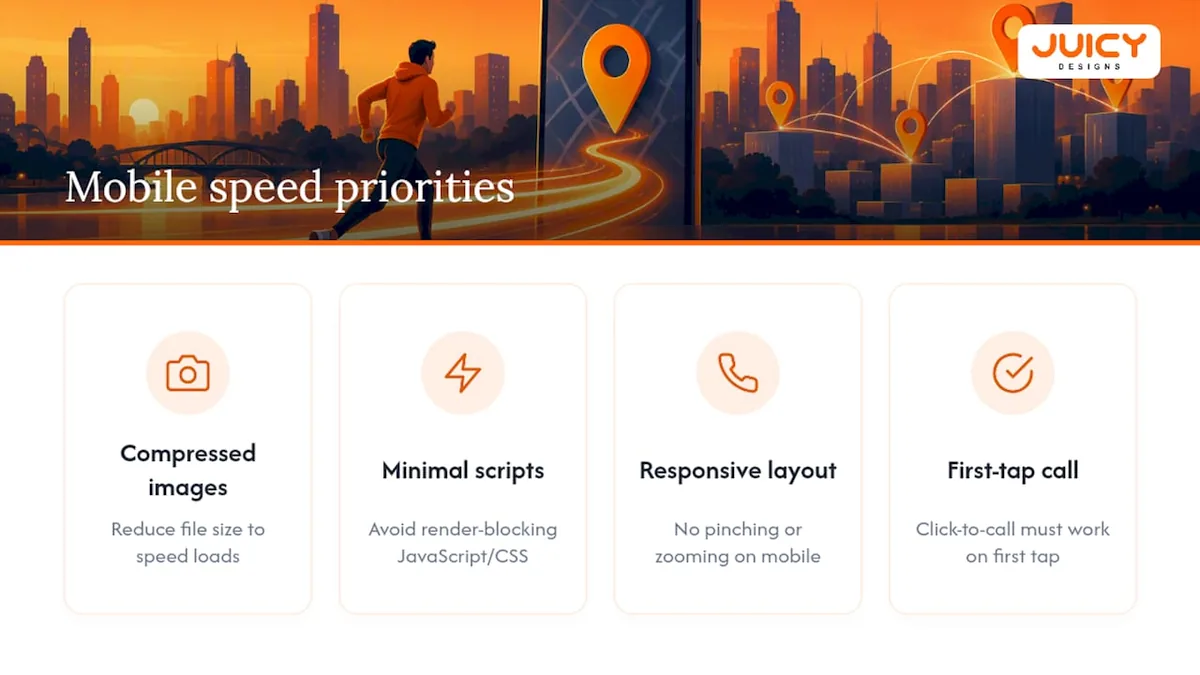
Mobile matters more than desktop here, since most Map Pack searches happen on a phone, often while someone is already out and looking for a business nearby. A slow, unresponsive site turns a strong Google ranking into a wasted click. Core technical priorities include compressed images, minimal render-blocking scripts, a mobile layout that doesn't require pinching or zooming, and click-to-call buttons that work on the first tap.
There's an indirect ranking connection too. Sites that load quickly and keep visitors engaged tend to show better behavioural signals, longer visits, more page views, which feed back into the same prominence and relevance pillars covered earlier. Treat speed as a conversion issue first and a ranking issue second, but don't ignore either.
A note on where businesses waste their effort
The biggest mistake I see is businesses pouring money into citation building and directory submissions while their Google Business Profile category is wrong and their review pipeline is running dry. It feels productive, you get a report showing forty new listings, but it does almost nothing if the foundation underneath is weak. Whitespark's research backs this up directly: category selection outweighs nearly everything else, and no volume of citations fixes a mismatched category.
If you're starting from scratch, or starting over, audit your primary category and your review velocity before you touch anything else. Those two things alone often explain more of the gap between you and the business outranking you than every other factor combined. Once those are solid, scale outward: landing pages, citations, then links. Doing it in reverse order is how businesses spend months and see nothing move.
, Cobus
Get your Google Business Profile audited by Juicydesigns
Some agencies bill you for a rotating account manager who has never spoken to the founders running your strategy. Juicydesigns works differently: you deal directly with the people who built your campaign, with no long-term contract locking you in if priorities change. That matters for local SEO specifically, since a wrong category or a stalled review programme needs a fast fix, not a ticket that sits in a queue for two weeks.
Juicydesigns' SEO services cover Google Business Profile setup, review systems, and location landing pages built around the exact checklist above, with the Foundation plan starting at R5,500 per month and a once-off SEO audit available from R8,000 if you want a full diagnostic before committing to ongoing work. If you're not sure which service fits your situation, get in touch directly and describe what you're working with. That's the fastest way to find out whether a one-off audit or a monthly retainer makes more sense for your business right now.
Sources
- Tips to improve your local ranking on Google, Google Business Profile Help
- Whitespark's Official 2026 Local Search Ranking Factors Report
- The 2026 Local Search & AI Discovery Report | Angarum Media
- Schema
FAQ
What are the top ranking factors in Google Maps?
Relevance, proximity, and prominence are the three factors Google names directly as the basis for local ranking. Within prominence, review signals and Google Business Profile completeness carry the most practical weight, with primary category selection identified as the single most important individual factor.
How can I increase my Google Maps ranking?
Start by verifying your listing and setting the most precise primary category available, since this is the highest-leverage change most businesses can make. Follow with consistent NAP details across your website and directories, a steady flow of recent reviews, and location landing pages that match your GBP services and area.
Is a 4.5 Google rating good?
A positive star rating is generally considered strong and competitive in most industries. What matters increasingly alongside the number is recency, since a 4.5 rating built on reviews from the last two months signals more to both Google and searchers than the same rating built on reviews from three years ago.
What are the top SEO ranking factors for local businesses?
For local search specifically, the top factors are Google Business Profile signals (category, completeness, verification), review count and recency, on-page relevance including NAP-matched landing pages, and prominence signals like local links and citations. General SEO factors like site speed and mobile-friendliness support these but work indirectly, mainly by protecting conversion once a searcher clicks through.
Recommended
- Local SEO South Africa: Rank in the Google Map Pack
- Local SEO: How to Rank in Google Maps in South Africa
- How Do I Do a Basic SEO Audit of My Own Website?
- How to Audit Your Digital Marketing Before Hiring an Agency