
Cut Junk Leads: Improve Lead Quality in Six Weeks with 3 Tests
Cut junk leads by tightening ICP, improving forms, and speeding follow-up. Includes a six week, three test plan.
The fastest way to improve lead quality is to fix three things in order: tighten your ICP and channel targeting so the right prospects even see your ads, rebuild your capture flow to collect real qualification signals, and cut your response time so warm intent doesn't cool off.


TL;DR: Quick Answer
Cut junk leads by tightening ICP, improving forms, and speeding follow-up. Includes a six week, three test plan.
The fastest way to improve lead quality is to fix three things in order: tighten your ICP and channel targeting so the right prospects even see your ads, rebuild your capture flow to collect real qualification signals, and cut your response time so warm intent doesn't cool off. Skip straight to speed-to-lead before fixing targeting, and you'll just contact bad-fit leads faster. Get the sequence right and quality follows.
TL;DR:
- Focusing on improving target audience precision and filtering using ICP and behavioural signals significantly increases lead quality rather than just speeding up follow-up.
- Excluding irrelevant job titles, company sizes, or industries from ad targeting and creating qualifying ad copy filters out low-quality prospects before they even click.
- Implementing short, targeted forms with conditional questions and validation methods helps gather meaningful qualification data without sacrificing too many conversions.
- Aligning landing page messaging with ad promises and streamlining the user experience enhances lead relevance and reduces confusion.
- Responding to leads within an hour with personalised communication dramatically increases the likelihood of qualifying the prospect, emphasising speed as a key factor.
What does improve lead quality actually mean?
Before fixing anything, work out whether you have a fit problem or an intent problem. They look identical on a lead report and need completely different solutions.
Fit describes whether a prospect matches your ideal customer profile (ICP): the right industry, company size, budget, or role. Intent describes how ready that prospect is to buy right now. A well-fitted prospect with low intent is a nurture candidate. A poorly-fitted prospect with high intent is often just noise, someone who will never convert no matter how fast you call them.
Run three quick checks before you touch your ad accounts:
- Sample 20 recent leads and manually tag each as good fit, poor fit, or unclear. If more than a third are poor fit, your problem is targeting, not follow-up.
- Check your sales acceptance rate. If sales rejects most leads as "not a real prospect," that's a qualification failure upstream.
- Break quality down by channel. One channel often carries most of the junk while another quietly delivers your best customers.
Whichever check reveals the biggest gap tells you where to spend the next two weeks.
How do you narrow targeting to attract better-fit leads?
Start with a written ICP, not a vague sense of "our typical customer." Include industry, company size, job title or role, tech stack (if relevant), and revenue band. Vague targeting is the single biggest reason budgets get wasted on clicks that were never going to convert.
Behavioural signals matter as much as firmographic ones. A visitor who checks your pricing page twice or returns for a third session is showing real intent, and platforms let you build audiences around exactly that.
Practical steps to apply this:
- Load your ICP attributes into Google Ads audience exclusions and Meta detailed targeting, not just inclusions.
- Build lookalike or similar audiences from your best-converting customers, not your entire lead list.
- Write SEO content around the specific problems your ICP searches for, not broad industry terms that attract researchers and students.
- Exclude job titles and company sizes you know don't convert, even if it shrinks reach.
Pro Tip: Pull your last 10 closed-won deals and look for the one attribute they all share. That single field, whether it's company size or industry, is usually your highest-leverage targeting filter.
What ad copy and offers pre-qualify leads?
Generic offers attract generic clicks. A "free consultation" invites everyone; a "scoped audit for businesses spending over R20,000/month on Google Ads" invites only the prospects who actually qualify.
Pre-qualifying offers work by doing some of the filtering before the click even happens:
- A priced or scoped service (rather than a vague "get in touch") tells low-budget prospects to self-select out.
- A qualifying checklist ("this is for you if...") in the ad copy itself reduces irrelevant clicks.
- Naming who you don't serve, alongside who you do, is one of the most underused filters in South African ad copy. It feels counterintuitive to write exclusion into an ad, but it works.
Test this with a simple A/B split: run your current generic ad against a version with explicit qualifying language, and compare cost-per-qualified-lead rather than cost-per-click. You'll often find the "worse performing" ad on raw click volume wins decisively once you filter for actual sales-accepted leads.
Which form fields actually improve lead quality?
Every field you add to a form trades some conversion rate for some qualification data. The trick is knowing which trade is worth making.
- Keep role, company size, and a budget bracket. These three fields do more qualifying work than ten generic questions combined.
- Add a timeline field ("when do you need this solved?") to separate active buyers from window shoppers.
- Avoid open-ended text fields for early-stage forms. They kill conversion and rarely get filled in usefully.
- Use conditional logic so most visitors see three or four fields, while prospects who select "enterprise" or a higher budget bracket get one or two extra questions.
Conditional logic is what lets you gather depth from high-fit prospects without punishing everyone else with a long form.
On verification, SMS verification, email validation, and a honeypot field catch most bot and junk submissions without adding friction for real prospects. Because form data usually includes personal information, keep your collection and storage practices aligned with applicable data protection rules for your market.
Pro Tip: If your form conversion rate drops sharply after adding a field, check whether that field appears before or after the visitor has committed mentally. Budget and timeline questions land better near the end of the form, not the start.
Does landing page copy affect lead quality?
Yes, and often more than the ad that drove the click. If your headline promises one thing and your ad promised another, you get confused visitors who convert out of curiosity rather than intent.
- Match your landing page headline to the exact offer in your ad. Congruence between the two keeps out visitors who clicked on a misunderstanding.
- State clearly who the page is for. "Built for South African retailers with 3+ locations" filters harder than any form field ever will.
- Use outcome-focused CTAs ("get your scoped audit") instead of generic ones ("submit"), and back them with proof: case studies, numbers, client logos.
- Use progressive profiling so returning visitors see shorter forms while first-time visitors answer the qualifying questions.
- Keep the page fast and clean on mobile. A slow or cluttered mobile experience will bleed your best-fit prospects before they ever reach the form.
Small, deliberate changes here compound. A landing page rebuilt for congruence and clarity routinely lifts qualified conversion without touching ad spend at all.
Which lead scoring framework should you use?
Framework choice depends on deal size and sales cycle length, not personal preference. BANT (Budget, Authority, Need, Timeline) suits smaller, faster-moving deals typical of SMB sales. MEDDIC fits complex enterprise sales with multiple stakeholders and long cycles, and applying it to a quick SMB deal usually just slows everything down with unnecessary process.
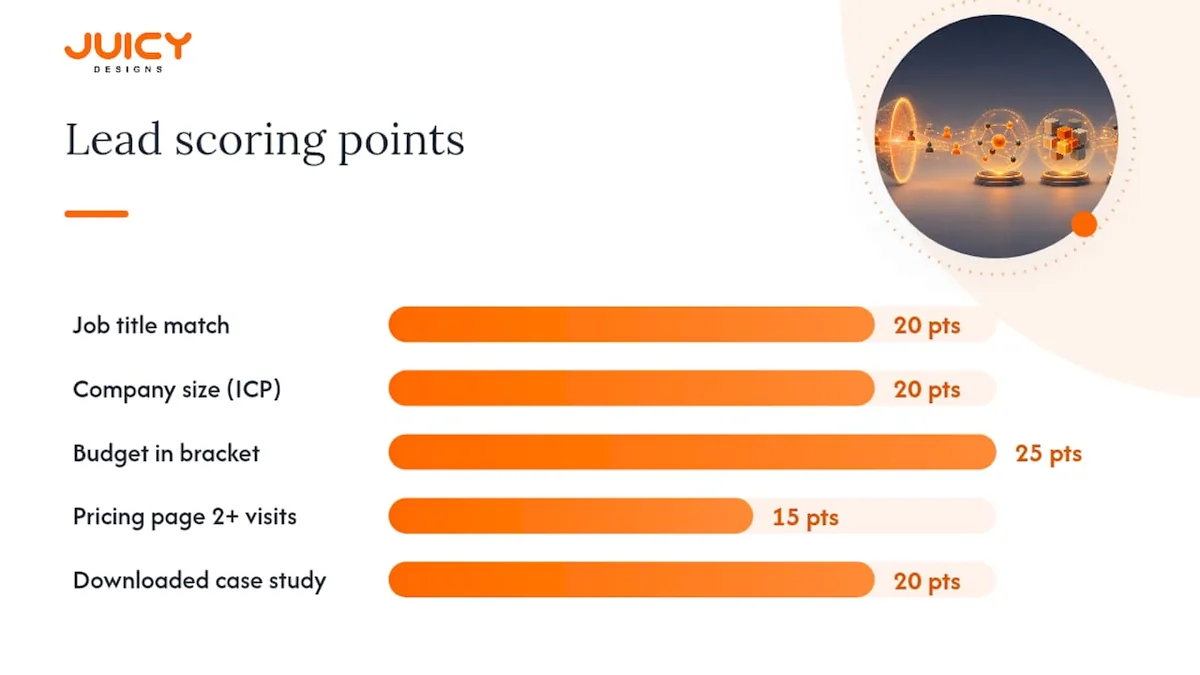
A simple point-based model works for most South African businesses:
- Job title match: +20 points
- Company size in ICP range: +20 points
- Budget stated in target bracket: +25 points
- Pricing page visited twice or more: +15 points
- Downloaded a bottom-funnel asset (case study, pricing guide): +20 points
Set your threshold (commonly 60 to 70 points) as the line where marketing hands the lead to sales.
A one-page SLA should state: marketing agrees to send only leads scoring above the threshold; sales agrees to make first contact within a set window and log disposition within 24 hours. Both sides sign off. Vague verbal agreements about "good leads" fall apart the first time pipeline gets thin, so scoring and qualification questions belong in writing, not in a Slack thread.
How fast should you respond to a new lead?
Faster than you probably do right now. Harvard Business Review's analysis of 1.25 million leads found that contacting a lead within an hour makes it roughly seven times more likely to qualify compared with waiting much longer. That single number should reset every SLA conversation your team has ever had about "getting to it by end of day."
The often-cited "five-minute rule" is best treated as a directional target rather than a strict deadline. What actually works is an instant automated acknowledgement paired with human follow-up inside the hour.
Build this with:
- An immediate, personalised auto-response referencing the specific enquiry, not a generic "thanks for reaching out."
- Parallel notifications to multiple reps so no single missed Slack ping stalls the lead.
- Round-robin or territory-based routing with a backup on-call rep for after-hours submissions.
A speedy generic reply still underperforms a slightly slower, specific one, so don't sacrifice relevance purely for velocity.
Which KPIs actually prove lead quality improved?
Volume tells you nothing on its own. The metrics that matter track what happens to leads after they enter your funnel:
- ICP fit rate: percentage of leads matching your defined ICP attributes.
- Sales acceptance rate: percentage sales agrees are worth working, a direct signal marketing and sales are aligned.
- Lead-to-SQL rate: how many raw leads become sales-qualified.
- Opportunity win rate: what percentage of qualified opportunities close.
- Revenue per lead: the number that ties this whole exercise to the budget conversation.
Report fit rate and sales acceptance weekly since they move fast and reveal problems early. Report lead-to-SQL, win rate, and revenue per lead monthly, since they need more data to be meaningful. If you see high volume with low fit, the problem sits in targeting. If MQL rejection is high but fit looks fine, the problem is usually scoring thresholds or a broken handoff, a pattern well documented in practical B2B measurement frameworks.
How do you nurture good-fit leads who aren't ready yet?
Not every well-fitted lead is ready to buy today, and chasing them with a sales call too early just burns the relationship. An eight-touch nurture sequence across six to eight weeks works well for most B2B cycles:
- Welcome email confirming their enquiry and setting expectations.
- Insight-driven content addressing their stated problem.
- Short SMS or email check-in with a low-friction question.
- Case study or proof point relevant to their industry.
- Retargeting ad reinforcing the same message.
- ROI-focused content (calculator, comparison, or cost breakdown).
- Direct ask: book a call or request a quote.
- Final value-add touch, even if they don't respond, to keep the relationship warm.
Watch for re-engagement signals: a pricing page revisit, an email open after weeks of silence, or a reply to any touch. Those moments should trigger immediate sales outreach rather than waiting for the sequence to finish. Structured lead nurturing built around clear cadence and content stages consistently converts more of this segment than sporadic manual follow-up.
What a real campaign taught us about lead quality
A local dealership client came to Juicydesigns with a familiar complaint: plenty of leads, few sales. Juicy Designs clients average a 4.8x return on ad spend, nearly double the industry standard.
If you want to test this yourself over six weeks:
- Write your ICP down and load it into your ad platforms.
- Audit your landing page for headline-offer congruence.
- Add one qualifying field and one conditional field to your main form.
- Set and enforce a same-hour human follow-up SLA.
- Build a simple point-based scoring model with a clear threshold.
- Track sales acceptance rate weekly, not just lead volume.
What I'd test first if I only had six weeks
If your team is stretched, don't try to fix everything at once. Run three experiments in parallel: fix your worst-performing form field, cut your response time to under an hour, and A/B test one qualifying line in your top ad. Give each experiment two to three weeks and judge it on sales acceptance rate, not click volume.
The mistake I see most often is teams declaring victory the moment lead volume climbs, then wondering months later why the pipeline is full of unqualified names. Volume is the easiest metric to move and the least useful one to chase. Scale whatever moves sales acceptance rate, and be willing to kill a "successful" campaign that only moved volume.
, Cobus
Get expert help improving lead quality
Reading about ICP targeting and speed-to-lead SLAs is one thing; rebuilding your funnel while running a business is another. Juicydesigns is the founder-led alternative to a traditional agency: no account managers relaying messages, no long-term contracts locking you in, just direct access to the people doing the work.
A typical starter engagement includes a full audit of your current Google Ads setup, landing page review, and lead flow diagnosis, priced as a flexible monthly retainer rather than a rigid annual contract. If you're ready to see where your own funnel is leaking quality, claim your free Google Ads audit and we'll show you exactly what to fix first.
Sources
Key sources behind this article: Harvard Business Review on response-time impact, Sendspark's B2B qualification guide on scoring frameworks, and GrowLeads' measurement framework on downstream KPIs.
- The short life of online sales leads | Harvard Business Review
- The 5-minute lead rule and why most fail it | LeadSource
- How to measure lead quality: a practical B2B framework | GrowLeads
- Data protection: rules for business and organisations | European Commission
FAQ
What makes a good quality lead?
A good quality lead matches your ICP (right industry, size, role, and budget) and shows genuine intent, such as visiting your pricing page or requesting a quote rather than just downloading a free guide.
What does lead quality mean?
Lead quality measures how likely a lead is to become a paying customer, based on fit with your ideal customer profile and readiness to buy, rather than the raw number of leads generated.
What is the 5-minute rule for leads?
The five-minute rule suggests contacting new leads almost immediately, and while it's a useful directional target, the researched threshold that reliably improves qualification is contact within one hour, paired with an instant automated acknowledgement.
How do you measure lead quality?
Track downstream metrics rather than lead volume: ICP fit rate, sales acceptance rate, lead-to-SQL conversion, opportunity win rate, and revenue per lead, reviewed weekly and monthly.
Recommended
- How to Qualify Leads: Questions That Work
- Lead Follow-Up: Timing and Cadence That Converts
- Get More Qualified Dealership Leads
- How to Convert Online Car Leads Into Buyers