
Law firm lead generation for small and mid-size practices
Discover effective strategies for law firm lead generation. Learn to optimise your website and launch targeted ads to attract quality clients.
The fastest way to generate quality legal leads is a conversion-focused website paired with targeted search ads and niche educational content.


TL;DR: Quick Answer
Discover effective strategies for law firm lead generation. Learn to optimise your website and launch targeted ads to attract quality clients.
The fastest way to generate quality legal leads is a conversion-focused website paired with targeted search ads and niche educational content. That combination captures people who are already searching for help, then proves your expertise before they even call.
Start with two moves this week:
- Fix your intake page so it asks for the case details you actually need, with one clear call to action above the fold.
- Launch a small, tightly targeted Google Ads campaign around two or three practice areas, not your whole service list.
Firms that follow this order see faster returns because they fix the leaky bucket (the website) before pouring in paid traffic. Law firm lead generation done this way converts existing demand instead of chasing attention nobody asked for, and it costs less than most firms assume, provided the budget is matched to the practice areas that actually pay.
Key Takeaways
Consistent lead flow for a law firm comes from fixing the website's conversion path first, then layering targeted search ads and educational content on top of it.
| Point | Details |
|---|---|
| Fix intake before ads | Simplify your contact form and CTA before spending on paid traffic, since a weak site wastes ad budget. |
| Sequence your channels | Run search ads for fast wins while SEO and content build over three to six months. |
| Measure weekly, not quarterly | Track CPL and qualified lead rate weekly so underperforming campaigns get cut within two to three weeks. |
| Systematise referrals | Build a tracked referral network with reciprocal, non-monetary thank-yous instead of relying on chance. |
| Consider expert support | Juicydesigns applies a founder-led approach and reports a 4.8x average ROAS across client campaigns. |
How should law firms structure their lead generation strategy?
Every channel serves a different stage of the funnel, and treating them as interchangeable is where most firms waste budget. Search engine optimisation and referrals work at the top, catching people who don't yet know your firm exists. Paid search catches urgent intent, someone searching "eviction lawyer near me" tonight. Content and email nurture the middle, and your intake process closes the bottom.
A workable starting budget for a small firm looks like this:
- 40% to search ads and Google Business Profile management, because this converts fastest.
- 30% to website and SEO improvements, since this compounds over 6 to 12 months.
- 20% to content production (guides, video, webinars).
- 10% held back for testing paid social or partnerships.
Expect the first qualified leads from paid search within two to four weeks. SEO and content typically take three to six months to show meaningful movement, which is why running both tracks together matters.
On guardrails: South African legal marketing rules require you to avoid touting, guarantee-style claims, and pressure tactics. Rather than promising outcomes, lead with education and process transparency. Analysis of the South African legal profession points to client-centred, ethical marketing and digital competence as the traits separating growing firms from stagnant ones in 2026.
What makes a law firm website convert visitors into leads?
Most law firm websites lose leads before a single ad is clicked. The homepage tries to be everything to everyone, the contact form asks for a life story, and the phone number is buried three scrolls down.
Fix these in order:
- Build one landing page per practice area. A page about "family law" converts worse than a page about "urgent contested divorce consultations in Pretoria," because specificity signals relevance.
- Put trust signals near the fold. Years practising, professional body membership, and case outcomes (where ethically disclosable) all reduce hesitation.
- Simplify the call-to-action. One phone number, one form, one clear next step. Multiple competing buttons split attention and lower conversion.
- Claim and optimise your Google Business Profile. Complete categories, respond to every review, and add photos of your office and team.
- Map keywords to service pages, not to blog posts alone, so someone searching "conveyancing attorney" lands on a page built to convert that exact intent.
Technical basics still decide whether any of this gets seen: page speed, mobile responsiveness, and clean site structure. A dedicated SEO guide for law firms covers the technical checklist in more depth if your site hasn't been audited in the past year.
Pro Tip: Test your own contact form on a phone before you spend a single rand on ads. If it takes more than four fields or 90 seconds to complete, you're losing leads at the finish line.
Which content formats actually generate legal leads?
Plain-language explainers outperform legal jargon every time, because the person reading them is stressed, unfamiliar with the process, and looking for someone who can translate it. Guides like "What happens during a divorce mediation" or "Your rights after a workplace dismissal" build trust before a prospect ever picks up the phone.
- Short-form blogs answering one specific question, written the way you'd explain it to a worried friend.
- Downloadable checklists (e.g., "Documents to bring to your first consultation") gated behind a simple email form, useful for building a nurture list without overreaching.
- Webinars on timely topics, such as changes to labour law or estate planning, which double as lead-qualification events since attendees have already shown intent.
- Short video explainers repurposed from blog content, posted to social and embedded on service pages.
Gate only mid-funnel content, not your core educational material. Forcing an email address for basic information frustrates prospects and hurts SEO. Reserve gating for higher-value assets like templates or detailed guides. This approach mirrors the ethical marketing principle documented by the Colandi Group: education, not touting, builds the strongest inbound pipeline.
How much should a law firm spend on paid ads?
Search ads capture the highest-intent traffic on the internet: someone typing "personal injury lawyer" into Google has usually already decided to hire someone. Paid social works differently, building awareness and retargeting people who visited your site but didn't convert.
- Structure search campaigns around case type, not generic terms. A campaign for "commercial litigation attorney" should never share a budget with "uncontested divorce," because the cost and intent differ sharply.
- Use paid social for retargeting, not cold acquisition. Show a testimonial-style ad (using only real, permission-cleared content) to people who read a blog post but left.
- Keep ad copy factual and outcome-neutral. Avoid "guaranteed win" language; lead with process and credentials instead.
South African firms typically allocate a monthly budget for search ads per practice area that varies with competitiveness, with some areas like family law and personal injury tending to cost more than niche commercial work. Cost per lead varies widely by specialty, but a well-targeted campaign with a tight landing page tends to outperform a broad one on the same spend. A firm managing Google Ads campaigns with clear practice-area segmentation avoids the most common mistake: one big campaign trying to catch every case type at once.
How should law firms use social media and reviews?
Different networks suit different practices. LinkedIn works well for commercial and corporate law, where referral partners and business clients spend their time. Instagram and TikTok, used carefully, suit family law, personal injury, and consumer-facing practices where short explainer videos build relatability.
- Ask satisfied clients for reviews immediately after a matter closes, when gratitude is highest, using a simple link rather than a demand.
- Display reviews on service pages, not just your homepage, so they sit next to the decision a prospect is actually making.
- Post short Q&A videos answering common client questions. These build authority faster than polished corporate content, because they show a real person explaining something clearly.
Review volume and response rate both matter for local search visibility, and a thin review profile quietly undercuts even the best website.
How do you turn website visitors into paying clients?
A lead that fills out a form and hears nothing for three days is a lead you paid for and lost. Fast follow-up matters more in legal services than almost any other industry, because prospects are often comparing two or three firms simultaneously.
- Keep intake forms short but targeted. Ask for case type, urgency, and preferred contact method. Skip anything that feels like a legal consultation before you've even spoken.
- Add live chat or a chatbot for after-hours enquiries, routed to a human within one business day at most.
- Build a four-email nurture sequence for leads who aren't ready to book: an introduction, a relevant guide, a client outcome (ethically framed), and a direct booking prompt, spaced roughly three to four days apart.
- Connect your intake form directly to your CRM or practice management software so no lead sits in an inbox unseen.
Pro Tip: Set an internal SLA of under two hours for responding to a new lead during business hours. Response speed alone can be the deciding factor when a prospect has already contacted two other firms.
How can law firms build a referral programme that works?
Referrals still outperform most paid channels on cost per client, but only when they're systematic rather than accidental. Waiting for referrals to happen organically leaves growth to chance.
- Identify five to ten complementary professionals (accountants, financial advisors, real estate agents) whose clients regularly need legal help.
- Set up a simple referral tracking sheet or CRM field so you know exactly which partnerships generate business.
- Keep reciprocity non-monetary and compliant: a thank-you note, a reciprocal referral, or a joint webinar, never a cash incentive, which risks running afoul of professional conduct rules.
- Attend niche industry events (not general networking mixers) where your ideal referral partners already gather.
Smaller firms without decades of legacy referral relationships can still build this network deliberately, using focused digital visibility to earn the credibility that older firms built through decades of courtroom reputation.
What metrics actually show whether lead generation is working?
Cost per lead (CPL), qualified lead rate, and return on ad spend (ROAS) are the three numbers that matter most in the first 90 days. CPL tells you what you're paying per enquiry; qualified lead rate tells you how many of those enquiries are real prospects; ROAS tells you whether the revenue justifies the spend.
- Track CPL and lead volume weekly, since paid campaigns shift fast and a stalling ad group needs quick attention.
- Review qualified lead rate and cost of client acquisition (CAC) monthly, comparing practice areas against each other.
- Pause any campaign with a qualified lead rate under 10% after two weeks of data, rather than waiting a full quarter to react.
- Scale spend on whichever practice area shows the lowest CAC relative to average case value.
Demand for legal services has been climbing, with Thomson Reuters reporting that firms are seeing rising rates alongside rising demand, which makes disciplined measurement more valuable than ever: growing demand rewards the firms that can convert it efficiently, not just the ones spending the most.
What should you do in your first 30, 60, and 90 days?
Break the work into three sprints so you're never trying to fix everything at once.
- Days 1 to 30: Audit and fix your website's intake form and calls-to-action. Claim or clean up your Google Business Profile. Launch one small search campaign around your highest-value practice area. Install analytics and conversion tracking properly before spending another rand on ads.
- Days 31 to 60: Build a simple content calendar (two posts a month minimum). Set up a systematic review request process after every closed matter. Launch a retargeting campaign on paid social aimed at website visitors who didn't convert.
- Days 61 to 90: Review campaign data and cut or scale based on CPL and qualified lead rate. Reach out to three to five potential referral partners. Calculate ROAS across channels and reallocate budget towards whatever is actually working.
By day 90, you should have enough data to know which practice area, channel, and message combination deserves more budget next quarter, and which ones to quietly retire.
What real results look like for law firm marketing
Juicy Designs clients average a 4.8x return on ad spend, nearly double the industry standard.
That case wasn't a law firm, but the underlying mechanics translate directly: fix the conversion path first, then layer targeted spend on top of it. Juicydesigns operates as a founder-led agency, meaning the person managing your campaign strategy is the same person accountable for its results, not a rotating account manager three layers removed from the work.
The overrated advice, and what actually moves the needle
Most law firm marketing content pushes "be everywhere" as the strategy: post daily, run ads on five platforms, publish weekly. That advice ignores capacity. A two-partner firm cannot sustain five channels well, and a half-maintained channel does more reputational damage than no channel at all.
What the evidence in this piece actually supports is sequencing, not breadth. Fix the website and intake process first, since a poorly converting site makes every rand spent on ads worth less. Run one disciplined search campaign before diversifying into paid social. Publish content consistently in one format rather than sporadically across four.
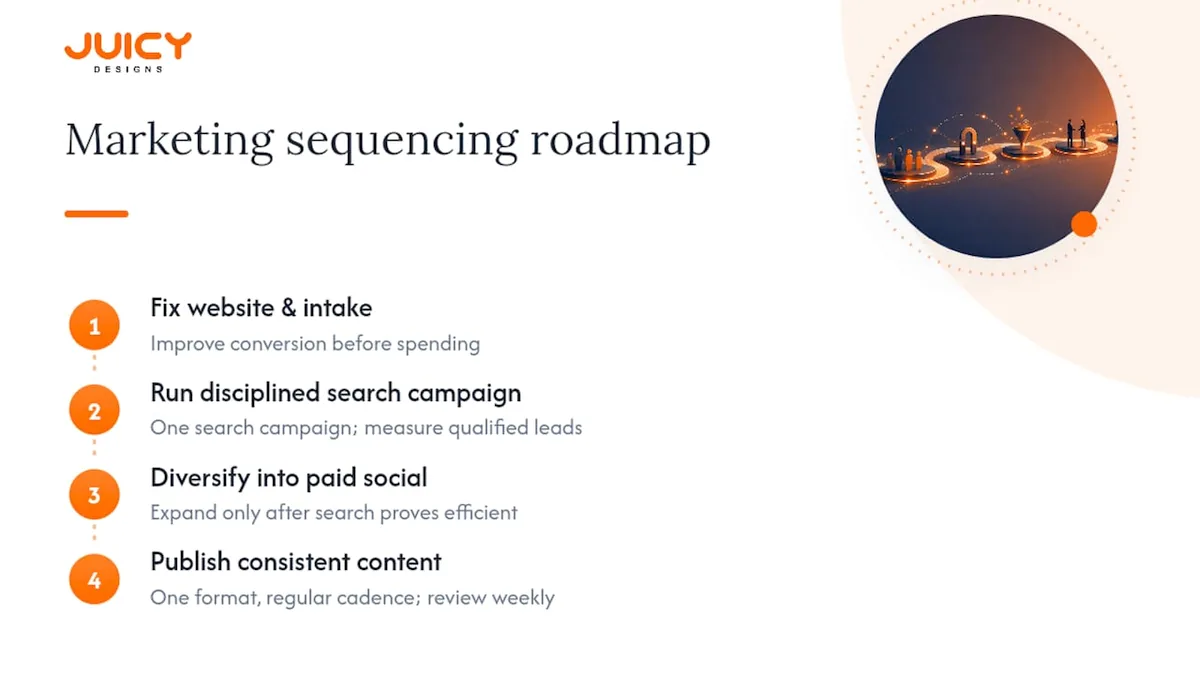
The conventional wisdom also undersells measurement discipline. Firms will happily track CPL but ignore qualified lead rate, which means they scale campaigns that generate volume without generating clients. Rising demand across the legal services sector means the market rewards firms that convert efficiently, not the ones simply spending the most.
If there's one habit worth building over any tactic in this article, it's reviewing your numbers weekly and being willing to cut what isn't working after two or three weeks, not two or three quarters.
, Cobus
Get expert help generating leads for your law firm
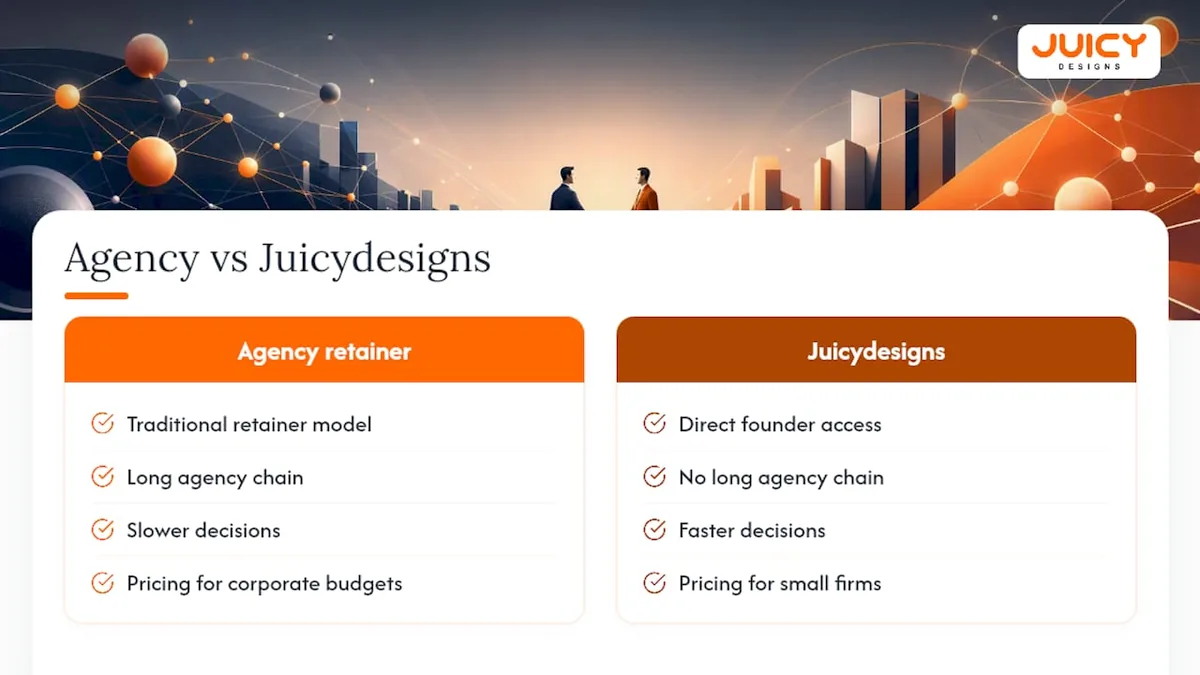
Juicydesigns gives small and mid-size law firms an alternative to the traditional agency retainer model: direct access to the founders managing your campaigns, no long agency chain slowing down decisions, and pricing structured for firms that don't have a corporate marketing budget. Our legal marketing services cover website conversion audits, Google Ads management, local SEO, and content production tailored to specific practice areas.
A strategy call typically covers a review of your current site and intake process, a proposed channel mix based on your practice areas, and a realistic budget range built around South African market pricing rather than borrowed international benchmarks. If you're ready to see where your leads are leaking and what a focused campaign could return, visit Juicydesigns to book a consultation.
Sources
- Marketing for South African Law firms: The essential guide to growth without touting - Colandi Group
- The South African legal profession in 2026 - De Rebus
- Thomson Reuters press release (2025)
FAQ
How much should a law firm pay for lead generation?
Costs vary by practice area, but South African firms typically allocate a monthly budget for search ads per practice area that varies with competitiveness, with some areas like family law and personal injury tending to cost more than niche commercial work, and content and SEO work priced separately depending on scope.
What is a lead generation firm?
A lead generation firm or agency manages the channels (search ads, SEO, content, paid social) that bring prospective clients to a business, then structures the intake process to convert enquiries into paying customers.
Can ChatGPT generate leads for a law firm?
AI tools can help draft blog outlines, ad copy variations, and email sequences faster, but every output needs human review for accuracy and compliance before it reaches a prospective client, as outlined in guidance on AI content optimisation for legal marketers.
What is the fastest way to start generating law firm leads?
Fix your website's intake form and calls-to-action first, then launch one focused search campaign around your highest-value practice area rather than spreading a small budget across everything at once.
Recommended
- Law Firm Lead Generation South Africa | Juicy Designs
- Legal Marketing Agency South Africa | Law Firms | Juicy Designs
- What Is Lead Generation? | Juicy Designs
- SEO for Law Firms in South Africa: Win More Clients