
SA Marketers: Match Lead Attribution Models to Decisions in 90 Days
Pick the lead attribution model that answers your budget or pipeline decision. Includes a 90 day plan, tracking checklist, and an SA example.
Lead attribution assigns credit for a generated lead to the marketing touchpoints that influenced it.


TL;DR: Quick Answer
Pick the lead attribution model that answers your budget or pipeline decision. Includes a 90 day plan, tracking checklist, and an SA example.
Lead attribution assigns credit for a generated lead to the marketing touchpoints that influenced it. There are three model families: single-touch, multi-touch, and data-driven. The right one depends on a single question: which decision are you trying to make? Pick the model that answers that decision, then add complexity only when your data can support it.
TL;DR:
- Data quality issues such as incomplete tracking and inconsistent CRM stages often undermine the accuracy of attribution models more than the choice of the model itself.
- For short sales cycles under two weeks, last-touch or time-decay models generally provide reliable insights, but longer cycles in B2B require position-based or multi-touch models to capture full contribution.
- Relying solely on last-touch attribution inflates bottom-of-funnel channels like branded search and neglects top-of-funnel efforts that build the pipeline initially.
- Start with simple models like time-decay or last-touch if your team has limited channels or data volume, and graduate to data-driven models only after hitting thousands of conversions.
- Fixing tracking gaps and aligning CRM definitions should precede model complexity, as these foundational issues greatly influence the reliability of attribution reports.
What are lead attribution models and how do they assign credit?
Lead attribution is the practice of connecting a lead back to the marketing touchpoints that helped create it. That's different from broader marketing attribution, which extends the same logic across the entire customer lifecycle, including post-sale revenue and retention. For most marketing teams, lead attribution answers a narrower, more urgent question: which channels are actually filling the pipeline?
Every attribution model applies a different rule for splitting credit across touchpoints. There's no universally "best" one. HubSpot's own attribution guide lists eight common models, and each one exists because it answers a different business question well. Here's how the main types actually work.
First-touch attribution gives 100% of the credit to the very first interaction a lead had with your brand, whether that's a Google search, a Facebook ad click, or a referral. It's useful when you want to know what's driving awareness and top-of-funnel discovery. Its weakness is obvious: it tells you nothing about what closed the deal.
Last-touch attribution does the opposite, crediting the final interaction before conversion. It's the easiest model to set up, and it's the default in most analytics platforms, which is exactly why so many teams still use it. The problem is what practitioners call "conversion harvesting": last-touch consistently overvalues bottom-of-funnel channels like branded search or retargeting, while starving the awareness channels that generated the lead in the first place.
Linear attribution spreads credit evenly across every touchpoint in the journey. It's fair in a mathematical sense, but it treats a passive blog visit the same as a demo request, which rarely reflects reality.
Time-decay attribution weights touchpoints by recency, giving more credit to interactions closer to conversion. It works well for shorter sales cycles where the "last few nudges" genuinely matter more, but it can still undervalue the channel that first created awareness months earlier.
U-shaped (position-based) attribution splits credit between the first touch and the lead-conversion touch, usually 40% each, with the remaining 20% spread across everything in between. This is popular in B2B because it directly rewards both demand generation and the moment someone became a marketing-qualified lead.
W-shaped attribution extends that logic further, adding a third major credit point at the opportunity stage. This tends to be the most practical multi-touch model for B2B pipelines, because it maps cleanly onto CRM milestones most sales teams already track: first touch, lead creation, and opportunity creation.
Custom or data-driven attribution uses algorithms to weight touchpoints based on actual conversion patterns in your own data, rather than a fixed rule. It can be the most accurate model available, but it needs real conversion volume, HubSpot notes that it typically requires thousands of conversions before the weighting becomes statistically dependable. Below that threshold, a well-configured W-shaped or position-based model will usually outperform a data-driven model trained on thin data.
A few practical notes worth keeping in mind as you compare these:
- First-touch and last-touch are single-source models: fast to set up, but structurally biased towards one end of the funnel.
- Linear and time-decay sit in the middle, useful for shorter or simpler funnels.
- U-shaped and W-shaped are the standard choice for B2B teams managing multi-stage CRM pipelines.
- Data-driven attribution is powerful but data-hungry, and premature adoption often produces misleading weightings rather than better ones.
How do attribution models change your budget and reporting?
Run the same funnel through five different models and you'll get five different stories about which channel deserves more budget. That's not a data problem. It's the entire point of the exercise: each model answers a different question, and the "right" answer depends on what decision sits behind it.
Last-touch models systematically overvalue close-touch channels like branded search and email retargeting, because the conversion harvesting effect rewards whatever happens right before someone converts. Adobe's research on this is blunt: single-source models bias credit towards the bottom of the funnel and actively recommend multi-touch models once a B2B programme matures past a certain scale.
Marketers who rely on last-click reporting by default, largely because it's what platforms display out of the box, tend to systematically underinvest in the awareness and nurture channels that created the lead in the first place.
Here's how the trade-offs typically break down against real business questions:
- Best for quick top-of-funnel signal: first-touch, but expect it to say nothing about what closes deals.
- Best for simple, short sales cycles: last-touch or time-decay, where the final nudge genuinely predicts conversion.
- Best for balanced multi-channel B2B reporting: U-shaped or W-shaped, since they reward both discovery and pipeline progression.
- Best for mature, high-volume programmes: data-driven, once conversion counts are high enough to trust the weighting.
Sales cycle length and funnel complexity should drive most of this decision. A retailer with a same-day purchase cycle can lean on last-touch or time-decay without much risk. A B2B software company with a four-month sales cycle and six touchpoints across paid, organic, email, and sales calls will misallocate budget badly if it relies on last-touch alone, because it will keep starving the top-of-funnel channels that actually build the pipeline.
Where governance requires visibility into both ends of the funnel, run two views in parallel rather than forcing one model to do both jobs: a simple single-touch view for quick directional reads, alongside a multi-touch or data-driven view for the budget conversations that actually move spend. That parallel structure resolves most internal disagreements about "which number is right", because both numbers are right, they're just answering different questions.
How do you choose the right attribution model for your team?
Run your situation through four filters before you touch a dashboard setting: the decision the model needs to answer, your sales cycle length, your channel mix, and your data maturity. Get these four right and the model choice becomes obvious rather than debatable.
- Name the decision first. Are you allocating next quarter's budget, deciding whether to cut a channel, or reporting pipeline health to leadership? A budget-allocation decision needs multi-touch visibility. A quick "is this campaign working" check can lean on last-touch or time-decay.
- Map your sales cycle. Cycles under two weeks tolerate last-touch or time-decay reasonably well. Cycles running months, common in B2B services, insurance, and higher-ticket retail, need U-shaped or W-shaped models to capture the full contribution of early-stage channels.
- Audit your channel mix. A business running two or three channels can manage with simpler models. Once you're juggling paid search, social, organic, email, referral, and offline calls, a multi-touch approach becomes necessary just to keep the picture coherent.
- Assess data maturity and volume. Data-driven attribution is only worth the investment once your CRM and analytics stack can reliably feed it enough conversions. Below that volume, choose a rules-based multi-touch model instead.
A 60-day sales cycle typically justifies a 70 to 90-day attribution window; go shorter and you'll clip legitimate early touches out of the report.
On governance, pick one canonical model for official reporting, keep a documented naming convention for campaigns and channels, and review the model choice roughly every six to twelve months as your data volume grows. Running a second, parallel view for the budget conversation is good practice, not indecision.
Pro Tip: Start every governance conversation by writing the decision the report needs to support on a whiteboard before you pick a model. Teams that pick the model first almost always end up defending the model instead of the decision.
As a starting point by maturity tier: small teams with limited channels should start with last-touch or time-decay; scaling teams running multi-channel B2B campaigns should move to U-shaped or W-shaped; and mature teams with high conversion volume can graduate to data-driven attribution.
What data and tools does reliable attribution actually require?
Attribution outputs are only as trustworthy as the data feeding them, and most attribution failures trace back to gaps in tracking rather than flaws in the model itself. Before you touch the reporting layer, get the plumbing right.
At minimum, you need to capture:
- UTM parameters on every campaign link, applied consistently across channels.
- Click IDs from paid platforms (Google Ads, Meta, TikTok) so paid clicks map cleanly to conversions.
- CRM timestamps for every stage a lead passes through, not just the final "closed" status.
- Call-tracking identifiers wherever phone leads represent a material share of conversions.
Identity resolution, the process of recognising that the same person filled out a form, clicked an ad last week, and called your office yesterday, is where most attribution programmes quietly fall apart. If your CRM stages aren't consistently defined (what actually qualifies someone as an MQL versus an SQL?), your attribution model will confidently report numbers built on inconsistent inputs. Fixing that hygiene matters more than choosing a fancier model, and doing it in the wrong order entrenches reporting bias rather than removing it.
Call tracking deserves particular attention. Businesses where phone enquiries drive a meaningful share of leads, dealerships, insurance brokers, and professional services among them, need unique tracking numbers tied back to campaign IDs, or the offline half of their funnel simply vanishes from the report.
On tooling, you're generally choosing across four categories: web analytics (for session and click data), your CRM (for stage and revenue mapping), call-tracking platforms (for offline touch capture), and dedicated attribution software (for stitching it all together). Selection should be driven by your channel mix and CRM setup, not by whichever tool has the most features. Common pitfalls, duplicate contact records, inconsistent stage naming, and unmapped offline touches, are best solved with strict naming standards, deduplication rules run monthly, and a documented process for mapping phone and in-person touches back into the CRM. Marketing teams that invest in this measurement layer see materially better return on their analytics spend than those that skip straight to dashboards.
What does lead attribution look like in a real South African campaign?
Juicy Designs is a founder-led digital marketing agency based in Pretoria, offering full-funnel services across SEO, Google Ads, and social media management. Attribution isn't a theoretical exercise for us. It's the mechanism that determines where a client's next rand of budget goes.
Clients working with such agencies can see an above-average return on ad spend, driven largely by getting attribution right before scaling spend rather than after.
One local dealership client saw a substantial increase in qualified leads once campaign tracking was rebuilt around a model that actually reflected their sales cycle, rather than defaulting to whatever the ad platform reported.
That result didn't come from a smarter algorithm. It came from fixing CRM stage definitions, mapping phone leads back to campaigns, and choosing a model that matched a multi-week car-buying decision instead of the last-touch default most dealership tracking ships with. If you want the fuller breakdown of how multi-touch attribution applies to a real sales funnel, Cobus has covered the mechanics in more depth elsewhere on the blog.
What's the recommended starting model and 90-day plan?
Small teams: start with time-decay or last-touch, they're fast to implement and good enough for early decisions. Scaling teams: move to U-shaped or W-shaped once you're juggling more than three channels. Mature teams: graduate to data-driven attribution once conversion volume supports it.
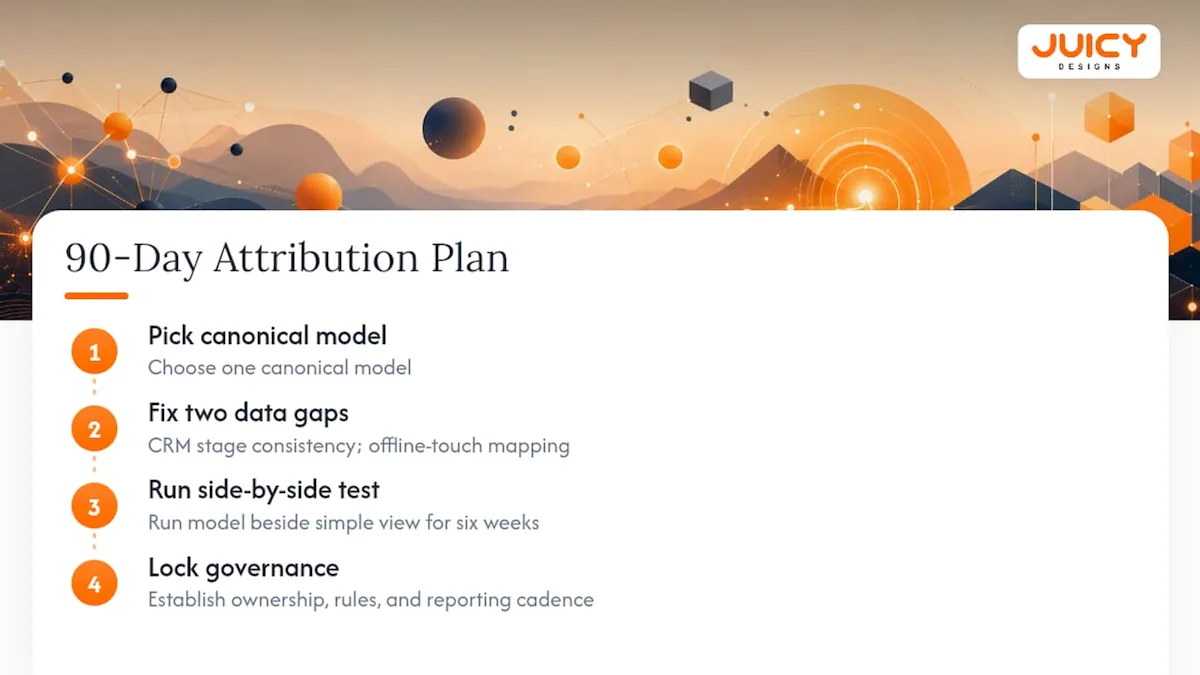
For the next 90 days: pick one canonical model, fix your two worst data gaps (usually CRM stage consistency and offline touch mapping), run your chosen model alongside a simple view for six weeks, then lock in governance. If you'd rather have that audit done for you, Juicy Designs' contact page is the place to start.
Why most attribution advice gets the order of operations wrong
The conventional advice on attribution obsesses over which model is "most accurate," as if accuracy were a property of the algorithm rather than the data feeding it. That's backwards. A W-shaped model running on messy CRM stages will mislead you with more confidence than a simple last-touch report running on clean data.
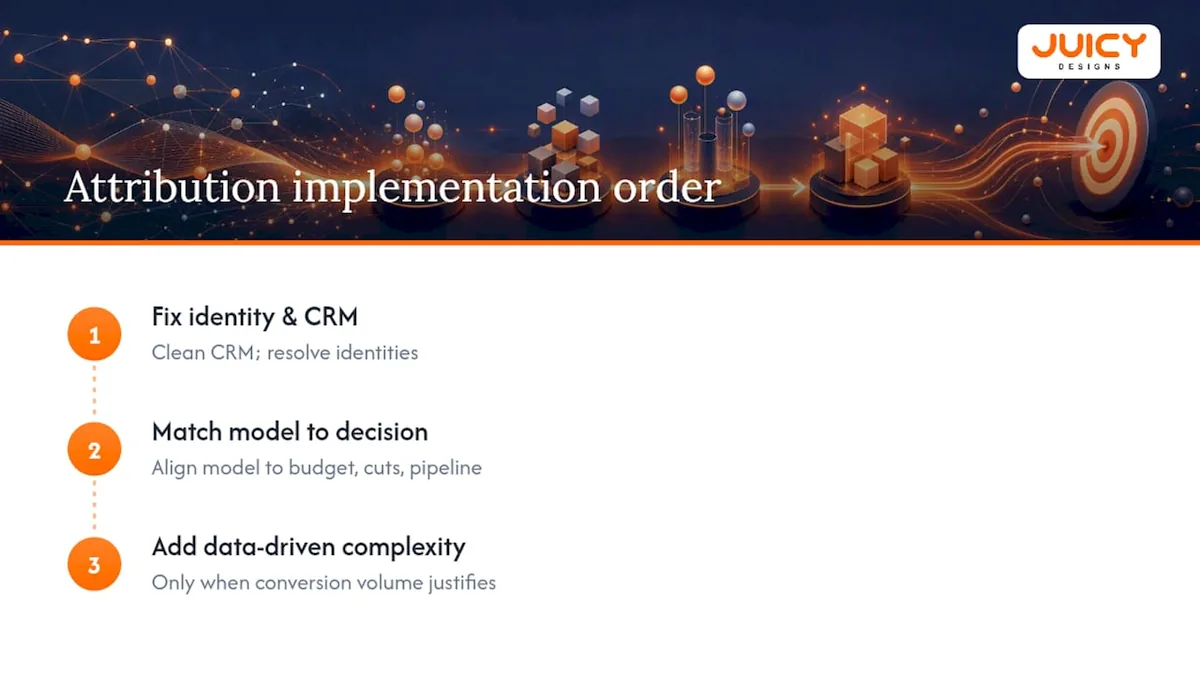
What the research actually supports is sequencing: fix identity resolution and CRM hygiene first, match the model to the decision second, and only reach for data-driven complexity once conversion volume justifies it. Teams that skip straight to sophisticated modelling usually end up automating their existing bias rather than removing it.
If there's one thing worth prioritising above model selection itself, it's asking what decision the report needs to support before building it. Budget allocation, channel cuts, and pipeline health checks each demand different views of the same funnel. Juicy Designs' own client work bears this out: the dealership case wasn't won with a cleverer model, it was won by matching the model to a multi-week buying decision the previous tracking setup had never accounted for.
, Cobus
Get your attribution fixed before you scale spend
A founder-led South African agency may build attribution into every campaign from day one, instead of bolting it on after spend has already gone out the door. Some agencies offer direct work with the people setting up tracking, not a junior account manager relaying platform defaults back to you.
If you're running Google Ads and suspect your current reporting is quietly misleading your budget decisions, start with a free Google Ads audit. It's a practical first step for South African businesses that want to see exactly where their tracking gaps are before committing to a monthly retainer, and pricing for ongoing Google Ads management is quoted in rand with no long-term lock-in.
Sources
These sources back the model definitions, bias warnings, and implementation guidance covered above:
FAQ
What is lead attribution?
Lead attribution is the process of connecting a generated lead back to the marketing touchpoints, ads, content, calls, or referrals, that influenced it, so marketers know which channels deserve credit.
What are the main types of attribution models?
The main model families are single-touch (first-touch, last-touch), rules-based multi-touch (linear, time-decay, U-shaped, W-shaped), and custom or data-driven models built from your own conversion data.
What are the four types of attribution most marketers start with?
Most teams begin with first-touch, last-touch, linear, and time-decay before moving to position-based (U-shaped or W-shaped) and data-driven models as their reporting needs grow.
How do lead attribution and lead generation models differ?
Lead generation models describe how leads are captured (forms, calls, referrals), while attribution models describe how credit for that lead gets split across the touchpoints that led to it.
How do I know if my business is ready for data-driven attribution?
You need enough conversion volume for the algorithm to train reliably, HubSpot's guidance points to thousands of conversions, plus clean CRM stage data; without both, a W-shaped or position-based model will serve you better.
Recommended
- Multi-touch attribution explained
- What Is Attribution in Marketing? Models Explained
- Lead Scoring: How to Prioritise Your Best Prospects
- Marketing Attribution Models Explained