
Facebook lead generation ads: a practical SA playbook
Unlock the power of Facebook lead generation ads in South Africa. Discover strategies to attract quality leads and boost your business success.
Facebook Lead Ads can generate high-quality leads for South African businesses when campaigns prioritise value-led offers, CRM lookalikes, and server-side attribution via the Conversions API (CAPI).


TL;DR: Quick Answer
Unlock the power of Facebook lead generation ads in South Africa. Discover strategies to attract quality leads and boost your business success.
Facebook Lead Ads can generate high-quality leads for South African businesses when campaigns prioritise value-led offers, CRM lookalikes, and server-side attribution via the Conversions API (CAPI). The platform's global reach of over 3 billion monthly active users makes audience scale a genuine advantage, not just a talking point. POPIA compliance is non-negotiable from day one, and the difference between a campaign that fills a spreadsheet and one that fills a pipeline usually comes down to three decisions made before you spend a single rand.
Your three-step starter checklist:
- Install Meta Pixel + CAPI. Wire server-side event tracking before launching so Meta optimises for real outcomes, not just form fills.
- Run a value-led lead magnet via Meta Lead Ads. A benchmark report, ROI calculator, or diagnostic guide attracts prospects already evaluating solutions, filtering out low-intent clicks.
- Route every lead into your CRM with a same-day SLA. Speed-to-contact is the single biggest predictor of lead conversion. Automate the handoff so no lead waits more than a few hours.
The trade-off to accept upfront: Lead Ads produce higher volume at lower cost-per-lead than most channels, but raw CPL is a misleading metric. Optimise for cost-per-qualified-lead and cost-per-SQL from week one, and you will run a very different campaign from the start.
Key takeaways
Facebook Lead Ads produce high-quality leads in South Africa when campaigns combine value-led offers, CRM lookalikes, CAPI attribution, and a same-day follow-up SLA.
| Point | Details |
|---|---|
| Install CAPI before spending | Server-side attribution lets Meta optimise for qualified leads, not just form fills, reducing cost-per-SQL by 25-45%. |
| Lead with a value offer | Benchmark reports, calculators, and diagnostic tools filter for prospects already evaluating solutions, raising lead quality at the form stage. |
| Route leads within 1 hour | Same-day WhatsApp or phone contact is the single biggest conversion lever after the ad itself. |
| Use the 3-2-2 testing method | Three creatives, two audiences, two bidding strategies give clear signals without fragmenting budget or resetting the learning phase. |
| Juicydesigns delivers strong ROAS | The agency's full-stack Facebook lead campaigns average strong ROAS, with a significant qualified lead uplift recorded for a South African dealership. |
What are Facebook lead ads and which format should you use?
Meta Lead Ads open an instant form directly inside the Facebook or Instagram app, collecting lead information without pushing users to an external website. That distinction matters practically: mobile users in South Africa, where data costs and page-load speeds still affect behaviour, are far more likely to complete a form that never leaves the app than one that requires a browser redirect.
There are three primary formats under the Lead Ads objective, and choosing the wrong one for your funnel stage is one of the most common setup errors.
| Format | Best use case | Friction level | Typical conversion quality |
|---|---|---|---|
| Instant Form | Top-of-funnel magnets, quote requests, newsletter sign-ups | Low | Moderate (improves with qualification fields) |
| Call Ads | High-intent, time-sensitive offers (insurance, automotive, emergency services) | Medium | High (self-selected) |
| Click-to-WhatsApp | Warm audiences, conversational sales, local service businesses | Low-Medium | High when followed up fast |
Instant forms are the default choice for most lead-generation campaigns. Meta's help centre documents how the form pre-fills fields from the user's profile data, which reduces typing friction significantly. The trade-off is that pre-filled forms can attract passive interest rather than active intent, which is why qualification fields and value-led offers are critical filters.
Call ads work well when your sales team can handle inbound calls immediately. For automotive dealerships, insurance brokers, and emergency trade services in South Africa, the phone call is still the fastest path to a booked appointment.
Click-to-WhatsApp ads are particularly well-suited to the South African market, where WhatsApp is the dominant messaging platform. A warm audience retargeting campaign that routes directly into a WhatsApp conversation can produce conversion rates that outperform email follow-up by a wide margin, provided the response is fast and human.
For cold audiences at the top of the funnel, use instant forms with a value-led magnet. Reserve click-to-WhatsApp for retargeting or audiences who have already engaged with your content. Call ads belong in campaigns where the offer is urgent and your team is ready to answer.
How to set up a lead generation Facebook ads campaign step by step
Campaign structure is where most South African advertisers lose money before the creative even runs. The setup sequence below applies whether you are spending R500/day or R5,000/day.
1. Choose the right objective and conversion event
Select the Leads campaign objective in Meta Ads Manager. Within that, choose Instant Form as your conversion location unless you are running call or WhatsApp ads. If you have CAPI wired and CRM offline events flowing back to Meta, set your optimisation event to a downstream outcome (qualified lead, SQL, or booked meeting) rather than the raw form fill. This tells Meta's algorithm to find people who do more than just submit a form.
2. Build your audience layers
Audience design follows a three-tier funnel:
- Cold (top of funnel): Interest and behaviour stacks combined with 1-3% lookalikes built from your best CRM contacts. For South African audiences, keep lookalike percentages at 1-2% to maintain similarity quality. Broader lookalikes (3-5%) dilute the signal.
- Warm (mid-funnel): Custom audiences from video viewers (50%+ watch time), page engagers, and website visitors. Exclude anyone who has already submitted a lead form.
- Hot (bottom of funnel): CRM-based custom audiences of leads who did not convert, past customers for upsell, and retargeting of high-intent page visitors.
Always use exclusion lists. Serving lead ads to existing customers or recent converters wastes budget and can damage brand perception.
3. Placements and creative matching
Mobile-first placements dominate South African Facebook usage. Prioritise Facebook Feed, Instagram Feed, and Facebook Stories for lead form ads. Audience Network tends to produce lower-quality leads and is worth excluding when lead quality is a priority. Match your creative format to the placement: vertical video for Stories, square or landscape for Feed.
4. Budgeting and bidding in ZAR
Starting budgets for South African campaigns:
- Micro campaigns (testing phase): R200, R500/day. Enough to generate data but expect limited reach.
- Small business campaigns: R500, R1,500/day. Sufficient to run 2-3 ad sets and gather meaningful optimisation signals within 7-10 days.
- Growth campaigns: R1,500, R5,000/day. Allows proper A/B testing, multiple audience tiers, and faster learning phase exit.
Use Lowest Cost bidding during the learning phase. Once you have 50+ conversion events per week, switch to Cost Cap to control your cost-per-lead ceiling. Lifetime budgets work well for campaigns with defined end dates (promotions, events); daily budgets give more control for always-on lead generation.
Pro Tip: South African audiences are smaller than US or European markets. If your audience is very small, broaden your seed list or loosen interest targeting to avoid ad fatigue within days.
How to design lead forms and ad creative that filter for quality
Volume is easy to buy. Quality requires deliberate form and creative design. The two levers that most directly control lead quality are the fields you ask for and the offer you lead with.
Form field strategy
Keep the form short for cold audiences: name, email, and one qualifying question. Every additional field reduces completion rate, but the right qualifying question can double your lead-to-SQL rate by filtering out unserious submissions.
Effective qualifying questions for South African B2B campaigns:
- "What is your monthly marketing budget?" (with ranges as options)
- "How many employees does your business have?"
- "When are you looking to get started?" (Immediately / Within 3 months / Just researching)
Use conditional logic in the form builder to show a follow-up question only when the first answer meets a threshold. Someone who selects "R50,000+ per month" budget gets asked about their timeline; someone who selects "Under R5,000" gets a softer next step. This keeps friction low for qualified prospects while gently redirecting poor fits.
POPIA and consent language
South Africa's Protection of Personal Information Act (POPIA) requires explicit consent for data collection and processing. Your lead form must include:
- A clear statement of what data you are collecting and why
- A link to your privacy policy (Meta requires this regardless of POPIA)
- An opt-in checkbox for marketing communications (do not pre-tick it)
- A statement of how long you will retain the data
Keep the consent language plain and specific. "We will use your details to send you our free report and follow up by phone or WhatsApp" is more trustworthy than generic legal boilerplate.
Ad creative checklist
| Creative element | Guidance |
|---|---|
| Hook (first 3 seconds) | State the specific benefit or problem solved, not the company name |
| Video length | 15-30 seconds for cold audiences; up to 60 seconds for warm retargeting |
| Headline | Lead with the outcome, not the feature ("Get your free dealership benchmark report") |
| Primary text | 2-3 sentences max for mobile; address one pain point and one benefit |
| CTA button | "Get Quote," "Download Now," or "Sign Up", match the form's offer exactly |
| Visual | Show the outcome or the asset (mockup of the report, screenshot of the tool) |
Value-led offers consistently outperform generic "contact us" ads for cold audiences. B2B campaigns that lead with benchmark reports, calculators, or diagnostic templates attract prospects already evaluating solutions, which means the lead arrives pre-qualified rather than merely curious.
How to connect leads to your CRM, WhatsApp, and sales workflows
A lead that sits in Meta's lead centre for 24 hours is a lead that has already gone cold. The integration layer between Meta and your sales team is where most campaigns fail silently.
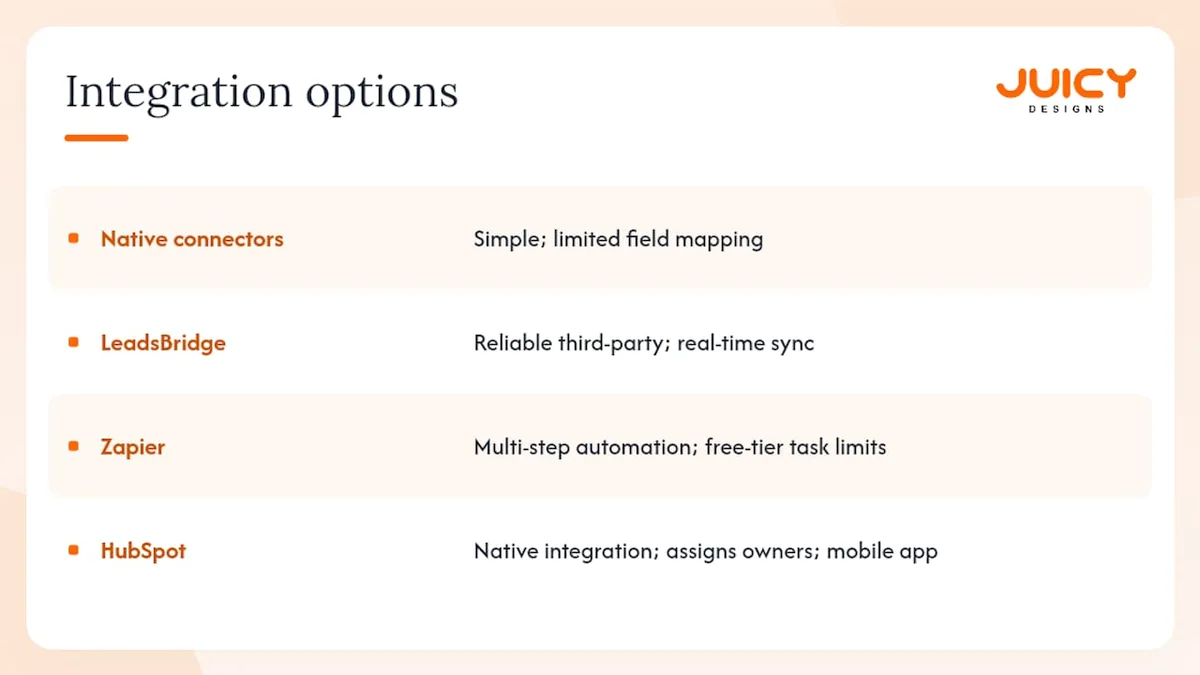
Integration options
Native CRM connectors are available for some platforms directly within Meta Ads Manager. They are the simplest option but often lack the field-mapping flexibility that complex forms require.
LeadsBridge is one of the most widely used third-party connectors for syncing Facebook leads into CRMs. Review listings confirm it as a reliable integration tool for routing lead data without custom development. It supports real-time sync, field mapping, and conditional routing rules.
Zapier offers broader automation flexibility. You can build multi-step workflows that simultaneously add a lead to HubSpot, send a WhatsApp notification to the assigned sales rep, and trigger an email sequence. The trade-off is that Zapier's free tier has task limits, and high-volume campaigns need a paid plan.
HubSpot has a native Facebook Lead Ads integration that pulls form submissions directly into the CRM, assigns them to a contact owner, and can trigger automated workflows. The HubSpot mobile app lets sales reps respond from their phones, which matters for South African teams where the first contact often happens via WhatsApp rather than email.
WhatsApp routing for South African teams
The most effective pattern for South African businesses is a two-step handoff: the lead form triggers an automated WhatsApp message within minutes (via a WhatsApp Business API provider), followed by a human rep taking over the conversation. Automated first messages should confirm receipt, deliver the promised asset, and ask one qualifying question to warm the conversation before the rep picks it up.
For click-to-WhatsApp ads, the conversation starts immediately. Set up a WhatsApp Business greeting message that delivers value before asking anything, and train your team to respond within 30 minutes during business hours.
Lead routing SLA
Research on purchase behaviour consistently shows that multiple contacts are needed before a prospect commits, which makes speed-to-first-contact critical for keeping prospects engaged through the full nurture cycle. Aim for:
- First contact: within 1 hour of form submission during business hours
- Fallback (no answer): SMS or WhatsApp message within 2 hours
- Second attempt: next business morning if the lead came in after hours
Pro Tip: Pass a unique event ID at every form fill and include it in your CAPI offline conversion events. This allows Meta to match your CRM's SQL and closed-won events back to the exact ad that generated them, which is the foundation of accurate attribution and algorithm optimisation.
How to qualify leads and build follow-up sequences that book meetings
Not every lead that enters your CRM deserves the same attention. A simple scoring model prevents your sales team from spending time on prospects who were never going to buy.
Lead scoring example
Assign points based on what you know at form fill and what happens afterwards:
- Job title or seniority match (decision-maker role): +15 points
- Budget range above your minimum threshold: +20 points
- Timeline "Immediately" or "Within 3 months": +15 points
- Company size in your target range: +10 points
- Opened follow-up email: +5 points
- Clicked a link in follow-up email: +10 points
- Replied to WhatsApp message: +15 points
- Visited pricing page after form fill: +20 points
Set your MQL threshold at 40 points and SQL threshold at 70 points. Leads below 40 go into a long-form nurture sequence; leads above 70 get a direct call from a senior rep within the same day.
Nurture timeline and channel mix
| Day | Action | Channel |
|---|---|---|
| Immediate | Deliver the promised asset + confirm receipt | WhatsApp / Email |
| Day 1 | Value email: one insight from the asset they downloaded | |
| Day 2 | WhatsApp check-in: "Did you get a chance to look at it?" | |
| Day 4 | Case study or social proof email | |
| Day 7 | Direct ask: "Would a 20-minute call be useful?" | WhatsApp + Email |
| Later stage | Final nudge: limited-time offer or new resource |
Feed scoring back into ad audiences
Once your scoring model is running, export your MQL and SQL lists from the CRM monthly and upload them as custom audiences in Meta. These lookalikes will consistently outperform interest-based audiences because they model on people who actually bought or nearly bought, not just people who clicked.
Budgeting, KPIs, and scaling: is R200/day enough?
The short answer is: R200/day is enough to test, not enough to scale. Here is what that budget actually buys you and when to increase it.
KPIs that matter
CPL (cost-per-lead) is the metric most advertisers watch. It is also the most misleading one in isolation. The KPIs that connect to revenue are:
- Cost-per-qualified-lead: CPL filtered to leads that meet your scoring threshold
- Lead-to-SQL rate: what percentage of form fills become sales-qualified opportunities
- Cost-per-SQL: the real cost of a pipeline opportunity
- Time-to-first-contact: how quickly your team reaches new leads
- Revenue-per-lead: the downstream value of your average lead
Optimising towards offline conversion events via CAPI rather than raw form fills can reduce cost-per-SQL by 25-45% because Meta's algorithm learns to find people who convert downstream, not just people who click.
Budget guidance by stage
- R200, R500/day: Testing phase. Run one audience, one offer, two creatives. Gather data for 7-10 days before drawing conclusions. Expect limited reach in smaller South African markets.
- R500, R1,500/day: Small campaign. Run the 3-2-2 method properly (see below). Enough budget to exit the learning phase within a week if your conversion event fires regularly.
- R1,500, R5,000/day: Growth phase. Multiple audience tiers, creative rotation, and meaningful A/B test data within days.
The 3-2-2 method
The 3-2-2 method structures your testing so you generate clear signals without fragmenting budget across too many variables:
- 3 creatives: test three different ad creatives (different hooks, formats, or visuals) within the same ad set
- 2 audiences: run the same creatives against two distinct audience segments simultaneously
- 2 bidding strategies: test Lowest Cost against Cost Cap (or two different cost cap levels)
Run each combination for at least 7 days before pausing underperformers. Pause the bottom-performing creative first, replace it with a new variant, and repeat. This keeps the campaign in continuous improvement without resetting the learning phase. For more on creative testing frameworks, this guide to Facebook ad creative testing covers the iterative approach in detail.
Scaling rules
When scaling, refresh creatives before increasing budget, not after. A tired creative with more budget behind it produces worse results at higher cost.
How to measure success and avoid the most common mistakes
Tracking setup checklist
- Install the Meta Pixel on every page of your website
- Wire the Conversions API server-side to send events directly from your server, bypassing browser-level ad blockers
- Pass unique event IDs at every conversion to prevent duplicate counting
- Map your CRM stages (MQL, SQL, closed-won) to offline conversion events in Meta
- Verify event quality scores in Events Manager before launching
Optimisation cadence
Review creative performance weekly. Review audience performance every two weeks. Review campaign structure and bidding monthly. Do not make changes daily based on short-term fluctuations; Meta's algorithm needs time to optimise, and frequent edits restart the learning phase.
Common mistakes and fixes
- Copying LinkedIn targeting logic to Meta. Job-title targeting on Meta is far less reliable than on LinkedIn. Use behavioural signals, content engagement, and CRM lookalikes instead.
- Optimising only for form fills. This trains Meta to find people who click forms, not people who buy. Wire offline conversions and optimise for qualified outcomes.
- Ignoring phone routing. If a lead submits a form and no one calls within 2 hours, the conversion rate drops sharply. Build the routing SLA before the campaign goes live.
- Running the same creative for more than 4 weeks. Frequency rises, CPL rises, and quality falls. Rotate creatives on a 3-4 week cycle.
- Not excluding converters. Serving lead ads to people who already submitted a form wastes budget and frustrates prospects.
Troubleshooting checklist for underperforming campaigns
- Check event quality score in Events Manager (aim for 6.0+)
- Confirm the learning phase has exited (50+ conversion events in 7 days)
- Review audience overlap between ad sets (use the Audience Overlap tool)
- Check frequency: above 3.0 for cold audiences usually signals creative fatigue
- Verify that the form is loading correctly on mobile devices
South Africa-specific considerations you need to plan for
POPIA compliance essentials
POPIA requires that every lead form collecting personal information must include explicit, informed consent. Practically, this means:
- State the specific purpose for which you are collecting data
- Include a link to your privacy policy (required by both POPIA and Meta)
- Use an unticked opt-in checkbox for marketing communications
- Collect only the data you actually need (data minimisation principle)
- Define and document your data retention period
Non-compliance carries real risk. The Information Regulator has enforcement powers, and a data breach without proper consent documentation compounds liability significantly.
WhatsApp as the primary follow-up channel
South Africa has one of the highest WhatsApp penetration rates in Africa. For most South African businesses, WhatsApp is not an optional follow-up channel; it is the primary one. Build your lead routing to deliver an automated WhatsApp message within minutes of form submission, then hand off to a human rep for the qualifying conversation. For Facebook marketing in South Africa, integrating WhatsApp into the post-lead workflow consistently outperforms email-only follow-up sequences.
Mobile-first creative and behaviour
The majority of South African Facebook users access the platform on mobile, often on mid-range Android devices. Keep video files under 15MB where possible, use subtitles on all video ads (many users watch without sound), and test your lead forms on a mid-range Android device before launching. Avoid creative that relies on fine detail or small text; it simply does not render well on smaller screens.
Local budget context in ZAR
- Small business / solo operator: R200, R500/day (R6,000, R15,000/month)
- Mid-market campaign: R500, R2,000/day (R15,000, R60,000/month)
- Enterprise / multi-product: R2,000, R10,000/day (R60,000, R300,000/month)
These ranges assume South African audience sizes and typical CPL benchmarks for the local market. Campaigns targeting niche B2B audiences in South Africa will often see higher CPLs than consumer campaigns, reflecting smaller addressable audiences.
When DIY makes sense and when to bring in an agency
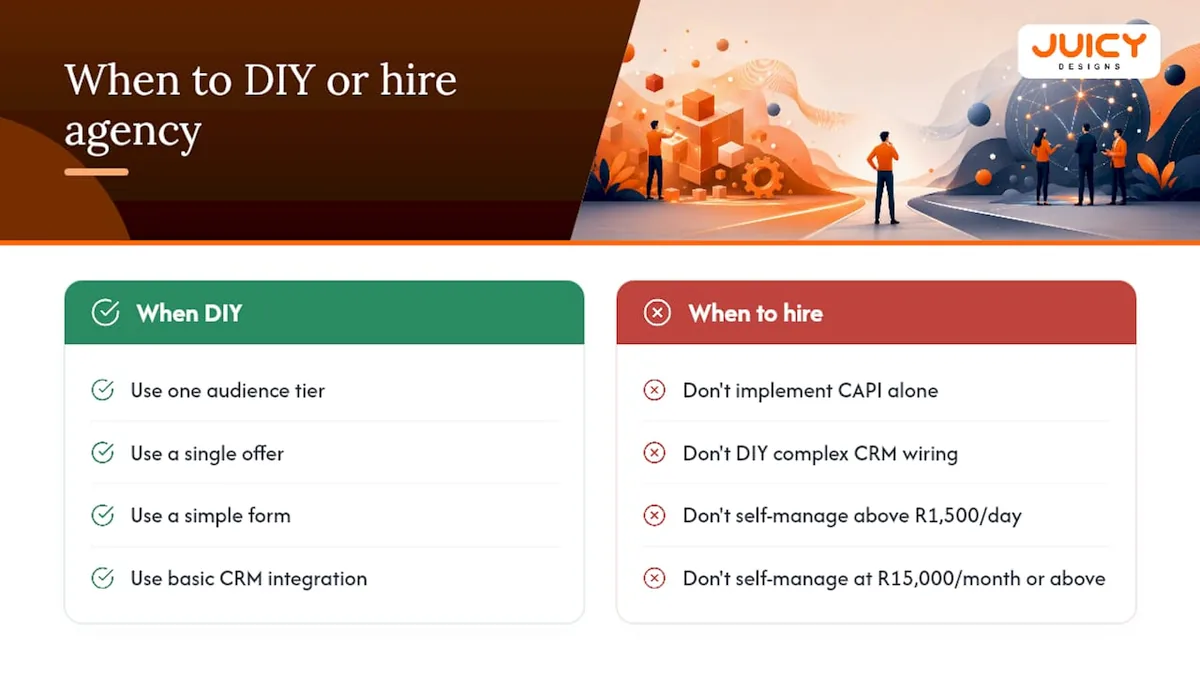
The honest answer is that Facebook lead generation ads are manageable as a DIY project when your campaigns are straightforward: one audience tier, one offer, a simple form, and a basic CRM integration. If you have the time to learn Ads Manager, monitor performance weekly, and rotate creatives every month, you can run a competent campaign without agency support.
The calculus changes when complexity enters the picture. CAPI implementation requires developer access and server-side event configuration that most business owners cannot set up correctly without technical help. CRM integrations with conditional routing, lead scoring, and offline conversion mapping add another layer. And when you are spending above R1,500/day, the cost of suboptimal targeting or a misconfigured learning phase quickly exceeds what an agency retainer costs.
Juicydesigns typically sees businesses engage for agency management when monthly ad spend reaches R15,000 or above, when the campaign involves multiple audience tiers and creative variants, or when CAPI and CRM wiring are required. Below that threshold, a one-time setup consultation and a clear campaign brief can get a capable marketer running independently. The marketing automation and lead generation tools guide covers the technology stack in more detail for teams who want to self-manage.
Juicydesigns runs Facebook lead campaigns that produce pipeline, not just form fills
Juicydesigns is a Pretoria-based digital marketing agency that handles the full Facebook lead generation stack: campaign strategy, ad creative, Meta Pixel and CAPI wiring, CRM integration, and ongoing optimisation. The agency's founder-led model means you work directly with the people building your campaigns, not an account manager relaying instructions.
For South African businesses, the typical engagement starts at a monthly retainer from R8,500, covering campaign management, creative production, and performance reporting. There are no long-term contracts.
If you are ready to move from ad spend to pipeline, get in touch with the Juicydesigns team for a campaign audit or a proposal tailored to your budget and objectives.
Sources
FAQ
What is lead generation in Facebook ads?
Lead generation in Facebook ads refers to using Meta's Lead Ads objective to collect contact information from prospects directly inside the Facebook or Instagram app, without sending users to an external website. The instant form pre-fills fields from the user's profile, reducing friction and increasing completion rates.
How do you create Facebook ads for lead generation?
Select the Leads objective in Meta Ads Manager, choose Instant Form as your conversion location, build a value-led offer as your lead magnet, and set up a CRM integration to receive leads in real time. Wire the Meta Pixel and Conversions API before launching so Meta can optimise for qualified outcomes rather than raw form submissions.
Is R200/day enough for Facebook lead ads?
R200/day is sufficient for a testing phase: one audience, one offer, and two creatives running for 7-10 days to gather initial data. It is not enough to exit the learning phase quickly or run meaningful A/B tests. Small business campaigns typically need R500, R1,500/day to generate reliable optimisation signals.
What is the 3-2-2 method for Facebook ads?
The 3-2-2 method structures campaign testing around three ad creatives, two audience segments, and two bidding strategies run simultaneously. It generates clear performance signals without spreading budget too thin, and it allows you to pause underperformers and replace them iteratively without resetting the campaign's learning phase.
How do you improve lead quality from Facebook lead ads?
Add one qualifying question to your instant form (budget range, company size, or timeline), use a value-led offer rather than a generic "contact us" prompt, build lookalike audiences from your best CRM contacts, and wire CAPI offline conversion events so Meta optimises for qualified leads rather than form fills.
Recommended
- Facebook Ads vs Google Ads: Which for SA Business?
- Lead Generation for Car Dealerships: A Practical Playbook | Juicy Designs
- Facebook marketing in South Africa: a practical guide
- Lead Generation Companies in South Africa: How to Pick One | Juicy Designs
Related reading: Facebook ads in South Africa, Lead generation services, What Facebook ads cost in South Africa.