
Validation First Lead Scoring Models for Small Sales & Marketing Teams
Validation first playbook for marketing and sales teams to build a working lead scoring model, backtest it on closed deals, and deploy quickly.
A lead scoring model ranks prospects by likelihood to convert, combining who they are (fit) with what they do (intent).


TL;DR: Quick Answer
Validation first playbook for marketing and sales teams to build a working lead scoring model, backtest it on closed deals, and deploy quickly.
A lead scoring model ranks prospects by likelihood to convert, combining who they are (fit) with what they do (intent). The fastest route to a working system is a rules-based model that separates those two axes, then gets checked against real closed-won and closed-lost data before it ever reaches a rep's desk. Everything else, from predictive machine learning to CRM automation, is a refinement you earn once that foundation holds up.
TL;DR:
- A rules-based lead scoring model should separate fit and intent signals and validate accuracy using historical closed-won and closed-lost data.
- The model's effectiveness is measured by a staircase pattern in conversion rates across score bands and should be recalibrated quarterly or after major product changes.
- Rules-based scoring is recommended to start with as it is fast, explainable, and easy to implement, while predictive models require large, consistent data sets.
- Incorporating decay and disqualifier signals helps keep scores honest and relevant, with transparency boosting sales team trust.
- Agencies can assist with building, validating, and scaling lead scoring models, easing the data and integration challenges for in-house teams.
What is a lead scoring model?
A lead score ranks prospects by conversion likelihood, and the useful ones separate two distinct questions: fit and intent. Fit asks whether this prospect resembles your best customers, drawing on explicit signals like job title, company size, and industry. Intent asks whether this prospect is acting like a buyer right now, drawing on implicit signals like page visits, pricing-page views, or demo requests.
Splitting these axes matters because a high score built from one dimension alone hides the play you should actually run. Picture two leads, both scoring 80 points. One is a perfect-fit CFO who visited your pricing page once. The other is a mid-level analyst who has visited five times this week. Same score, opposite next step: the first needs a nurture sequence, the second needs a call today.
Why lead scoring matters for revenue and alignment
Prioritisation changes how fast leads move through your funnel. When sales reps work a ranked list instead of a raw feed, they spend their time on prospects who are statistically closer to closing, and pipeline health improves because effort concentrates where conversion odds are highest.
The bigger win is often organisational. A shared score forces marketing and sales to agree on what "qualified" means before an argument breaks out over a bad lead handoff. That agreement becomes a service level agreement: marketing commits to sending leads above a threshold, sales commits to contacting them within a set window. Teams that operationalise this typically see fewer wasted outreach hours and a tighter marketing-to-sales feedback loop, because disagreements get settled by the model's own audit trail instead of by opinion.
What are the main types of lead scoring models?
Most teams draw from four categories, often blending two or three:
- Demographic and firmographic scoring weighs job title, company size, industry, and location. It dominates early in a company's life, when you have more instinct about your ideal customer than behavioural data to prove it.
- Behavioural scoring tracks page visits, content downloads, demo requests, and product usage, weighted by velocity and recency. A prospect who visited the pricing page twice this week outranks one who did it once in March.
- Predictive scoring uses machine learning to learn which combinations of signals actually preceded past closed-won deals, rather than relying on someone's guess at point values. It only works with enough labelled history to train on, per the progression practitioners recommend from point systems to predictive models.
- Negative and decay scoring subtracts points for disqualifying signals (a competitor's domain, an unsubscribed) and reduces stale points over time so an old spike in activity doesn't inflate today's score.
Choose based on data volume: thin historical data favours demographic and behavioural rules; a few thousand closed deals with consistent tracking opens the door to predictive models.
How do you build a lead scoring model step by step?
Building a workable model is less about sophistication and more about sequencing. Skip a step here and you end up recalibrating under pressure later, once sales has already lost faith in the score.
- Define the conversion event. Decide what actually counts as success, whether that's closed-won revenue, a booked demo, or paid activation. Everything downstream calibrates against this one definition.
- Classify your signals. List every available data point and sort it into fit versus intent, and into deterministic (a firm fact like company size) versus judgmental (an inferred signal like engagement quality).
- Assign initial weights. Give more points to signals that correlate with your conversion event, and include negative points for disqualifiers plus decay rules for time-sensitive behaviour.
- Set explicit thresholds and route actions. Draw the line between hot, warm, and cold, and document exactly what happens at each tier, including the response-time SLA sales agrees to honour.
- Operationalise the writeback. Push the score into the CRM field reps actually look at, trigger notifications for hot leads, and route by territory or product line as needed.
- Run an initial backtest before rollout. Score your historical closed-won and closed-lost leads with the new model and check whether it would have correctly prioritised the deals that actually closed.
That last step is the one teams skip under deadline pressure, and it's the one that prevents an embarrassing recalibration in month two.
How do you validate that a lead scoring model actually works?
Backtesting is the audit that separates a model that predicts conversion from one that just feels reasonable. Take your closed-won and closed-lost history, run it through the scoring logic, and plot conversion rate by score band. A working model produces a staircase: hot leads convert noticeably more often than warm, warm more than cold.

Track a small set of KPIs alongside that chart: conversion rate per score band, the MQL to SQL ratio, average time-to-contact for hot leads, and the false positive rate (high scores that never converted). If hot, warm, and cold bands show similar conversion rates, the model has failed and needs re-tuning, not a fresh coat of paint. Our own guide to prioritising your best prospects treats this audit as a repeatable cycle rather than a one-time launch task.
Put a recalibration cadence on the calendar. A quarterly review catches slow drift, while a sudden shift, like a new product line or a pricing change, should trigger an emergency retune outside that schedule.
When should you use rules versus predictive scoring?
Rules-based scoring is cheap, fast to deploy, and fully explainable to a skeptical sales team, which makes it the right starting point for almost every company. You can build one in a spreadsheet, move it into your CRM's native scoring fields, and have it running within a week.
Predictive machine learning pays off once you have enough labelled history, typically a large volume of closed deals with consistent tracking, and the integration effort to support it. Below that threshold, it adds complexity without adding accuracy.
A hybrid approach, a rules-based foundation with a machine learning re-ranker layered on top, often delivers the most practical balance of explainability and lift for mid-market B2B teams, keeping the score defensible while still catching patterns humans miss. Whichever route you take, the score is worthless if it stays in a dashboard: writeback into the CRM field reps actually use is what makes adoption happen. Our overview of marketing automation and lead generation tooling covers what to look for when your stack needs to support that handoff.
Best practices that keep a lead scoring model accurate
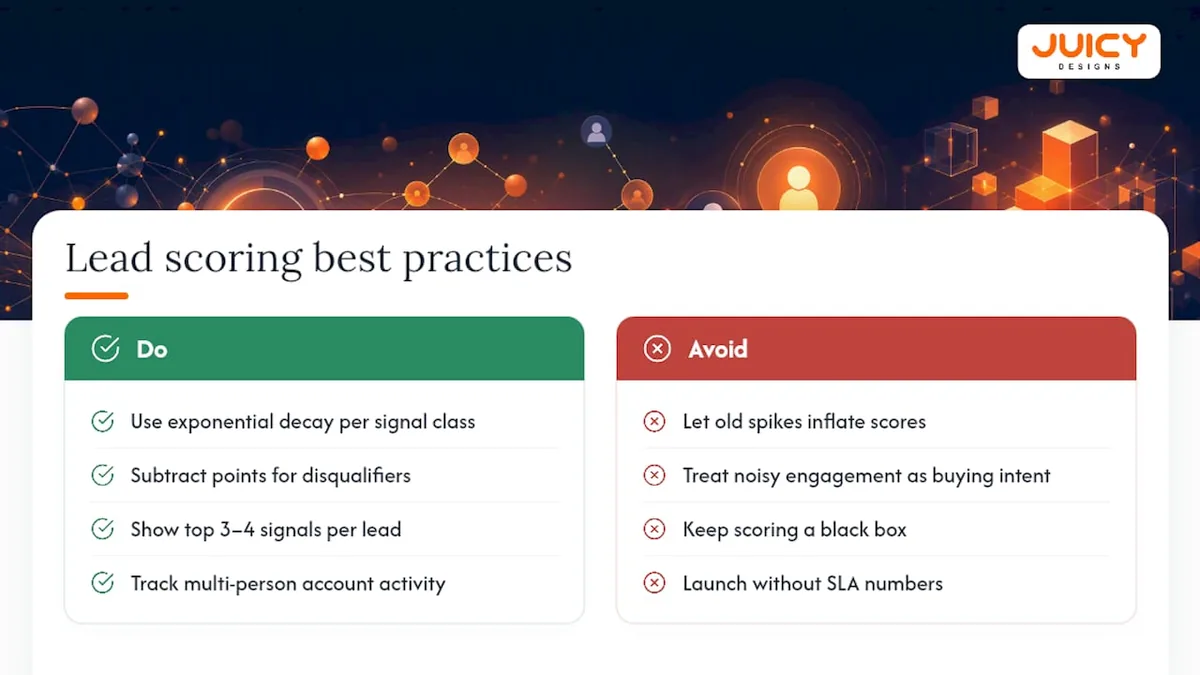
Decay prevents a score from lying to you. Apply exponential decay with different half-lives per signal class, for example a 14-day half-life on pricing-page visits and a longer 30-day window on lower-intent content, so a spike from months ago stops inflating today's number.
Negative scoring closes the other gap. Without disqualifiers built in, noisy engagement, like a student researching your industry for a school project, can outscore a genuine buyer. Subtracting points for disqualifying signals keeps the model honest.
Explainability drives adoption. Surface the top three or four signals behind each score directly in the lead record, so a rep can see why a lead ranks where it does instead of trusting a black box.
One underrated B2B signal: multiple people from the same account engaging in a short window. Three colleagues visiting your site in the same week is often a stronger buying signal than one person visiting five times.
Pro Tip: Start your SLA with one sentence sales can't argue with: "Marketing sends leads scoring above X within Y minutes of the trigger event; sales contacts them within Z hours." Put a number on both halves before you launch.
How does an agency put lead scoring into practice?
Cobus leads content strategy at Juicydesigns, with a focus on the full-funnel mechanics behind qualified-lead generation for South African businesses. Juicy Designs clients average a 4.8x return on ad spend, nearly double the industry standard. The agency's approach runs an initial audit of existing signals and CRM data, pilots a rules-based score against a defined conversion event, then scales the working model once the backtest holds up.
Why treat your lead scoring model as a hypothesis, not a launch?
A lead scoring model is a hypothesis about what predicts your buyers, not a finished product. Test it against real outcomes, keep it explainable enough that reps trust it, and revisit it before drift sets in. If you haven't already, the first move is simple: define your conversion event and run the audit.
, Cobus
Get help building and validating your lead scoring model
Building the model is the easy half. The harder half is feeding it clean data, wiring it into your CRM, and running the audit that proves it actually predicts revenue, and that's where most in-house teams run out of time. Some agencies offer founder-led service delivery with minimal intermediaries, which can help ensure audits are conducted by the analysts who built the lead generation campaigns.
If your scoring problem starts upstream, with too few qualified signals reaching the funnel at all, a Google Ads account audit from R3,500 once-off is the logical starting point, followed by an SEO audit from R8,000 once-off to check whether organic traffic is even sending the right kind of visitor. Book a scope call through the Juicydesigns contact page and we'll tell you honestly whether your bottleneck is scoring, traffic quality, or both.
Sources
- Lead scoring (Wikipedia)
- How to build a lead scoring model that actually predicts conversions | Pecan AI
- Kumo
FAQ
What Are the 7 Types of Leads in Sales?
Sales teams typically distinguish cold leads, warm leads, hot leads, marketing-qualified leads (MQLs), sales-qualified leads (SQLs), product-qualified leads (PQLs), and disqualified leads. A lead scoring model is what moves a prospect between these categories based on fit and intent signals rather than gut feel.
How Is a Lead Score Calculated?
A lead score is calculated by assigning point values to fit signals (job title, company size, industry) and intent signals (page visits, downloads, demo requests), then applying decay over time and subtracting points for disqualifiers. Practitioner guides recommend validating the resulting formula against historical closed-won and closed-lost data before trusting it.
What Are the Best Lead Scoring Tools?
The right tool depends on data maturity: CRM-native scoring fields work well for a rules-based start, while dedicated marketing automation platforms and predictive scoring add-ons suit teams with larger volumes of tracked behaviour. A platform like Cairrot can help early-stage teams centralise the signals a scoring model depends on before adding more complex layers.
What Are Some Best Practices for Lead Scoring?
Separate fit from intent, apply decay so old activity stops inflating scores, and build in negative points for disqualifying signals. Pair those rules with a documented SLA between marketing and sales, and recalibrate the model quarterly or immediately after a major shift in product or pricing.
Can an Agency Help Set Up Lead Scoring?
Yes. Juicydesigns audits existing CRM and signal data, pilots a rules-based model against a defined conversion event, and scales it once a backtest confirms it predicts real outcomes. Pricing for the underlying SEO audit starts from R8,000 once-off, and current rates for other services are listed on the Juicydesigns site.