
Claim Yellosa, FindMy & Yellow Pages for South Africa Local Citations
Start with Google Business Profile, then claim Yellosa, FindMy.co.za, and Yellow Pages. Run a step‑by‑step NAP audit, check listing costs, or book a...
Claim your Google Business Profile first, then lock in three high-value South African directories: Yellosa, FindMy.


TL;DR: Quick Answer
Start with Google Business Profile, then claim Yellosa, FindMy.co.za, and Yellow Pages. Run a step‑by‑step NAP audit, check listing costs, or book a...
Claim your Google Business Profile first, then lock in three high-value South African directories: Yellosa, FindMy.co.za, and Yellow Pages. From there, run a quick audit to make sure your business name, address, and phone number match everywhere. That single sequence fixes most of what holds South African local rankings back.
TL;DR:
- Claim your Google Business Profile and key South African directories, then ensure your business name, address, and phone number are consistent across all listings.
- Prioritise Tier 1 platforms like Google, Apple Maps, Bing, and Yellow Pages, followed by high-value sites such as Yellosa and FindMy.co.za for maximum impact.
- Regularly audit your citations by searching for your business details and fix inconsistencies like abbreviations, old URLs, or multiple phone number formats to improve search trust.
- Most core directories are free to claim and verify within days, but building rankings takes several weeks to months based on citation quality and consistency.
- For multiple locations or complex industries, outsourcing citation management to a local agency can ensure structured, consistent data and ongoing performance tracking.
What are local citations in South Africa and why do they matter?
A local citation is any online mention of your business name, address, and phone number, usually shortened to NAP. Every directory listing, map entry, or business profile that repeats those three details is a citation, whether it links back to your website or not.
South African local SEO specialists treat NAP consistency and citations as essential corroborating signals that Google Business Profile leans on to decide whether your listing deserves trust in local search results. Google cross-checks your details against other places your business appears online. When those details line up, Google gets more confident showing you in the Map Pack for searches like "plumber near me" or "coffee shop in Rosebank."
Citations do double duty. They build the trust signal search engines use for ranking, and they build the trust signal actual customers use when deciding whether to call you. A listing with the wrong phone number does not just cost you a search ranking. It costs you the customer who dialled it.
Which South African directories should you claim first?
Not every directory carries equal weight. Some move your Google Business Profile ranking; others mostly help customers find you directly. Here's how to prioritise your time.
Tier 1: non-negotiable essentials
- Google Business Profile, the foundation of local search visibility in South Africa. If you do nothing else this month, do this.
- Apple Business Connect, increasingly relevant as more South Africans search and navigate using Apple Maps and Siri.
- Bing Places, smaller search share than Google, but a five-minute setup once your GBP is done.
- Yellow Pages South Africa (SayYellow), one of the oldest, most recognised directory brands in the country, with a domain authority that still carries weight with Google.
Tier 2: high-value South African platforms
- Yellosa manages a database of over 621,337 South African business contacts and offers verified listings with customer reviews and SEO-friendly pages, which makes it one of the largest local directories you can claim for free.
- FindMy.co.za lists more than 100,000 South African businesses and offers paid visibility upgrades for businesses that want to stand out faster.
- Brabys has served South African businesses for decades and remains a trusted reference point, particularly for older, established searches.
- DBD.directory offers SEO-optimised listing pages with do-follow links, Google Map embeds, and WhatsApp click-to-chat buttons, which gives it more functional depth than a basic name-and-number listing.
Tier 3: niche and secondary directories
Platforms like ListingsSA, Yobiz, and ULC add extra reach without much extra effort, and industry-specific directories (hospitality boards, trade associations, medical registries) and city or municipal business portals can matter more than generic sites if your customers actually search there.
On every profile, prioritise the fields that carry real weight: your NAP block, the most accurate business category, your website URL, correct opening hours, and at least three to five photos. Experts advise using every available field, including keyword-rich descriptions and service lists, since directories rank listings internally too, not just in Google's results.
How do you claim and verify a listing step by step?
Before touching a single directory, write down your official NAP exactly as it should appear everywhere. Pick one version of your address (street type spelt out or abbreviated, but consistently) and one phone number format, then use that same block on every platform.
- Search for an existing listing first. Many South African businesses already have an unclaimed profile generated automatically. Search your business name plus suburb before creating a duplicate.
- Claim or create the listing. Most directories, including Yellosa and Yellow Pages, offer a "claim this business" or "add your business" flow.
- Verify ownership. Expect a phone call, SMS code, email confirmation, or postcard, depending on the platform.
- Complete every available field. Category, hours, services, payment methods, and a proper business description.
- Add images and service details. Listings with photos consistently get more engagement than text-only entries.
- Request reviews. A handful of verified reviews often does more for conversions than the listing itself.
If verification stalls, check your spam folder for the confirmation email, confirm your listed phone number is currently active, and try an alternate method (email instead of SMS, for example) if the directory offers one.
Pro Tip: Keep a simple spreadsheet with columns for directory name, login email, claim date, and verification status. It takes ten minutes to set up and saves hours the next time you need to update your hours or address.
How do you audit citations and fix errors that hurt rankings?
An audit starts with a search, not a tool. Google your exact business name plus suburb, and separately search your phone number in quotes. Cross-check your address against OpenStreetMap, which is free and often surfaces listings you forgot existed.
The errors that do the most damage are rarely dramatic. They're small and repeatable:
- Inconsistent abbreviations ("St" vs "Street", "Rd" vs "Road")
- A PO box on one directory and a street address on another
- Multiple phone number formats (with and without the country code)
- An old website URL still live on a directory you claimed years ago
Local SEO guidance on the South African market points to fixing exact-match business-name variants and address formatting first, since these small corrections produce measurable improvements in how directories and search engines match your listing to the real business.
Fix Google Business Profile and your Tier 1 listings before touching anything else. Then work through the high-traffic South African directories. Pro Tip: Set a calendar reminder every quarter to re-check your top five listings. Citations decay quietly. A directory redesign or a data migration can quietly revert your details without any notification.
What do South African listings cost, and how long do they take?
Most core directories cost nothing. Google Business Profile, Apple Business Connect, Bing Places, and the free tiers of Yellosa, Brabys, and Yellow Pages are all free to claim and maintain.
Paid tiers exist mainly for visibility, not for the citation itself. FindMy.co.za offers growth features starting at around R290 per month for priority placement and enhanced profile features. Paid placement can speed up discovery, but it never replaces consistent NAP data across your free listings.
- Listing goes live: hours to a few days on most platforms
- Verification: same day to about a week, depending on the method
- Ranking impact: typically weeks to a few months, since citations build trust cumulatively rather than instantly
If you're working with a limited budget, claim every free listing properly before spending a single rand on paid placement.
When should you bring in a local agency instead of doing it yourself?
DIY citation building works well for a single-location business with time to spare. It gets harder fast once you're managing multiple branches, a limited internal team, or a brand that needs consistent messaging across dozens of platforms.
Juicydesigns approaches citation work as data standardisation first: one clean NAP record, pushed consistently across every directory, then reinforced with Google Business Profile optimisation and ongoing reputation monitoring. Juicy Designs clients average a 4.8x return on ad spend, nearly double the industry standard. Agency-managed citation work typically covers claiming, standardisation, and monthly reporting, integrated with the same local SEO and Google Business Profile strategy driving your Maps rankings.
Do citation strategies differ by industry or city in South Africa?
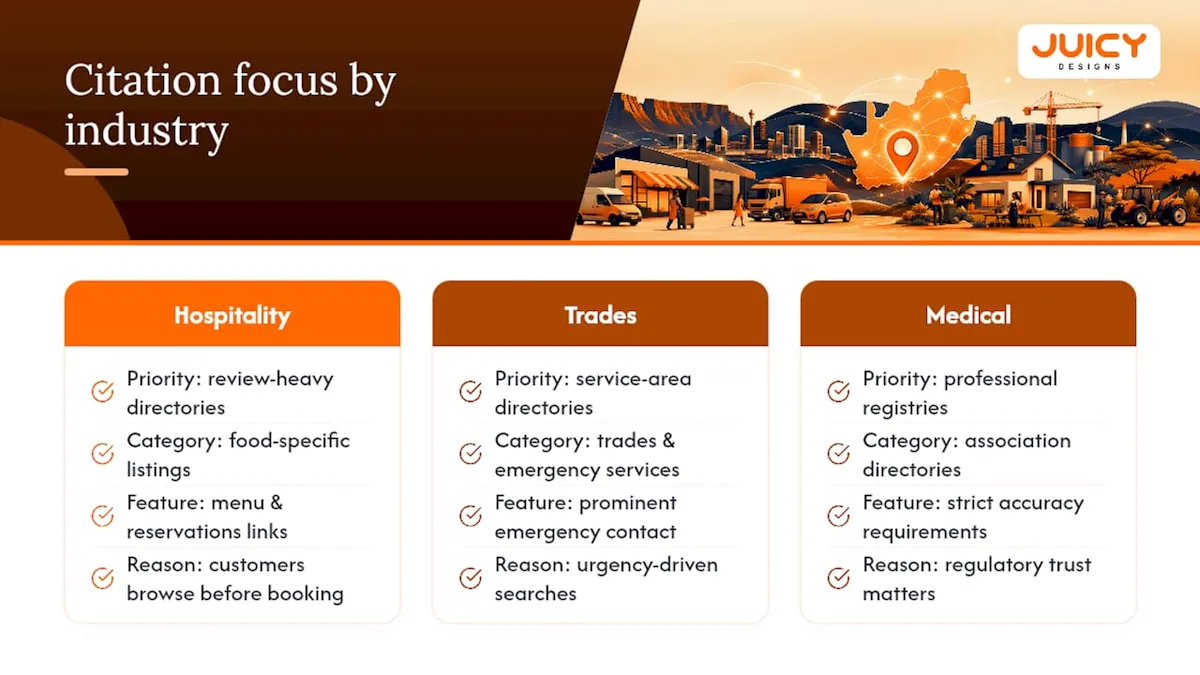
A restaurant in Cape Town and an accounting firm in Pretoria should not build citations the same way. Hospitality businesses gain more from platforms with strong review integration and food-specific categories, since customers actively browse those directories before booking. Trades businesses (electricians, plumbers, contractors) benefit more from directories with service-area fields and emergency contact prominence, because urgency drives those searches.
Medical and healthcare providers face a different set of priorities entirely: professional registries and association directories often carry more trust weight with both patients and Google than general business listings do, and accuracy matters more given the regulatory environment.
City-level differences matter too. A business in Johannesburg competes in one of the densest local search markets in the country, where Tier 1 and Tier 2 directories alone may not be enough to stand out. A business in a smaller centre, say Polokwane or George, often sees faster ranking movement from the same set of listings simply because there's less competition claiming them. Municipal business portals and regional chamber-of-commerce directories tend to punch above their weight in smaller cities, where national directories have thinner local coverage.
The practical takeaway: claim the Tier 1 and Tier 2 directories everywhere, then adjust which niche platforms you prioritise based on what your specific customers actually search before they buy.
Why citations still matter heading into 2026
Search behaviour keeps shifting towards AI-driven answers and voice search, but citations remain the trust layer underneath all of it. Google Business Profile, a handful of reviews, and three to five high-value South African directories still outperform scattergun listing sprees. Treat your citation data as a living asset. Audit it on a routine, not just when rankings dip.
, Cobus
Let Juicydesigns handle your local visibility
Building and maintaining citations across a dozen South African directories takes real hours, and most business owners would rather spend that time running the business. Juicydesigns is the alternative to hiring an in-house specialist or juggling directory logins yourself: founder-led local SEO work, standardised NAP data across every platform that matters, and direct reporting with no middlemen and no long-term contract locking you in.
If your listings are scattered, inconsistent, or simply neglected, a proper audit is the fastest way to find out what's costing you visibility. Get in touch through Juicydesigns' local SEO and Google Business Profile services and ask about a citation audit for your business. It's a practical first step before spending another rand on paid advertising that a broken local presence would only undercut.
Sources
- South Africa's Verified Online Business Directory Portal , Yellosa
- FindMy.co.za - South Africa's Smart Business Directory
- NAP consistency & local citations: The unsung heroes of South African local SEO
FAQ
How do I do local citations for my South African business?
Start by claiming your Google Business Profile, then build a consistent NAP record and submit it to Tier 1 and Tier 2 South African directories like Yellosa, FindMy.co.za, and Yellow Pages, verifying ownership on each platform as you go.
Where should I search for existing citations?
Search your exact business name and suburb on Google, search your phone number in quotes to find duplicate or outdated listings, and cross-check your address against free tools like OpenStreetMap.
What are some local municipalities worth checking for business listings in South Africa?
Metro and local municipalities, including the City of Johannesburg, City of Cape Town, City of Tshwane, and eThekwini, often maintain their own business portals or supplier databases that can serve as extra citation sources, particularly for businesses seeking municipal or government contracts.
How to cite a case in South Africa?
Legal case citation follows South African law report conventions (case name, year, volume, and page reference) and is unrelated to business directory citations. If you're building local SEO citations rather than legal references, the directory steps and NAP guidance in this guide apply.
How much does it cost to list a business in South African directories?
Most Tier 1 and Tier 2 directories, including Google Business Profile, Yellosa, and Brabys, are free to claim. Paid upgrades exist on some platforms, such as FindMy.co.za starting at around R290 per month for enhanced visibility features.
Recommended
- Free Business Directories in South Africa (2026)
- Local SEO: How to Rank in Google Maps in South Africa
- Local SEO and Google Business Profile in South Africa