
Multi Location SEO for Owners & Marketers: Operations for 2026 Maps
Operations-first playbook for owners and marketers scaling multi-location SEO. Centralise your master repo, verify GBPs, grow review velocity, and win...
Treat every real, customer-facing address as its own local entity: verify a Business Profile and give it a unique, useful location page tied to a master data repo.


TL;DR: Quick Answer
Operations-first playbook for owners and marketers scaling multi-location SEO. Centralise your master repo, verify GBPs, grow review velocity, and win...
Treat every real, customer-facing address as its own local entity: verify a Business Profile and give it a unique, useful location page tied to a master data repo. Data consistency across every listing, genuinely local content on every page, and steady review growth at each branch are the three pillars that hold up multi-location SEO. Skip governance and none of it scales past a handful of sites.
TL;DR:
- Building a master repository with accurate, consistent data is essential before creating location pages or profiles to prevent inherited errors and ensure AI recognition.
- Creating unique, locally relevant content for each location, including specific services, photos, and local details, significantly improves ranking potential and converts template-based pages into authoritative listings.
- Managing Google Business Profiles requires ongoing verification, monitoring, and correction to prevent suspensions caused by duplicate listings, virtual addresses, or inconsistent data.
- Locally focused backlinks from community sources and PR bolster ranking signals more effectively than generic national citations, with regular backlink audits helping identify gaps.
- Coordinated efforts between paid search and organic SEO, with dedicated location pages and accurate call tracking, maximise visibility and ROI for each business branch.
What is multi-location SEO and why does it need its own playbook?
Multi-location SEO is the practice of getting each physical branch, franchise outlet, or service area of a business to rank independently in local search and AI-driven recommendations, rather than relying on one head-office website to carry the whole brand. Standard local SEO strategies assume one address. Franchise local SEO and multi-site SEO optimisation assume dozens, sometimes hundreds, and that changes the entire operating model.
The foundation work has to happen before a single location page gets written. Get the inventory wrong and every page, listing, and citation built on top of it inherits the error.
Start with a full audit. List every physical location and record its canonical name, address, phone number, hours, services offered, the person responsible for that site, and the verification credentials tied to its Google Business Profile. This becomes your master repository, the single source of truth that every other system pulls from.
Not every address deserves the same treatment. A flagship store with walk-in customers needs a full location page and a verified Business Profile. A satellite office that only handles paperwork might not. Google itself distinguishes storefronts from service-area businesses, and that distinction should drive your build list, not a blanket "one page per address" rule.
Three foundation decisions matter most:
- Eligibility first. Only build a dedicated page and profile for locations that genuinely serve customers face-to-face or within a defined service radius.
- Local phone numbers where possible. A number with a local area code performs better for trust and click-through than a shared national line.
- One naming convention, enforced everywhere. Decide now whether it's "Juicy Coffee Sandton" or "Juicy Coffee, Sandton Branch" and never let it drift.
AI and LLM-driven recommendation engines lean heavily on this kind of consistency. They cross-reference business data, review signals, and citations before deciding what to surface, and conflicting or sloppy data actively suppresses a location's chances of being recommended. A location with three different phone numbers across the web isn't just untidy. It's invisible to systems that reward certainty.
Pro Tip: Build your master repository in a shared spreadsheet or database before you touch a single GBP listing. Every downstream fix, whether it's a citation update or a new location page, should reference that one file, never a person's memory of "how we usually write it."
How do you build location pages that actually rank?
The biggest mistake franchise local SEO teams make is swapping the city name into an otherwise identical template and calling it done. Search engines and AI systems both recognise this pattern instantly, and it does nothing for rankings. Search Engine Land's guidance on structuring geographic pages at scale is blunt about it: create the smallest number of pages you actually need, and make each one authoritative rather than duplicated.
URL structure should mirror your real footprint. A common approach:
- Use
/locations/city-name/for individual storefronts with a physical address. - Use a regional hub page (
/locations/gauteng/) when you have several branches in one province, linking down to each individual page. - Use a service-area format without a public street address for businesses that travel to customers rather than host them.
Every location page needs the same non-negotiable sections, but the content inside them has to be genuinely local:
- Full address, hours, and an embedded map.
- The specific services or stock available at that branch (not the full national catalogue).
- Photos of the actual location, staff, and work, never stock imagery.
- A short bio of the manager or lead staff member.
- Directions and parking notes, especially for shopping centres or CBD locations with tricky access.
- Local FAQs (load-shedding hours, loading zones, appointment-only days).
- Reviews or testimonials specific to that branch.
What separates a page that ranks from one that doesn't is usually a single paragraph of real local proof: a recent project completed for a nearby client, a note about the taxi rank two doors down, or a mention of the shopping centre's peak parking times. That kind of detail is what a genuinely useful location page has that a template done never will. A dealership branch that names the industrial park it sits in and the suburbs it serves will consistently outperform a branch page that just repeats the brand's national copy with a new suburb name dropped in.
How do you manage Google Business Profiles across dozens of locations?
A verified Google Business Profile per physical storefront is the default requirement, and Google's own documentation confirms why it matters so much: local ranking depends on relevance, distance, and prominence, and a complete profile improves your odds on all three. Service-area businesses without a public storefront can still qualify for a profile, but they hide their address and set a defined service radius instead.
Verifying ten profiles is manageable by hand. Verifying eighty is a project. Google offers bulk verification for chains with ten or more qualifying locations, which cuts the manual back-and-forth significantly, but it still requires clean, matching data across every listing before you submit.
Suspensions are the biggest risk once you're operating at scale, and they almost always trace back to the same handful of causes:
- Duplicate listings created when a franchisee or previous agency set up a second profile.
- PO boxes or virtual offices listed as physical addresses.
- Keyword stuffing in the business name field ("Juicy Coffee Sandton Best Coffee Shop").
- Photos or posts that don't match the verified address.
Once profiles are live, treat them as a living asset, not a one-time setup. That means weekly checks for new reviews, monthly audits of hours and photos, and a fast correction process whenever a listing drifts out of sync with the master repository. A dedicated Google Business Profile optimisation routine, run consistently, is usually the difference between a listing that quietly decays and one that keeps earning impressions.
How many reviews does each location actually need?
Review velocity, not just review count, is what search engines and AI systems weigh most heavily. A location with 40 reviews collected steadily over two years signals something different than one with 40 reviews dumped in a single week. Set a monthly velocity target per location, not just a lifetime total, and treat any branch falling behind as a priority fix.
A workable system for generating reviews consistently:
- Ask at the point of service. Staff trained to make the ask in person outperform any automated flow.
- Send a location-specific review link by SMS or email within 24 hours of the visit, tied to that branch's exact GBP listing, not a generic company link.
- Follow up once, politely, if there's no response within a week. Never chase harder than that.
- Flag any negative review for a same-day owner response, and aim to reply to positive reviews within 48 hours.
Response cadence matters as much as volume. A location manager who replies to every review, good or bad, within two days builds a visible pattern of engagement that both customers and algorithms notice. Location-specific reviews and photos materially increase how discoverable and trustworthy a branch appears to modern search and AI systems, which now weigh review quality alongside raw star ratings.
Pro Tip: Ask staff at each branch to photograph finished work, events, or the storefront itself once a week and upload it directly to that location's profile. Fresh, location-specific photos do more for perceived legitimacy than almost any other single action, and they cost nothing.

What technical setup makes location pages machine-readable?
Search engines and AI answer engines both parse structured data before they parse prose, and LocalBusiness schema is how you tell them exactly what a page represents.
Every location page needs its own JSON-LD block with, at minimum: business name, exact address, phone number, opening hours, geo-coordinates, and a sameAs array linking to that location's own social profiles and directory listings, not the brand's national accounts. A schema markup guide built for South African businesses walks through the exact fields Google's validator expects, and a free schema generator can produce a working snippet in minutes if you'd rather not write JSON-LD by hand.
Sitemap hygiene matters more as location count grows:
- Every live location page belongs in the XML sitemap; closed or relocated locations should be removed immediately, not left to 404 silently.
- Canonical tags should point each location page to itself, never to a regional hub, or you risk collapsing distinct locations into one indexed entry.
- A 301 redirect from a closed location's URL to its nearest active branch preserves any link equity instead of losing it outright.
Internal linking should express the real hierarchy of the business: a national or regional hub links down to each location page, which links down to its own service and team pages. That structure matches how site architecture for multi-location businesses should reflect real markets, and it gives search engines a clear map of how locations relate to each other rather than a flat list of disconnected pages.
Thin content remains the single biggest indexing risk. A location page with roughly fewer than 300 words, no unique photos, and no local specifics is a candidate for Google to quietly drop from its index rather than rank.
How do you govern multi-location SEO without losing control?
A master repository only works if someone owns it. Assign one person, usually a marketing manager, as the sole editor with authority to approve changes, and give location managers view access with a simple request process for updates. Uncontrolled edit access is how NAP data drifts out of sync in the first place.
Prioritise effort with a simple rubric rather than treating every location equally:
- Highest revenue potential locations get first access to new content and review campaigns.
- Highest competition markets get priority technical and citation work, since the ranking gap is hardest to close there.
- Weakest performers get audited first each quarter, since they represent the most recoverable upside.
That approach mirrors what structuring geographic pages at scale recommends: put limited resources where competition and revenue potential are highest, not spread evenly across every branch regardless of performance.
Track a consistent set of KPIs per location every month:
- Google Business Profile views and search queries.
- Organic traffic to the location page itself.
- Calls and direction requests.
- Review count and average rating, tracked as a monthly delta, not a static number.
- Conversions, whether that's bookings, quote requests, or in-store visits attributed back to the page.
Build a simple checklist for opening, relocating, merging, or closing a location, covering GBP updates, redirect setup, citation corrections, and sitemap changes, so no step gets missed when the business itself is changing.
What has actually worked for Juicy Designs' clients?
Proof beats theory here. That kind of result doesn't come from clever copywriting. It comes from disciplined operational work applied consistently across every location.
The playbook that produces it is short:
- Audit and build the master repository first. Nothing else in this article works without accurate, centralised data.
- Fix the quick wins next. Correct the worst Google Business Profile errors and publish three genuinely local pages for your highest-priority branches.
- Scale with templates, a review programme, and monthly measurement. Once the pattern works for three locations, it should work for thirty.
Pro Tip: Copy this into a spreadsheet as your audit columns: Location Name, Address, Phone, GBP Status, Review Count, Review Velocity (last 30 days), Page Word Count, Schema Present (Y/N), Last Citation Check. Review it monthly, not once a year.
How should you manage phone numbers and call tracking across locations?
Every location should list its own local phone number wherever possible, matched exactly across the website, the Google Business Profile, and every citation. A shared national call centre number attached to every branch listing is one of the fastest ways to erode local trust signals and confuse the NAP consistency that AI systems and search engines both rely on.
Call tracking adds a layer worth setting up carefully. Dynamic number insertion, where a website displays a different tracked number depending on traffic source, is useful for attributing calls to specific campaigns, but it has to be implemented correctly to avoid showing a different number to Google's crawlers than to actual visitors. The safest approach is a static, location-specific number on the page itself and Google Business Profile, with call tracking layered on separately through paid campaigns or a secondary tracking line that never conflicts with the primary listed number.
Attribution matters most once you're running local paid search alongside organic efforts. A branch manager needs to know whether a call came from a Google Business Profile listing, an organic search result, or a paid ad, and a call tracking platform tied to each location's campaigns makes that distinction possible. Without it, marketing spend decisions get made on guesswork rather than actual call volume by source.
Review your tracked numbers quarterly against your master repository. A tracking number that's been swapped without updating the citation network becomes exactly the kind of inconsistency that undermines everything else you've built.
How do you build local backlinks and PR at scale?
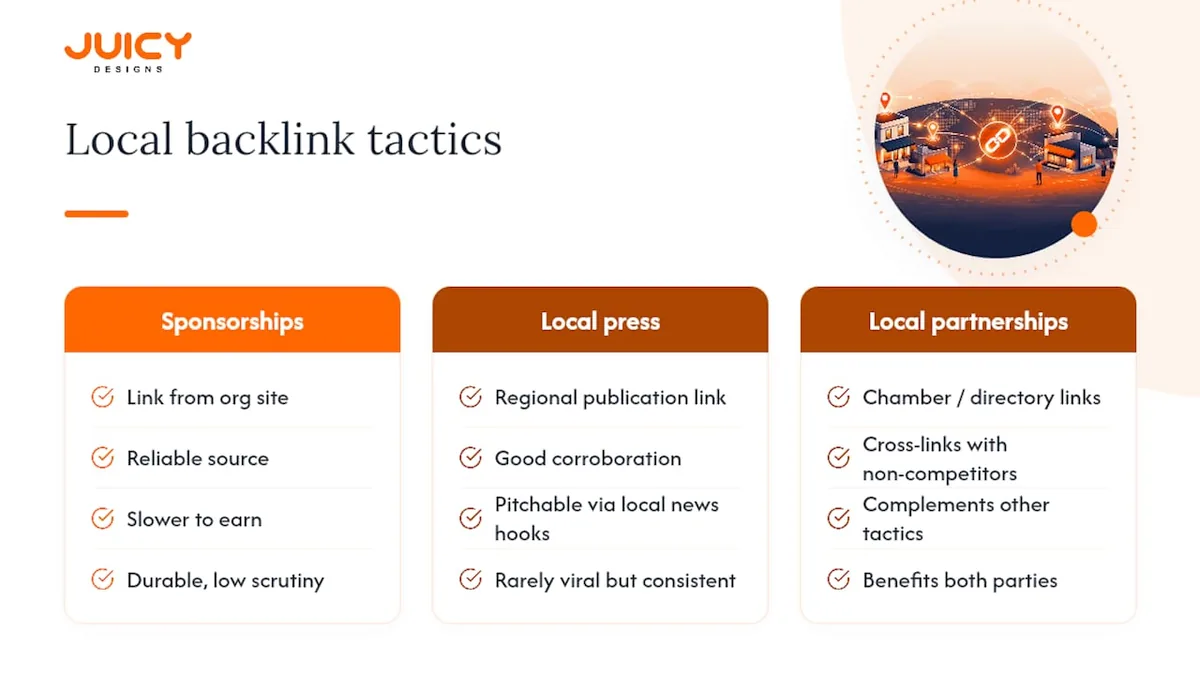
Local backlinks work differently than national ones. A single link from a suburb's community newsletter or a regional business association carries more local ranking weight than a generic national directory link, because it signals genuine geographic relevance to search engines.
Sponsorships are one of the most reliable sources. Sponsoring a school fundraiser, a local sports team, or a community event near a specific branch typically earns a link back from that organisation's website, tied directly to the neighbourhood that location serves. It's slower than buying links, but it's durable and it rarely triggers the kind of scrutiny that manipulative link schemes do.
Local press coverage compounds this. A new branch opening, a milestone anniversary, or a locally relevant charity partnership are all legitimate hooks for a short pitch to a regional publication or local news site. These stories rarely go viral, but they consistently produce the kind of location-specific, third-party corroboration that both search engines and AI recommendation systems treat as a trust signal.
Chamber of commerce memberships, local business directories tied to a specific municipality, and partnerships with complementary (non-competing) local businesses round out a realistic local PR programme. A hardware store and a local landscaping company cross-linking to each other's location pages, for instance, benefits both without any conflict of interest.
Track backlinks per location, not just as a company-wide total, so you can see which branches are falling behind on third-party corroboration and prioritise outreach accordingly.
Should you run paid search alongside your local SEO efforts?
Local paid search and organic multi-location SEO work best as a coordinated pair, not two separate budgets managed by different teams. A Google Ads campaign built around location extensions, running per branch rather than as one national campaign, captures the exact searchers your organic pages are also trying to reach, and the two channels reinforce each other in the map pack and beyond.
The most efficient use of paid budget is filling gaps, not duplicating strength. A newer location with a thin review history and low organic visibility benefits far more from a well-targeted local campaign than a flagship branch that already dominates its local map pack organically. Reviewing organic performance per location before setting paid budgets prevents wasted spend on branches that don't need the extra push.
Location-specific ad copy and landing pages matter as much in paid as they do in organic. An ad that sends a searcher to a generic homepage instead of that branch's own location page loses the local relevance the campaign was built to capture, and it usually shows up as a lower quality score too. Keep paid and organic pointing to the same, dedicated location page, never a shared template.
Budgets should flex with what the data shows each month rather than staying fixed. A location with rising organic visibility can usually reduce its paid spend gradually, while a struggling branch may need a temporary increase while its review count and content catch up.
How do you handle duplicate listings and location closures?
Duplicate listings are one of the most common and most damaging problems in multi-location SEO, and they usually appear for one of three reasons: a previous agency or franchisee created a second profile without realising one existed, a location moved and Google generated a new listing instead of updating the old one, or two similar business names got merged incorrectly by Google's own systems.
Finding duplicates requires a direct search of your business name and city combination across Google, Bing, and major directories, then flagging every result that doesn't match your master repository. Google allows merging duplicate profiles through its support tools once ownership is verified, and the sooner a duplicate is caught, the less damage it does to review counts split across two listings instead of consolidated on one.
Closures need a defined process, not an afterthought. When a location shuts permanently:
- Mark the Google Business Profile as permanently closed rather than deleting it outright, which preserves the historical record and prevents a confusing reopening later.
- Remove the page from your sitemap and set a 301 redirect to the nearest active branch.
- Update every citation and directory listing to reflect the closure, or remove the listing entirely where the platform allows it.
- Notify customers through the profile itself and any local PR contacts built up over time.
A location that quietly disappears from the website but stays live and unmanaged across ten directories creates exactly the kind of inconsistent data that undermines trust signals for the rest of the business. Treat closures with the same discipline as openings, working from the same master repository every time.
Why founder-led execution changes multi-location outcomes
Direct founder involvement shortens the distance between a field-level problem and a fix. When the person making strategic calls also fields the daily questions from location managers, decisions happen in hours, not sprint cycles. Most multi-location mistakes trace back to fragmented data. No one owned the master repository, so three teams edited it three different ways. A disciplined repo with one accountable owner prevents most of the damage before it starts. If nothing else, run an audit this month.
, Cobus
How Juicy Designs helps multi-location businesses grow visibility
This agency is an alternative to hiring a large agency layered with account managers between you and the people doing the work. Clients work directly with the leadership team, which means key tasks such as master repository audits, Google Business Profile fixes, schema implementation, and review-growth programmes are handled by the same accountable team, not passed through multiple layers of account management.
Pricing is flexible without long-term contracts, allowing businesses to test multi-location SEO without being locked into long retainers before assessing fit.
If your locations are inconsistent across listings, thin on local content, or losing ground on reviews, a full-service digital marketing agency built around measurable results is worth a direct conversation. Start with an audit request through the SEO services page and get a clear view of what's fixable first.
Sources
Not every directory deserves equal attention, and chasing all of them wastes budget that could go towards higher-impact work. A simple tiering approach keeps citation management manageable as location count grows.
- Multi-Location SEO: How To Win Google & AI Search Visibility At Scale
- Multi-location SEO: How to structure geographic pages at scale
- How Google determines local search results
For businesses with ten or more locations, manually checking every directory for consistency stops being realistic. Citation discovery tools like Whitespark and GeoRanker can surface overlaps and gaps across dozens of cities far faster than a manual spreadsheet audit, and they flag duplicate listings before they turn into suspension risks.
Fixing inconsistent citations follows a predictable pattern: search your business name and phone number as a phrase, note every result that shows outdated hours, a wrong address, or a duplicate profile, then correct or merge each one against your master repository. Do this quarterly at minimum, monthly if you're opening or closing locations often.
A dedicated listings management platform earns its cost once you cross roughly fifteen to twenty locations, where the manual audit time starts costing more than the software itself. Below that threshold, a well-maintained spreadsheet and a disciplined quarterly review usually does the job.
FAQ
Is SEO Still Worth It in 2026?
Yes. AI-driven recommendation systems and traditional search both depend on accurate business data, strong reviews, and well-built location pages, and businesses that ignore multi-location SEO strategies lose visibility on both fronts simultaneously.
What Are the Four Types of SEO?
The four main types are on-page SEO (content and site structure), off-page SEO (backlinks and citations), technical SEO (schema, sitemaps, indexing), and local SEO, which covers Google Business Profile optimisation and location-specific ranking factors.
What Is Multi-Location SEO?
Multi-location SEO is the process of optimising search visibility for every physical branch or service area of a business individually, using a verified Business Profile, a unique location page, and consistent citations for each address.
How Do I Know If a Location Needs Its Own Page?
If it has a physical, customer-facing address with its own hours, staff, or services, it needs a dedicated location page and a verified Google Business Profile rather than sharing a page with another branch.
Recommended
- Local SEO for Multi-City Service Businesses
- GEO Reporting, Analytics and Integrations (2026)
- Local SEO South Africa: Rank in the Google Map Pack
- Local SEO and Google Business Profile in South Africa