
1-2 Hour SLA For Online Review Management: Public First Playbook
Adopt a public‑first, private‑second review system with 1-2 hour SLAs, ready reply templates, and a Juicydesigns case study to scale monitoring and responses.
Online review management is the ongoing practice of monitoring, responding to, and acting on customer reviews across every platform where your business gets rated.


TL;DR: Quick Answer
Adopt a public‑first, private‑second review system with 1-2 hour SLAs, ready reply templates, and a Juicydesigns case study to scale monitoring and responses.
Online review management is the ongoing practice of monitoring, responding to, and acting on customer reviews across every platform where your business gets rated. It differs from broader online reputation management because it focuses on one specific, repeatable job. The first move, before anything else, is to claim and actively monitor your primary Google Business Profile and any industry-specific listing that matters to your category.
TL;DR:
- Review responses should be prioritised by urgency, with negative reviews about safety or legal issues addressed within 1 to 2 hours.
- Consistent, timely replies to reviews boost local search rankings, customer trust, and repeat business, especially when addressing complaints publicly.
- Monitoring should be automated with alerts, sentiment scoring, and draft replies approved by humans to handle high volume across multiple platforms efficiently.
- Multi-language reviews require responses in the original language or professional translation, considering cultural norms to maintain effective communication.
- Clear escalation pathways are vital for handling reviews about discrimination, injury, or fraud, with documented patterns helping identify operational issues early.
What is online review management (and how it differs from reputation management)?
Online review management is a focused, ongoing system built around three actions: watching for new reviews, replying to them, and using what they reveal to improve the business. Reputation management is the wider umbrella. It includes press coverage, social sentiment, search results about your brand name, and how executives are perceived. Review management sits inside that umbrella as the most frequent, most measurable piece of the work.
The distinction matters because businesses that treat the two as identical usually end up doing neither well. Reputation management gets handled quarterly, in broad strokes, often by someone senior. Review management needs daily attention, because reviews arrive constantly and unattended negative feedback compounds fast.
Reviews show up in more places than most owners track:
- Search profiles (Google Business Profile, Bing Places)
- General marketplaces and directories (Yelp, Hello Peter, industry directories)
- App stores, for businesses with a mobile app
- Social platforms (Facebook recommendations, TikTok comments)
- Niche or vertical sites (TripAdvisor for hospitality, medical review sites for healthcare)
Ownership of the function should sit with marketing or customer experience, not with whoever happens to check Google occasionally. In smaller teams, one person owns monitoring and drafts replies; a manager approves anything sensitive before it posts. In larger operations, this becomes a defined role with its own service level agreement, which we cover further down.
Why review management matters for revenue, trust and SEO
Reviews influence buying decisions before a customer ever speaks to your sales team, and they influence how visible you are in search before that. Both effects are measurable, and both respond directly to how consistently you manage the feedback coming in.
Consumers actively favour businesses that respond. Survey data referenced across the industry shows a strong consumer preference for brands that engage with their reviews rather than ignoring them. A business with a pile of unanswered one-star reviews signals neglect, regardless of how good the product actually is.
The SEO angle is often underestimated. Search engines treat review recency, volume, and owner responses as freshness and engagement signals tied to your business profile. A profile with reviews from three years ago and no replies reads, to both searchers and algorithms, as a business that has gone quiet.
Three business outcomes tie directly back to review management:
- Conversion lift. Recent, responded-to reviews raise click-through and contact rates from your business listing.
- Local visibility. Active review activity supports stronger rankings in local search packs.
- Retention. Customers who see their complaint addressed publicly are more likely to return, and many businesses still fail to respond at all, which leaves an easy opportunity on the table for competitors who do.
Replying to reviews isn't just damage control. It's a low-cost retention lever that most businesses leave unused, and the ones that use it consistently tend to see it show up in repeat purchase rates over time.
Operational workflow: generate, monitor, respond, showcase, analyse
Treat review management as a loop, not a task list. Monitoring feeds triage, triage feeds response, response feeds resolution, and resolution feeds analysis that improves the product or service. Run this loop weekly at minimum, daily if you have any meaningful review volume.
1. Generate reviews ethically. Ask at the right moment, not randomly. The strongest trigger points are right after a successful delivery, a resolved support ticket, or a completed service visit, while satisfaction is still fresh. Automated post-purchase emails or SMS messages sent at these moments meaningfully increase the volume of authentic reviews, and integrating the request with your ecommerce or CRM system makes delivery reliable instead of ad hoc. Never offer payment or discounts in exchange for a positive review. It breaches most platform policies and, in South Africa, risks falling foul of misleading-conduct provisions under consumer protection law.
2. Monitor and prioritise. Set up alerts across every platform where you appear, then triage by urgency rather than reading reviews in the order they land. A useful triage model weighs sentiment score, reviewer influence, and issue severity together. A one-star review alleging a safety issue jumps the queue ahead of a three-star review complaining about parking.
3. Respond within a defined window. Speed matters more than most business owners assume. Aim to acknowledge negative reviews within 1 to 2 hours during business hours, with full resolution or a move to private conversation inside 24 to 72 hours depending on complexity. Thank positive reviewers quickly too. It costs nothing and reinforces the relationship.
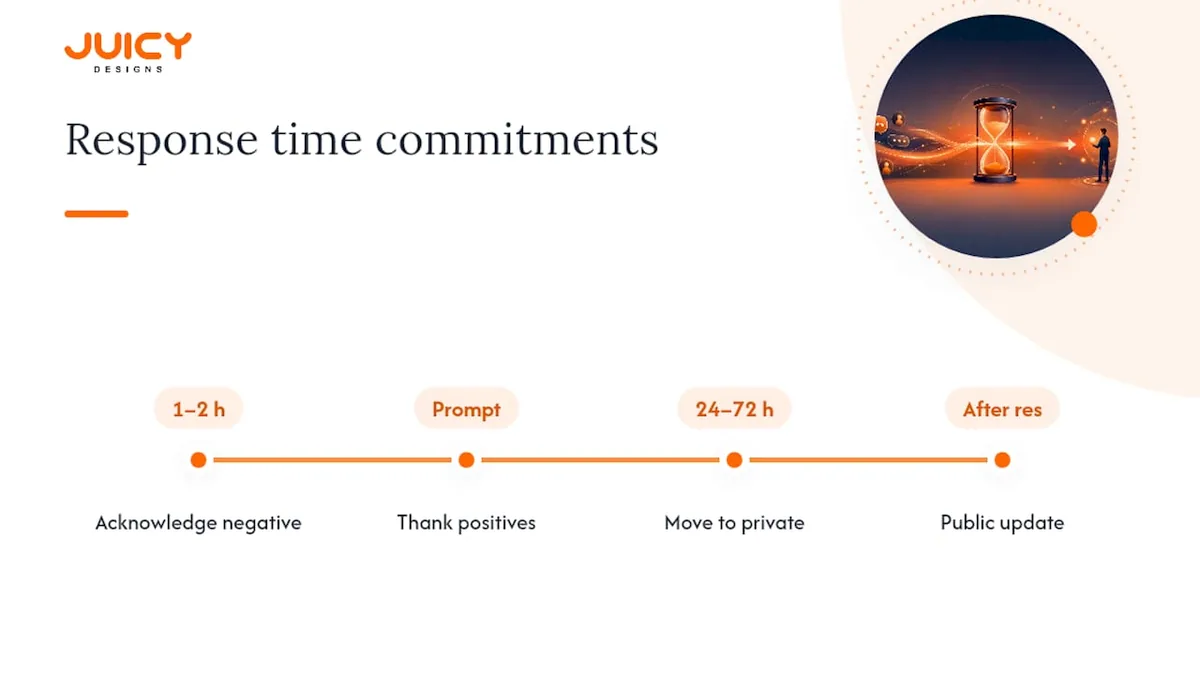
4. Resolve issues offline, then close the loop publicly. Once you have taken the detailed conversation to phone or email, post a short public update confirming the outcome. This reassures the next searcher that the issue didn't just vanish into a support inbox.
5. Showcase strong reviews. Feature standout reviews on your website, in social proof sections, and in sales materials, with the reviewer's permission where required. This is the "showcase" step most workflows skip, and it's often the easiest win in the whole loop.
6. Analyse for patterns. Once a month, pull every review with a rating below four stars and look for repeated complaints. If three customers in a month mention slow delivery, that's not three isolated incidents. That's a process problem worth escalating to operations.
Pro Tip: Keep a simple shared spreadsheet or dashboard tagging each negative review by root cause (pricing, staff, product, delivery, communication). After eight weeks, the pattern usually points straight at the fix, long before a formal audit would catch it.
Escalation needs a clear path before you need it, not after. Define upfront who handles a review alleging discrimination, injury, or fraud versus who handles a review about a late delivery. The first category goes straight to a manager or legal contact; the second stays with the front-line team.
Reply templates and examples for positive, neutral and negative reviews
The single most important rule in review response is public-first, private-second. Reply to the review publicly first, in a professional and specific tone, then invite the customer to continue the conversation privately by phone, email, or direct message. Jumping straight to "please DM us" without a public acknowledgement looks evasive to everyone else reading that review.
Starting with a public, professional reply and then moving details offline demonstrates accountability to every future customer who reads that thread, not just the person who wrote it.
This approach works because it does two jobs at once: it resolves the individual complaint, and it shows every future searcher how your business handles problems when they go wrong.
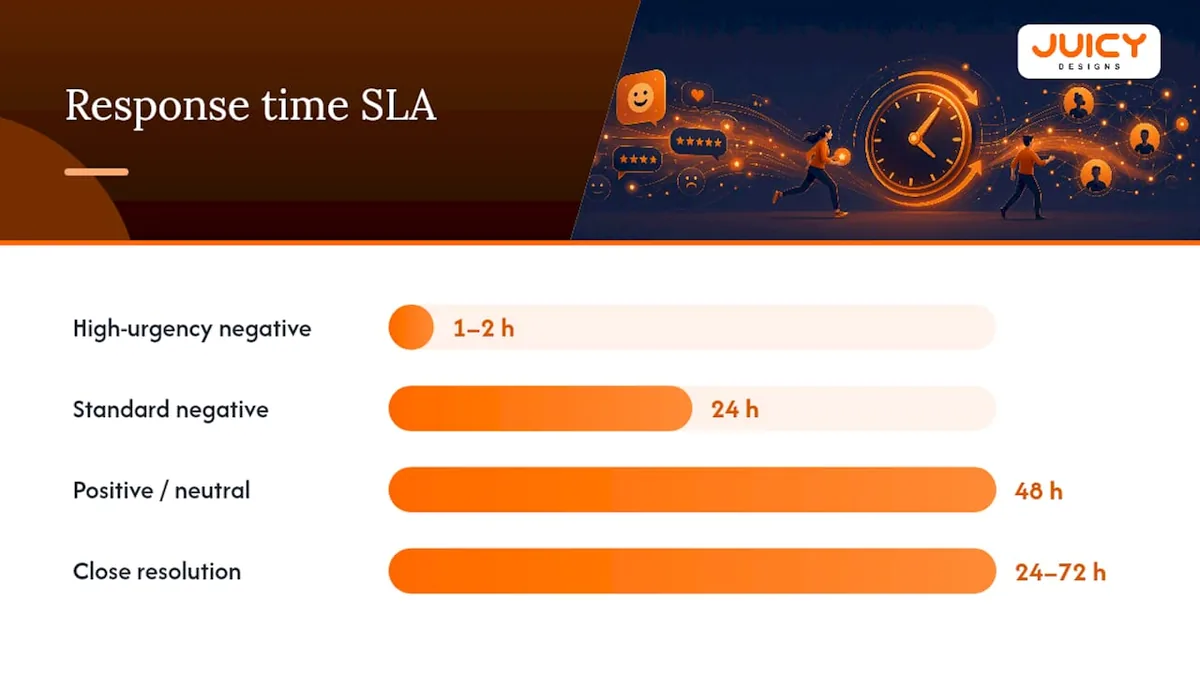
Response time benchmarks worth adopting as an SLA:
- Acknowledge high-urgency negative reviews within 1 to 2 hours during business hours
- Acknowledge standard negative reviews within 24 hours
- Reply to positive and neutral reviews within 48 hours
- Close out resolution (public or private) within 24 to 72 hours depending on complexity
Three short templates cover most situations, though every reply should be edited to reference specifics from the actual review, never pasted verbatim:
Positive review reply: "Thank you for taking the time to share this, [Name]. We're glad the [specific detail they mentioned] worked out well for you, and we'll pass your kind words on to the team."
Neutral or mixed review reply: "Thanks for the honest feedback, [Name]. We're pleased [positive point] worked well, and we'd like to understand more about [specific concern] so we can improve. Please reach us at [contact] when you have a moment."
Negative review reply: "We're sorry to hear about your experience with [specific issue], [Name]. This isn't the standard we hold ourselves to, and we'd like to make it right. Could you contact us directly at [contact] so we can resolve this quickly?"
Compensation or remediation should be reserved for cases where the business genuinely fell short of a service promise, refund policy, or warranty. Offering discounts reflexively to every complainer trains customers to leave a bad review as a negotiating tactic. Reserve it for verified failures, and always process it through the private channel, not in the public thread.
Tools, automation and AI: categories and safe automation patterns
A manual check process, someone logging into each platform weekly, works fine for a single-location business with a handful of reviews a month. Past that volume, or across multiple locations, you need a centralised dashboard with automated triage pulling every platform into one view.
Three automation patterns cover most legitimate use cases:
- Alerting. Instant notification when a new review lands, filtered by star rating so urgent negative feedback surfaces first.
- Sentiment triage. Automated scoring that flags tone and urgency before a human reads the review, cutting the time spent scanning low-priority feedback.
- AI draft, human approve. AI tools can generate a first-pass reply instantly, but a person reviews and adjusts it before it posts, especially for anything sensitive.
That last pattern is where most businesses get automation wrong. Templates and AI drafts should be scaffolds, not final copy. Multi-location brands in particular need to guard against a reply that reads technically correct but sounds nothing like the business's actual voice. A tool like an AI-assisted marketing workflow can speed up drafting, but it still needs a person checking tone before anything goes live.
Integrating review monitoring with your CRM or helpdesk means a flagged complaint automatically opens a support ticket instead of sitting isolated in a review feed. Be careful with data privacy here. Never pull customer personal details into a public reply, and check what customer data any third-party review tool stores and where.
Pro Tip: If you adopt AI-assisted drafting, keep a "banned phrases" list for your brand, the same corporate filler that makes every reply sound identical. Reviewers can tell when a response was copy-pasted from a template, and it undoes the trust the reply was supposed to build.
Scaling and governance: SLAs, brand voice and audits
Consistency breaks down fastest at scale, when five locations or three team members are all replying to reviews with no shared rulebook. Governance fixes that before it becomes a visible problem.
A workable SLA matrix looks like this:
Brand voice governance keeps every reply sounding like one business, not five different people improvising:
- Define three to five tone words for your brand (warm, direct, formal, playful) and check drafts against them.
- Maintain a living template library, updated quarterly, not written once and forgotten.
- Route anything mentioning legal threats, injury, or discrimination straight to a manager, never a front-line template.
- Run a monthly quality audit: pull ten random replies and score them against the brand voice checklist.
- Train new team members on the escalation path before they're allowed to reply solo.
Routing rules matter as much as response speed. A review mentioning a slip-and-fall or a discrimination complaint needs to bypass the standard queue entirely and land directly with whoever handles legal risk, not sit in a general inbox until someone gets to it.
Measuring impact: KPIs, dashboards and reporting templates
Six metrics tell you whether the system is working: average rating, response rate, average response time, review volume, sentiment trend, and conversion lift.
Attribution is the tricky part. You cannot always draw a straight line from "we replied faster" to "revenue went up." The more reliable approach is running controlled experiments, testing updated review content on a landing page against a control, and tracking click-throughs from enriched search snippets that display star ratings.
A monthly dashboard should include:
- Average star rating, trended over the last 12 months
- Response rate (percentage of reviews replied to) and average response time
- New review volume by platform
- Sentiment trend, flagging repeated complaint themes
- Conversion or contact-rate changes tied to profile activity
Report monthly to leadership, and weekly internally if review volume is high enough to warrant it. Pair this with social sentiment tracking for a fuller picture of how the brand is perceived beyond star ratings alone.
Juicydesigns evidence: a case study in what the system actually delivers
Review and feedback loops aren't theoretical for us. Faster, more consistent review responses fed directly into stronger local visibility and higher-trust search snippets.
Author Cobus leads Juicydesigns with a founder-direct approach: no account managers between you and the person actually running your campaign. That model applies to review management the same way it applies to paid media and SEO, tied to a proven average return on ad spend of 4.8x across client accounts, nearly double the typical industry benchmark.
A typical review management engagement runs a two-week setup (profile audits, dashboard configuration, template library), followed by ongoing monthly management with weekly reporting.
Handling multi-language and multicultural reviews
South African businesses routinely get reviews in English, Afrikaans, isiZulu, and other languages within the same platform, sometimes within the same week. Ignoring anything not in English is a common mistake, and it signals to non-English reviewers that they're an afterthought.
Reply in the language the review was written in wherever your team can manage it competently. A short, genuine reply in the reviewer's own language carries far more weight than a polished English response that ignores the original wording. If nobody on your team speaks the language confidently, a professional translation service is worth the small cost for anything beyond a simple thank-you. Machine translation tools have improved, but they still misfire on idiom and tone, which is exactly where a review reply can go wrong in a way that reads worse than saying nothing.
Cultural context matters as much as language. A direct, blunt complaint style common in one cultural context can read as unusually harsh in another, and a warm, indirect compliment in one culture might read as vague in another. Train whoever handles replies to recognise these differences rather than assuming every review follows the same conversational norms.
Track review language as a data point in your monitoring dashboard. If a meaningful share of your reviews arrive in a language your current templates don't cover, that's a gap in your reply system worth fixing before volume grows further.
Dealing with coordinated attack reviews or review bombing
Review bombing happens when a coordinated group posts a wave of negative reviews in a short window, often unrelated to any actual customer experience, usually triggered by a controversy, a social media pile-on, or a competitor-driven campaign. It looks distinctly different from organic negative feedback: a sudden spike in one-star reviews within hours, generic or repetitive language across multiple reviews, and accounts with no other review history.
The first step is documentation, not panic. Screenshot every suspicious review, including timestamps and account details, before anything gets edited or deleted. This record matters if you need to report the pattern to the platform.
Report the cluster to the platform directly. Google, Yelp, and most major platforms have policies against reviews that don't reflect a genuine customer experience, and a documented pattern of coordinated, non-genuine activity gives you grounds for removal requests.
Resist responding to every single review in the wave individually with a defensive tone. A short, calm, consistent public statement addressing the situation once, pinned or referenced where possible, reads far better than a dozen increasingly frustrated individual replies. Continue responding normally to any genuine reviews mixed into the wave. Don't let the noise stop you from handling real feedback properly.
Legal and compliance considerations in online review management
Fake or incentivised reviews carry real legal risk, not just a platform policy violation. Paying for reviews, or offering discounts explicitly in exchange for positive ones, breaches most platform terms of service and can expose a business to action under consumer protection law for misleading commercial practices.
Removal requests need to follow the platform's actual process, not a business owner's judgment about what "should" be removable. Google, Yelp, and other platforms allow removal requests for reviews that violate content policies, spam, hate speech, conflicts of interest, or clearly fabricated content, but a genuine negative review about a real experience will not be removed simply because it's damaging.
Never publish a customer's personal information (medical details, financial information, home address) in a public reply, even in response to a review that included such details itself. Data protection obligations under South Africa's Protection of Personal Information Act apply to how you handle any personal data collected through the review process, including anything gathered during a private resolution conversation.
Employees posting fake positive reviews of their own employer, or soliciting friends and family to do so, creates both a policy violation and a reputational risk if discovered, which happens more often than businesses expect once platforms start flagging suspicious review clusters tied to a single IP range or device.
When in doubt on a specific removal request or a review that raises defamation concerns, a quick consultation with legal counsel is worth more than guessing. This is general guidance, not a substitute for advice on your specific situation.
Integration of online review management with overall digital marketing strategy
Review management works best woven into the rest of your marketing, not run as an isolated task disconnected from everything else. Star ratings and review snippets appear directly in search results, which means your review activity directly affects the performance of your organic and paid search efforts.
Feed standout review content into your social media calendar, website testimonials section, and even ad creative where platform policy allows it. A five-star review mentioning a specific product benefit often makes better ad copy than anything a copywriter would draft from scratch, because it carries the credibility of a real customer's own words.
Local SEO and review management are close to inseparable. A strong SEO strategy for a local business depends heavily on consistent review activity and profile completeness, and the two functions should be planned together rather than assigned to separate people who never compare notes.
Customer feedback surfaced through reviews also belongs in product and service planning meetings, not just marketing reports. If reviews keep flagging the same friction point, that's marketing data pointing straight at an operational fix, and treating it purely as a PR concern wastes the insight.
Best practices for leveraging reviews across multiple platforms
Google Business Profile carries the most weight for most businesses because it sits directly in local search and Maps results. Keep it fully complete, respond to every review, and post updates regularly, since an inactive profile signals neglect to both searchers and the algorithm.
Yelp rewards a slightly different approach: detailed, specific replies tend to perform better than generic ones, and Yelp's own guidance backs the public-first, private-second approach explicitly.
Industry-specific platforms (TripAdvisor for hospitality, HelloPeter for South African consumer complaints, medical and legal directories for professional services) often carry more weight with a specific buyer than a general platform does, simply because that audience trusts the vertical site's specialised context.
Don't spread review requests evenly across every platform regardless of relevance. Concentrate your ask on the two or three platforms your actual customers check before buying, and monitor the rest passively rather than chasing volume everywhere at once.
How to handle spam, fraud and removal requests
Spam reviews typically show obvious tells: generic phrasing with no specific detail about your business, posting patterns that spike unnaturally, or content that's clearly promotional for an unrelated business rather than a genuine customer opinion.
Fraudulent reviews, meaning reviews from someone who was never actually a customer, require a different response than a genuine negative review you simply disagree with. Report suspected fraud through the platform's formal reporting tool rather than replying publicly and accusing the reviewer of lying, which almost always looks worse to onlookers than staying quiet and letting the report process run.
Keep records of every removal request you file, including the date, the platform's response, and the outcome. If a pattern of fraudulent reviews keeps recurring from the same source, that documentation becomes valuable if you ever need to escalate further.
Genuine negative reviews, even harsh ones, don't qualify for removal just because they hurt. Platforms are generally consistent on this point: a real customer's real complaint stays up, and the correct response is a good public reply, not a removal request that will get rejected anyway.
Founder-led perspective: common mistakes and quick wins
The three mistakes I see most often: businesses reply only to negative reviews and ignore positive ones, they let response time drift past 48 hours, and they never look for patterns across complaints. Two quick wins this week: reply to every unanswered review from the last month, and set up a simple alert for new reviews on your main profile.
Bring in an agency once volume outpaces what one person can handle consistently, or once you need multi-platform monitoring tied to broader SEO and paid strategy.
, Cobus
How Juicydesigns can help with review management
Juicydesigns is the alternative to a traditional agency for review management because there's no account manager buffer between you and the person actually running your campaign, and no long-term lock-in contract forcing you to stay if it isn't working. Our full-service digital marketing package covers monitoring, response templates, SLA setup, and reporting, built alongside local SEO so review activity and search visibility move together instead of sitting in separate silos.
Pricing runs on flexible monthly retainers and project-based arrangements, with no fixed-term contracts locking you in. Request a free audit of your current review presence and we'll show you exactly where the gaps are before you commit to anything. If paid visibility is part of the mix, our Google Ads management team can align campaign messaging with what your reviews are already telling customers. A typical first engagement starts with a two-week setup phase, then moves into ongoing monthly management with weekly check-ins.
Sources
- What is Online Review Management? - BrightLocal
- Business
- Review Management: The Complete Guide for 2026| Sprinklr
FAQ
What is the main difference between SEO and online reputation management?
SEO focuses on ranking pages and profiles in search results, while reputation management covers the broader perception of your brand across reviews, press, and social sentiment; review management is the operational piece connecting both.
What companies pay you to write reviews?
No legitimate company should pay for reviews. It breaches nearly every platform's terms of service and risks action under consumer protection law for misleading commercial practices.
Can you give examples of online reputation management in practice?
Examples include monitoring Google Business Profile reviews, responding publicly to a negative TripAdvisor review before resolving it privately, tracking social media sentiment, and correcting inaccurate business listings across directories.
How much does online reputation management cost?
Costs vary widely by scope, but a managed monthly retainer for review and reputation management with an agency like Juicydesigns typically starts from a moderate monthly fee, depending on platform coverage and reporting needs.
How quickly should a business respond to a negative review?
Aim to acknowledge high-urgency negative reviews within 1 to 2 hours during business hours, with full resolution or a move to private conversation within 24 to 72 hours depending on complexity.
Recommended
- Online Reputation Management South Africa
- How to Respond to Negative Comments on Your Business Page
- How to Get More Google Reviews the Right Way
- How Reviews and Testimonials Grow Your Business