
People Also Ask: 40-60 Words for AI Visibility
Optimise for People Also Ask and AI visibility with 40-60 word answers, question research tools, measurement, and Juicy Designs' audit checklist.
People Also Ask: 40-60 Words for AI Visibility ! SEO specialist editing concise question answers The fastest way to improve your People Also Ask visibility is to turn the target question into an H2 or H3 and place a concise 40-60 word answer directly beneath it, matching the exact format Google already shows for that query.


TL;DR: Quick Answer
Optimise for People Also Ask and AI visibility with 40-60 word answers, question research tools, measurement, and Juicy Designs' audit checklist.
Key takeaways
- Very cheap quotes (under R5,000) almost always exclude copywriting, SEO, custom design and post-launch support
- On-page SEO built into the website at launch costs a fraction of what it costs to retrofit after the site is live
- Hosting, SSL, domain and maintenance add R3,000-R10,000 per year on top of build cost
- E-commerce adds significant cost due to payment gateway integrations, product data, security requirements and checkout UX
- Timeline and client responsiveness directly affect cost: slow feedback rounds extend agency hours

The fastest way to improve your People Also Ask visibility is to turn the target question into an H2 or H3 and place a concise 40-60 word answer directly beneath it, matching the exact format Google already shows for that query. Matching answer length and structure matters, but so does keeping that content crawlable. The sections below walk through discovery, formatting, technical checks, and measurement.
TL;DR:
- Collect PAA questions from Google, AlsoAsked, and keyword tools, then prioritise recurring, commercially relevant queries and map each to an existing page before creating content.
- Use paragraphs for factual or why questions, numbered steps for how to queries, and tables or paired contrasts for comparisons; lead with the answer.
- Render answers in initial HTML, use semantic headings and lists, and check crawler access; FAQPage schema can clarify structure but does not guarantee placement.
- Track PAA placements and compare organic clicks and CTR; review competitive topics monthly, stable topics quarterly, and investigate source swaps.
- Refresh pages already ranking on page one, consolidate duplicate answer blocks, update the modification date, and request recrawling so Google can process the changes.
What People Also Ask is and how it behaves on the SERP
People Also Ask (PAA) is the expandable accordion of related questions that Google inserts into search results, usually a few lines beneath the top organic listings or woven between them. Each question hides a snippet pulled from a web page, and clicking one often reveals two or three more questions underneath it, a pattern that keeps expanding as users interact.
Google pulls these answers in several shapes depending on the question type, according to Search Engine Land's SERP features guide:
- A short paragraph for definitional or factual questions.
- A numbered or bulleted list for process and "how to" questions.
- A table for comparison or data-heavy questions.
- An AI-generated overview summarising multiple sources.
- An image or video thumbnail for visual queries.
PAA now shows up in roughly 40 to 52% of search results, which makes it one of the more common SERP features worth building content around rather than ignoring.
Why PAA matters now: traffic impact and AI/AEO context
Search behaviour has shifted towards answers delivered on the results page itself rather than on the page you click through to. That shift raises the stakes for PAA: if your content never earns a slot, it never gets the exposure that slot provides, even when you rank well in the standard organic list.
a notable share of PAA answers were AI-generated in a mid-2025 analysis of 8.4 million results, according to Search Engine Land's study on Google's PAA generation. That means the large majority of PAA snippets still come straight from a web page, which leaves real room for well-structured content to win the slot instead of being replaced by a synthesised summary.
Winning a PAA placement also feeds into answer engine optimisation (AEO). When your content is structured clearly enough to be pulled into a PAA box, it tends to be structured clearly enough for large language models to extract and cite as well. The two goals, PAA visibility and AI citation, reward the same underlying habit: answer the question plainly, early, and in a format the system can lift without editing.
How to find and prioritise PAA questions
Building a target list starts with collecting every question variant tied to your topic, then narrowing that list down to the ones worth writing for.
- Pull the full question tree for your core topic from Google's own PAA boxes, clicking through several levels to surface the questions that only appear after expansion.
- Run the same topic through AlsoAsked to map how questions cluster and overlap across related searches.
- Check the "Questions" tab in your keyword research tool to catch phrasing variants that AlsoAsked and manual SERP checks miss.
- Cross-reference the three lists and flag questions that recur across multiple queries, since repetition signals genuine demand rather than a one-off phrasing.
Once you have a raw list, filter it before writing anything:
- Keep questions with meaningful search volume or clear commercial relevance, even at low volume, when they align with a page you want to rank.
- Drop zero-volume, one-off phrasings unless they map directly to a strategic buyer question.
- Match each surviving question to an existing page first; only build a new page when no current page fits the intent.
- Note whether the question needs a new section on an existing page or a dedicated standalone piece.
This mapping step matters more than the discovery step itself. A question with no home on your site becomes a page nobody will ever update.
How to craft answers that win: exact format, length and patterns
Google tends to favour a self-contained, 40-60 word answer sitting directly under a heading phrased as the question itself, according to Semrush's guidance on optimising for AI search engines. Brevity works in your favour twice over: it fits the space Google reserves for the snippet, and it gives large language models a clean, quotable block to extract without having to summarise a longer passage themselves.
Format has to match question type, not just length:
- "What is" questions call for a plain paragraph answer, no list needed.
- "How to" questions call for numbered steps, since that mirrors the sequence the reader actually needs.
- Comparison questions ("X vs Y") call for a short table or a two-item bulleted contrast.
- "Why" questions usually read best as a paragraph with one supporting reason stated plainly.
A reusable micro-template covers most cases: one direct answer sentence, one or two sentences of supporting context, and an optional example or short list. Write the answer sentence first, then build the supporting detail around it, never the reverse.
Pro Tip: Change one heading or one answer at a time, then watch whether the PAA source swaps to your page within two to four weeks before making a second edit.
Technical and site-readiness checklist for PAA and AEO
None of the formatting work matters if Google or an AI crawler cannot read the answer. A short checklist keeps the technical side from undoing the editorial side:
- Render the answer in the initial HTML response rather than behind JavaScript or a client-side accordion toggle.
- Use real semantic HTML, proper heading tags, paragraph tags and list tags, instead of styled divs that look like headings but carry no structural meaning.
- Add FAQPage schema as a supporting clarity layer, understanding that schema does not guarantee PAA placement on its own.
- Check robots.txt and any llms.txt file to confirm crawlers aren't blocked from the page carrying your answer.
- Keep page speed and DOM size light, since a heavier page slows down the crawl and extraction process for both traditional and AI systems.
- Set a review cadence, monthly for competitive topics and quarterly for stable ones, to catch stale answers before a competitor's fresher page takes the slot.
A page that passes every formatting rule but loads an answer only after a user clicks an accordion is, from a crawler's perspective, a page with no answer at all.
Tracking and reporting: how to measure PAA wins and when to act
Treat PAA placements as a metric you monitor on a schedule, not a one-time win you check once and forget.
- Add your priority PAA questions to a SERP-feature-aware rank tracker so you can see which URL is currently supplying the answer, including competitors' pages.
- Record placement changes alongside organic clicks and click-through-rate shifts for the same page, since a PAA win sometimes pulls clicks away from the standard listing even as it adds new ones.
- Watch for AI-citation signals where your tool provides them, treating a citation the same way you'd treat a PAA placement.
- Set an alert for overnight source swaps, since PAA sources can change without warning, and schedule a monthly audit pass to refresh any answer that's slipping.
Scaling PAA optimisation and recommended tooling
A handful of answers is manageable by hand. Dozens of pages across a growing site need a system instead.
- Build a templated answer block (question heading, 40-60 word answer, short supporting list) that writers can drop into any page without reinventing the format each time.
- Run an editorial calendar that assigns refresh dates to existing answer blocks, not just new ones.
- Use AlsoAsked for question-tree capture, a keyword tool's Questions tab for volume context, a SERP-feature tracker for placement monitoring, and a change-detection tool to catch source swaps early.
- Favour adding answer blocks to an established topical hub page over spinning up a new standalone page, since an authoritative hub tends to hold a PAA placement longer than a thin new page competing from zero.
Cobus and Juicy Designs: practitioner evidence and checklist
Cobus writes on search visibility and AI-driven discovery for Juicy Designs, where the day-to-day work includes auditing client content against exactly these PAA and AEO patterns.
Our PAA audit checklist covers:
- Answer-first placement directly under the question heading.
- Format matched to question type: paragraph, list or table.
- Schema added as a supporting layer, never a substitute for content quality.
- Page speed and server-rendering checks on every answer block.
- Monthly source tracking to catch competitor swaps early.
Guidance on avoiding common pitfalls when optimising for PAA
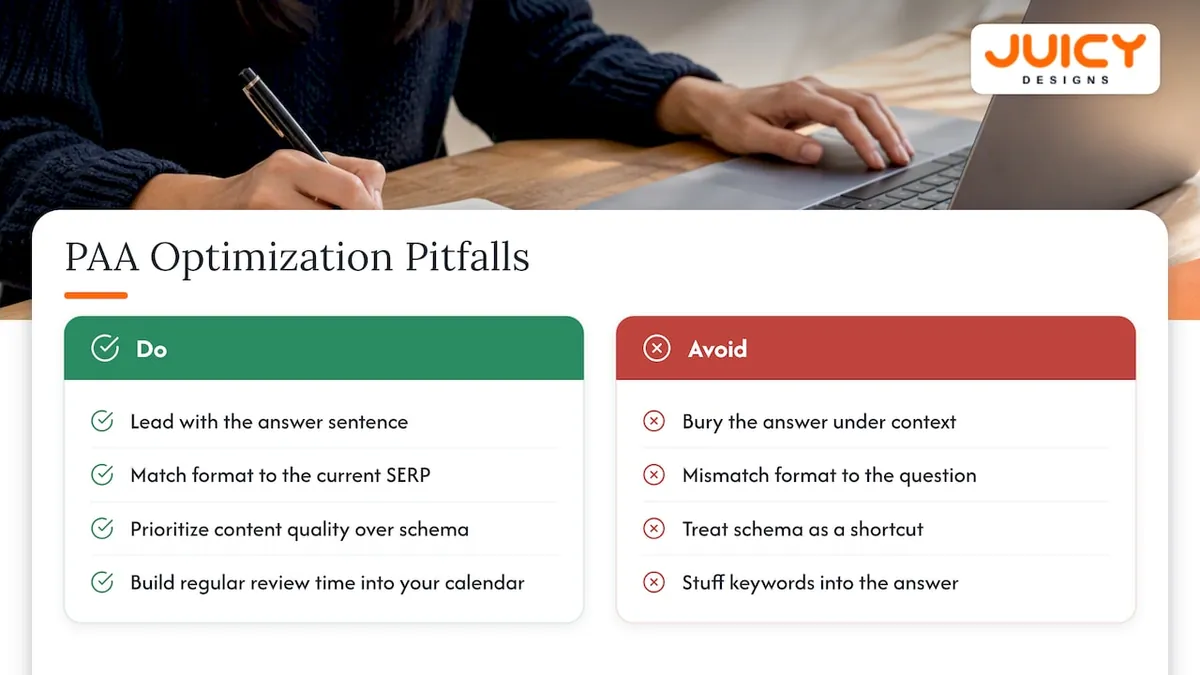
The most common mistake is burying the answer. Writers often open with three sentences of context before stating the actual answer, which pushes the useful snippet below the fold of what a crawler or an AI system will extract cleanly. Lead with the answer sentence, every time.
A second mistake is mismatched format: writing a flowing paragraph for a "how to" question that Google already answers with a numbered list elsewhere in the SERP. Check the current format before you write, not after.
A third mistake is treating schema as a shortcut. FAQPage schema clarifies structure but does not determine placement; content quality and format match carry far more weight, so teams that add schema and skip the content work rarely see a lift.
A fourth mistake is writing once and never revisiting. PAA sources rotate, sometimes within days, and an answer that won a placement in January can lose it by March if a competitor publishes a tighter version. Build review time into your calendar rather than treating PAA work as a single project with an end date.
Finally, watch for keyword stuffing inside the answer sentence itself. A 40-60 word answer has no room for repeated phrasing; every word has to carry meaning, or the sentence reads as unnatural to both readers and extraction systems.
Best practices for updating existing content to target PAA questions effectively
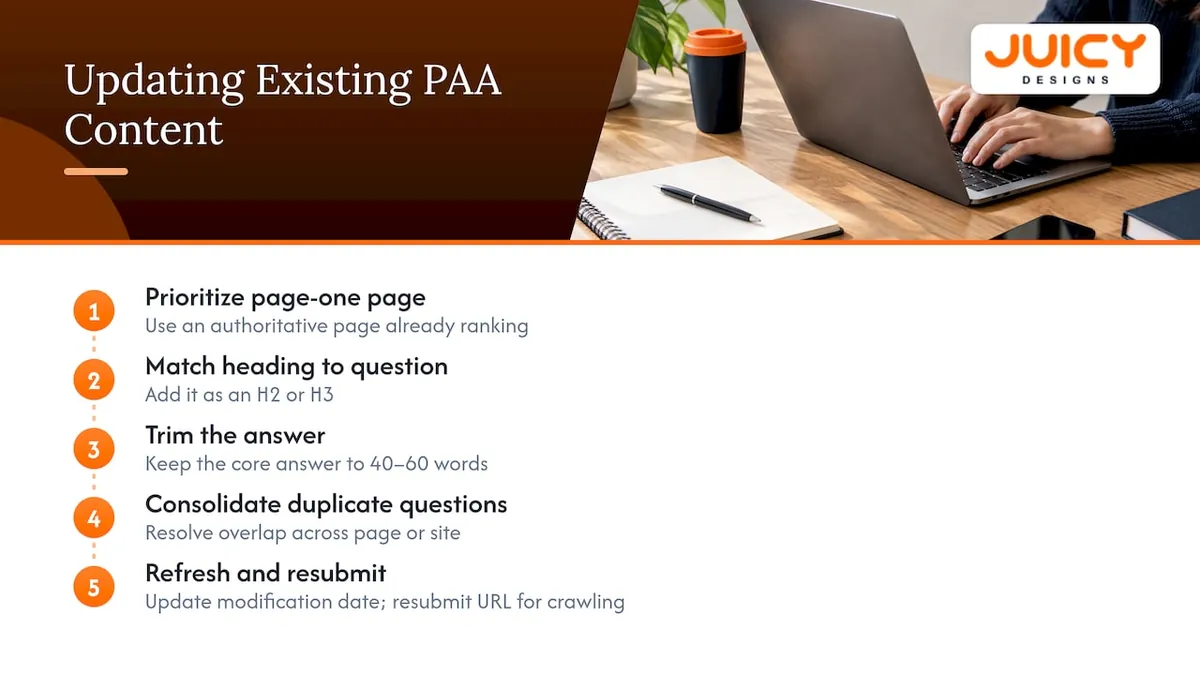
Start with pages that already rank on page one for the topic, since Google tends to pull PAA answers from pages it already trusts for that query. Adding a tightly formatted answer block to an existing, authoritative page usually outperforms publishing a brand new page from zero.
Audit the page's current heading structure first. If the relevant question isn't already phrased as its own H2 or H3, add it rather than hoping the surrounding paragraph gets extracted on its own. Google rewards a heading that mirrors the question almost exactly.
Trim the answer that follows the heading down to the 40-60 word range recommended by Semrush's AI search optimisation guide, moving any additional detail into supporting sentences or a short list after the core answer.
Check for duplicate or near-duplicate questions elsewhere on the same page or site, since competing answer blocks for the same question can confuse which URL Google treats as the authoritative source. Consolidate where you find overlap.
Finally, re-publish with an updated modification date where your CMS supports it, and re-submit the URL for crawling. A refreshed answer that Google hasn't recrawled yet gets no benefit from the edit.
Examples of successful PAA optimisation case studies to illustrate impact
Combined SEO, paid, and content work drove the lift, with PAA-style answer formatting as one contributing layer rather than the sole driver.
More broadly, the pattern holds across the SEO industry: pages built with question-formatted headings and answers in the 40-60 word range tend to hold PAA placements longer than pages where the answer is scattered across several paragraphs, according to Semrush's PAA opportunity study. Hub-and-spoke structures, where related questions sit together under one authoritative page, perform particularly well because they let a single page accumulate trust across many related queries instead of splitting that trust across several thin pages.
Short perspective: prioritise iterative edits and measurement
PAA shifts constantly. A programme of small, tracked edits beats a single big optimisation push, and pairing that work with reviews, citations, and PR mentions strengthens the AEO signals search systems weigh alongside format.
, Cobus
Juicy Designs services for PAA/AEO optimisation
We build PAA and AEO work directly into our SEO service work: question discovery, answer-block rewrites, schema support, and monthly placement tracking, all handled by the same founders who review your account, with no account manager layer in between. Our Once-off SEO audit starts from R8,000 and gives you a prioritised PAA target list, while our Foundation plan at R5,500 per month on the same SEO pricing page keeps answers refreshed on an ongoing basis. Reach out through our contact page to scope the right starting point for your site.
FAQ
What is People Also Ask and why does it matter for SEO?
People Also Ask is the expandable box of related questions Google shows on search results pages, pulling short answers directly from indexed web pages. It matters because it occupies prominent space on the results page itself, appearing in 40 to 52% of SERPs, which gives a well-structured page a visibility boost beyond its standard organic ranking.
How long should a PAA answer be?
Aim for a direct answer of 40 to 60 words, placed immediately under a heading phrased as the question itself, following the pattern Semrush recommends for AI search optimisation. Add supporting context or a short list after that core answer rather than before it.
Does FAQ schema guarantee a PAA placement?
No, FAQPage schema supports clarity but does not determine or guarantee placement, since PAA selection remains algorithmic and content-driven. Strong content and correct format matching matter far more than schema markup alone.
How often should I update content targeting PAA questions?
A monthly review works well for competitive topics, since PAA sources can swap without warning, while quarterly reviews suit more stable topics, a cadence echoed in Search Engine Land's PAA tracking guidance. Treat the work as ongoing rather than a single edit you complete once.
Can AI-generated answers replace my page in a PAA box?
Sometimes, but it's still the minority outcome: a notable share of PAA answers were AI-generated in a mid-2025 analysis, according to Search Engine Land's study on Google's PAA answers. A clear, intent-matching answer on your own page reduces the chance Google substitutes a synthesised summary in its place.
Sources
- What are SERP features? Types, benefits, and how to rank, Search Engine Land
- How to Optimise Content for AI Search Engines, Semrush
Recommended
- AI Search Visibility: Brand Presence in AI Results
- AI Overviews (Google): Google's AI Answer Feature
- AIO Visibility: Appearing in Google AI Overviews
- AI Overview Source: Pages Cited in Google AI Summaries