
Convert CPA Into Programmatic Ad Budgets, 65-75% Media (SA)
Turn your CPA or ROAS target into a working programmatic media budget. Learn how auctions, tech fees and formats shape costs, with South African examples.
Programmatic ads are sold mainly by CPM, but that number only tells you what you pay per thousand impressions, not what you pay per customer.


TL;DR: Quick Answer
Turn your CPA or ROAS target into a working programmatic media budget. Learn how auctions, tech fees and formats shape costs, with South African examples.

Programmatic ads are sold mainly by CPM, but that number only tells you what you pay per thousand impressions, not what you pay per customer. The real budgeting rule is to work backward from the CPA or ROAS your business needs and let that figure set your target CPM rather than the other way around. Platform fees, verification costs and management fees all sit between your budget and the media you actually buy, so the sticker CPM is never the full story.
TL;DR:
- Open auction buying is the cheapest but least predictable, with prices fluctuating based on demand and inventory quality influencing actual costs.
- Selecting the appropriate pricing model depends on campaign goals; CPA is best for conversions, while CPM suits brand awareness efforts.
- Actual programmatic costs often dip well below the proposal CPM due to fees, fraud, and viewability losses, sometimes leaving only 28% of spend reaching active media.
- Different formats have significantly varying costs and creative requirements, with connected TV being the most expensive and native ads priced in between display and video.
- Building a media budget based on target CPA or ROAS ensures better alignment with business outcomes, rather than relying solely on reported CPM figures.
What drives programmatic costs: auction types, targeting, inventory and seasonality
Three buying methods sit behind most programmatic CPMs, and each carries a different price and a different level of control. Open auction is the cheapest and least predictable: you bid against everyone else for available impressions, and prices swing with demand. Private marketplace deals reserve inventory from specific publishers at negotiated floor prices, usually costing more than open auction but delivering better context and lower fraud risk. Programmatic guaranteed locks in fixed inventory at a fixed price, closer to a direct buy than an auction, and commands the highest CPMs of the three.
Beyond the auction type, a handful of practical levers move your price:
- Narrow audience segments cost more because fewer bidders qualify, pushing up demand for that specific slice of inventory.
- First-party data used for targeting tends to raise CPMs but also raises relevance, which can lower your effective CPA.
- Publisher floor prices set a hard minimum for a given placement, and premium publishers set theirs higher than long-tail sites.
- Inventory quality (site reputation, ad placement, device type) shifts price independently of audience.
- Seasonality pushes CPMs up sharply around retail peaks such as Black Friday and the December shopping period, when more advertisers compete for the same eyeballs.
The MDPMI Final Report from South Africa's Competition Commission breaks down exactly how these auction types work and how DSPs, SSPs and ad servers each take a role in setting the final CPM. Understanding that chain matters before you accept a proposal at face value, since two agencies quoting the same CPM might be buying very different quality of inventory.
Pricing models: CPM, CPC, CPA, vCPM and when each is appropriate
Programmatic platforms bill in several currencies, and picking the wrong one for your objective is a common budgeting mistake.
- CPM (cost per mille) charges per 1,000 impressions and suits awareness campaigns where reach matters more than immediate action.
- vCPM (viewable CPM) charges only for impressions that meet a viewability standard, giving a more honest read on what you actually paid for eyes on screen.
- CPC (cost per click) charges per click and fits campaigns built around driving traffic, though it says nothing about what happens after the click.
- CPA (cost per acquisition) charges per completed action, such as a sale or a lead, and is the closest billing model to your actual business outcome.
- CPCV (cost per completed view) charges when a video plays to completion, a standard for video and connected TV campaigns judged on attention rather than reach.
You can estimate CPA from a CPM by dividing the CPM by 1,000 to get cost per impression, then dividing by your expected click-through rate and conversion rate. Performance-based billing suits advertisers with tight CPA targets and enough volume to let the algorithm optimise, while CPM still makes sense for brand campaigns where a direct sale is not the immediate goal. IAB South Africa's adspend report found that performance-based buying accounted for 44.0% of buys locally, a sign that outcome-linked pricing is already the preferred model for a large share of buyers.
Channel and format cost differences: display, video, native and CTV
Format choice changes both your unit cost and your creative budget, often by more than targeting does.
- Display CPMs sit at the lower end of the scale and work well for retargeting and always-on awareness.
- Video CPMs run higher than display because of production demands and stronger completion-rate measurement, typically billed on CPCV.
- Connected TV CPMs sit at the top of the range, reflecting premium, brand-safe inventory and audiences that resemble traditional TV viewers.
- Native ad units often price between display and video, trading a lower CPM for lower click-through rates than a well-placed video.
Creative costs scale with the format: a display banner can be resized cheaply across sizes, while a video or CTV spot needs its own production budget and cannot simply be shrunk from an existing asset. A practical sequence many advertisers use is to run cheaper display or native for broad awareness, then shift budget towards video or CTV retargeting once a prospect has shown interest, which spends the higher-cost format only on audiences already warmed up.
Turning a CPA or ROAS goal into a media budget
Building a defensible programmatic budget starts with the outcome, not the media plan.
- Set your target CPA or ROAS first. If you need a R500 CPA and expect a 2% conversion rate on landing page visitors, you can afford roughly R10 per click.
- Model the impressions required. Divide your click target by your expected click-through rate to estimate impressions needed, then multiply by your target CPM to get a rough media cost.
- Split the budget across media, tech and management. A common rule of thumb allocates around 65 to 75% to working media, 10 to 15% to platform and verification fees, and the remainder to agency or management fees.
- Test at small scale before committing. Run a starter budget for two to four weeks to validate your assumed conversion rate before scaling spend.
Three simple scenario splits illustrate how this shifts by stage:
- Starter: 70% media, 15% tech and verification, 15% management, focused on learning which segments convert.
- Growth: 75% media, 10% tech and verification, 15% management, once winning audiences are known.
- Scale: 80% media, 8% tech and verification, 12% management, as volume improves negotiating leverage on fees.
Pro Tip: Build your budget from the CPA backward every time. A CPM that looks cheap on a proposal can still produce an expensive customer if the audience or creative does not convert.
Hidden costs and measurement: tech tax, viewability and ad fraud
The CPM on a proposal is rarely what reaches working media. DSP, SSP and ad server fees each take a cut before your impression is even served, and verification tools add their own line item on top. Analysis referenced by The Media Online found that as little as 28% of programmatic spend may reach working media once tech tax, agency fees and fraud are accounted for. That is a wide gap between what you pay and what you actually buy.
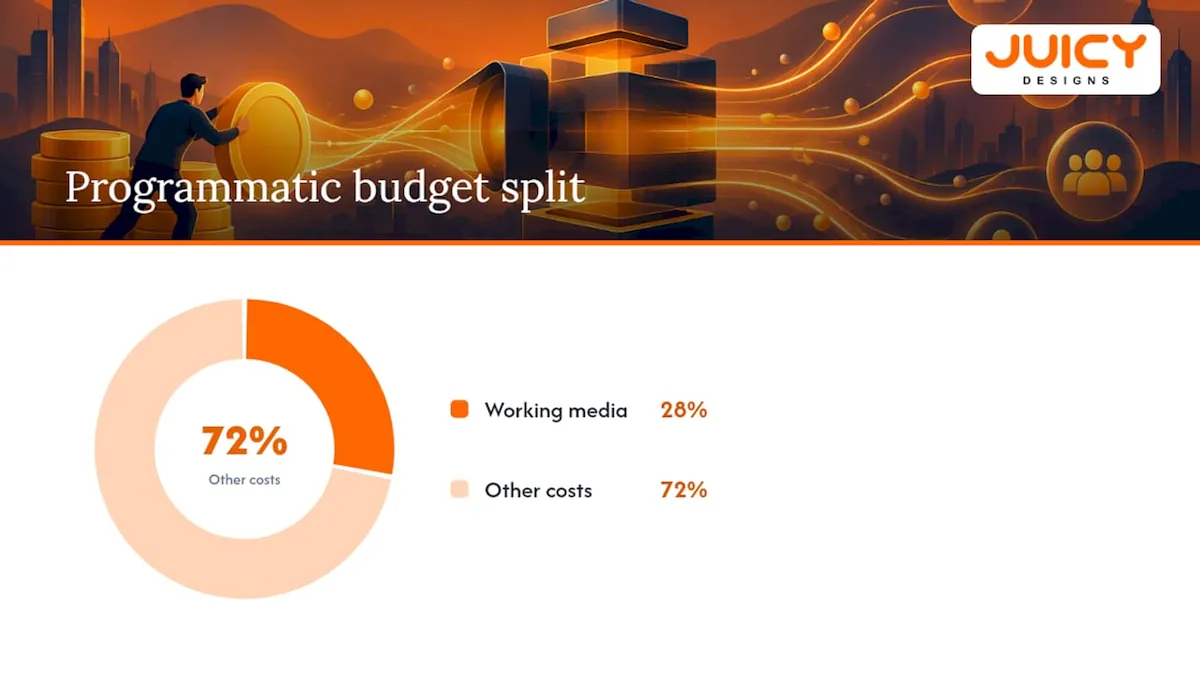
A significant portion of programmatic spend may not reach working media after fees and fraud are deducted, according to analysis cited by The Media Online, which makes fee transparency a budgeting necessity rather than a nice-to-have.
Viewability and invalid traffic shrink your effective delivery further, since an impression that never loads on screen or comes from a bot still counts against your budget unless your contract excludes it. A few habits reduce that leakage:
- Negotiate private marketplace deals for the placements that matter most, since they typically carry less fraud exposure than open auction.
- Require third-party verification on every campaign and set a minimum viewability threshold before signing off on inventory.
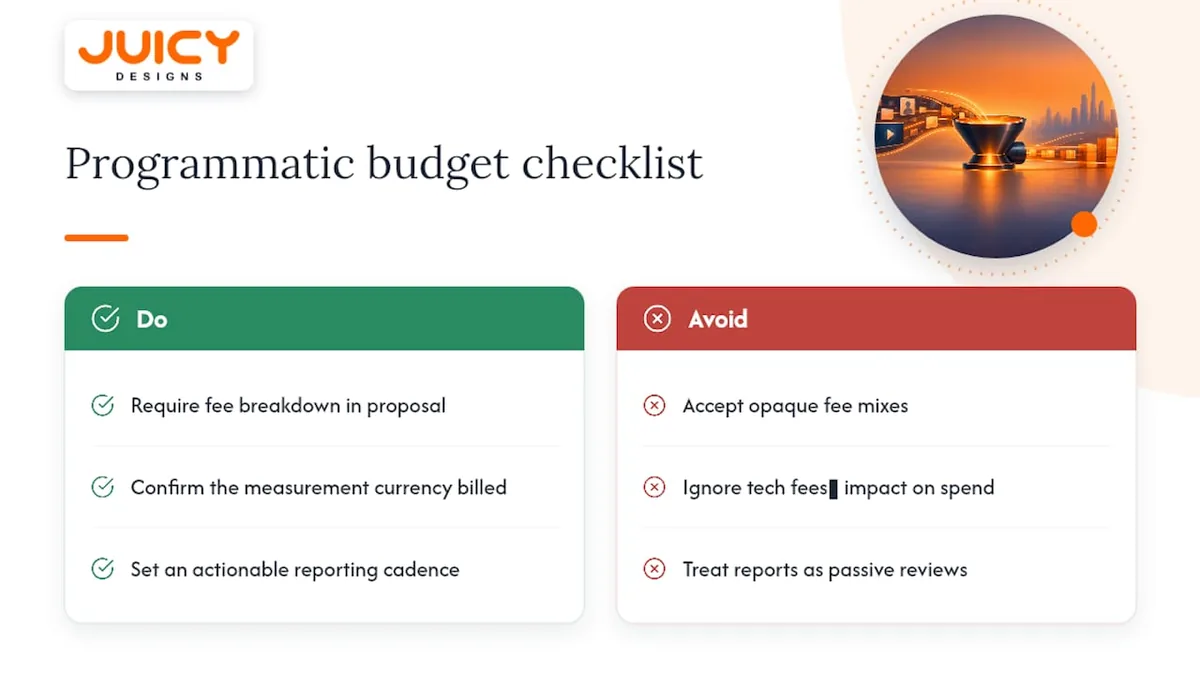
- Ask every vendor for a fee breakdown that separates media, tech and management costs, and name the measurement currency (CPM, vCPM or CPA) in the contract before spend begins.
How Juicy Designs structures programmatic campaigns and pricing
Juicy Designs runs programmatic campaigns with a clear split between media spend and management fees, so clients know what portion of their budget buys impressions and what portion pays for strategy, setup and reporting. That transparency matters given how much of a typical programmatic budget can disappear into tech fees before it reaches an audience. Any proposal you evaluate, whether from Juicy Designs or another agency, should spell out the fee breakdown, confirm the measurement currency being billed, and set a reporting cadence you can act on rather than just review.
In-house programmatic or agency: how to decide
Running programmatic in-house works when you already have a media buying team, access to a DSP, and the time to build fraud and viewability checks yourself. Agencies bring negotiated publisher relationships, established fraud mitigation and a fee structure you can compare against alternatives without building that capability from scratch. A simple decision rule: if your monthly media budget cannot absorb the learning curve of a first few underperforming campaigns, an agency-managed route is usually the cheaper path to a working CPA.
, Cobus
Juicy Designs: managed programmatic and how to get started
If you would rather hand the auction mechanics, fee negotiation and reporting to someone else, Juicy Designs runs programmatic and paid media as founder-led work, with no account managers and no long-term contracts locking you in. Because pricing stays flexible, you can start small, check whether the CPA holds up, and scale once it does, rather than committing to a annual agreement before you have proof it works.
- Google Ads management plans start at R6,000 per month for Local and scale to R15,000 per month for Competitive depending on scope.
- Every proposal includes a fee breakdown separating media spend from management cost.
- Reporting is built around the outcome you set, whether that is CPA, ROAS or qualified leads.
If you want a straight answer on what your budget could realistically deliver, check current Google Ads pricing or get in touch through the contact page to talk through your numbers directly with the team running the campaigns.
Key reports, standards and measurement resources
For deeper reading, the IAB South Africa adspend report tracks local buying trends, the MDPMI public hearings cover practitioner views on fees and viewability, and Better Ads standards set minimum creative and placement quality benchmarks. For a primer on how the ecosystem fits together, see what programmatic advertising actually is.
Sources
- IAB Online Adspend Report 2024 (IAB South Africa)
- Hidden costs for programmatic advertising reduce its effectiveness (The Media Online)
FAQ
How much does programmatic advertising cost?
Programmatic CPMs vary widely by auction type, audience and format, so there is no single market rate. Budget from your target CPA or ROAS backward into a CPM range instead of anchoring on a headline number from a proposal.
What are the four types of programmatic advertising?
The main buying methods are open auction, private marketplace, programmatic guaranteed and preferred deals, each trading price for control over inventory quality. Open auction is the cheapest and least predictable, while programmatic guaranteed offers the most control at the highest price, as described in the Competition Commission's MDPMI report.
How much does a 30 second ad to make cost?
Production costs for a short video ad depend heavily on scope, from a simple in-house edit to a full studio shoot, and no single figure applies across markets. Many advertisers start by repurposing existing footage or social content before commissioning new video for connected TV or premium placements.
What is programmatic advertising?
Programmatic advertising is the automated buying and selling of digital ad space through auctions run by demand-side and supply-side platforms, rather than manual insertion orders. It lets advertisers target specific audiences at scale across display, video, native and connected TV in real time, as explained in this plain-English guide.
Recommended
- How to Cut Wasted Ad Spend in South Africa
- Return on Ad Spend: The Complete Guide for Small Business Owners