
Be Eligible for ChatGPT Citations in 30 Days: SA Marketer Playbook
A South Africa playbook pairing OpenAI's crawler checklist with PR outreach, measurement steps, and a Juicy Designs mini-case to boost ChatGPT citation...
Allow OAI-SearchBot in your robots.txt and publish extractable, fact-dense content backed by editorial mentions: those two moves make your site eligible for citation and meaningfully improve your odds.


TL;DR: Quick Answer
A South Africa playbook pairing OpenAI's crawler checklist with PR outreach, measurement steps, and a Juicy Designs mini-case to boost ChatGPT citation...

Allow OAI-SearchBot in your robots.txt and publish extractable, fact-dense content backed by editorial mentions: those two moves make your site eligible for citation and meaningfully improve your odds. Technical access gets you considered, but conservative engines like ChatGPT lean on durable third-party coverage to decide what to trust. Inclusion is never guaranteed, so treat every change as a test you measure, not a box you tick once.
TL;DR:
- Allowing OAI-SearchBot in robots.txt and ensuring your content is clear, extractable, and has credible external signals increases your chances of being cited in AI answers.
- Content must be positioned near the top with a direct answer, labelled facts, and structured data to maximise AI extraction and citation potential.
- Technical setup requires verifying accessible, crawlable pages with stable URLs, structured schemas, and avoiding JavaScript-only rendering for key facts.
- External validation through reputable editorial mentions and maintaining a consistent entity presence influence AI models like ChatGPT more than backlinks alone.
- Regularly monitor AI citation performance using tools like Bing Webmaster reports and programmatic queries to refine your strategy over time.
How ChatGPT and similar engines source their answers
ChatGPT draws on three distinct pools of information, and understanding which one applies to your query shapes your entire strategy. The first is training data: the static corpus the model learned from, which gets refreshed periodically but is never live. The second is a live web index, similar in spirit to a search engine crawl, that lets ChatGPT Search pull current pages into an answer. The third is third-party citation and editorial signal: the reputation and coverage a topic or brand has built across trusted publications, which shapes whether the model treats a claim as safe to repeat.
These buckets do not behave the same way across platforms. Some AI answer engines lean towards freshness, surfacing recently published pages quickly, while ChatGPT tends to favour a more conservative editorial bias, preferring sources with an established publishing history. In South Africa, that shows up clearly: ChatGPT tends to cite durable editorial outlets such as BusinessTech and Moneyweb over newer or less established sites, while other engines weight sources differently. That single distinction should guide where you invest your outreach budget.
Being technically crawlable is the entry ticket, not the prize. A page that OAI-SearchBot can reach but that reads like a wall of unstructured text still loses out to a shorter, clearer page from a source the model already trusts. The three factors that decide whether your content gets pulled into an answer are:
- Access: the crawler must be allowed to fetch your page and receive a normal 200 response.
- Extractability: the page must contain a clear, quotable answer near the top, not buried in paragraph six.
- Authority: the model needs some external signal, usually editorial coverage or entity recognition, that says this source is safe to repeat.
Miss any one of the three and the other two do little good. A perfectly structured page that no reputable outlet has ever linked to still struggles to get grounded, and a well-covered brand with a JavaScript-only site that blocks crawlers never gets the chance to be read in the first place. Our guide to creating content for generative AI walks through how these three factors interact on real pages, and it is worth treating them as a checklist rather than a hierarchy: you need all three working at once.
Technical checklist to make your site eligible for ChatGPT Search
Before you touch content or outreach, confirm the technical door is open. OpenAI's own crawler documentation distinguishes between GPTBot, which is used for model training, and OAI-SearchBot, which powers ChatGPT Search results. Blocking GPTBot does not affect your Search eligibility, but blocking OAI-SearchBot does.
Work through these steps in order:
- Update robots.txt to explicitly allow OAI-SearchBot. A minimal allow rule looks like this:
User-agent: OAI-SearchBot
Allow: /
- Check your CDN and server rules for anything that blocks unfamiliar user agents or applies aggressive rate limiting. OpenAI publishes IP ranges for its bots, and your firewall or bot-management tool should permit requests from those ranges rather than challenging them with CAPTCHAs.
- Verify CORS and response codes by fetching key pages with the OAI-SearchBot user agent string and confirming you get a clean 200 response, not a redirect chain or a soft 404.
- Expose a stable sitemap and canonical tags so the crawler can find and correctly attribute your most important pages without guessing.
- Avoid JavaScript-only rendering for the specific facts, prices or figures you want cited. If the answer only appears after a script runs, many crawlers never see it.
OpenAI's Help Center article on ChatGPT Search confirms that allowing OAI-SearchBot and permitting requests from its published IPs improves eligibility, though it does not promise inclusion. Robots.txt changes typically propagate within about 24 hours, so give it a day before you start testing, then confirm the crawl in your server logs by filtering for the OAI-SearchBot user agent string.
Pro Tip: Run a simple log-file check weekly: if OAI-SearchBot has never visited a page you care about, no amount of content polish will get it cited.
Authoring for extraction: structure, schema and writing patterns
Once a crawler can reach your page, the next job is making sure it can lift a clean answer out of it. AI systems extract facts the way a busy editor skims a press release: they want the who, what, when, where and how within the first few lines, not buried under throat-clearing context.
Structure your most important pages around these patterns:
- Lead with the answer. Put the direct claim or figure in the first sentence, then explain it, the same inverted-pyramid approach journalists have used for over a century to get key facts read first.
- Label your facts. Write dates, prices and figures in plain text rather than only inside images or charts, since a model cannot extract a number it cannot read.
- Add structured data. Article, FAQ and ClaimReview schema give engines a machine-readable confirmation of what your page claims, on top of what the prose already says.
- Use durable URLs. A page that moves or gets deleted breaks every citation pointing to it, so treat your URL structure as a long-term commitment.
- Chunk with headings. Short, descriptive headings let a model isolate the exact paragraph that answers a specific query instead of having to parse an entire article.
Content that AI models can quote directly needs a clear factual anchor near the top of the page, not a rhetorical introduction that delays the answer. This is the same principle that makes a page skimmable for a human reader: if you cannot summarise your key point in one sentence at the top, an AI system will struggle to extract it too.
It helps to build two versions of the same page in one document: a short, TL;DR-style summary block near the top for quick extraction, and a longer, authority-building section beneath it for readers who want depth. Our breakdown of blog structure for AI citation covers how to build that split without making the page feel disjointed. The short block earns the citation; the long block earns the trust that keeps you cited next time.

Off-page signals: editorial mentions and entity presence
Technical access and clean formatting get your page read. What gets it repeated is a separate question, and the answer is almost always external validation. Conservative engines like ChatGPT are built to avoid repeating claims from sources they cannot corroborate, which means a brand with a thin editorial footprint struggles to get cited even when its own content is well structured.
Three tactics move the needle here:
- Structured press outreach. A well-placed mention in an established outlet does more for citation odds than a dozen low-authority backlinks.
- Expert commentary. Offering a named spokesperson for journalist queries builds the kind of durable, dated coverage that conservative engines treat as trustworthy.
- Syndication to category specialists. Getting a piece picked up by a trade or niche publication signals topical relevance beyond your own domain.
In South Africa specifically, local analysis shows ChatGPT favours brands with a long editorial history, while other engines such as Google AI Overviews or Perplexity weight sources differently, including wider forum discussion. That means backlinks alone, the currency of traditional SEO, are less decisive here than an authoritative editorial mention that ties your brand to a specific, checkable claim. A clean, consistent entity presence (your brand name, description and key facts matching across your site, directories and any Wikipedia-style reference) reinforces that same signal by giving the model fewer conflicting versions of who you are.
How to measure AI citation performance and run experiments
You cannot improve what you do not track, and AI citation is measurable, just not through a single dashboard. Build your measurement approach around three activities:
- Check Bing Webmaster Tools' AI performance report. Its Citation Share metric shows how often your pages appear in Bing's AI-generated answers, though it only reports your own share, not competitor visibility, and it covers Bing's surfaces specifically, not ChatGPT directly.
- Run programmatic queries. Issue the same set of target questions to ChatGPT, Perplexity and Google AI Overviews on a schedule, logging which sources get cited and how the grounding phrasing changes over time.
- Define clear KPIs before you start. Track citation frequency for your target queries, the stability of the grounding phrases used, and any referral traffic that arrives through a grounding link.
As of mid-2026, neither ChatGPT nor Perplexity offers a native publisher dashboard that exposes citation data the way Bing does for its own surfaces, so manual sampling remains the most reliable cross-engine method available. Run your query set at a consistent cadence, weekly is reasonable for an active campaign, and log every change alongside your publishing calendar so you can connect a citation shift to the specific page or press mention that likely caused it. Citation Share is a useful proxy for structural readiness, but a high score there does not guarantee citation on engines outside Bing's ecosystem.
Fast retrieval actions: quick wins to implement this week
Start with the changes that take the least effort and carry the widest effect, then layer in the slower editorial work behind them.
- Allow OAI-SearchBot in robots.txt and confirm the change in your server logs within a day or two.
- Add a TL;DR block and an FAQ section to your two or three highest-priority pages.
- Publish one short, authoritative explainer that directly answers your target query in the first paragraph.
- Add Article and FAQ schema to those same pages so the structured data backs up what the prose already says.
- Secure one editorial mention this month and log the exact URL, date and headline so you can track it against your citation tests.
Sequence these across a 7 to 30 day window: technical fixes in week one, content and schema updates in weeks two and three, and outreach running in parallel since it takes longer to land. By day 30, rerun your programmatic query set and compare the grounding phrases against your baseline. Our free SEO and AI search tools can help you audit crawlability before you commit outreach budget to a page that a bot cannot even reach yet.
Juicy Designs' proof points and how we apply these tactics
We built our own approach around the same three pillars covered above: access, extractability and authority. Our founder-led model means the person structuring your content is the same person tracking whether it gets cited, with no account manager layer in between. Juicy Designs clients average a 4.8x return on ad spend, nearly double the industry standard.
A typical engagement follows a simple shape: we audit a client's crawlability and content structure first, since a beautifully written page that a bot cannot fetch is still invisible. Then we rebuild the highest-priority pages around a clear lead answer, add the schema markup that reinforces it, and run a short, targeted press push tied to specific, checkable facts about the business. The measurement step never gets skipped: we sample AI answers before and after publishing to confirm the work actually shifted what gets cited, rather than assuming a structural fix worked because it looked right on paper.
Understanding and leveraging recent training data cutoffs
Every large language model has a training cutoff, the point after which it has no built-in knowledge of new events, prices or product launches. Content published after that date only reaches the model through the live web index or through citations pulled in at answer time, not through the model's trained memory. That distinction matters for planning: a page announcing a new offer or updated price will not be "known" by the model until it gets crawled and grounded live, which puts weight back on the technical access steps covered earlier.
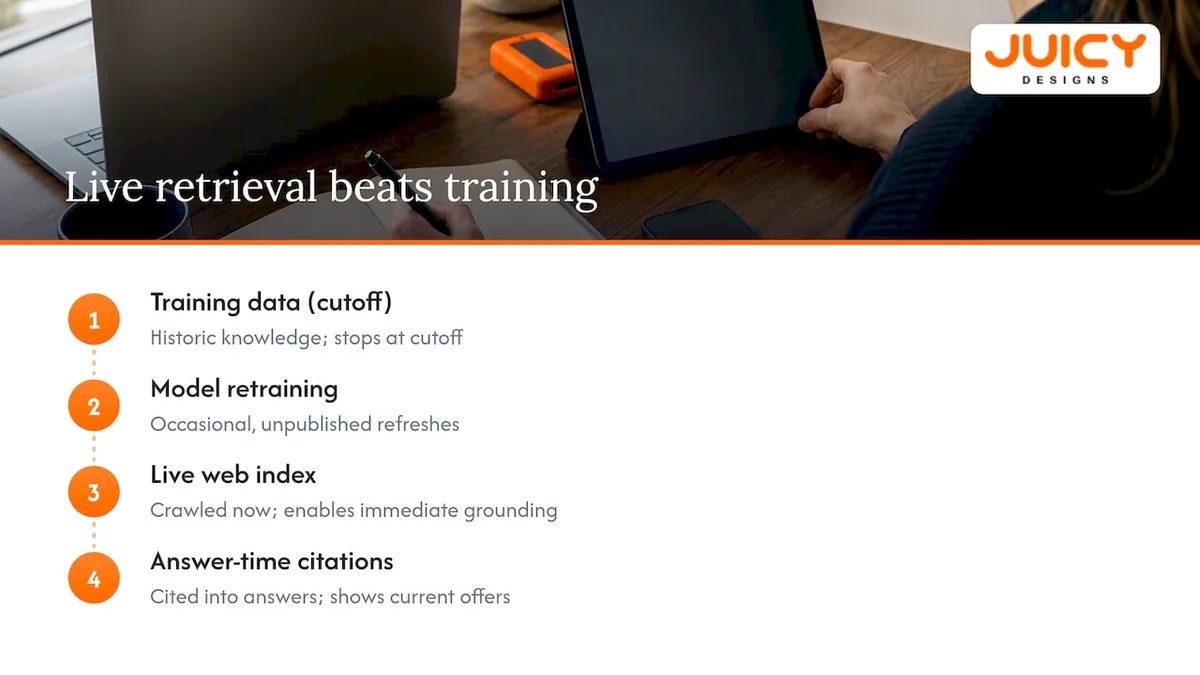
Model providers periodically refresh training data, but the schedule is not published in a way marketers can plan around precisely. The practical response is to stop treating training data as your target audience for anything time-sensitive and instead treat the live index and citation pathway as your primary channel. Anything you want reflected accurately in an AI answer this month needs to be crawlable and extractable now, not eventually folded into a future training run. Evergreen reference content benefits from both pathways over time, but news, pricing and current offers depend entirely on live retrieval working correctly.
Best practices for updating and maintaining content relevance
Content that earns a citation once does not keep it automatically. Engines that favour freshness will drop a stale page in favour of a newer one making the same claim, and even conservative engines reassess sources periodically as new coverage appears.
Build a maintenance rhythm around your highest-value pages rather than treating publication as a finish line. Revisit key statistics, dates and prices on a set schedule, quarterly is reasonable for most commercial content, and update the visible "last updated" signal when you do. Keep your TL;DR and FAQ blocks in sync with the longer body content beneath them: a mismatch between the short answer and the detailed section undermines the trust that got you cited in the first place.
Treat old high-performing pages as assets to refresh, not archive. A page that once earned strong citation frequency but has gone quiet in your query sampling is a signal to check whether the facts have aged, whether a competitor page has overtaken it with fresher coverage, or whether the crawler has simply stopped fetching it. Our guide to generative engine optimisation covers how to build that review cadence into a normal content calendar rather than a separate project.
Legal and ethical considerations when aiming for AI citation
Chasing citation should never mean sacrificing accuracy. A model that grounds an answer in your page is effectively vouching for it, and a factual error that gets picked up and repeated at scale is harder to correct than a normal editorial mistake, since it can persist in cached answers and training snapshots long after you fix the source page.
Keep a few principles in place. State only what you can support with a real figure, date or named source, since an AI system has no way to independently verify a claim you present confidently but cannot back up. Avoid manipulating structured data to claim things your content does not actually say, since ClaimReview and FAQ schema that contradicts the visible page text is a form of deception that can also violate the schema provider's own guidelines. Respect crawler directives honestly: allowing a bot while secretly serving it different content than a human sees (cloaking) undermines the entire system of trust these engines depend on, and it risks your domain's standing across every engine, not just one.
Finally, disclose sponsored or promotional content clearly. An AI system that surfaces a paid placement as if it were independent editorial judgement misleads the reader just as much as a human writer doing the same thing would, and it is the kind of pattern that erodes the durable editorial trust this entire approach depends on.
Why 'ranking' is the wrong word for this game
There is no ranked list inside ChatGPT the way there is a results page in Google, so chasing a "rank in ChatGPT" mindset misses what is actually happening: each engine grounds answers differently, and optimising for one can do nothing for another. The marketers who win here are not the ones hunting a single hack. They are the ones running a combined programme of technical access, editorial investment and honest measurement, then adjusting based on what the data actually shows rather than what feels like it should work.
, Cobus
How Juicy Designs helps with AI-ready SEO and technical setup
Getting cited by ChatGPT touches the same skills most businesses already outsource separately: technical SEO, content structuring and PR. We bring them together under one team instead of coordinating three vendors.
- AI SEO and technical audits to confirm crawlers can reach and read your key pages.
- Content restructuring around lead answers, FAQ blocks and schema markup.
- Editorial outreach to build the durable third-party mentions conservative engines respond to.
- Ongoing SEO retainers, including our Foundation package at 5,500 R per month, for teams that want this managed rather than run in-house.
The agency works with a streamlined team structure to keep technical fixes and outreach decisions moving efficiently without multiple hand-offs. If you want a straight read on where your site currently stands with AI crawlers, get in touch through our SEO pricing and packages page and we will walk you through what an audit would cover.
Official docs and measurement tools to implement the checklist
- OpenAI's crawler documentation: user-agent strings and published IP ranges for OAI-SearchBot and GPTBot.
- ChatGPT Search Help Center article: OpenAI's own guidance on eligibility for Search results.
- Bing Webmaster Tools AI Citation Share explainer: how to read Bing's AI performance reporting.
- AI search citation patterns analysis: how ChatGPT, Gemini and Perplexity cite brands differently.
- One vetted external resource on optimising for ChatGPT visibility covers complementary marketing tactics.
Sources
- Overview of OpenAI Crawlers
- ChatGPT Search | OpenAI Help Center
- How to Measure Your GEO Performance: Bing Webmaster Tools' AI Citation Share, Explained | Pondero
- AI Search in South Africa: How ChatGPT, Claude, Gemini and Perplexity Cite SA Brands · Cited Brands
FAQ
How do I get my content to rank in ChatGPT results?
Allow OAI-SearchBot in your robots.txt, publish a clear answer near the top of your page, and back it with genuine editorial coverage. There is no ranked list inside ChatGPT the way there is on a search results page, so the goal is citation eligibility and frequency rather than a fixed position, and OpenAI itself notes that inclusion is never guaranteed.
Which AI model is considered the most capable overall?
There is no single, universally agreed leaderboard, since different benchmarks measure different tasks and rankings shift with each model release. Rather than chasing a "best AI" label, marketers get more value from testing how their own target queries get answered across the specific engines their audience actually uses.
Is there a definitive number one AI system?
No independent, stable ranking crowns one model as number one across every use case, and claims to that effect tend to reflect a single benchmark rather than overall capability. What matters for citation strategy is less which model tops a chart and more which engines your prospective customers are actually querying.
Is there an AI that consistently outperforms ChatGPT?
Performance varies by task and by benchmark, and different systems lead on different measures such as reasoning, coding or factual recall. For AI citation purposes specifically, the more useful question is which engines your audience relies on and whether your content is structured to be crawlable and extractable on those platforms.
Does allowing OAI-SearchBot guarantee my page will be cited?
No. Allowing OAI-SearchBot makes your page eligible for consideration in ChatGPT Search, but OpenAI's own documentation is clear that being crawlable does not guarantee inclusion in any specific answer. Extractable formatting and independent editorial authority both still need to be in place.
Recommended
- How to Get Your Brand Cited by ChatGPT
- How to Get Cited by ChatGPT, Perplexity and Google AI
- Startup Marketing South Africa: First 90 Days
- AI Marketing Implementation Roadmap: 12-Week Plan