
Rebrand Without Losing Traffic: South Africa Checklist in 8 Phases
An 8 phase rebrand checklist for South African companies. Protect SEO, map redirects, and complete required CIPC and POPIA steps.
A rebrand checklist sequences five stages: strategy, legal and administrative clearance, visual identity, digital rollout and internal launch, so nothing gets missed or done out of order.


TL;DR: Quick Answer
An 8 phase rebrand checklist for South African companies. Protect SEO, map redirects, and complete required CIPC and POPIA steps.

A rebrand checklist sequences five stages: strategy, legal and administrative clearance, visual identity, digital rollout and internal launch, so nothing gets missed or done out of order. In your first week, run a brand audit, set measurable goals and KPIs, and check your company name, trade mark and domain availability before you commit to anything new. The full ordered checklist below walks through every phase after that.
TL;DR:
- Legal filings like name change and trade mark registration are essential and take time, typically requiring documentary proof and official confirmation.
- The digital rollout must include detailed URL mapping, testing redirects, updating metadata, and monitoring performance for at least two weeks after launch to preserve search visibility.
- Internal staff training and clear communication are critical, with prepared templates and a designated brand guardian to ensure consistent messaging and approval workflows.
- Measurement should occur at 30, 90, and 180 days post-launch, with KPI tracking and documented adjustment plans to accurately gauge rebrand success.
- A full rebrand usually spans several weeks to months, with larger organisations needing more time to coordinate legal, digital, and physical updates effectively.
The full rebrand checklist at a glance
Before you touch a logo file, it helps to see the whole project mapped out. A rebrand moves through eight phases, and skipping one usually means revisiting it later, at a higher cost.
- Prepare: brand audit, customer interviews, competitor gap analysis. Owner: marketing lead. Metric: audit report signed off by leadership.
- Strategy: goals, KPIs, positioning statement, messaging pillars. Owner: founder or CMO. Metric: documented positioning approved by stakeholders.
- Identity: logo, colour palette, typography, style guide. Owner: design lead. Metric: finalised brand guidelines document.
- Legal & admin: name change filing, trade mark search, contract updates. Owner: company secretary or legal advisor. Metric: CIPC confirmation and trade mark filing receipt.
- Digital rollout: redirects, metadata, analytics, new website. Owner: digital or SEO lead. Metric: zero broken redirects, stable organic traffic.
- Internal launch: staff training, playbooks, governance. Owner: HR or operations lead. Metric: percentage of staff trained before go-live.
- External launch: PR, campaigns, social rollout. Owner: marketing team. Metric: reach and engagement on launch content.
- Measure & iterate: 30/90/180-day reviews. Owner: marketing lead. Metric: KPI performance against pre-launch baseline.
A realistic timeline generally runs between several weeks to a few months depending on company size, covering audit, strategy, identity, legal filings, digital rollout, internal rollout, launch, and measurement phases. Smaller businesses can compress this; larger ones with multiple product lines or regional offices typically need the longer end.
What matters more than speed is sequencing. Legal filings, identity work and digital prep can overlap, but launch should never happen before internal teams are briefed and your redirects are tested.
The detailed step-by-step rebrand checklist
This is the operational version: each step names an owner, a deliverable and how you will know it is done.
-
Brand audit. Inventory every touchpoint (website, signage, invoices, social profiles, packaging), interview a sample of customers and staff, and run a competitor gap analysis against two or three direct rivals. Owner: marketing lead. Done when: a single audit document lists every asset that needs updating.
-
Define goals and metrics. Decide what business outcome the rebrand needs to deliver: higher conversion, entry into a new market, recovery from reputational damage, or a merger. Set target KPI thresholds (lead volume, retention rate, brand recall) and a timeline for reviewing them. Owner: founder or CMO. Done when: goals and KPIs are written down and signed off.
-
Name, trade mark and domain checks. Search the CIPC company register, check domain availability, confirm social handles are free, and run an initial trade mark clearance search before you fall in love with a name. Name reservation is no longer mandatory for incorporation in South Africa, which makes these pre-checks the real safeguard against future disputes. Owner: founder or legal advisor. Done when: the name, domain and handles are confirmed clear.
-
Strategy and messaging. Write a positioning statement, a value proposition and three to five key messages with proof points behind each one. Owner: marketing lead. Done when: a messaging document exists that every writer and designer can reference.
-
Visual identity deliverables. Commission the logo, colour palette, typography, iconography and a packaged asset library, then compile it all into a style guide. Owner: design lead. Done when: the style guide is approved and distributed.
-
Collateral and operations. Update stationery, invoices, packaging, supplier-facing documents and any legal templates that carry the old name or mark. Owner: operations manager. Done when: no active document in circulation still shows the old identity.
-
Digital rollout. Map every old URL to its new equivalent, build a 301 redirect plan, update metadata and confirm analytics tracking continues uninstalled. Owner: SEO or digital lead. Done when: redirects are tested and live, and analytics shows continuous data.
-
Soft launch and QA. Preview the new brand internally, gather stakeholder feedback, and roll it out to a small external segment before the full public launch. Owner: project manager. Done when: no critical issues remain unresolved from the preview.
-
Full launch and campaigns. Coordinate PR, email and paid media around a single launch date, and keep your direct-marketing lists compliant: POPIA requires written consent for electronic direct marketing, so confirm your database has valid opt-ins before the first announcement email goes out. Owner: marketing team. Done when: launch assets are live across every channel on the same day.
-
Post-launch measurement and iteration. Review performance at 30, 90 and 180 days against the baseline set in step 2. Watch organic traffic, conversion rate, brand search volume and customer feedback. Owner: marketing lead. Done when: each review produces a written adjustment plan.
Pro Tip: Build your redirect spreadsheet before you touch the new website, not after it goes live. Retrofitting redirects under launch pressure is where most rebrands lose search visibility.
Legal and administrative steps you cannot skip
A new name or logo is not official until the paperwork catches up, and in South Africa that paperwork runs through CIPC. A company name change needs a shareholders' special resolution first, after which the application runs through CIPC e-Services or BizPortal for a R250 fee, with the full process, including OTP verification and the confirmation certificate, documented in CIPC's own step-by-step guide.
Trade mark protection is a separate track. You register through CIPC under the Nice Classification system, which covers 45 classes, and a registration must be renewed every ten years to stay valid. Budget for filing fees alongside smaller administrative charges such as certification and inspection fees.
A documented brand strength gain matters here too: Brand Finance's 2026 report shows South Africa's top 100 brands grew 12% to R771 billion in value, underlining how much consistent, well-protected brand equity is worth defending through proper legal filings.
Before you file anything, prepare:
- A signed shareholders' special resolution authorising the name change.
- Proof of trade mark search results for your proposed name and logo.
- Updated supplier and banking documentation reflecting the new legal name.
- A direct-marketing consent record if you plan to announce the rebrand by email or SMS, since POPIA's single-approach rule means you only get one shot at asking a non-customer for consent.
Keeping your SEO and analytics intact during the digital rollout
A rebrand can quietly erase years of search visibility if the technical work is rushed. Treat this as its own project with its own checklist.
- Build a URL mapping spreadsheet pairing every old page with its new address, then implement 301 redirects and test each one before the new site goes live.
- Rewrite page titles, meta descriptions and H1 tags to match the new brand voice and positioning, and update structured data so search engines read the new entity correctly.
- Preserve historical data by updating your analytics property settings, Google Tag Manager containers and conversion IDs rather than creating fresh ones, and document every change you make.
- Update social profiles, directory listings and ad account names, then stage your public announcements with consistent UTM parameters so you can track where traffic and conversions come from.
- Monitor crawl activity, indexation, click-through rate and keyword rankings daily for the first two weeks post-launch, then weekly through day 90.
Pro Tip: Keep your old domain live with redirects for at least six months. Search engines need time to fully transfer authority, and some direct traffic will still arrive on old URLs for months after launch.
Preparing your team for the new brand
Your staff are the first audience for any rebrand, and the ones customers will judge it by.
- Brief leadership first, then train brand ambassadors who deal with customers daily, before anyone else sees the new assets.
- Hand every team ready-to-use templates: updated email signatures, a slide deck explaining why behind the change, and a short FAQ for frontline staff fielding customer questions.
- Appoint a brand guardian who owns approval workflows for new assets and sets a cadence for reviewing and updating brand materials going forward.
- Update contracts, invoicing templates, supplier communications and HR records so the new name appears everywhere it legally needs to.
Pro Tip: Run a mock customer question session with frontline staff before launch day. The questions they struggle to answer reveal gaps in your messaging document.
What founder-led rebrand work has taught us
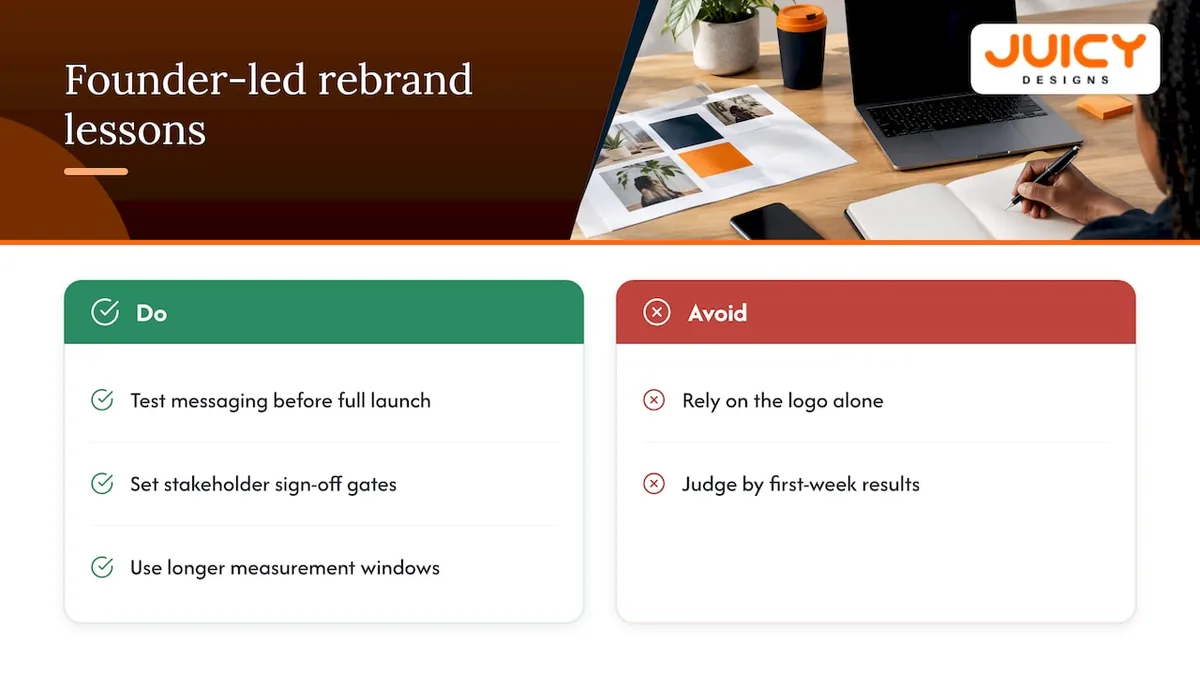
We run full-funnel digital marketing, and the rebrands we have supported confirm a pattern: sequencing and measurement matter more than the creative work itself.
Those outcomes rarely come from the logo. They come from testing messaging before full launch, setting stakeholder sign-off gates so no asset ships without approval, and choosing measurement windows long enough to separate launch noise from real performance change. A rebrand measured only in its first week will always look worse than it actually is.
, Cobus
How we can help you execute your rebrand
Planning a rebrand checklist is one thing. Executing it without dropping a redirect, missing a filing deadline or confusing your customers is another, and that execution gap is where most of our engagements start. We handle branding and identity work from logo through full style guide, website design and rebuilds for the digital side, and SEO audits to protect your search visibility through the transition, all delivered directly rather than handed off to account managers.
A typical engagement starts with a request for an audit or quote, after which we scope deliverables and timelines against your launch date. Depending on scope, that includes:
- A brand and digital audit identifying every asset that needs updating.
- A redirect and SEO continuity plan built before your new site goes live.
- Ongoing retainer support for social media, Google Ads or email marketing once launch is complete.
If you are planning a rebrand and want a partner who can take the checklist from paper to execution, get in touch with our team for a quote.
FAQ
What is included in a rebrand?
A rebrand typically includes a brand audit, updated strategy and positioning, new visual identity (logo, colours, typography), legal and administrative filings, a digital rollout across your website and accounts, and an internal launch to prepare staff. Most checklists also build in a measurement phase after launch to confirm the changes are working.
What are the 5 C's of branding?
Definitions vary across marketing sources, but a common version covers Company, Customer, Competitors, Collaborators and Climate, the factors a brand strategy needs to account for. These overlap closely with the audit and strategy phases covered earlier in this checklist.
What are the 7 stages of the branding process?
Common versions of this framework walk through research, strategy, naming, identity design, messaging, launch and ongoing management, broadly mirroring the phased checklist outlined above. The exact number and labels of stages differ between sources, so treat it as a flexible structure rather than a fixed rulebook.
What are the 5 P's of branding?
Definitions vary here too, but one widely used version centres on Purpose, Positioning, Personality, Promotion and Perception, the pillars that shape how a brand is strategised and messaged. These map closely onto the strategy and messaging step in a rebrand checklist.
How long does a full rebrand typically take?
A full rebrand generally takes several weeks to a few months depending on company size and how many legal, digital and physical touchpoints need updating. Larger organisations with multiple locations or product lines usually need the longer end of that range.
Sources
- How to change company name CIPC South Africa (ClearComply)
- Register a trade mark | South African Government
- POPIA Form 4, consent for direct marketing (Department of Human Settlements)
- South Africa's top 100 brands grow 12% to R771 billion in 2026 | Brand Finance
Recommended
- Brand Strategy & Rebranding Agency South Africa
- How to Create a Social Media Marketing Plan in SA
- Rebranding: When and How to Do It Right
- Brand awareness strategy: your practical guide for 2026