
First Hour AI Answer Schema: Copy Ready JSON-LD for Marketers & Devs
Use copy ready JSON-LD snippets, a first hour checklist, and validation steps to raise your odds of AI citations for marketers & devs.
Structured data in JSON-LD is the fastest, highest-leverage step you can take to make your content machine-readable for AI answer systems.


TL;DR: Quick Answer
Use copy ready JSON-LD snippets, a first hour checklist, and validation steps to raise your odds of AI citations for marketers & devs.

Structured data in JSON-LD is the fastest, highest-leverage step you can take to make your content machine-readable for AI answer systems. When you add matching, visible JSON-LD for FAQ, Article and HowTo content, then validate it against Google's Rich Results Test and Validator, you materially increase the odds of being cited.
TL;DR:
- Validating and matching JSON-LD schema to visible content is essential for AI systems to reliably extract facts and increase citation chances.
- Use the correct schema types, FAQPage, HowTo, or Article, based on content, and ensure facts in schema match the page text exactly.
- Implement server-side rendering of JSON-LD for JavaScript-heavy pages and validate it with Google's Rich Results Test before deployment.
- Monitor performance through Search Console's AI report to track impressions, citations, and identify schema errors that hinder AI extraction.
- Avoid including personal identifiers in schema without consent, and prioritise clear, people-first content over mere markup for AI citations.
Your first-hour checklist for AI answer schema
Before you touch templates or CMS settings, run through this list. It's the difference between markup that sits there and markup that actually gets read.
- Pick your types: FAQPage, Article or HowTo, matched to what the page actually contains.
- Use JSON-LD with @graph: bundle related entities (Organization, Person, BreadcrumbList) in one script block.
- Match visible content exactly: every fact in your schema must appear, word for word, on the page.
- Validate before publishing: run the page through Rich Results Test and validator.schema.org.
- Set a monitoring baseline: record current impressions and pages in Search Console before you roll out changes.
Run both validators on a live URL today, not a staging copy, and note any warnings as your starting point.
Why schema matters for AI answers, not just rankings
Classic SEO asks a search engine to rank your page. AI answer systems ask a different question: can they lift a clean fact or passage out of your page without guessing? That's the real shift. Structured data reduces ambiguity for the extraction tools and large language models that sit behind AI answers, giving them a labelled, machine-readable version of your content next to the prose itself.
Google Search Central is explicit that structured data makes pages eligible for certain search features and helps share information in a machine-readable way, but it doesn't guarantee a citation on its own. Eligibility and selection are two different steps.
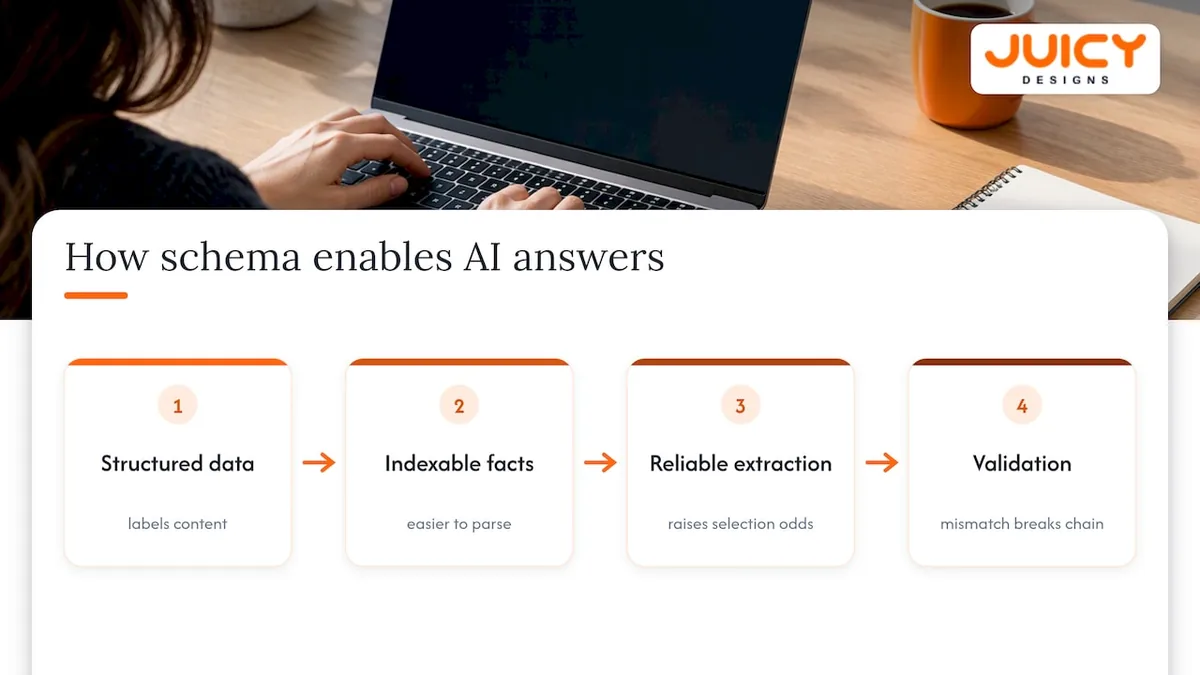
The pathway looks like this: structured data turns prose into indexable facts, indexable facts become easier for extraction systems to parse reliably, and reliable extraction raises the probability that your page gets chosen when an AI system assembles an answer. Skip any link in that chain, and the rest doesn't matter, which is why unvalidated or mismatched markup often does nothing at all.
Which schema types do AI systems actually extract?
Not every type pulls equal weight. Match the type to the content shape you already have rather than forcing a format that doesn't fit.
- FAQPage: use it for genuine question-and-answer pairs, each with a short, complete answer in the
acceptedAnswerfield. - HowTo: use it for ordered steps that an AI system can reproduce as a procedure, with each
stepholding one discrete action. - Article or BlogPosting: mark the headline, author, date Published and mainEntityOfPage so the piece has clear provenance.
- Speakable: flag your opening paragraph or summary lines so voice and AI systems know which sentences are extract-ready.
- Organization, Person, BreadcrumbList: supply the entity facts (name, URL, sameAs) that back up who is publishing and why it's credible.
- Product or Service, including pros-and-cons schema: relevant on editorial review pages, where Google prioritises supplied structured data over automatically extracted data.
A simple FAQPage example to adapt:
{
  "@context": "https://schema.org",
  "@type": "FAQPage",
  "mainEntity": [{
    "@type": "Question",
    "name": "What is schema for AI answers?",
    "acceptedAnswer": {
      "@type": "Answer",
      "text": "Structured data in JSON-LD format that labels facts and answers so AI systems can extract them reliably."
    }
  }]
}
Why JSON-LD, and how @graph bundling works
JSON-LD wins over Microdata and RDFa because it sits in one clean script block, separate from your HTML, which makes it easier to generate, template and validate at scale. Schema documents this syntax directly, along with how to combine multiple entities under a single @graph array so one script can describe your Article, its Author, and the Organization that publishes it without repeating properties.

Placement matters less than consistency: put the script in the <head> or just before </body>, but wherever it lives, the facts inside it must match what a visitor actually sees on the page. A price, a date, or an answer text that differs between the visible copy and the JSON-LD is the single most common reason AI systems and Google both disregard a block. Keep the schema as a mirror of the page, not an upgraded version of it, and the main pitfalls (hidden text, outdated facts after a content edit, orphaned @id references) mostly resolve themselves.
How to roll out schema across your site
- Author the base snippets: adapt the FAQPage, Article and HowTo examples above to your page templates, filling
mainEntitywith real, page-specific content. - Choose your injection method: template-level injection in your CMS, a tag manager container, or a data layer feed, in that order of reliability.
- Render server-side wherever you can: for JavaScript-heavy pages, serve the JSON-LD in the initial HTML response rather than injecting it client-side, since not every crawler executes scripts the same way.
- Lint, validate, then deploy: run the generated JSON-LD through a linter, check it with Rich Results Test, push to staging, then production.
- Monitor after launch: watch Search Console for errors and track whether the pages start appearing in generative AI reports.
Pro Tip: Keep one canonical JSON-LD template per content type in your codebase, so a fix to the FAQPage schema updates every page at once instead of twenty hand-edited copies.
If your site relies heavily on client-side rendering, treat server-side rendering of the JSON-LD block as a priority fix, not a nice-to-have; learn more about how to evaluate an AI feature in a sales tool beyond the demo.
How to validate and monitor your schema
Validation is a two-tool job. Run the live URL through Google's Rich Results Test first, since it reflects what Google's own systems parse, then cross-check with validator.schema.org for broader syntax errors that Rich Results Test won't always flag.
- Record a baseline: note current impressions, click-through rate and indexed pages before changes go live.
- Track weekly for 8 to 12 weeks: consistent markup changes rarely show results inside the first few days.
- Flag pages with movement: keep a short list of URLs where impressions or citations increase, so you can study what worked.
Search Console now ships generative AI performance reports that show impressions, pages, countries and devices for generative AI features, giving you a direct read on whether your structured data is actually surfacing in AI experiences rather than just passing validation.
Common schema mistakes that block AI citation
Most failures aren't exotic. They're small mismatches that quietly break the chain between your markup and the page it describes.
- Visible text and schema text don't match: keep the answer field in your FAQPage identical, character for character, to what's printed on the page.
- Invalid JSON or unsupported properties: a missing comma or a property that doesn't exist for that type will silently fail; Validator catches most of these before they ship.
- Markup injected only client-side: if a crawler doesn't execute your JavaScript, it never sees the schema at all, which is why server-side rendering matters for JS-heavy pages.
- Inconsistent entity facts across the site: a business name, address or author bio that differs between pages confuses the provenance signals Organization and Person schema are supposed to provide.
A quick privacy note on personal data in schema
Avoid putting personal identifiers, direct phone numbers or ID numbers into Person or Organization schema unless you have a lawful basis or clear consent. Use a generic role contact or an organisation inbox instead of a named individual's personal email. The Protection of Personal Information Act sets the conditions for processing personal information, including provisions on automated decision making, and is worth reading in full before you publish anything with personal data attached, alongside our POPIA guide for marketers.
What founder-led AEO work looks like in practice
Structured data is one layer inside that broader AEO work, never the whole strategy.
Our honest take on schema and AI citations
Schema earns you eligibility, not a guarantee. We'd rather you write a genuinely clear, people-first answer first, then wrap it in markup, than polish tags around thin content. If AI tools helped draft or summarise a page, say so plainly. That order of operations matters more than any single tag.
, Cobus
Where we come in if you'd rather not build this yourself
We handle structured data, AEO and technical SEO together as one workstream, built and reviewed directly by our team rather than handed off to a rotating account team. If you want a second pair of eyes on your markup or a full audit, our SEO services start at R5,500 per month on the Foundation plan, with a once-off SEO audit available from R8,000.
FAQ
What is a schema in AI?
A schema, in this context, is structured data written in JSON-LD that labels facts on a page (questions, answers, steps, authorship) so AI answer systems can extract them without guessing at meaning from plain prose.
Which AI is best for answering questions from web content?
There's no single best system since different AI answer engines pull from search indexes, their own crawlers, or a mix of both. The practical move is the same regardless: structure your content with validated schema and track citations through Search Console's generative AI reports rather than betting on one engine.
What counts as an AI question-and-answer pair for schema?
A genuine question-and-answer pair is one real question paired with a complete, self-contained answer, formatted using FAQPage schema with the question in the name field and the answer text in acceptedAnswer. Pairs that split one idea across several loosely related questions tend to extract poorly.
How do I know if AI is actually answering from my pages?
Check the generative AI performance reports inside Search Console, which show impressions, pages, countries and devices for generative AI features. A rising impression count on specific URLs is the clearest sign your schema and content are being surfaced.
Sources
- Top ways to ensure your content performs well in Google's AI experiences on Search | Google Search Central Blog
- Protection of Personal Information Act 4 of 2013
- Validator
- Schema
Recommended
- How to Create Content That Generative AI Picks Up
- FAQ Schema: Structured Data for Question Content
- Schema Markup Generator (JSON-LD) | Free Tool
- What Is Schema Markup? (Structured Data)