
Real Rand Examples: Small Business Marketing Budget in South Africa
Budget 5-10% of revenue. This South African guide converts percentages into rand examples, uses funnel math to set defendable spend, and lists low-cost,...
Most small businesses should budget between 5% and 10% of revenue for marketing, leaning towards the lower end if you're B2B or protecting margins, and towards the higher end if you're B2C or chasing aggressive growth.


TL;DR: Quick Answer
Budget 5-10% of revenue. This South African guide converts percentages into rand examples, uses funnel math to set defendable spend, and lists low-cost,...
Most small businesses should budget between 5% and 10% of revenue for marketing, leaning towards the lower end if you're B2B or protecting margins, and towards the higher end if you're B2C or chasing aggressive growth. Startups often need to spend beyond that range just to get noticed. The next section turns those percentages into actual rand figures so you can set a number today.
TL;DR:
- Small businesses typically allocate between 5% and 10% of revenue for marketing, with B2B on the lower end and B2C closer to the higher end, unless growth demands higher spending.
- Turning percentages into actual budgets requires multiplying annual revenue by the chosen percentage and dividing by 12 for monthly expenditure, including agency, software, and event costs.
- The ideal channel split for growth-focused small businesses is approximately 60 to 70% on acquisition, 20 to 25% on retention, and 10 to 15% on brand awareness campaigns.
- Monitoring CAC, LTV, and ROAS monthly or quarterly is essential, with a healthy business maintaining an LTV at least three times CAC to ensure sustainable growth.
- Owned channels like email and local listings are the most cost-effective ways to stretch, especially when testing new tactics or operating with a limited budget.
What percentage of revenue should a small business spend on marketing?
Benchmarks give you a starting point, not a formula. Gartner's 2025 CMO Spend Survey found that marketing budgets across companies of all sizes have flattened at roughly 7% of overall company revenue on average, a useful sanity check but not a target to aim for blindly. That average hides real variation by business model and by how competitive your market is.
Locally, Bridgement's guidance for South African SMEs suggests businesses often allocate around 7 to 8% of sales revenue to marketing, with that figure climbing when growth is the priority rather than simple maintenance.
Broader rules of thumb split by business type:
- B2B businesses tend to sit lower, often 2 to 5% of revenue, since sales cycles are longer and referrals carry more weight.
- B2C businesses, especially in crowded retail or hospitality categories, often spend 5 to 10% or more because visibility competes directly with paid rivals.
- Startups and early-stage businesses frequently need to spend above these ranges temporarily, since brand awareness starts at zero.
- Mature businesses with steady demand can often trim towards the lower end and shift spend from acquisition to retention.
What does a marketing budget look like in rands?
Turning a percentage into a number is where most owners get stuck. The formula is simple: annual revenue × chosen percentage = annual marketing budget, then divide by 12 for your monthly figure.
Here's how that plays out across common small-business revenue bands:
- R300,000 annual revenue: at 5% that's R15,000 a year, or R1,250 a month. At 7.5% it's R22,500 a year (R1,875 a month). At 10% it's R30,000 a year (R2,500 a month).
- R1,000,000 annual revenue: 5% gives R50,000 a year (R4,166 a month). 7.5% gives R75,000 a year (R6,250 a month). 10% gives R100,000 a year (R8,333 a month).
- R5,000,000 annual revenue: 5% gives R250,000 a year (R20,833 a month). 7.5% gives R375,000 a year (R31,250 a month). 10% gives R500,000 a year (R41,666 a month).
That budget needs to cover more than ad spend. Fold in agency or freelancer fees, software subscriptions, creative production, and any event or sponsorship costs. If you're leaving out tools and only counting media spend, your real number is higher than it looks on paper.
How do you set your marketing budget step by step?
Percentages give you a range. A funnel calculation gives you a number you can actually defend to a business partner or bank manager.
- Define the goal first. Decide what you actually need: a revenue target, a number of new customers, or a lifetime value (LTV) figure you're trying to hit. Vague goals produce vague budgets.
- Map your funnel. Estimate how many site visitors or leads it takes to close one sale, then work out your customer acquisition cost (CAC). If 100 leads produce 5 sales and each lead costs R50 to generate, your CAC is R1,000.
- Reverse-engineer the spend. If you need 50 new customers this quarter and your CAC is R1,000, that's R50,000 in acquisition spend, plus a test budget for channels you haven't validated yet. Shopify's guidance on small business budgeting recommends forecasting expected return per rand spent so you can prioritise the initiatives most likely to pay off before scaling anything untested.
- Add fixed costs and a buffer. Retainers, design tools, and email platforms run every month regardless of campaign performance. Build in a contingency of 10 to 15% for seasonal spikes, like a retail rush before December.
- Write down your assumptions and set review dates. Note your CAC, conversion rates, and expected LTV, then review monthly for paid channels and quarterly for anything brand related.
Pro Tip: Keep a small, ring-fenced test budget separate from your core spend. That way a failed experiment doesn't threaten the campaigns you know are working.
How should you split your budget across channels?
Where you put the money matters as much as how much you have. Early-stage businesses generally need to weight spend towards acquisition, since there's no existing customer base to retain. Mature businesses can shift more towards retention and brand building once they have proven demand.
A workable starting split for a growth-focused small business looks like this:
- 60 to 70% acquisition: paid search, paid social, and lead generation aimed at new customers.
- 20 to 25% retention: email, SMS, loyalty programmes, and customer service touches that keep existing buyers spending.
- 10 to 15% brand: content, sponsorships, or awareness campaigns with no immediate conversion goal.
Channel costs vary widely, and that should shape where your first rand goes. Search advertising is priced per click and tends to reward precision targeting, while social platforms sell impressions in bulk, making them cheaper for broad awareness but less predictable for direct sales. BroadMedia's 2024 report shows that digital channels absorb the large majority of small-business marketing budgets in South Africa, which tracks with how measurable and adjustable digital spend is compared to print or outdoor.
The sequencing matters too: test performance channels first, prove the return, then layer in brand spend once you have cash flow to support it. Spending on brand awareness before you've validated a paid channel is how budgets disappear without a clear result.

How do you measure whether your marketing budget is working?
Three numbers tell you almost everything: customer acquisition cost (CAC), lifetime value (LTV), and return on ad spend (ROAS). CAC tells you what one new customer costs to acquire. LTV tells you what that customer is worth over time. ROAS tells you how much revenue each rand of ad spend generates.
A healthy business generally wants LTV to be at least three times CAC. If it's lower, you're paying too much to acquire customers relative to what they're worth, and no amount of extra ad spend fixes that ratio.
Review paid channels monthly, since performance data accumulates fast enough to act on. Brand and content investments move slower, so quarterly reviews make more sense there. Set simple decision rules in advance: if a channel's ROAS stays below your break-even point for two consecutive months, cut it or redesign the test rather than letting it drain the budget on hope.
Measurement discipline is what separates a budget that grows a business from one that just gets spent. Analytics-driven marketing decisions consistently outperform gut-feel allocation, because they catch underperforming spend before it compounds.
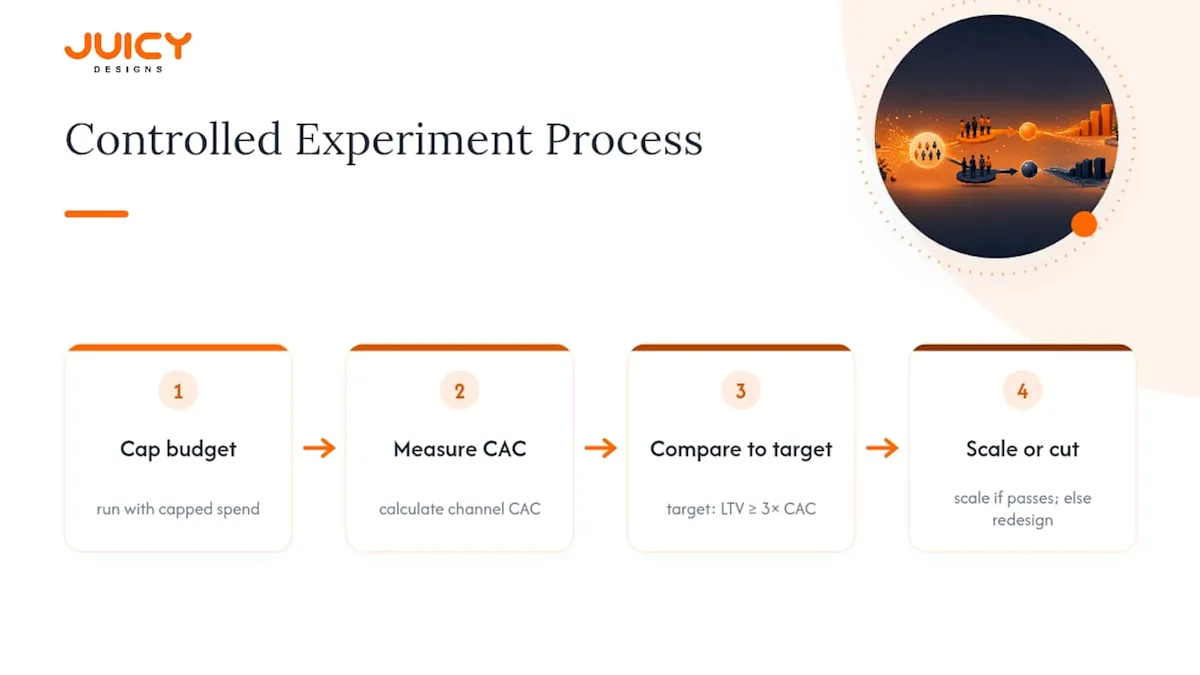
Running small, controlled experiments before committing real money is the cheapest insurance you can buy. Test a channel with a capped budget, measure CAC against your target, then scale only what clears the bar.
What are the cheapest ways to stretch a small marketing budget?
Owned channels cost time, not media spend, which makes them the first place to invest when cash is tight. Email remains one of the most cost-effective tools available. Harvard Business Review has long pointed to email as a channel that delivers a strong return for retention and repeat-purchase marketing, particularly for businesses that already have a customer list to work with.
- Build and segment your email list before spending anything on paid acquisition.
- Claim and optimise free local listings like Google Business Profile.
- Ask happy customers for referrals directly rather than assuming they'll happen organically.
- Reuse strong creative across multiple platforms instead of producing new assets for every campaign.
- Partner with a complementary local business for a joint promotion or event, splitting the cost and doubling the reach.
Pro Tip: One well-written email sequence can outperform a month of untested paid ads, and it costs nothing to send once it's built.
Founder-led marketing changes how far a budget stretches
Most small businesses lose money not from underspending but from spending without a clear system tying rands to results. That's the gap Juicydesigns was built to close. Working directly with founders instead of account managers means fewer handoffs and faster decisions when a test is failing or scaling.
, Cobus
Get help turning your budget into results
Setting a budget is only half the job. Spending it well against a plan, and adjusting fast when a channel underperforms, is where most small businesses need support. An alternative to traditional agencies for South African small businesses offers no account managers, no long-term contracts, and direct access to the founders running your campaigns.
If search visibility is where you want to start, the Foundation SEO plan runs R5,500 per month, or you can start with a once-off SEO audit from R8,000 to see where your budget is leaking. For paid acquisition, the Local Google Ads plan starts at R6,000 per month, built for businesses that want measurable ROAS without committing to a year-long agreement. Get in touch to talk through where your budget should go first.
Sources
- Gartner 2025 CMO spend survey
- How to create a small business marketing budget (Shopify South Africa)
- 2024 Marketing Budget & ROI Report (BroadMedia)
- How small businesses can finance their marketing (Bridgement)
FAQ
How much should a small business budget for marketing?
Most small businesses should budget 5 to 10% of revenue, with B2B businesses often nearer the lower end and B2C businesses nearer the higher end. Gartner's 2025 survey puts the average across all company sizes at around 7% of revenue.
What is the 70/20/10 rule for marketing budget?
It's a common allocation model: 70% of budget goes to proven channels that already work, 20% to channels showing early promise, and 10% to experimental, unproven ideas. It gives structure to testing without risking the whole budget on unvalidated tactics.
What is the 3-3-3 rule for marketing?
Definitions of this rule vary across marketing circles, and there's no single standard version worth quoting as fact. If you've seen it applied to your industry, treat it as one framework among several rather than a fixed formula.
How do you promote a small business on a limited budget?
Start with owned channels: email marketing, organic social, and a fully optimised Google Business Profile cost time rather than money. Layer in tightly scoped paid tests once you have a baseline, and reuse strong creative across platforms to cut production costs.
What does it cost to get professional marketing help in South Africa?
Costs vary by service. Juicydesigns lists SEO plans from R5,500 per month, Google Ads management from R6,000 per month, and social media management from R6,000 per month, with current pricing always available on the Juicydesigns pricing pages.
Recommended
- How to Set a Marketing Budget for an SA Small Business
- Marketing Strategies for Small Businesses in South Africa
- How to Promote Your Business on a Budget in SA
- Digital Marketing for Small Business: What Works in SA