
Website Redesign Timing for Decision Makers: Set 48-72 Hour SLAs
Calendar rules for decision makers: turn website redesign timing into a schedule, set 48-72 hour review SLAs, and choose safer launch windows to avoid...
Most website redesigns take between 4 weeks and 8 months, depending on scope: small sites typically run 4 to 8 weeks, mid-sized sites 8 to 16 weeks, large sites 16 to 24 weeks, and enterprise projects 3 to 12 or more months.


TL;DR: Quick Answer
Calendar rules for decision makers: turn website redesign timing into a schedule, set 48-72 hour review SLAs, and choose safer launch windows to avoid...

Most website redesigns take between 4 weeks and 8 months, depending on scope: small sites typically run 4 to 8 weeks, mid-sized sites 8 to 16 weeks, large sites 16 to 24 weeks, and enterprise projects 3 to 12 or more months. These ranges assume prompt stakeholder reviews and no unexpected integration work. Your first move should be a 1 to 2 week audit paired with a confirmed stakeholder availability calendar.
TL;DR:
- Small sites typically complete redesigns in 4 to 8 weeks, but delays often occur if content isn't ready or stakeholder reviews extend beyond a few days.
- Mid-sized projects with more integrations can take 8 to 16 weeks, especially if third-party access or scope creep arise unexpectedly.
- Larger sites and enterprise projects often require 16 weeks to over a year due to complex content audits, API integrations, and multi-region requirements.
- Rapid review cycles, late accessibility checks, or scope changes can push timelines into the next size band or cause significant delays.
- Ensuring clear scope, early vendor access, and fixed review SLAs can help keep redesigns within planned schedules.
Typical timelines by site size and complexity
The range you land in depends less on your industry and more on three factors: how many pages you're touching, how many people need to sign off, and how ready your content already is.
Small sites (4 to 8 weeks) usually cover a brochure-style site of 5 to 15 pages, a template-based design, and minimal custom functionality. This range commonly excludes ecommerce, membership portals, or multilingual builds. Agency process guides describe this band as achievable when reviews happen on schedule and the client isn't rewriting content mid-project, a pattern confirmed across multiple timeline estimates.
Mid-sized sites (8 to 16 weeks) typically involve 15 to 50 pages, several content templates, a CRM or email integration, and at least one round of stakeholder committee review rather than a single approver. The wider band here reflects how much integration work is baked in: a booking system or payment gateway can add weeks that a template site never needs.
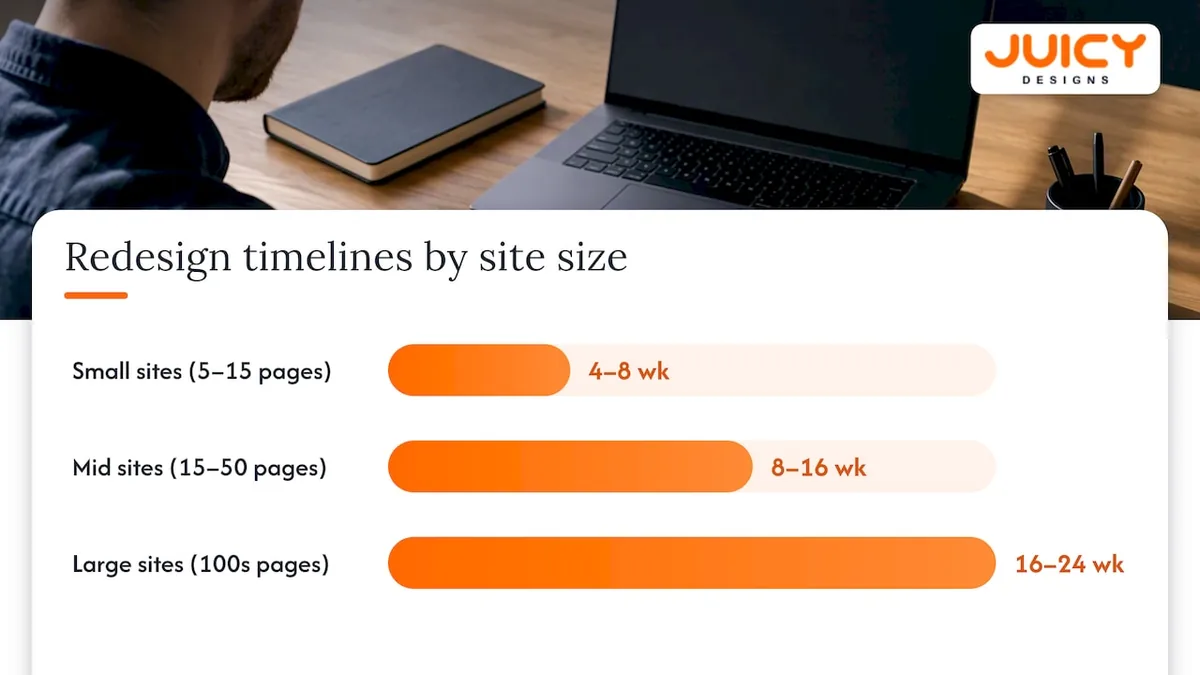
Large sites (16 to 24 weeks) and enterprise projects (3 to 12+ months) carry hidden work that rarely shows up in a first quote: legacy content audits across hundreds of pages, custom API integrations with internal systems, multi-region or multi-language variants, and security or compliance reviews. Wix's own redesign guide notes that extensive redesigns, particularly those bundling content strategy, SEO migration and complex builds, often run four to eight months even before enterprise-scale complexity enters the picture.
Response time is the variable that quietly rewrites every one of these ranges:
- Same-day to 48 hours: projects tend to track close to the low end of their band.
- 3 to 5 business days per review round: this is common agency guidance, and it can stretch a project by roughly a third to a half over the original estimate, according to Phenomenon Studio.
- A week or more, or reviews that require a full committee: timelines regularly slip into the next size band entirely.
Before you commit to a launch date, confirm which of these three patterns matches your organisation's actual behaviour, not its stated intention.
Phases of a redesign and time allocation per phase
A redesign isn't one long task, it's a sequence of phases that can overlap more than most teams assume. Understanding where the parallel work is possible is often the single biggest timeline lever you have.
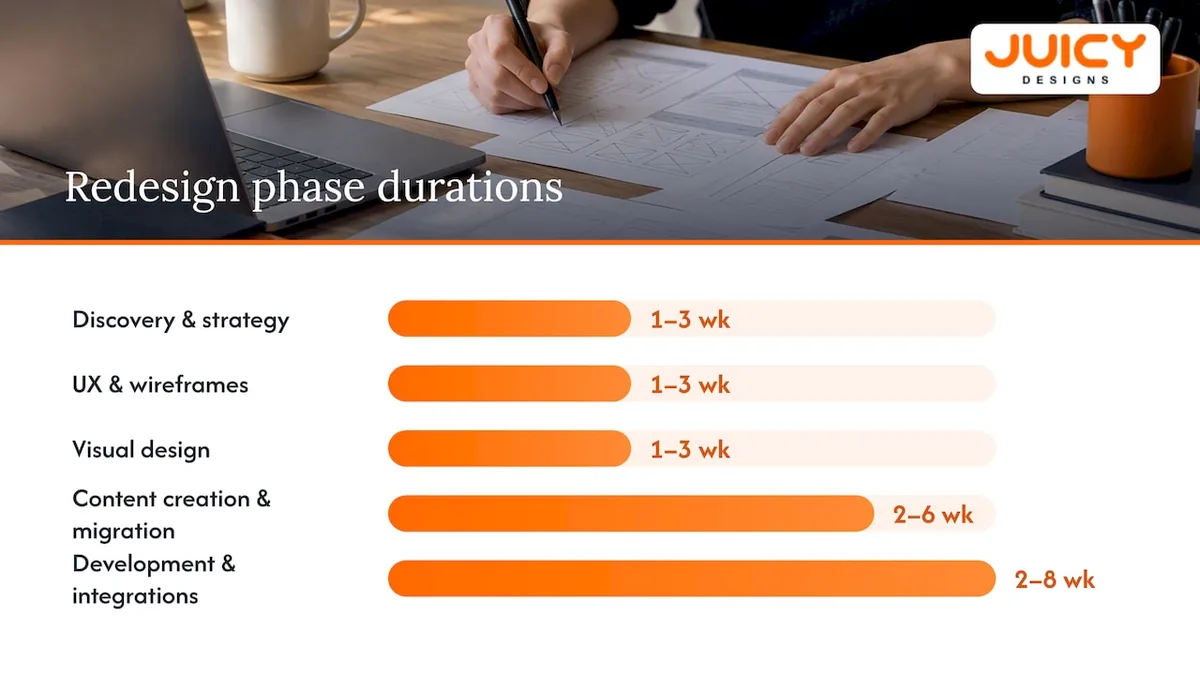
- Discovery and strategy (1 to 3 weeks): goal setting, competitor review, sitemap planning, and stakeholder alignment on scope. This phase sets the boundaries everything else depends on.
- UX and wireframes (1 to 3 weeks): structural planning for key templates, typically requiring one or two stakeholder review rounds.
- Visual design (1 to 3 weeks): brand application, layout refinement, and approvals; this phase can run longer when more than one decision maker needs to weigh in.
- Content creation and migration (variable, often 2 to 6 weeks): copywriting, image sourcing, and moving existing content into new templates. This is frequently the phase with the least predictable duration because it depends on people outside the project team.
- Development and integrations (2 to 8 weeks): backend build, CMS setup, third-party connections, and internal testing windows that should start before development finishes.
- QA, accessibility testing, and pre-launch checks (1 to 2 weeks): functional testing, cross-browser checks, and WCAG conformance review.
- Launch and post-launch stabilisation (30 to 90 days): monitoring, fixing issues that only surface under real traffic, and adjusting based on early data.
Agency process breakdowns consistently list discovery, design, development, QA and launch as the core structure, with each phase adding predictable time that compounds if review cycles slip.
Accessibility deserves a specific note here: it works best as a thread through design and development, not a single QA checkpoint at the end. Catching contrast issues or missing labels during wireframing costs a design tweak. Catching them after development is a rebuild.
Pro Tip: Run content creation in parallel with visual design rather than waiting for final approval, most content teams can work from an approved wireframe just as well as a finished mockup.
Common causes of redesign delays and how to spot them early
Every delayed redesign traces back to one of a handful of repeat offenders, and most of them are visible weeks before they cause a problem if you know where to look.
- Content readiness and approvals: content is consistently the most frequent blocker because it depends on people who aren't dedicated to the project, according to common cause breakdowns from agency guidance. Watch for a content owner who hasn't started drafting by the end of discovery.
- Scope creep: new page requests or feature additions after design sign-off are the second most common slip. A written scope document with a formal change process, rather than a verbal agreement, is the guardrail that actually holds.
- Third-party integrations and access delays: waiting on API credentials, CRM access, or vendor documentation can stall development for days at a time. Request all third-party access during discovery, not development.
- Legacy CMS or technical debt: an old platform with undocumented customisations often takes longer to migrate away from than anyone estimated at kickoff.
- Skipped or late accessibility checks: treating WCAG review as a final step, rather than an early one, is a documented cause of schedule slips and rework.
Spotting these early usually means asking blunt questions in week one: who owns content, what's the change process, and who has vendor logins.
How to speed up a redesign responsibly
There are real ways to compress a timeline without gutting quality, but each comes with a trade-off worth naming upfront.
- Use templates and component libraries to compress the handoff between design and development, this can shave one to two weeks off a mid-sized project.
- Launch in phases (an MVP approach): release the highest-priority pages first and iterate afterwards. Nielsen Norman Group supports incremental redesign specifically because it reduces risk while still delivering value early.
- Outsource content production rather than waiting on internal teams stretched across other priorities, this is often the fastest fix for the single biggest bottleneck in the whole project.
- Run QA and accessibility checks earlier, not to skip them, but to catch issues before they become expensive to fix.
The honest trade-off: rushing development without rushing QA is fine. Rushing QA to hit a date is how technical debt and accessibility failures get shipped, and both cost more to fix after launch than before it. A rush is acceptable when it compresses process, not when it compresses testing.
Pro Tip: If a deadline is fixed and immovable, cut scope before you cut QA time, a smaller launch that works beats a full launch that breaks.
Launch and migration checklist
The launch itself is where months of planning either pay off or unravel in a single afternoon. A short, disciplined checklist prevents most of the damage.
- Pre-launch: confirm URL mapping and 301 redirects for every changed page, run a full staging QA pass, verify crawlability with a site crawler, and confirm analytics goals are firing correctly.
- Accessibility check: run an automated WCAG scan and complete manual checks for keyboard navigation and screen reader compatibility, ideally days before launch rather than hours.
- Launch day: monitor organic traffic in real time, check server logs for crawl errors, confirm analytics goals are recording, and smoke-test the main user journeys (search, checkout, contact forms) as a human, not just a script.
- Post-launch (30 to 90 days): re-crawl the full site to catch redirect chains, monitor for accessibility regressions introduced by content updates, and adjust underperforming pages based on early traffic data.
The 2026 WebAIM Million analysis found that the average home page reached 1,437-page elements in February 2026, with detectable accessibility errors rising alongside that complexity. More complex redesigns carry a higher baseline risk of accessibility issues slipping through, which is exactly why the earlier check in phase two matters more as sites grow.
Phased launches, prioritising your highest-traffic and highest-conversion pages first, let you stabilise SEO signals and fix migration issues on a smaller scale before rolling out the rest of the site, protecting the organic traffic you've already built.
How often to redesign versus refresh
A full redesign every 2 to 4 years, paired with continuous small updates in between, is a reasonable default cadence for most businesses, adjusted when specific triggers appear rather than by the calendar alone.
Prioritise a redesign sooner when you see falling conversion rates, persistent mobile usability complaints, or accessibility failures surfacing in testing or user feedback. These are data-driven triggers, not aesthetic ones, and they tend to justify moving the project up regardless of where you are in your cycle.
Timing the launch window matters as much as timing the decision to redesign:
- Avoid peak sales periods and major promotional campaigns, a redesign launched mid-campaign compounds two sources of risk at once.
- Launch after a major campaign wraps, not during it, so your team can focus on stabilisation instead of splitting attention.
- Avoid the close of financial or accounting cycles, when internal teams are already stretched on reporting.
- Choose a quieter trading period where a short traffic dip, if one happens, causes the least business disruption.
How Juicy Designs plans and protects timelines
Founder-led delivery removes a layer that commonly slows agency projects down: the account manager relay between client and the people doing the work. At Juicy Designs, decisions happen directly with the founders, which shortens the gap between a stakeholder question and an answer.
On the redesign side, that same direct-access model translates into practical review SLAs, typically 48 to 72 hour turnarounds, and phased launch plans that keep timelines predictable rather than open-ended.
What we'd tell any team planning a redesign
If you take one policy away from this, make it this: set a fixed review SLA (48 to 72 hours) and name a single decision owner before the project starts, not after the first delay. Vague accountability, more than any technical issue, is what turns an 8 week project into a 14 week one.
It's also worth knowing when to say not now. If your business is heading into its busiest trading period, postpone the redesign rather than rush it through. A slower launch beats a broken one during your highest-stakes weeks.
, Cobus
Juicy Designs: how we help deliver redesigns on schedule
A predictable timeline depends on predictable decisions, and that's where working directly with founders instead of an account management layer tends to pay off. Juicy Designs builds redesign projects around the same founder-led model behind our advertising and SEO work: fewer handoffs, faster answers, and no long-term contract locking you into a schedule that no longer fits your business.
- Web design packages start at Starter (from 12000 R one-off), Business (from 28000 R one-off), and Custom and ecommerce (from 85000 R one-off), detailed on our web design pricing page.
- Flexible terms mean you're not committed beyond the project itself, useful when you need timeline certainty without a multi-year agreement.
- Direct founder access replaces the usual review bottleneck with same-team decision-making from discovery through launch.
If you're weighing a redesign against your own calendar and stakeholder availability, our contact page is the fastest way to get a scoped timeline back.
Sources
- WebAIM Million (2026)
- Website redesign timeline & process, Clique Studios
- A 15-step guide to website redesign, Wix
- Radical incremental redesign, Nielsen Norman Group
FAQ
How long should a website redesign take?
Most redesigns take 4 to 8 weeks for small sites, 8 to 16 weeks for mid-sized sites, and 16 to 24 weeks for large sites, with enterprise projects running 3 to 12 or more months. The exact figure depends heavily on how quickly stakeholders review and approve work at each phase.
How do I announce a website redesign?
Announce a redesign through your existing channels (email, social media, and an on-site banner) shortly before launch, and follow up once the new site is live with a short explanation of what changed. Keeping the announcement close to launch avoids confusing visitors during the final testing window.
What are the stages of a website redesign?
A typical redesign moves through discovery and strategy, UX and wireframing, visual design, content creation and migration, development and integrations, QA and accessibility testing, and launch with post-launch stabilisation. Each stage has its own time range, and several can run in parallel to shorten the overall project.
How long does it take to update an existing website?
A smaller content or design update, rather than a full redesign, typically takes days to a few weeks depending on how many pages and templates are affected. A single-page update with no structural changes can often be completed within days.
How often should a business redesign its website?
A major redesign every 2 to 4 years is a reasonable default, with continuous smaller updates in between to keep the site current. Move that timeline up sooner if you see falling conversions, mobile usability problems, or accessibility failures, since these are the clearest signals it's time.
Recommended
- Redesign Your Website Without Losing SEO Rankings
- How Often Should a Small Business Redesign Its Website?
- How to Redesign a Website Without Losing Traffic
- How Long Does It Take to Build a Business Website?