
What is a digital advertising budget? Your 2026 guide
A digital advertising budget is the specific amount a business allocates to paid online channels like Google Ads and Meta to reach measurable revenue goals. Most businesses allocate 8-12% of revenue and manage spend against a target return on ad spend (ROAS).
A digital advertising budget is not the same thing as a marketing budget, and confusing the two is the fastest way to distort your real return on ad spend. This guide explains how South African businesses should set, manage and scale paid media spend in 2026.


TL;DR: Quick Answer
A digital advertising budget is the specific amount a business allocates to paid online channels to achieve measurable goals. Set it as 8-12% of revenue or reverse-engineer it from revenue targets using a target ROAS. Spend at least R9,000 per month per platform so the algorithm has enough data, scale by no more than 20-30% at a time, and give campaigns four to six weeks (60-90 days for B2B) before judging performance. Patience and clean conversion data beat a bigger budget every time.
Key takeaways
- Define the budget correctly: separate paid media spend from total marketing costs for accurate ROAS reporting
- Use goal-based budgeting: reverse-engineer spend from revenue targets and ROAS, not arbitrary percentages
- Respect platform minimums: spend at least R9,000 per month per platform to enable algorithm optimisation
- Scale incrementally: increase budgets by no more than 20-30% at a time to avoid performance resets
- Match evaluation windows to sales cycles: B2B campaigns need 60-90 days of data before drawing conclusions
A digital advertising budget is the total amount a business allocates to paid online marketing channels to achieve specific, measurable outcomes. It is distinct from a general marketing budget, which covers all marketing costs. The advertising budget covers only paid media spend, and confusing the two distorts your true return on ad spend (ROAS). Businesses that treat these as separate line items make better decisions about where their money actually goes. Getting this right is the foundation of effective ad spending, and this guide walks you through exactly how to do it in the South African context.

What is a digital advertising budget and how is it set?
A digital advertising budget defines how much you commit to paid online channels over a set period, typically monthly or quarterly. The most common starting point is a percentage of revenue: businesses typically allocate 8-12% of total revenue to digital advertising. That range shifts significantly with growth stage, so treat it as an anchor rather than a fixed rule. The data behind the benchmark is summarised in Marpany’s digital ad budget research.
Startups and businesses in aggressive growth phases often spend 20-30% of revenue on ads. Mature brands with established customer bases tend to sit closer to 5-8%. B2B companies generally invest 2-5% of revenue, while B2C ecommerce businesses often spend 5-12%. The logic is simple: the less brand recognition you have, the more you need to spend to build it.

A more precise method is reverse-engineering your budget from revenue goals. Start with your target monthly revenue, then work backward using your target ROAS and average order value. If you want to generate R500,000 in revenue and your target ROAS is 4x, you need to spend R125,000 on ads. This approach ties your ad spend directly to outcomes rather than arbitrary percentages.
Customer lifetime value (LTV) also shapes budget decisions. A business where customers spend R10,000 over their lifetime can afford a higher cost per acquisition than one where customers spend R500 once. Factor LTV into your allowable cost per lead or sale before setting any platform budgets.
- Percentage of revenue: Simple and scalable, but requires accurate revenue forecasting.
- Goal-based budgeting: Reverse-engineer from revenue targets using ROAS and conversion rates.
- LTV-based budgeting: Set acquisition cost limits based on what a customer is worth over time.
- Competitive benchmarking: Research typical spend levels in your industry and geography.
Pro tip: Start with a goal-based budget, then cross-check it against the percentage-of-revenue benchmark. If the two numbers are far apart, your revenue targets or ROAS expectations need revisiting.
What are the key cost factors in digital advertising?
Digital advertising costs vary widely by platform, industry, audience and campaign objective. Average CPC on Google Ads ranges from roughly R30 to R96 (approximately $1.63 to $5.26), while CPM rates run from $2 to $15 and higher for premium placements. These figures, drawn from Landingi’s ad cost benchmarks, are averages: competitive industries like legal, finance and insurance pay significantly more per click. For a local deep dive, see our guide to Google Ads costs in South Africa.
Platform choice drives cost structure. Google Ads charges primarily per click (CPC), making it suited to high-intent search campaigns. Meta (Facebook and Instagram) uses a CPM model, charging per thousand impressions, which works well for awareness and retargeting. LinkedIn costs more per click than most platforms but delivers B2B audiences that other platforms cannot match. TikTok offers lower CPMs for younger demographics but requires creative investment to perform.
Industry competition is the single biggest cost variable. A personal injury attorney in Johannesburg pays far more per click than a local bakery, because more advertisers are bidding on the same keywords. Audience targeting also affects cost: narrower, more specific audiences often cost more to reach but convert at higher rates.
Campaign objective matters too. Awareness campaigns optimised for reach and impressions cost less per result than conversion campaigns optimised for purchases or leads. The trade-off is that awareness spend is harder to tie directly to revenue.
| Platform | Primary cost model | Typical use case |
|---|---|---|
| Google Ads | CPC (cost per click) | High-intent search, lead generation |
| Meta (Facebook/Instagram) | CPM (cost per thousand impressions) | Awareness, retargeting, ecommerce |
| CPC / CPM | B2B lead generation | |
| TikTok | CPM | Brand awareness, younger demographics |
In South Africa, digital advertising costs are generally lower than US or European benchmarks in rand terms, but the principles of cost management remain identical. Local competition levels, audience size and platform penetration all influence what you pay.
How can businesses manage and optimise their ad budget?
Budget management is not a set-and-forget task: treat the monthly number as a performance tool, not a fixed commitment. Modern automated bidding strategies prioritise efficiency targets like target ROAS over strict budget limits. That means the quality of your conversion data matters more than the budget number itself.
Platforms like Google Ads use machine learning to allocate spend towards the highest-converting opportunities. But that learning requires data. Meeting platform minimum spend thresholds is not sufficient for algorithm learning. A practical minimum of R9,000-R18,000 per month per platform (roughly $500) gives the algorithm enough data to optimise meaningfully. Spending less than this produces unreliable results and wastes money.
Scaling budgets requires patience. Increasing budgets by more than 20-30% at once forces the algorithm into a costly re-learning phase, which spikes acquisition costs temporarily. The right approach is incremental increases with at least two weeks between adjustments to let performance stabilise.
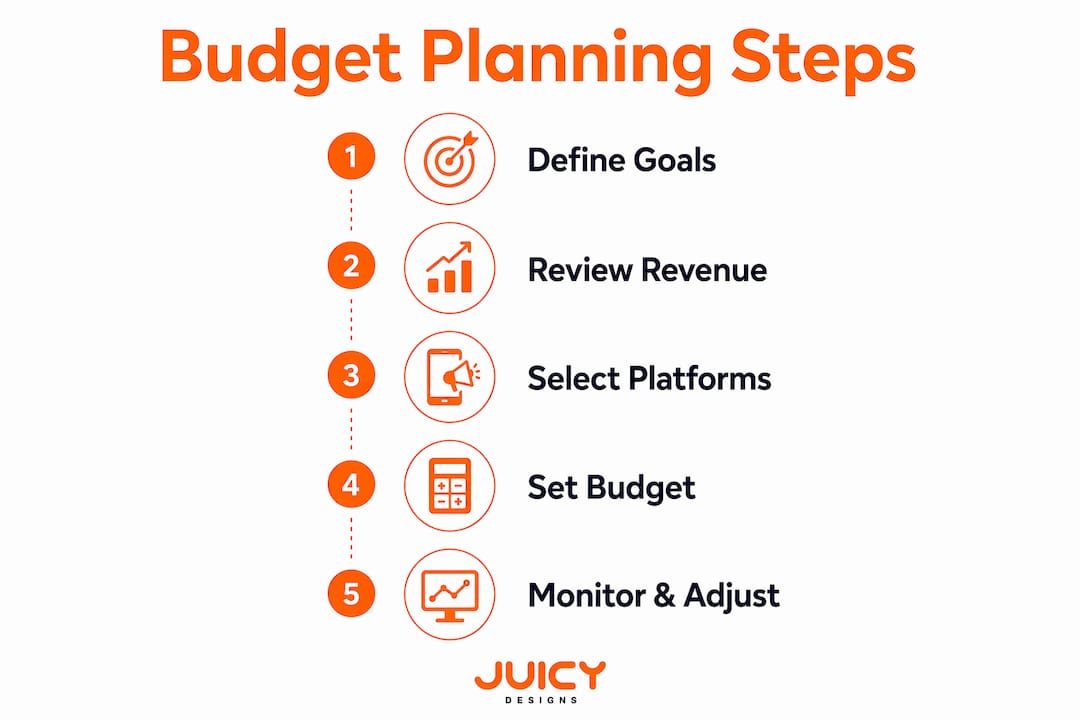
- Audit current performance before changing any budget. Identify which campaigns generate the best ROAS and which drain spend without results.
- Set ROAS and CPA targets before increasing spend. Know what a successful result looks like before you scale.
- Increase budgets incrementally by 20-30% at a time, then wait two weeks before the next adjustment.
- Review attribution windows regularly. Short windows miss late conversions and make campaigns look worse than they are.
- Use a digital marketing audit to identify budget leaks before scaling.
Pro tip: If a campaign looks like it is underperforming after three weeks, check the attribution window before cutting the budget. Many conversions, especially in B2B, happen days or weeks after the first click.
B2B advertisers need 60-90 day evaluation windows because sales cycles are longer. Cutting a campaign after 30 days often means abandoning leads that were still moving through the funnel.
What are practical budget allocation strategies across digital channels?
A well-structured advertising budget breakdown puts 60-70% of spend into your primary acquisition channel, 20-30% into retargeting, and 10-15% into testing new channels or formats. Distributing budget this way requires a clear view of where your audience spends time and what stage of the buying process you are targeting, and it keeps acquisition spend cleanly separated from retargeting spend.
Search advertising (Google Ads) captures existing demand. People searching for your product or service are already interested. This makes search the highest-intent channel and often the best place to start. Social advertising (Meta, TikTok, LinkedIn) creates demand by reaching people who are not yet searching. Both serve different roles in the marketing funnel.
- Allocate 60-70% of budget to your primary acquisition channel based on historical performance data.
- Reserve 20-30% for retargeting to convert people who have already visited your site or engaged with your content.
- Keep 10-15% for testing new channels, audiences or ad formats without risking core campaign performance.
- Set platform-specific daily minimums. Effective daily budgets of R550-R1,800 (roughly $30 to $100) per platform produce meaningful data.
- Review channel allocation monthly, not quarterly. Platform performance shifts, and budgets should follow results.
For South African businesses running multi-platform campaigns, Google Ads and Meta typically deliver the broadest reach. LinkedIn is worth the premium cost for B2B companies targeting decision-makers in sectors like finance, manufacturing or professional services. TikTok is growing in South Africa but requires strong creative to compete for attention.
Budget planning: lessons from managing real campaigns
The most common budgeting mistake is treating spend as the primary performance lever: what actually drives results is the quality of your conversion data and the clarity of your goals. Business owners entering digital advertising often assume that spending more automatically produces more results. It does not work that way.
Campaigns with modest budgets regularly outperform larger spends simply because the smaller account has cleaner tracking, tighter audience targeting and a realistic ROAS target. The algorithm has less to work with when you give it a large budget but poor data.
The second mistake is impatience. Business owners cut campaigns after two or three weeks because the numbers look flat. In most cases, the campaign has not had enough time or spend to exit the learning phase. This is especially true in B2B, where a lead might click an ad today and sign a contract 60 days later. Cutting early means you never see the return.
“My honest view is that most businesses in South Africa are underinvesting in digital advertising relative to the opportunity. The cost per click and cost per lead on most platforms here is still significantly lower than in Western markets. That gap will not last indefinitely. The businesses that build strong campaign structures and data foundations now will have a meaningful advantage as competition increases.”
Cobus van der Westhuizen, Founder & Digital Strategist, Juicy Designs
If you are unsure where to start, focus on one channel, set a clear ROAS target and spend enough to give the algorithm real data. Patience and consistency beat scattergun spending every time.
How Juicy Designs approaches digital advertising budgets
Juicy Designs builds ad budgets grounded in real revenue goals, not guesswork, for business owners across South Africa. The team manages Google Ads campaigns with a proven average ROAS of 4.8x, nearly double the industry standard. Every budget recommendation starts with your specific targets, your customer lifetime value and the platforms where your audience actually spends time. You can see how engagements are structured on our pricing page, and if you want a clear picture of what your ad spend should look like and what it should return, request a free Google Ads proposal and get a plan built around your numbers.
Frequently asked questions
What is a digital advertising budget?
A digital advertising budget is the total amount a business allocates specifically to paid online media, separate from other marketing costs. It covers spend on platforms like Google Ads, Meta, LinkedIn, and TikTok to drive traffic, leads, or sales.
How much should a small business spend on digital ads?
Small businesses typically spend R5,500 to R55,000 per month on digital advertising, depending on industry and goals. A practical minimum of R9,000 per month per platform gives algorithms enough data to optimise effectively.
What is ROAS and why does it matter for budgeting?
ROAS (return on ad spend) measures revenue generated for every rand spent on advertising. Setting a target ROAS before allocating budget lets you reverse-engineer exactly how much to spend to hit your revenue goals.
How often should I adjust my digital advertising budget?
Review budget allocation monthly and scale individual campaigns by no more than 20-30% at a time. Larger increases force the algorithm into a re-learning phase that temporarily raises acquisition costs.
How long does it take to see results from digital advertising?
Most campaigns need at least four to six weeks to exit the learning phase and produce reliable data. B2B campaigns require 60-90 days of evaluation due to longer sales cycles and extended attribution windows.