
What is a photography studio, and how does it make money?
Discover what a photography studio is and how it generates profit. Learn key services, pricing strategies, and effective marketing tips.
What is a photography studio, and how does it make money? !


TL;DR: Quick Answer
Discover what a photography studio is and how it generates profit. Learn key services, pricing strategies, and effective marketing tips.
A photography studio, as a business, is a professional service company that sells photography deliverables to clients, licensing images for commercial, editorial, or personal use. Success depends less on gear than on repeatable services, profitable pricing, and predictable marketing.
That's the single biggest shift owners need to make in how they think about the work: run it like a service business, not a creative hobby that occasionally invoices someone. Price for profit. Invest in marketing that actually converts enquiries into signed bookings.
This article covers what that looks like in practice, with South African pricing throughout:
- The services and packaging models that generate consistent revenue
- Startup and running costs, plus a floor-rate formula you can calculate today
- The marketing and website features that convert commercial clients
- How to choose a digital marketing or web design partner without wasting money
- What a physical studio setup and daily workflow actually involve
Key Takeaways
A photography studio succeeds as a business when it prices for profit using a real floor rate, packages repeatable services, and treats marketing as a permanent function rather than an occasional push.
| Point | Details |
|---|---|
| Define the business correctly | A photography studio sells deliverables and licenses images, so run it as a service business, not a hobby. |
| Calculate your floor rate | Gross up for a 25% tax assumption and realistic billable hours (around 16/week) before quoting any job. |
| Budget for hidden costs | Insurance, travel, education, and software often erode margins more than gear ever does. |
| Build a conversion-focused website | Service-based portfolios, case studies, and integrated booking cut enquiry-to-deposit friction significantly. |
| Choose an agency with proof | Juicydesigns offers measurable outcomes, including a 4.8x average client ROAS. |
What services does a photography studio sell?
A photography studio's revenue comes from a mix of one-off shoots and recurring work, and the businesses that grow fastest usually lean towards the latter.
The common service lines include:
- Product photography for ecommerce brands and retailers needing catalogue-ready images
- Brand and lifestyle shoots for marketing campaigns and social content
- Corporate headshots for teams, executives, and LinkedIn profiles
- Event coverage for conferences, launches, and corporate functions
- Wedding and portrait photography for direct consumer clients
- Content retainers, where a business pays monthly for a set volume of fresh images
Client types buy differently. Small ecommerce brands often need fast turnaround and predictable pricing for recurring product batches. Agencies buying on behalf of their own clients want reliability and clear licensing terms they can pass along. Corporate procurement teams move slower, often requiring quotes, invoices, and sometimes formal registration before they'll sign. Consumer clients (weddings, portraits) tend to arrive through referrals and reviews rather than cold outreach.
The market has been shifting towards more ecommerce and product photography demand, with clients expecting faster digital turnarounds and content that scales across multiple channels.
Packaging matters as much as the shoot itself. Spell out exactly what the client receives (raw files, edited images, usage rights, turnaround time) and decide upfront whether you're selling a one-off session or a retainer. Retainers create the predictable monthly revenue that makes it easier to plan and to justify ongoing marketing spend.
How do you calculate a sustainable floor rate?
Startup costs for a professional photography business commonly run between R20,000 and R80,000, covering a camera body, lenses, lighting, and basic editing software. Ongoing marketing and web costs often add up to a few thousand rand monthly once you factor in ads, a website, and content production.
Beyond the obvious gear, several overheads quietly erode margins if you don't budget for them:
- Insurance, equipment cover and public liability, both easy to skip and expensive to regret
- Travel and accommodation for out-of-town shoots
- Software subscriptions for editing and delivery platforms
- Ongoing education, including workshops and courses
- Equipment depreciation, since cameras and lenses lose resale value every year
These hidden costs are often the exact reason photographers underprice their work. Making them visible in a proposal helps justify charging what the job actually costs.
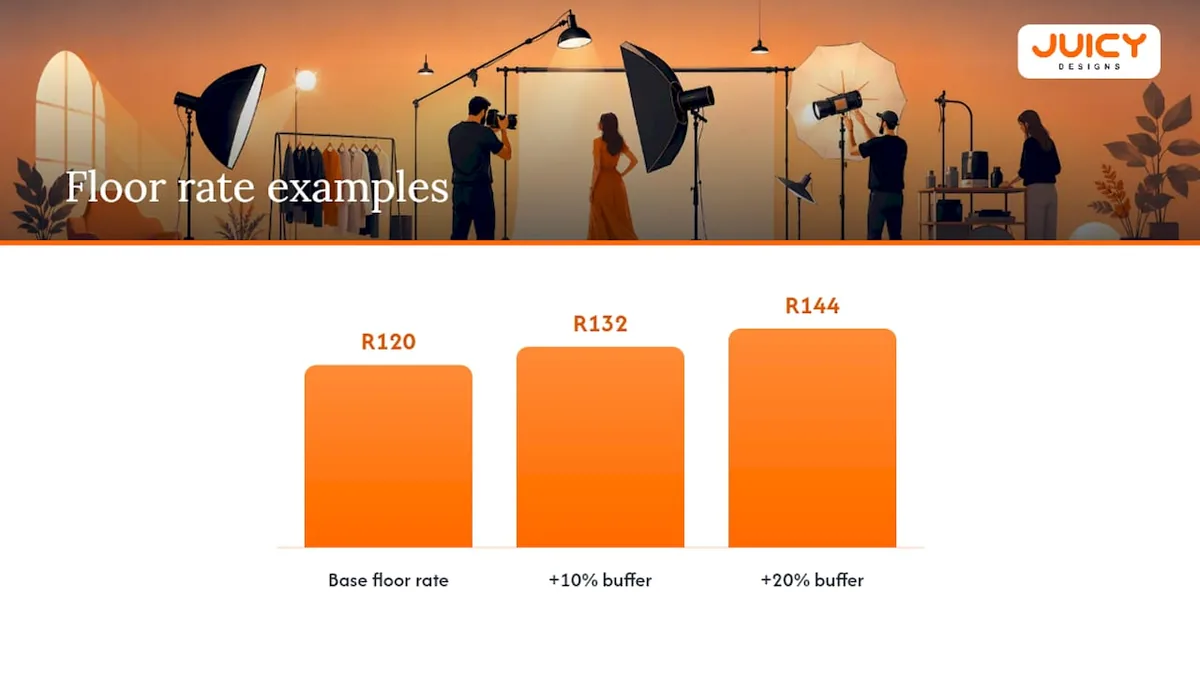
Statistic: A practical floor-rate method grosses up for an assumed 25% tax rate and realistic billable hours, often around 16 per week for a solo operator once admin, editing, and marketing time are subtracted. One published South African example lands on a floor rate near R120 per hour for certain profiles. Add a 10 to 20% buffer for scope creep, and you have a defensible minimum you can build packages around instead of guessing.
What marketing and web features actually drive bookings?
A portfolio alone doesn't convert commercial clients. What converts is a site built to answer a buyer's practical questions fast: what do you shoot, what's it cost, and how do I book you.
A working checklist for a photography-business website includes:
- A portfolio organised by service or industry, not just a chronological gallery
- Case studies showing results, not just pretty images
- Clear calls to action on every service page
- An integrated booking and payment flow
- Service and local business schema markup so search engines understand what you offer
On channels, LinkedIn tends to outperform for B2B leads (corporate headshots, brand shoots for other businesses), while targeted Google Ads work well for niche searches like "corporate headshot photographer" in a specific city. Organic SEO earns compounding traffic for service-plus-location searches over time. Social proof, meaning testimonials and behind-the-scenes content, closes the trust gap that a portfolio alone leaves open.
On operations, integrating a CRM or booking platform with your website removes the manual back-and-forth that kills momentum after a promising enquiry. Practitioner experience suggests automated onboarding and booking speeds up deposits and reduces no-shows, and integrated booking and payment systems have been reported to cut enquiry-to-deposit friction by around 30%. Contract and deposit workflows that trigger automatically the moment someone books convert faster than a "we'll send you an invoice" email three days later.
Pro Tip: Add a visible price range or starting rate to your service pages. Buyers who see zero pricing signals often assume you're either too expensive or too unproven to bother enquiring.
Strong visual content also does measurable work beyond your own site. Visual-first marketing tends to earn substantially more engagement than text alone, which is one more reason to treat your own portfolio and case studies as sales assets, not just a gallery.
How do you choose a marketing or web design partner?
Picking an agency badly costs more than picking slowly. Before you sign anything, run the relationship through a short evaluation.
Look for these signals first:
- A relevant portfolio, ideally with experience in photography, creative services, or similarly visual B2B categories
- Measurable outcomes, meaning actual case studies with numbers, not vague claims about "great results"
- A clear reporting cadence, so you know exactly when and how you'll see performance data
- Flexible pricing with no long-term lock-in, so you can leave if results don't materialise
- Clarity on asset ownership, especially who owns your website, ad accounts, and creative files if you part ways
At your first briefing, ask directly:
- "Can you show me a case study from a photography or visual-services client?"
- "What would a 90-day plan for my business actually look like?"
- "What does your reporting template include, and how often do I get one?"
- "Can I speak to a current client as a reference?"
Red flags include vague answers about past results, contracts that lock you in for a year with no exit, and agencies that can't explain how they'll measure success. Trust signals worth prioritising include a documented return on ad spend figure, named case studies, and a founder or senior team member who's actually reachable when something needs fixing.
What types of physical photography studios exist?
Even though this article is about the business side, owners still need to understand the physical setups their business is built around, since studio type shapes what services you can realistically sell.
Natural light studios rely on large windows or skylights and suit portrait and lifestyle work where a soft, organic look matters. They're cheaper to run since there's less lighting gear to buy and maintain, but they depend on weather and time of day, which limits scheduling flexibility.
Flash and strobe lighting studios use controlled artificial lighting, giving total control over shadows, highlights, and mood regardless of the time of day. These suit product photography, corporate headshots, and commercial work where consistency across a shoot matters more than a particular aesthetic.
Mobile or pop-up studios pack lighting and backdrops into a portable kit, letting you shoot on location at a client's offices or event. These fit corporate clients who want headshots done on-site for an entire team in one sitting, or event coverage where setting up a fixed studio isn't practical.
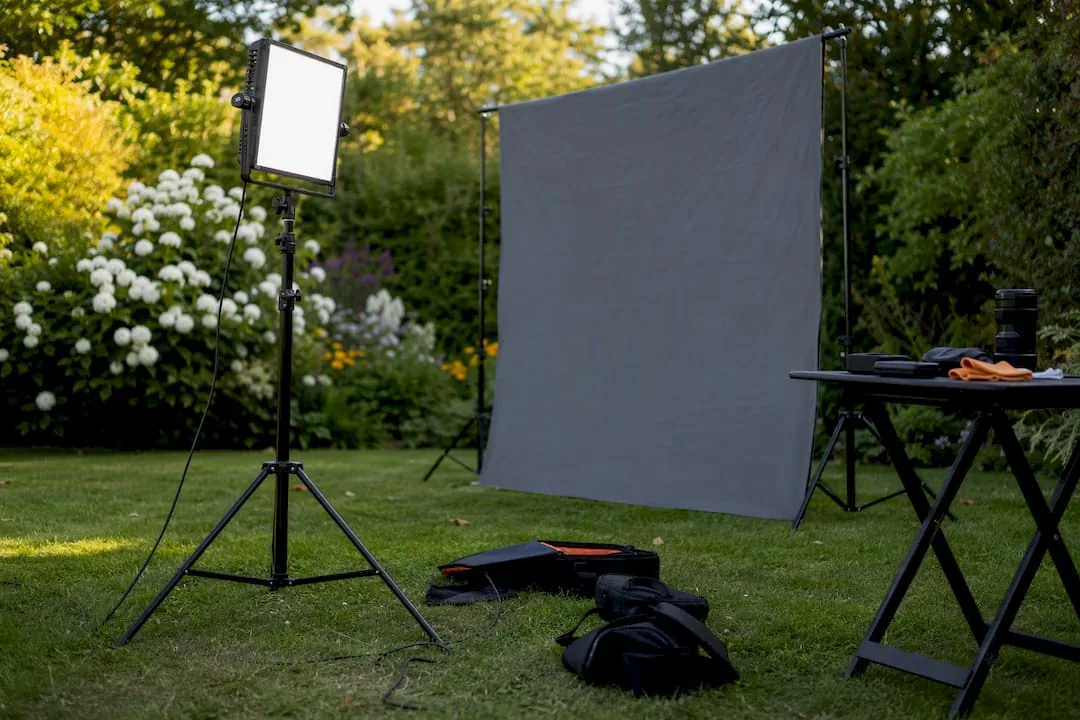
Many businesses run more than one setup, or rent studio space by the hour rather than owning a fixed location, which keeps overhead lower while startup capital is still tight.
What equipment does a photography studio need?
Equipment choices should map directly to the services you're selling, not to what looks impressive in a gear photo.
Cameras and lenses form the base cost. A full-frame body with a versatile zoom and a dedicated portrait lens covers most portrait and corporate headshot work, while product photography often benefits from a macro lens for detail shots.
Lighting is where budgets diverge most. Continuous LED panels are cheaper and easier for beginners, while strobe or flash systems with softboxes and modifiers give more control for commercial and product work. Reflectors and diffusers round out most lighting kits at low cost.
Backdrops range from simple paper rolls in standard colours to seamless muslin or vinyl options for a more textured look. Product photographers often need a dedicated shooting table or light tent for consistent, shadow-free results across a batch of items.
Props and set dressing matter more for lifestyle and brand shoots than for headshots or product work, where a clean, uncluttered frame usually sells better.
Editing software (Lightroom or Capture One are the industry standards) and reliable storage for client files round out the essential kit. None of this needs to be premium on day one. Renting specialty gear for specific jobs is often more sensible than buying it outright while cash flow is still tight.
How should a photography studio space be laid out?
Studio layout affects both what you can shoot and how efficiently you can turn clients around, which matters more for a business than most owners initially assume.
Ceiling height is the first constraint. Full-length portraits and group shots need enough vertical space for lighting stands and backdrop stands without crowding the frame, and a low ceiling limits the angles you can use.
Shooting distance matters just as much. A wide-angle lens still needs physical room to work, so a cramped studio forces compromises on composition that a client will notice in the final images even if they can't say why.
Separate zones help workflow. A dedicated shooting area, a changing or preparation space for clients, and a quiet corner for client consultations or contract signing all reduce the chaos of trying to do everything in one room.
Storage deserves real thought too. Backdrops, lighting stands, and props take up more space than most new owners expect, and a disorganised storage area slows down setup between clients, which costs billable hours over a full day of back-to-back bookings.
Power access is easy to overlook until it isn't. Strobe lighting setups need enough outlets in the right places, and running extension cords across a walkway during a client shoot is both unprofessional and a liability risk.
Why choose a dedicated studio over on-location shoots?
A dedicated studio gives you control that on-location work simply can't match, and that control translates directly into billable efficiency.
Lighting is the biggest advantage. In a studio, you set the lighting once and it stays consistent shoot after shoot, regardless of weather, time of day, or a client's office having terrible fluorescent lighting. On location, you're often fighting conditions instead of directing the shoot.
Turnaround speed improves too. A studio setup that's already dialled in lets you move from one client to the next without the setup and breakdown time that on-location work demands, which matters directly for how many bookings you can fit into a working week.
Cost predictability is another factor. Once a studio is paid for, each additional shoot has a lower marginal cost than a location shoot, which usually involves travel time, location fees, or permits.
That said, on-location work still has its place. Corporate headshots for an entire team are often more convenient done on-site, and lifestyle brand shoots sometimes need the authenticity a real environment provides that a studio backdrop can't replicate.
The right answer usually isn't picking one exclusively. It's knowing which service each format suits and pricing accordingly, since on-location work typically carries its own travel and setup costs that should be reflected in the quote.
What does a typical studio workflow look like?
The daily mechanics of running a studio matter for capacity planning and pricing, since every hour spent on non-shooting tasks is an hour you're not billing.
Booking starts the process, and this is where friction kills the most revenue. A client enquires, receives a quote, and ideally can book and pay a deposit through an integrated system rather than a manual back-and-forth over email. The faster this step moves, the higher your conversion rate from enquiry to signed client.
Shoot preparation covers gear checks, backdrop and lighting setup, and confirming exactly what the client expects to receive. For commercial clients, this often includes a pre-shoot brief covering brand guidelines, shot list, and usage requirements, since licensing terms for commercial work differ meaningfully from a standard consumer shoot.
The shoot itself is usually the shortest part of the total time investment for commercial work, especially for product photography, where a batch of items can be shot efficiently once the setup is dialled in.
Post-processing is where most of the actual labour hours go: culling, editing, colour correction, and exporting in the formats and resolutions a client needs. This is also the stage most owners underestimate when pricing a job, since editing time rarely scales down proportionally with a smaller shoot.
Delivery and follow-up close the loop, and a smooth delivery process, paired with a request for a testimonial or referral, does quiet work for future bookings.
What actually matters when you're growing this business
Most advice aimed at photographers focuses on gear and technique, and almost none of it addresses the two things that actually determine whether a studio survives its first three years: pricing discipline and marketing consistency.
The floor-rate calculation earlier in this article isn't a nice theoretical exercise. It's the single most-skipped step among owners who eventually burn out from being busy and broke at the same time. Undercharging doesn't get fixed by working harder. It gets fixed by doing the math once, sticking to the number, and treating hidden costs like insurance and travel as real line items rather than surprises.
The second gap is marketing consistency. Most photography businesses market in bursts, active before a slow month, silent once bookings pick up. That start-stop pattern is why so many owners feel like they're constantly starting over. A studio that treats its website, its outreach, and its follow-up systems as a permanent function rather than an occasional project builds the kind of pipeline that survives a quiet season.
If there's one thing worth prioritising over new gear or a rebrand, it's fixing the pricing and the pipeline first. Everything else is easier once those two are solid.
, Cobus
Grow your studio with a marketing partner built for measurable results
Beyond photography-specific fixes, you'll eventually need a partner who can run the marketing engine itself, and that's where Juicydesigns fits, without the overhead of a traditional agency retainer that locks you in regardless of results. Juicydesigns handles the full stack a growing studio needs: SEO and AEO to get found for commercial photography searches, Google Ads management for niche high-intent terms, social advertising on Meta and TikTok, and web design that actually converts enquiries into deposits.
Juicy Designs clients average a 4.8x return on ad spend, nearly double the industry standard. Because you work directly with the founders, there's no middleman diluting what you actually asked for.
Book a first conversation and ask three things: for a case study relevant to visual or creative services, for a sample 90-day plan, and for their reporting cadence. Start that conversation on the Juicy Designs contact page.
Sources
- How to start a photography business, Okhantu
- The hidden costs of professional photography in South Africa, Hot Coffee Photo
- Freelance photographer rates in South Africa (2026), SoloHourly
FAQ
What is a photography studio as a business?
A photography studio, in the business sense, is a company that sells professional photography services and licenses the resulting images to clients, rather than the physical room where shoots happen.
How much does it cost to start a photography studio in South Africa?
Startup costs commonly range from R20,000 to R80,000, covering camera gear, lighting, and basic software, with ongoing marketing and web costs often adding thousands of rand per month.
What is a floor rate and why does it matter?
A floor rate is the minimum hourly or per-shoot price that covers your costs, tax, and a reasonable margin, calculated by grossing up for a roughly 25% tax assumption and your actual billable hours rather than total hours worked.
What should a photography business website include?
At minimum, a service-organised portfolio, case studies, clear calls to action, an integrated booking and payment flow, and schema markup so search engines can identify your services.
How do I choose a digital marketing partner for my studio?
Look for a relevant portfolio, measurable case studies, flexible pricing with no long-term lock-in, and clarity on who owns your assets, and ask for a sample 90-day plan before signing anything, which is the exact model Juicydesigns uses with new clients.
Recommended
- Product Photography on a Budget (SA Guide) | Juicy Designs
- Product Photography South Africa | Juicy Designs
- Instagram for your online store in South Africa | Juicy Designs
- Printing of Marketing Materials in Pretoria | Juicy Designs