
AEO explained for South African brands in 2026
Discover how Answer Engine Optimisation can elevate your South African brand in 2026 by enhancing visibility and relevance across AI platforms.
Answer Engine Optimisation (AEO) is the practice of ensuring your brand is named, cited, and accurately described when AI assistants like ChatGPT, Gemini, Claude, Microsoft Copilot, and Perplexity compose answers to buyer questions.


TL;DR: Quick Answer
Discover how Answer Engine Optimisation can elevate your South African brand in 2026 by enhancing visibility and relevance across AI platforms.
Answer Engine Optimisation (AEO) is the practice of ensuring your brand is named, cited, and accurately described when AI assistants like ChatGPT, Gemini, Claude, Microsoft Copilot, and Perplexity compose answers to buyer questions. According to Cited Brands, AEO works across three layers: visibility (whether models mention you unprompted), narrative (which sources they trust), and locality (whether SA-specific sources back your brand). Your two immediate moves this week: run a blind-visibility baseline across at least three AI platforms, and assign a named internal owner for AEO before the end of the month.
Pro Tip: Ask ChatGPT and Gemini "Which [your category] companies in South Africa would you recommend?" without mentioning your brand name. If you are not in the answer, you have a visibility gap that costs you shortlist positions.
Key takeaways
AEO success in South Africa requires clean entity records, earned SA-masthead coverage, and a quarterly measurement cadence running across ChatGPT, Gemini, Claude, and Perplexity.
| Point | Details |
|---|---|
| Run a blind-visibility baseline | Ask 10 unprompted category queries across ChatGPT, Claude, and Gemini before spending anything. |
| Assign one named owner | AEO crosses SEO, PR, and comms; without a single accountable person, work stalls. |
| Fix Wikidata and schema first | Technical setup takes 4-8 hours and anchors your entity in the knowledge graph. |
| Earn SA-masthead coverage | BusinessTech, MyBroadband, and TechCentral carry disproportionate weight for local AI queries. |
| Juicydesigns delivers proven results | Founder-led AEO retainers from R6,500/month, with a 4.8x average client ROAS. |
Why AEO is urgent for South African brands right now
The buyer journey has shifted faster than most SA marketing budgets have. ITWeb reports that Forrester's 2025 B2B Buyer Study found a large majority of B2B buyers now consult an AI assistant during vendor research, and a significant share say an AI recommendation shaped their final shortlist. Gartner projects AI-first vendor evaluations will be the majority by 2027.
For South African brands, three local risks compound this shift:
- Offshore answer sourcing. AI models trained on global data default to international brands unless SA-specific sources explicitly name local alternatives.
- Complaint-platform narratives. HelloPeter reviews and similar platforms are indexed and cited by AI models. Unmanaged negative narratives get amplified into AI answers at scale.
- Tooling and coverage gaps. SA brands are underrepresented on the trusted mastheads (BusinessTech, MyBroadband, TechCentral) that models weight most heavily for local queries.
The commercial consequence is direct: a brand invisible to AI assistants loses shortlist momentum before a salesperson ever makes contact. The state of digital marketing in South Africa confirms AI adoption is accelerating locally, making 2026 the year to act.
How does AEO differ from traditional SEO?
The operational gap between AEO and SEO is wider than most leaders expect. Traditional SEO is a ranking game: you compete for positions 1-10 on a results page, where partial visibility can still drive clicks. AEO is binary. An AI assistant either names your brand in its composed answer or it does not. There is no position two.
| Dimension | Traditional SEO | AEO / GEO |
|---|---|---|
| Success metric | Page rank, organic traffic | Citation share, named-mention rate |
| Primary signals | Keywords, backlinks | Structured data, entity records, trusted citations |
| Output | A ranked list of links | A single composed answer |
| Ownership | SEO team | SEO + PR + Comms jointly |
| Reporting cadence | Weekly rank tracking | Monthly citation audit, quarterly narrative review |
Different KPIs mean different budgets and different owners. PR and communications teams become as important as technical SEO leads because earned coverage on trusted SA mastheads is one of the strongest signals a model uses to decide which brand to name.
Pro Tip: Brief your exec team with one number: citation share. It is the percentage of relevant AI answers that name your brand, and it is the AEO equivalent of market share in search.
What are the three layers of AEO and the six priority categories?
Think of AEO success as three nested layers, each building on the one below.
- Visibility, the model mentions your brand in an unprompted category answer.
- Narrative, the model draws on sources that describe your brand accurately and favourably.
- Locality, SA-specific mastheads and directories back your brand, so the model trusts it for local queries.
The recommended sequence is: repair narrative first, secure locality second, then chase visibility. Chasing named recall before your narrative is clean produces sycophancy uplift (the model flatters you when prompted) without genuine organic citation.
The six priority categories of work, in order:
- Owned content for machine reading, reformat key pages as clear Q&A blocks and structured lists that AI can extract cleanly.
- Earned media on trusted SA mastheads, BusinessTech, MyBroadband, TechCentral, and sector titles carry disproportionate weight with models for SA queries.
- Structured data and entity records, schema markup, a correct Wikidata entry, and a complete Google Business Profile anchor your entity in the knowledge graph.
- Complaint and response operations, actively manage HelloPeter and Google reviews; unanswered complaints become the narrative models cite.
- Multilingual coverage, for brands serving Zulu, Sotho, or Afrikaans-speaking audiences, content in those languages improves locality signals.
- Quarterly measurement cadence, without regular blind-visibility tests, you cannot tell whether any of the above is working.
Pro Tip: Add an llms.txt file to your site root. It is a plain-text file that lists your key pages and describes your business for AI crawlers. Setup takes under two hours and signals readiness to AI systems without affecting your Google ranking.
A practical 90-day AEO checklist for SA brands
Technical setup is faster than most teams expect. Smart AI Solutions notes that core schema, llms.txt, and Wikidata work typically takes 4-8 hours, while content reformatting and earned-coverage outreach runs 20-40 hours or more. Budget accordingly.
Assign one named owner who coordinates across SEO, PR, and comms. Without a single accountable person, AEO work fragments across teams and stalls. For SMBs, a typical monthly retainer with a specialist agency often starts around R6,500, R12,000. Mid-market brands running full-scope AEO campaigns often budget R15,000, R35,000 per month depending on content volume and PR reach.
How do you measure AEO performance?
Mo recommends starting with blind-visibility baselines rather than flattering named-recall checks. The method is straightforward: ask 10 open category questions across ChatGPT, Claude, Gemini, and Perplexity without mentioning your brand name, then record how often you appear organically.
Key metrics to track:
- Blind-visibility rate, percentage of unprompted category queries where your brand appears.
- Citation share, share of relevant AI answers that name your brand versus competitors.
- Named-mention rate, how often your brand appears when the query includes your category and city or region.
- Sycophancy uplift, the gap between prompted recall (when you name yourself) and blind recall. A large gap means models flatter you but do not recommend you organically.
- Referral traffic from AI platforms, track direct traffic spikes in Google Analytics 4; ITWeb notes that AI-driven discovery often appears as rising direct traffic because users type brand names they first heard from an assistant.
Run blind-visibility tests monthly and a full narrative audit quarterly. Use AI SEO tools to automate citation monitoring where possible.
Common AEO mistakes and red flags to watch for
Most SA brands make the same handful of errors when they start.
- Measuring only named recall. Asking "What do you know about [Brand]?" tells you nothing about whether an undecided buyer would ever hear your name.
- Ignoring SA-source citation share. Global citation share is misleading for local brands. Track specifically whether BusinessTech, MyBroadband, or TechCentral mention you.
- Leaving complaint narratives unchecked. HelloPeter threads with no brand response are prime material for AI models constructing a "what do customers say about X" answer.
- Thin, unstructured pages. Pages without clear answer blocks, schema, or logical heading hierarchies are harder for models to extract cleanly, per Mo.Agency's ranking guide.
- No llms.txt or schema. Both are quick wins that signal AI readiness; their absence is a red flag in any AEO audit.
If you see rising direct traffic alongside flat organic traffic, that is a signal AI is driving discovery your analytics are not attributing correctly. Escalate complaint-platform issues to legal or compliance when responses involve regulated claims (financial services, healthcare, insurance).
Pro Tip: Set a Google Alert for your brand name plus "HelloPeter" and "review." Catch new complaint threads within 24 hours so your response appears in the same indexed thread that AI models read.
How Juicydesigns runs AEO for South African clients
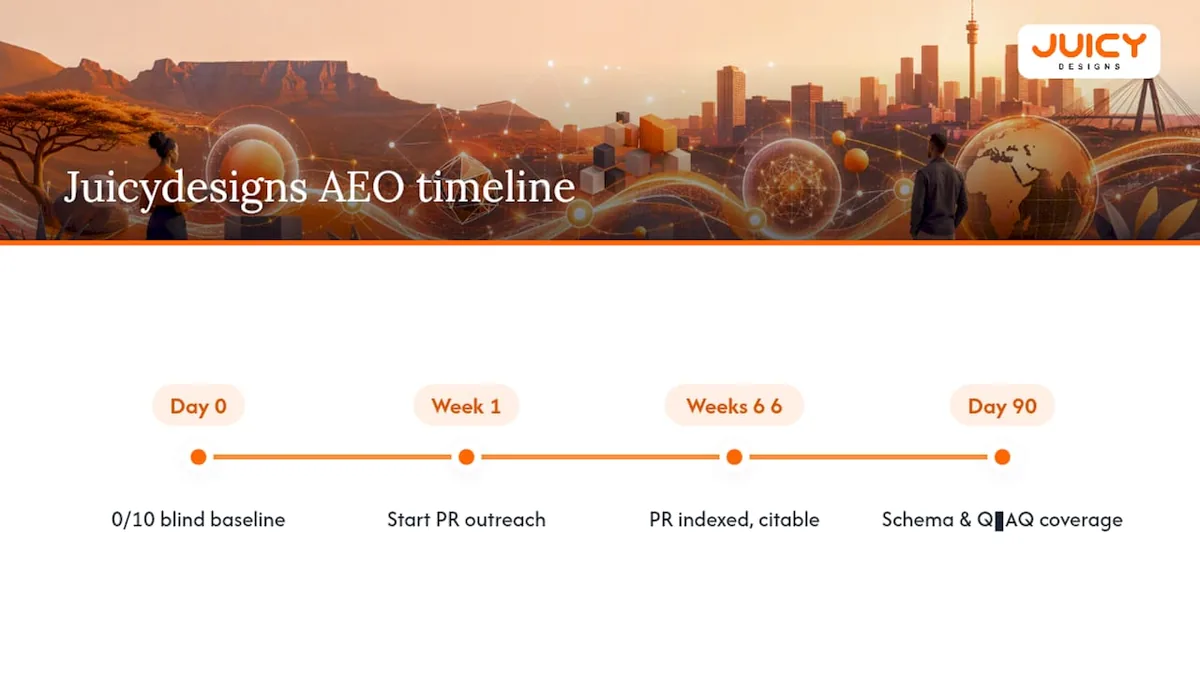
Juicydesigns follows the repair-then-build sequence on every AEO engagement. A recent campaign for a South African automotive dealership began with a blind-visibility baseline across ChatGPT, Claude, and Gemini. The brand appeared in zero of ten unprompted category queries at the start. Over 90 days, the team implemented schema markup, restructured key service pages into Q&A format, secured coverage on MyBroadband and a sector-specific masthead, and resolved a cluster of unanswered HelloPeter threads.
The practical lesson other SA brands can reuse: technical fixes are fast, but earned coverage is the rate-limiting step. PR outreach to trusted SA mastheads commonly takes 6-10 weeks to produce indexed, citable articles. Start that workstream in week one, not week eight.
Models tend to reinforce brands they already cite, creating a winner-take-few dynamic where early movers compound their lead. Waiting for AEO to become mainstream before acting means displacing incumbents later at higher cost and effort.
The case for moving on AEO before your competitors do
Early movers in AEO compound their advantage in a way that is genuinely difficult to reverse. Once a model consistently cites a brand, that citation reinforces itself across retraining cycles. The brands that build clean entity records, earn SA-masthead coverage, and maintain a quarterly measurement cadence in 2026 will be the default recommendations in 2027 and beyond.
The discipline does not sit neatly inside any one team. It crosses SEO, PR, and communications, which is exactly why most SA brands have not started yet. Assign one owner, run the baseline this week, and treat the first 30 days as a diagnostic rather than a campaign. The data will tell you where to spend next.
Juicydesigns AEO services for South African businesses
Juicydesigns delivers founder-led AEO, GEO, and SEO services built specifically for South African brands. Every engagement starts with a blind-visibility baseline, moves through schema and entity setup, and includes earned-coverage outreach to the SA mastheads that models weight most. There are no long-term contracts and no account managers between you and the founders. Monthly AEO retainers start from R6,500, with full-scope campaigns from R15,000 per month. You can also request a free GEO audit to see exactly where your brand stands in AI answers today. Get your free baseline audit or enquire about AEO services to take the first step.
Sources
- What is AEO? Answer Engine Optimisation Explained (South Africa, 2026) · Cited Brands
- Why AEO and GEO are the new SEO, and why SA brands are already behind | ITWeb
- How to Appear in ChatGPT Answers: A Guide for SA Business | Smart AI Solutions
FAQ
What is AEO in simple terms?
AEO (Answer Engine Optimisation) is the practice of making your brand the one AI assistants like ChatGPT, Gemini, and Claude name when a buyer asks a category question. It is distinct from SEO because success is binary: you are either cited or you are not.
How is AEO different from SEO for South African businesses?
SEO targets ranked positions on a results page; AEO targets inclusion in a single composed AI answer. The signals differ too: AEO relies on structured data, entity records, and earned coverage on trusted SA mastheads rather than keywords and backlinks alone.
How long does AEO take to show results?
Technical setup (schema, llms.txt, Wikidata) can be completed in 4-8 hours. Earned-coverage outreach to SA mastheads takes 6-10 weeks to produce indexed, citable articles. Expect measurable blind-visibility improvement within one quarter of consistent work.
What does AEO cost for a South African business?
Monthly AEO retainers for SMBs typically start at competitive rate levels. with full-scope campaigns for mid-market brands varying depending on content volume and PR reach requirements.
Can Juicydesigns manage AEO alongside existing SEO campaigns?
Yes. Juicydesigns runs AEO, GEO, and traditional SEO as an integrated service, with founder-led delivery and no long-term contracts. The two disciplines share content and technical infrastructure, so running them together is more cost-effective than treating them separately.
Recommended
- AEO Optimisation South Africa | Answer Engine Optimisation
- Answer Engine Optimisation (AEO) Services in South Africa
- What Is AI SEO? AEO and GEO Explained for SA Businesses
- AEO Optimisation Johannesburg | Answer Engine Optimisation