
Brand awareness strategy: your practical guide for 2026
A brand awareness strategy is a deliberate plan for making a brand familiar and recognisable to a defined audience, so that later marketing costs less and converts better.
It sets out the audience, the message people should remember, the channels that reach them, and how recognition gets measured.



TL;DR:
- A brand awareness strategy systematically builds familiarity and recognition to support all marketing efforts. It involves defining brand identity, segmenting audiences, and selecting appropriate channels. Measuring success focuses on awareness levels and brand perception to ensure marketing investments lead to business growth.
A brand awareness strategy is a deliberate plan to make your brand familiar, recognisable, and top-of-mind for the people most likely to buy from you. It is not a single campaign or a logo refresh. It is the structured foundation that makes every other marketing activity work harder, because people cannot consider a brand they have never heard of. As MediaValet notes, brand awareness acts as the cornerstone for all other marketing efforts, sitting upstream of demand generation and purchase consideration.
For South African business owners and marketers, getting this foundation right is what separates brands that grow consistently from those that rely on discounts to survive. A well-built brand awareness strategy does the following:
- Establishes a clear, consistent identity across every channel your audience uses
- Defines who you are speaking to and what they actually care about
- Builds trust and preference before a prospect ever reaches your sales team
- Creates long-term brand equity that reduces your cost per acquisition over time
- Anchors paid and organic campaigns to a single, coherent message
Salesforce research confirms that strong brand awareness increases ad efficiency and cross-channel returns while establishing market leadership. Put simply, the brands that invest in awareness spend less to convert the same customer later.
What makes up a brand awareness strategy?
Understanding the building blocks helps you build something that actually holds together. A brand awareness strategy has two layers: the components you need in place, and the types of awareness you are trying to create.
Core components
1. Brand identity Your visual identity, tone of voice, and values must be locked in before you spend a rand on promotion. Inconsistency at this level means every campaign teaches your audience something slightly different about who you are.
2. Audience segmentation Scattergun awareness is expensive and ineffective. Segment your audience by demographics, behaviour, and need so your messaging lands with the people who are most likely to become customers.
3. Consistent messaging Every touchpoint, from a Google Ad to an Instagram caption to an email footer, should reinforce the same core promise. Consistency is what converts repeated exposure into genuine recall.
4. Channel selection Choose channels based on where your audience actually spends time, not where it is cheapest or easiest to post. For most South African brands, this means a combination of Meta platforms, Google Search, YouTube, and increasingly WhatsApp Business.
Types of brand awareness
Not all awareness is equal. Cision’s research draws a clear line between brand recognition and brand awareness. Recognition is the ability to identify a logo or name when prompted. Awareness goes further: it includes familiarity with what the brand sells and the value it delivers. A strategy that stops at recognition leaves money on the table.
The three types marketers track are:
- Unaided awareness (top-of-mind recall): Your brand is the first one a consumer names when asked about a category, without any prompting. This is the most valuable and hardest to earn.
- Aided awareness: A consumer recognises your brand when shown the name or logo. Useful as a baseline, but not sufficient on its own.
- General brand recall: A consumer can describe what your brand does and why it matters, even if they cannot name it unprompted. This is where storytelling and emotional connection do their work.
Focusing exclusively on aided awareness, which is easy to inflate with display advertising, often masks weak unaided recall. The goal is to move audiences up through all three levels.
How to build a brand awareness strategy from the ground up
Building brand awareness is not complicated, but it does require discipline. These steps apply whether you are launching a new brand in Johannesburg or repositioning an established business in Cape Town.
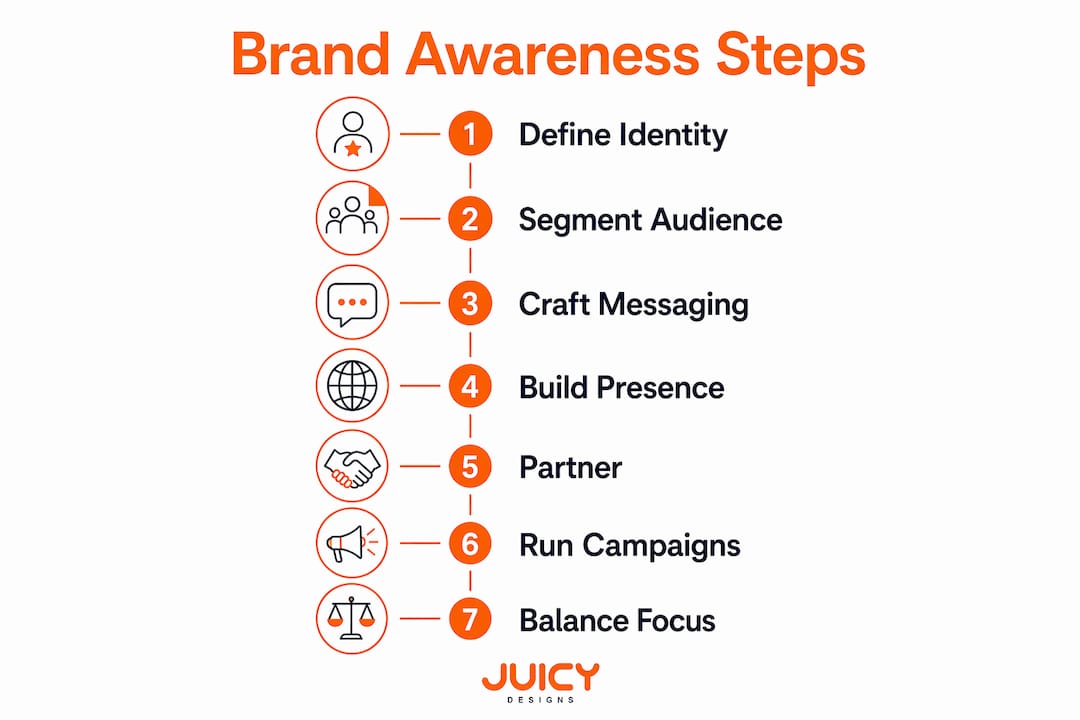
1. Define your brand identity and unique value proposition Before anything else, document your brand: its mission, visual identity, tone, and the one thing it does better than anyone else. This is your anchor. Every piece of content and every campaign should be traceable back to it. If you cannot articulate your value proposition in a single sentence, your audience certainly cannot.
2. Research and segment your audience Use a combination of Google Analytics, Meta Audience Insights, and direct customer interviews to build accurate audience profiles. In South Africa, this step must account for language preferences, regional differences between Gauteng, the Western Cape, and KwaZulu-Natal, and the significant variation in digital access across income groups.

3. Craft messaging that reflects your brand values HubSpot’s marketing research shows that campaigns evoking emotion and reflecting brand values yield stronger recall and loyalty. Write messaging that speaks to your audience’s real concerns, not a generic version of their needs.
4. Build a multichannel presence Publish consistently across the channels your audience uses. For South African businesses, this typically means SEO-optimised blog content, active social media, and Google Ads working together. A social media strategy built around your brand values amplifies organic reach without requiring an outsized budget.
5. Use partnerships and co-marketing Collaborating with complementary brands or guest contributing to respected publications puts your brand in front of audiences that already trust the host. This is one of the fastest ways to build unaided awareness without paying for every impression directly.
6. Run paid campaigns to accelerate reach Organic growth is slow. Paid channels, particularly Google Display and Meta ads, compress the timeline for building recognition. The key is to run paid activity in support of a consistent brand message, not as a substitute for one.
7. Balance short-term campaigns with long-term brand building Short-term campaigns drive spikes in traffic and leads. Long-term brand building is what makes those spikes bigger over time. The two are not in competition; they are designed to work together.
Pro Tip: Set a fixed percentage of your marketing budget for brand-building activity that has no direct conversion goal. Many South African businesses allocate their entire budget to performance campaigns and then wonder why their cost per lead keeps rising year on year.
Practical challenges in the South African context include load-shedding disrupting campaign continuity, multilingual audiences requiring adapted creative, and a mobile-first population that consumes content very differently from desktop users. Plan for these from the start rather than retrofitting solutions later. For businesses just getting started, a guide to marketing a new business in South Africa covers the foundational steps in detail.
How do you measure whether your brand awareness is actually working?
Measurement is where most brand awareness efforts fall apart. Marketers either track nothing, or they track vanity metrics that feel good but do not connect to business outcomes.
The metrics that matter fall into two categories.
Quantitative metrics
- Unaided and aided awareness scores: Measured through surveys, these tell you what percentage of your target audience can recall or recognise your brand without and with prompting.
- Ad recall: Tracks whether exposed audiences remember seeing your advertising, a leading indicator of whether your creative is doing its job.
- Branded search volume: The number of people searching your brand name directly in Google. Rising branded search is one of the clearest signals that awareness is growing.
- Website traffic from direct and organic branded searches: Separating branded from non-branded traffic in Google Search Console shows you how many people are actively seeking you out.
- Social media engagement and follower growth: Reach, impressions, and engagement rates across Meta, LinkedIn, and TikTok indicate how widely your content is spreading.
Qualitative metrics
- Net Promoter Score (NPS): Measures how likely customers are to recommend you, which is a proxy for brand strength.
- Brand sentiment analysis: Monitoring mentions across social platforms and review sites reveals whether awareness is positive, neutral, or negative. Tools like brand sentiment tracking on social media give you a real-time read on how your brand is perceived.
- Message association: Do people associate your brand with the attributes you want to own? This requires survey-based research but is worth doing annually.
Research Bureau’s brand tracking methodology outlines three research designs: continuous tracking, which provides real-time campaign insights; pre/post studies, which measure the lift from a specific campaign; and exposure-based studies, which isolate the effect of seeing an ad. Continuous tracking is the most powerful because it catches shifts in awareness as they happen, allowing you to reallocate media spend before a campaign underperforms.
The critical discipline is linking awareness data to business outcomes. If unaided awareness rises by ten points but sales do not move, something is broken between awareness and consideration. That gap is worth diagnosing before you spend more on reach.
Pro Tip: Set up Google Alerts for your brand name and your key competitors’ names. It takes five minutes and gives you a free, ongoing feed of brand mentions that supplements your formal tracking.
What Juicy Designs knows about brand awareness in South Africa
South Africa’s consumer market is genuinely unlike any other. You have eleven official languages, a population spread across vastly different income brackets, and a digital adoption curve that is still accelerating in many segments. A brand awareness strategy that works in the UK or the US will not simply transplant here. Local cultural nuance, community trust, and the role of word-of-mouth in township and suburban markets alike all shape how awareness is built and sustained.
Juicy Designs operates as a founder-led digital marketing agency based in Pretoria, which means clients work directly with the people making strategic decisions, not account managers reading from a brief. That direct communication model matters for brand awareness work because the feedback loop between campaign performance and creative adjustment is much tighter.
Juicy Designs has delivered a 4.8x average return on ad spend, nearly double the industry standard, across clients in sectors ranging from automotive to professional services. One local dealership saw a significant increase in qualified leads after Juicy Designs rebuilt their full-funnel strategy, starting with brand awareness campaigns that warmed audiences before retargeting them with conversion-focused ads.
Flexible pricing with no long-term contracts means South African businesses can invest in brand awareness without locking themselves into a retainer that outlasts their budget. For businesses operating in Gauteng, the Western Cape, or any other province, the approach is the same: build awareness deliberately, measure it rigorously, and adjust based on what the data shows.
Key takeaways
A brand awareness strategy is the structured foundation that makes every other marketing investment more effective, and the brands that build it deliberately outperform those that treat it as an afterthought.
| Point | Details |
|---|---|
| Start with identity | Lock in your brand identity and value proposition before spending on promotion. |
| Know your awareness type | Unaided recall is more valuable than aided recognition; build towards top-of-mind status. |
| Measure what connects to outcomes | Track branded search volume, unaided awareness scores, and NPS alongside reach metrics. |
| Balance short and long term | Pair performance campaigns with consistent brand-building activity to reduce cost per lead over time. |
| Localise for South Africa | Segment by language, region, and income group; generic messaging loses resonance in this market. |
FAQ
What is a brand awareness strategy?
A brand awareness strategy is a structured plan to make your brand familiar and recognisable to your target audience, ensuring it is considered early in the buyer journey. It covers identity, messaging, channel selection, and measurement.
What are the four brand strategies?
The four common brand strategies are line extension (adding products under an existing brand), brand extension (entering a new category), multi-brand (separate brands for separate segments), and new brand (launching an entirely new identity for a new market).
What are the three types of brand awareness?
The three types are unaided awareness (top-of-mind recall without prompting), aided awareness (recognition when shown the brand name or logo), and general brand recall (familiarity with what the brand does and its value). Cision’s research highlights that moving audiences from aided to unaided awareness is the strategic goal.
What are the five pillars of a brand strategy?
Definitions vary across frameworks, but a widely used version covers purpose (why the brand exists), positioning (how it differs from alternatives), personality (how it communicates), perception (how the audience sees it), and promotion (how it builds visibility). Each pillar informs the others.
How do you measure brand awareness effectively?
Track unaided and aided awareness through surveys, monitor branded search volume in Google Search Console, and analyse social engagement and direct website traffic. Continuous brand tracking provides real-time insights on campaign reach and recall, allowing you to adjust media spend before a campaign underperforms.