
What is ecommerce SEO explained for online stores
Discover what ecommerce SEO explained means for your online store. Attract ready-to-buy customers and boost your rankings with our guide.
> TL;DR: > > - E-commerce SEO helps online stores rank higher by targeting buying intent keywords and optimising technical, content, and local signals.


TL;DR: Quick Answer
Discover what ecommerce SEO explained means for your online store. Attract ready-to-buy customers and boost your rankings with our guide.
TL;DR:
- E-commerce SEO helps online stores rank higher by targeting buying intent keywords and optimising technical, content, and local signals. It requires ongoing effort, including unique descriptions, local relevance, and technical fixes, to build sustainable organic traffic. Combining SEO with paid advertising accelerates growth while rankings develop over months.
E-commerce SEO is the practice of optimising an online store so it ranks higher on search engine results pages, attracting more organic traffic and ready-to-buy customers. Unlike general SEO, it targets keywords with buying intent, such as "buy running shoes online South Africa," rather than purely informational queries. The three core ranking factors Google weighs are relevance, authority, and experience. Get all three right and your store earns consistent, free traffic that paid ads cannot replicate. This guide covers ecommerce SEO basics, the most common mistakes South African store owners make, and a practical strategy you can act on today.
What is ecommerce SEO explained: the essential components
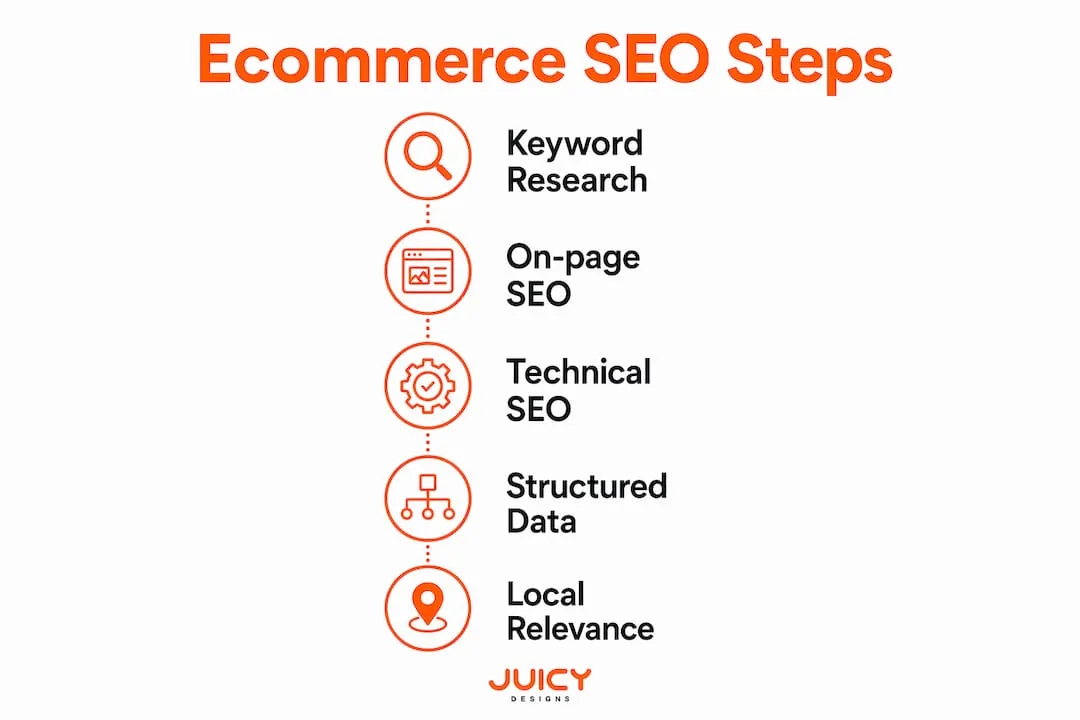
E-commerce SEO combines keyword research, on-page content, technical health, structured data, and local relevance into one coordinated effort. Each component feeds the others. A fast site with weak content still loses to a slower site with exceptional product pages.
Keyword research
Target three keyword types: product-specific terms ("leather wallet South Africa"), purchase-intent phrases ("buy leather wallet online"), and local modifiers ("leather wallet Johannesburg"). Ecommerce keyword research should map directly to your product and category pages, not just your blog. Generic keywords attract browsers; purchase-intent keywords attract buyers.
On-page SEO
Every product page needs a unique title tag, a descriptive H1 heading, and original body copy. Unique product descriptions of at least 300 words that include locally relevant details give your store a real competitive edge. Reusing manufacturer copy is one of the fastest ways to lose rankings because Google treats duplicate content as low-value.

Image alt text matters too. Descriptive alt text like "black leather bifold wallet South Africa" tells Google exactly what the image shows and helps your products appear in image search results.
Technical SEO
Google uses page experience including mobile-friendliness and load speed as direct ranking factors. A slow, hard-to-navigate store loses rankings and customers at the same time. Clean URLs, an XML sitemap, and an SSL certificate form the technical baseline every store needs.
Structured data
Product schema, review schema, and FAQ schema tell Google exactly what your page contains. Stores that implement valid structured data earn rich results in search, including star ratings and price snippets. These rich results increase click-through rates without requiring a higher ranking position.
Local relevance signals
Including ZAR pricing, South African shipping information, and a local contact number helps your store rank above international competitors for local search intent. A shopper searching "buy sneakers online" in Pretoria expects local results. Give Google the signals it needs to show your store first.
Pro Tip: Add your physical address, South African phone number, and ZAR pricing to your footer and contact page. These three details alone strengthen your local relevance signals significantly.
How does ecommerce SEO differ from general SEO?
General SEO often targets informational queries. E-commerce SEO targets transactional ones. That distinction changes everything from the keywords you choose to the content you write.
A blog post ranks for "how to choose a running shoe." A product page ranks for "buy Brooks Ghost 16 South Africa." Both matter, but your product and category pages drive revenue directly. Prioritise them first.
- Buying intent keywords dominate. Product pages must target terms that signal purchase readiness. Informational content supports authority but rarely converts directly.
- Duplicate content is a bigger risk. E-commerce stores often have hundreds of similar product pages. Without unique descriptions and proper canonical tags, Google may ignore large portions of your catalogue.
- Local SEO carries more weight. South African stores compete against global retailers. Local backlinks from South African suppliers, local press, and industry directories build the authority Google needs to rank you above international alternatives.
- SEO and paid ads work together. E-commerce SEO takes 3-6 months or longer to build meaningful organic traffic for a new store. Google Ads fills that gap immediately. Running both channels together gives you short-term revenue while your organic rankings grow.
- Platform defaults are not enough. Platforms like Shopify handle clean URLs, SSL, and sitemaps automatically. But ranking competitively requires manual keyword targeting, original content, and active optimisation. The platform does the heavy lifting on infrastructure; you do the work that actually wins rankings.
What common mistakes do ecommerce sites make in SEO?
Most e-commerce SEO problems are avoidable. The same errors appear repeatedly across South African online stores, and each one costs rankings and revenue.
- Duplicate product descriptions. Copying manufacturer copy is the single most common mistake. Google sees it as thin content and ranks the original source, not your store.
- Accidental indexation blocks. Many South African Shopify stores accidentally block product and category pages with "noindex" tags or robots.txt rules after theme updates. Your pages cannot rank if Google cannot crawl them.
- Too many apps slowing the site. Every app you install on Shopify can inject scripts that slow your load time. Site speed directly affects rankings and conversion rates. Audit your apps regularly and remove any that do not earn their place.
- Invalid or missing structured data. Many stores skip schema markup entirely or implement it incorrectly. Invalid schema earns no rich results and can trigger Google Search Console warnings.
- Ignoring keyword intent. Targeting broad keywords like "shoes" instead of "buy trail running shoes South Africa" wastes your effort on traffic that never converts.
Pro Tip: Run a free SEO audit on your store every quarter. Catching an accidental noindex tag early can save months of lost organic traffic.
How to implement a practical ecommerce SEO strategy
A working SEO strategy for an online store follows a clear sequence. Skip steps and you build on an unstable foundation.
- Conduct keyword research first. Map purchase-intent keywords to specific product and category pages. Use informational keywords for blog content that builds topical authority. Shopify SEO automation tools can help identify keyword gaps across large catalogues.
- Write original product descriptions. Aim for at least 300 words per product page. Include local details like ZAR pricing, South African delivery times, and local use cases. Original content is the single biggest differentiator between stores that rank and stores that do not.
- Optimise titles and metadata. Place your primary keyword near the front of every page title. Keep titles under 60 characters. Write meta descriptions that describe the page clearly and include a call to action.
- Improve site speed. Compress all images before uploading. Use lazy loading for images below the fold. Limit your installed apps to only those that directly support sales or SEO. A faster store ranks better and converts better.
- Build topical authority with content. Write blog posts that answer the questions your buyers ask before purchasing. A post titled "How to choose the right trail running shoe for South African terrain" supports your product pages and earns backlinks.
- Earn local backlinks. Reach out to South African suppliers, local publications, and industry directories for links. Quality local backlinks outperform large volumes of generic links every time.
| SEO action | Expected impact |
|---|---|
| Original 300+ word product descriptions | Higher rankings for product-specific keywords |
| Local signals (ZAR pricing, SA contact) | Better visibility for local search intent |
| Site speed improvements | Lower bounce rate, improved Google ranking |
| Structured data implementation | Rich results with star ratings and pricing |
| Quality local backlinks | Stronger domain authority in South African SERPs |
Pair your SEO work with a fully completed Google Business Profile to capture local map pack visibility alongside organic rankings.
Key takeaways
E-commerce SEO wins when you combine original local content, clean technical foundations, and quality South African backlinks into one consistent strategy.
| Point | Details |
|---|---|
| Target buying-intent keywords | Map purchase-ready search terms to product and category pages, not just blog content. |
| Write original product descriptions | At least 300 words per page with ZAR pricing and local details beats duplicate manufacturer copy every time. |
| Fix technical issues first | Check for accidental noindex tags and slow load times before building content or links. |
| Use structured data | Product and review schema earn rich results that increase click-through rates without needing a higher position. |
| Combine SEO with paid ads | SEO takes 3-6 months to build traffic; Google Ads fills the revenue gap while organic rankings grow. |
What I have learned about ecommerce SEO in South Africa
After working with South African e-commerce businesses across multiple sectors, the pattern is consistent. Store owners assume their platform handles SEO. It does not. Shopify, WooCommerce, and similar platforms build a solid technical floor, but the rankings come from the work you do on top of that floor.
The most damaging mistake I see is the accidental noindex block. A theme update quietly adds a noindex tag to category pages, and the store owner has no idea for weeks or months. Traffic drops and the assumption is that "SEO stopped working." The real cause is a two-minute fix that a quarterly audit would have caught.
Local content is the biggest untapped opportunity for South African stores. International retailers cannot write about South African delivery times, local use cases, or ZAR pricing with the same authenticity a local store can. That gap is your advantage. Use it.
SEO is not a once-off project. The stores that grow consistently treat it as an ongoing process: monthly content, quarterly audits, and steady link building. The ones that stop after the initial setup plateau within six months. Pair your SEO with a well-managed Google Ads campaign during the early months so you are not waiting on organic traffic to pay the bills while your rankings build.
The on-page SEO checklist we use at Juicydesigns covers the exact elements that move the needle for South African stores. Start there if you are not sure where to begin.
, Cobus
How Juicydesigns helps South African ecommerce stores grow with SEO
Juicydesigns works directly with South African e-commerce businesses to build SEO strategies that produce measurable organic growth. Services include technical SEO audits, keyword research mapped to product pages, original content creation, structured data implementation, and local link building. Every engagement is founder-led, meaning you speak directly with the people doing the work. There are no long-term contracts and pricing is in ZAR. If you want to know exactly where your store's SEO stands right now, start with a free SEO audit or browse the full SEO service offering to see how Juicydesigns approaches ecommerce growth.
FAQ
What is ecommerce SEO in simple terms?
E-commerce SEO is the process of optimising an online store so it appears higher in Google search results, attracting more organic traffic and buyers without paying for every click.
How long does ecommerce SEO take to show results?
New stores typically need 3-6 months to build meaningful organic traffic through SEO. Running Google Ads alongside SEO covers the revenue gap during that period.
Does Shopify handle SEO automatically?
Shopify automates technical basics like clean URLs, SSL, and sitemaps, but ranking competitively requires manual keyword targeting, original product descriptions, and active content optimisation.
Why is local SEO important for South African online stores?
Local signals like ZAR pricing, South African shipping details, and a local contact number help your store rank above international competitors for searches made by South African buyers.
What is the most common ecommerce SEO mistake?
The most common mistake is using duplicate manufacturer product descriptions. Google treats copied content as low-value and ranks the original source instead of your store.
Recommended
- Ecommerce SEO: Optimise Online Stores for Search | Juicy Designs
- E-commerce SEO: How to Get Your Online Store Found
- Enterprise SEO: Large-Scale Search Optimisation | Juicy Designs
- Ecommerce marketing in South Africa: a guide | Juicy Designs