
Organic reach explained for South African marketers
Organic reach is the number of unique people who see your content without any paid promotion behind it. It is the clearest measure of how far your brand
Organic reach is the number of unique people who see your content without any paid promotion behind it. It is the clearest measure of how far your brand travels on its own merit, and for South African


TL;DR: Quick Answer
Organic reach is the number of unique people who see your content without any paid promotion behind it. It is the clearest measure of how far your brand
Key takeaways
- Very cheap quotes (under R5,000) almost always exclude copywriting, SEO, custom design and post-launch support
- Professional copywriting can represent 20-35% of a total website project cost, and is worth it for search visibility
- On-page SEO built into the website at launch costs a fraction of what it costs to retrofit after the site is live
- Hosting, SSL, domain and maintenance add R3,000-R10,000 per year on top of build cost
- E-commerce adds significant cost due to payment gateway integrations, product data, security requirements and checkout UX
- Timeline and client responsiveness directly affect cost: slow feedback rounds extend agency hours
Organic reach is the number of unique people who see your content without any paid promotion behind it. It is the clearest measure of how far your brand travels on its own merit, and for South African businesses watching every rand of marketing spend, it signals whether your content strategy is doing real work or just filling a feed.
Three things to do right now:
- Audit your last 90 days in Meta Business Suite, Instagram Insights, or LinkedIn Analytics and pull your top five posts by reach.
- Inventory what worked. Note the format, topic, and posting time for each high-reach post.
- Run one quick test this week: repost your best-performing content as a short-form video and compare reach after 48 hours.
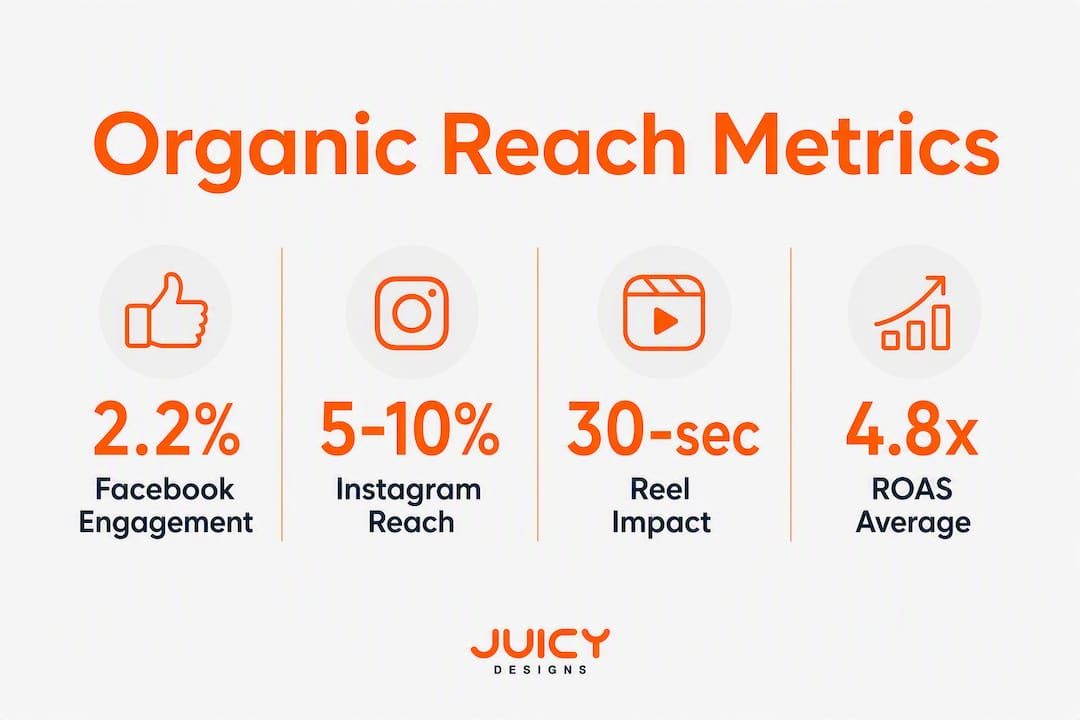
Hootsuite's industry data shows Facebook business page engagement falling from roughly 5.2% in 2020 to around 2.2% by 2025. That decline is not a glitch. It is the new baseline, and understanding it is the first step towards building a strategy that works around it.
How does organic reach differ from paid reach and impressions?
These three terms appear in every analytics dashboard, yet they measure fundamentally different things.
- Organic reach:, unique people who saw your content because the algorithm served it, not because you paid.
The distinction between reach and impressions matters more than most marketers realise. A post with 1,000 impressions and 400 reach means roughly 600 of those views came from people already exposed to it. High impressions with low reach often signals strong repeat engagement from a small audience, not broad discovery.
Paid reach is bought and targeted. You define the audience, set a budget in rands, and the platform delivers. Organic reach is earned. The algorithm decides who sees your post based on signals like watch time, saves, shares, and comment velocity.
The practical difference: a post that earns 800 organic reach and 200 paid reach has touched 1,000 unique people, but the organic 800 came at zero incremental cost and often carries higher trust signals because the audience chose to engage.
Native tools that report all three metrics clearly:
What metrics actually define your organic reach?
Reach alone tells you how many people saw your content. The metrics below tell you whether that exposure is doing anything useful.
| Metric | What it measures | Example formula | Why it matters |
|---|---|---|---|
| Reach | Unique people who saw the post | Reported directly by platform | Baseline for all other calculations |
| Impressions | Total views (including repeats) | Reported directly by platform | Signals repeat exposure and content stickiness |
| Reach rate | Share of followers actually reached | Reach ÷ Total followers × 100 | Shows how well the algorithm distributes your content |
| Engagement rate (by reach) | Interactions relative to people reached | (Likes + Comments + Shares + Saves) ÷ Reach × 100 | More accurate than engagement by followers |
| Share rate | How often reached users share | Shares ÷ Reach × 100 | Proxy for viral potential |
| Watch time (video) | Average seconds watched | Total watch time ÷ Total views | Key algorithm signal on TikTok, Reels, YouTube Shorts |
A reach rate around 2-5% on Facebook and 5-10% on Instagram is now common for brand pages, according to recent benchmarks. On LinkedIn, organic reach per post can still hit 10-20% of your connections for well-timed, high-quality content. TikTok remains the outlier: non-follower discovery is built into its algorithm, so reach rate relative to followers is a less useful benchmark there.
Pro Tip: Match your primary metric to your objective. Chasing brand awareness? Prioritise reach rate. Building a community? Track engagement rate by reach. Testing content for future paid campaigns? Watch share rate and saves, because those signal the posts worth putting budget behind.
Why has organic reach been falling across every platform?
The decline is structural, not accidental. Three forces drive it simultaneously.

Platform monetisation. Every major social network is a publicly traded or investor-backed business. More ad inventory means more revenue. Reducing organic distribution creates demand for paid reach. SmashBalloon's analysis frames this directly: platforms deliberately monetise audience access, and that trend will not reverse.
Content saturation. The volume of content published daily on Facebook, Instagram, TikTok, and LinkedIn has grown faster than user attention. Algorithms filter aggressively to keep feeds relevant, which means more posts compete for the same eyeballs.
Algorithm prioritisation of engagement signals. Platforms now weight watch time, saves, and shares far more heavily than follower count. A brand page with 50,000 followers but low engagement often reaches fewer people than a personal profile with 2,000 followers and high interaction rates. Follower counts no longer guarantee distribution.
Format shifts towards video. Deep Marketing's 2026 platform benchmarks show Instagram Reels driving roughly 9% engagement in some formats, while static photo feed posts average around 0.5%. TikTok business accounts average approximately 5.7% engagement. The algorithm rewards formats that keep users on the platform longer, and short video does that better than any static format.
The result: posting more does not fix the problem. SmashBalloon notes that frequent low-engagement posts can actively suppress distribution, because the algorithm interprets poor engagement as a signal to show your content to fewer people. Fewer, better posts consistently outperform a high-frequency, low-quality calendar.
How can you increase organic reach with practical strategies?
The framework is straightforward: create content worth sharing, distribute it at the right time, and build engagement loops that signal quality to the algorithm.
-
Audit your posting time. Pull your last 30 posts in Meta Business Suite or Instagram Insights and sort by reach. Note the day and hour for your top performers. Post your next three pieces of content at those times and compare.
-
Repurpose top posts into short-form video. Take your highest-reach static post from the last quarter and rebuild it as a 30-60 second Reel or TikTok. Short video consistently outperforms static content for discovery, per Deep Marketing's benchmarks.
-
Write for saves and shares, not just likes. Saves and shares are the strongest organic reach signals on Instagram and Facebook. A post that teaches something specific ("3 ways to reduce your Facebook ad cost per lead") earns saves. A post that resonates emotionally earns shares.
-
Use community features actively. Facebook Groups, LinkedIn newsletters, and Instagram broadcast channels give your content a second distribution path outside the main feed algorithm. Personal profiles also tend to outperform brand pages for organic reach, so encourage your team to share and comment.
-
Collaborate with peers and micro-influencers. A co-created post or a tag from a complementary South African business exposes your content to an entirely new audience. This is one of the zero-budget tactics that still delivers real reach without ad spend.
-
Optimise the first 2-3 seconds of every video. On TikTok and Reels, the algorithm measures drop-off rate in the opening seconds. A strong hook (a bold claim, a question, or a surprising visual) keeps viewers watching, which signals the algorithm to push the content further.
-
Pin your best-performing post. On Instagram, TikTok, and LinkedIn, pinning a high-reach post to the top of your profile extends its discovery window for new visitors.
-
Use platform-native editing tools. Meta's algorithm gives a measurable distribution advantage to content created and edited inside its native tools rather than uploaded from third-party apps.
Platform-specific quick tips:
- Meta/Instagram: Reels with native text overlays and trending audio outperform uploaded video. Stories with link stickers drive profile visits that feed the algorithm.
- TikTok: Jump on trending sounds within the first 24-48 hours of a trend. The hook in the first three seconds determines whether the algorithm tests your content with a wider audience.
- LinkedIn: Long-form posts and document carousels (PDF slides) drive significantly higher dwell time than link posts. Tag collaborators, not just connections.
- YouTube Shorts: Optimise your thumbnail and first frame. Shorts with high click-through rates get pushed into the Shorts feed for non-subscribers.
Pro Tip: Run a simple A/B test: publish the same core message as a 30-second Reel and as a static carousel on the same day, one week apart. Compare reach rate and saves. The result tells you which format your specific audience responds to, which is more useful than any industry benchmark.
For a deeper look at social media strategy for South African businesses, including platform selection and local audience timing, the Juicydesigns blog covers the local context in detail.
social media strategy" src="/images/blog/what-is-organic-reach-explained-2.jpg" />
How do you measure organic reach and improve it over time?
Measurement without a baseline is guesswork. Build a simple, repeatable workflow.
- Set your baseline. Pull the last three months of data from your native analytics tools. Record average reach per post, reach rate, engagement rate, and share rate by content type.
- Identify your top 10 posts by reach. Note format, topic, posting time, and any external factors (trending topic, collaboration, paid boost).
- Form a hypothesis. "Video posts published on Tuesday between 7-9 PM reach 40% more unique accounts than posts published at midday."
- Run a time-split test. Publish similar content at different times over four weeks and compare reach rates. Hootsuite recommends documenting hypotheses and measuring lift with holdout groups or time-based splits.
- Review weekly, adjust monthly. Weekly reviews catch anomalies; monthly reviews reveal trends.
| Metric | How to calculate | Review cadence | Reasonable benchmark |
|---|---|---|---|
| Reach rate | Reach ÷ Followers × 100 | Weekly | 2-5% Facebook; 5-10% Instagram; 10-20% LinkedIn |
| Engagement rate (by reach) | Total engagements ÷ Reach × 100 | Weekly | 1-3% Facebook; 3-6% Instagram; 2-5% LinkedIn |
| Share rate | Shares ÷ Reach × 100 | Monthly | 0.5-2% across platforms |
| Watch time (video) | Avg seconds watched ÷ Video length × 100 | Per video | 50%+ completion rate is a strong signal |
Build a simple tracking sheet in Google Sheets or Microsoft Excel. Columns: date, post type, reach, impressions, engagement rate, reach rate, share rate. Add a notes column for hypotheses and test conditions. After eight weeks, patterns emerge clearly.
On attribution: organic reach does not always convert directly. Use UTM parameters on any link in your bio or Stories to track organic-driven website sessions in Google Analytics 4. When a session converts without a paid touchpoint in the path, that is an organic-assisted conversion worth counting.
Pro Tip: Use Hootsuite, Sprout Social, or SocialPilot to consolidate multi-platform data into one view. Native analytics are accurate but siloed. A third-party dashboard lets you compare reach rate across Meta, TikTok, and LinkedIn side by side, which makes pattern recognition much faster.
How Juicydesigns improved organic reach for a South African client
A South African automotive dealership came to Juicydesigns with a straightforward problem: their social media pages had a reasonable follower count but almost no organic discovery. New audiences were not finding them, and their content was generating minimal engagement beyond existing followers.
The approach combined three tactics: a shift to short-form video (Reels and TikTok clips showcasing inventory and behind-the-scenes content), a revised posting cadence based on audience activity data from Meta Business Suite, and an engagement loop that encouraged comments by asking specific questions in every caption. The team also activated the dealership's personal staff profiles to share and comment on brand posts, which extended organic distribution beyond the brand page's limited algorithmic reach.
Over the campaign period, qualified leads increased by 312%. The organic content improvements also fed directly into paid campaigns: the highest-reach organic posts became the creative foundation for Meta ads, reducing creative testing costs and improving paid performance.
The lesson for South African businesses: organic reach and paid reach are not competing strategies. Organic content tells you what your audience actually responds to. Paid media then scales the winners. Starting with organic is not just cost-effective at ZAR ad budgets, it produces better paid creative.
Juicydesigns clients average a 4.8x ROAS, which reflects exactly this hybrid approach: organic reach builds the signal, paid reach amplifies it.
Pro Tip: Before spending a single rand on paid social, identify your top three organic posts by share rate. Those are your paid creative starting points. You will spend less on testing and more on scaling what already works.
Common mistakes that quietly kill your organic reach
Myths worth dropping:
- "Post more and reach will rise." Frequency without quality suppresses distribution. The algorithm penalises low-engagement content by showing it to fewer people over time.
- "Followers guarantee reach." A large follower count with low engagement often performs worse than a smaller, active audience. The algorithm distributes based on interaction signals, not audience size.
- "Only paid helps discovery." TikTok's non-follower discovery model, LinkedIn's document posts, and Instagram Reels all still deliver meaningful organic reach to new audiences when the content earns engagement.
- "Engagement farming always helps." Generic "comment below!" CTAs with no context generate low-quality engagement that algorithms increasingly discount.
Quick-fix checklist (30-60 minutes):
- Review your last 10 posts. Remove or archive any that received zero engagement within 48 hours of posting.
- Check whether your last five videos had a clear hook in the first three seconds. If not, re-edit and repost.
- Confirm your posting times align with your audience's peak activity window in your native analytics.
- Audit your CTAs: are you asking for something specific (save this, share with someone who needs it) or something generic (let us know what you think)?
- Check that you are using platform-native formats and tools, not just uploading content created elsewhere.
Paid amplification still makes sense when you have a proven organic post and want to extend its reach beyond your existing audience. The hybrid approach of organic testing followed by paid scaling is consistently more efficient than running paid campaigns on untested creative.
Key takeaways
Organic reach is earned, algorithm-driven visibility, and building it consistently requires quality content, smart timing, and a measurement habit that turns data into decisions.
| Point | Details |
|---|---|
| Define your baseline first | Pull three months of reach rate and engagement rate data before changing anything. |
| Short-form video leads discovery | Instagram Reels and TikTok consistently outperform static posts for reaching new audiences. |
| Quality beats frequency | Fewer high-engagement posts outperform a high-volume, low-quality calendar every time. |
| Organic feeds paid strategy | Your top organic posts by share rate are your best paid creative starting points. |
| Measure reach rate, not just reach | Reach ÷ followers × 100 tells you how well the algorithm is distributing your content. |
Why organic reach still deserves your full attention
Most agencies will tell you organic reach is dying and pivot immediately to paid. That is a convenient argument for an agency that sells ads. The reality is more useful.
Organic reach is the only channel that tells you, at zero incremental cost, what your audience genuinely responds to. Every high-share post, every saved Reel, every comment thread that runs long is a data point about what your market actually cares about. Paid media can scale that signal, but it cannot replace it. Brands that abandon organic entirely end up running paid campaigns on creative that was never tested against a real audience, which is why so many ad accounts burn through budget without results.
The South African context adds another layer. Local audiences on platforms like Facebook and TikTok respond to content that reflects their specific context: local pricing, local references, local humour. A generic global content strategy rarely earns the engagement signals that drive organic distribution here. That is why building a social media strategy grounded in local audience data matters more than copying what works in the US or UK.
If you want to grow organic reach without wasting months on trial and error, Juicydesigns works with South African businesses to build and test content strategies that produce measurable results. Talk to the team about what a founder-led approach looks like for your business.
Useful sources
The sources below were used to build this article and are worth bookmarking for ongoing reference.
- Sprout Social: Organic Reach in 2026, platform algorithm guidance, hybrid strategy recommendations, and native analytics tool references.
- Hootsuite: Organic Reach Declining, industry engagement benchmarks, audit methodology, and A/B testing guidance.
- SmashBalloon: Organic Social Media Reach, analysis of platform monetisation incentives and content quality guidance.
- SocialPilot: Organic Reach Definition, plain-language definition and algorithm factor overview.
- Social Status: Facebook Organic Reach Rate Benchmarks, reach rate benchmarks and explanation of posts exceeding 100% reach relative to followers.
- SmallBusinessDirectory.co.za: Zero-Budget Content Marketing, practical low-budget distribution tactics relevant to South African small businesses.
Native analytics to check regularly: Meta Business Suite, Instagram Insights, TikTok Analytics, and LinkedIn Analytics all report reach, impressions, and engagement rate directly. These are your primary data sources before any third-party tool.
FAQ
What is organic reach in simple terms?
Organic reach is the number of unique people who see your content without paid promotion. The platform's algorithm determines who sees it based on engagement signals like shares, saves, and watch time.
Is organic reach declining across all platforms?
Yes. Hootsuite's data shows Facebook business page engagement falling from roughly 5.2% in 2020 to around 2.2% by 2025. The decline is driven by platform monetisation, content saturation, and algorithm changes that prioritise paid inventory.
What does 100% organic reach mean?
It means your content reached at least as many unique people as you have followers, which happens when shares and platform discovery push the post beyond your existing audience. Social Status benchmarks confirm posts can exceed 100% reach rate when content spreads virally.
What is the difference between organic and paid reach?
Organic reach is earned through algorithm distribution at no direct cost. Paid reach is bought: you set a budget in rands, define an audience, and the platform guarantees delivery to that group. Both count unique people, but only organic reach signals genuine audience interest without financial incentive.
What is a real example of organic reach?
A South African restaurant posts a short video of a new dish on Instagram without any ad spend. The Reel earns strong watch time and shares, so Instagram's algorithm serves it to non-followers in the Explore feed. The post reaches thousands of unique accounts, many of whom do not follow the page. That audience is pure organic reach beyond the existing audience.
Recommended
- How to Measure Social Media ROI in South Africa | Juicy Designs
- Social Media Advertising in South Africa | Juicy Designs
- Multilingual Social Media Marketing for South Africa
- Social media ads in South Africa: a practical guide