
Performance marketing for automotive dealerships in South Africa
Discover what performance marketing automotive means for South African dealerships. Drive qualified leads, improve showroom visits, and optimise ad spend.
Performance marketing for automotive dealerships in South Africa ! Marketing manager reviewing campaigns at car dealership > TL;DR: > > - Performance marketing for South African automotive dealerships focuses on paying only for measurable actions like leads and sales.


TL;DR: Quick Answer
Discover what performance marketing automotive means for South African dealerships. Drive qualified leads, improve showroom visits, and optimise ad spend.
Key takeaways
- Very cheap quotes (under R5,000) almost always exclude copywriting, SEO, custom design and post-launch support
- Professional copywriting can represent 20-35% of a total website project cost, and is worth it for search visibility
- On-page SEO built into the website at launch costs a fraction of what it costs to retrofit after the site is live
- Hosting, SSL, domain and maintenance add R3,000-R10,000 per year on top of build cost
- E-commerce adds significant cost due to payment gateway integrations, product data, security requirements and checkout UX
- Timeline and client responsiveness directly affect cost: slow feedback rounds extend agency hours
TL;DR:
- Performance marketing for South African automotive dealerships focuses on paying only for measurable actions like leads and sales. It combines channels such as Google Ads, Meta, and marketplace listings with CRM integration to track performance accurately. Proper setup, UX, and monitoring are essential for optimising results and increasing qualified leads.
Performance marketing for automotive dealerships means paying for measurable outcomes, not exposure. Every rand you spend is tied to a specific action: a qualified lead, a test-drive booking, a vehicle detail page (VDP) view, or a showroom visit. If the action does not happen, you do not pay. That is the model, and for South African dealers managing tight margins and real inventory pressure, it is the most accountable way to run digital advertising.
Here is what you should expect from a well-run performance marketing programme:
- Qualified leads delivered directly into your CRM, not just form fills from tyre-kickers
- VDP views from buyers who are actively comparing models and pricing
- Test-drive bookings captured online and handed to your sales team with context
- Showroom visits that can be tracked back to specific campaigns and channels
The channels that do this heavy lifting are Google Ads (search and display), Meta (Facebook and Instagram), and South Africa's two dominant automotive marketplaces, AutoTrader.co.za and Cars.co.za. Juicydesigns ties these together with CRM integration, call tracking, and conversion mapping so every lead has a clear source and cost attached to it.
What is performance marketing, and how does it differ from traditional automotive advertising?
Performance marketing is outcome-based media buying. You define the action you want, set the cost you are willing to pay for it, and the platform charges you only when that action occurs or is attributed to your ad. The industry term for this model is "pay-for-performance," and it sits in contrast to traditional brand advertising, where you pay for reach and frequency regardless of what buyers do next.
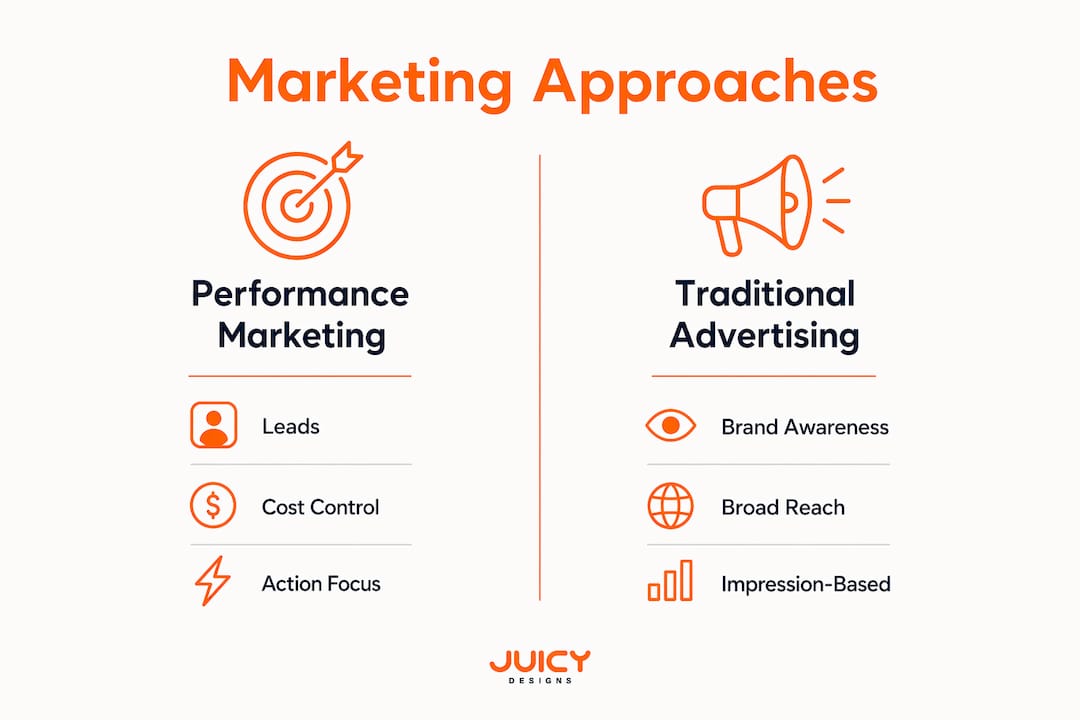
For a dealership, the practical difference looks like this:
| Dimension | Performance marketing | Traditional / brand advertising |
|---|---|---|
| Primary objective | Leads, bookings, sales | Awareness, brand recall |
| Cost basis | Cost per lead, cost per click, ROAS | CPM (cost per thousand impressions) |
| Measurement | CRM-tracked, attributed, real-time | Surveys, brand lift studies, estimated reach |
| Creative style | Inventory-specific, offer-led, direct CTA | Emotional, aspirational, brand-building |
| Timeline to results | Days to weeks | Months |
| Best for | Clearing stock, model promotions, lead targets | New model launches, brand repositioning |
Performance marketing does not replace brand advertising. It occupies the lower half of the funnel, where buyers are actively searching, comparing, and deciding. The majority of purchase decisions are made before a buyer sets foot in your showroom, with most research completed online, so your performance campaigns need to win the digital moment, not just the in-person one.
 digital marketing dashboards">
Pro Tip: Prioritise performance spend when you have inventory pressure, a model-level promotion, or a clearance window. Keep a portion of budget in brand channels during quieter periods so you are not starting from zero when the next push begins.
Which channels should dealers use, and what is each one best for?
The channel mix for automotive performance marketing in South Africa is broader than most dealers realise. Each channel serves a different stage of the buyer journey, and the right starting point depends on your inventory volume and monthly budget.
- Google Ads (Search): Captures buyers with active purchase intent. Someone searching "Toyota Hilux for sale Pretoria" is ready to act. This is your highest-converting channel and the right place to start.
- Meta (Facebook & Instagram): Reaches buyers earlier in the consideration phase. Social ad formats like lead-gen forms and dynamic vehicle ads work well for trade-in offers, finance enquiries, and model awareness.
- AutoTrader.co.za and Cars.co.za: Third-party marketplaces where high-intent buyers are already browsing. Car brands lose influence when buyers spend most of their research time on these platforms, so buying premium placement and tracking VDP views is not optional.
- Google Display and retargeting (DSPs): Re-engages visitors who viewed a VDP but did not enquire. Lower cost per impression, effective for keeping your inventory top-of-mind during a buyer's consideration window.
- YouTube video: Builds confidence by showing ownership benefits, service plans, and finance options. Works best as a mid-funnel support channel, not a standalone lead driver.
- Email and CRM remarketing: Re-activates leads already in your database. Low cost, high relevance when segmented by model interest or enquiry date.
| Channel | Best use for dealers | Primary measurement metric |
|---|---|---|
| Google Ads (Search) | Immediate purchase intent, model-specific queries | CPL, CPA, conversion rate |
| Meta (Facebook & Instagram) | Trade-in leads, finance enquiries, model awareness | Cost per lead, lead quality score |
| AutoTrader.co.za / Cars.co.za | VDP views, marketplace enquiries | VDP views, enquiry volume, cost per enquiry |
| Google Display / retargeting | Re-engaging VDP visitors, remarketing sequences | CPM, view-through conversions, ROAS |
| YouTube | Confidence-building, mid-funnel consideration | View rate, assisted conversions |
| Email / CRM | Database re-activation, follow-up sequences | Open rate, click-to-lead rate |
Start with Google Ads search and one Meta campaign. Add marketplace placements once you have baseline CPL data. Layer in retargeting after four to six weeks when your audience pools are large enough to be effective.
How do you measure performance marketing at your dealership?
The KPIs that matter for dealer revenue are not the ones ad platforms default to. Clicks and impressions tell you about activity. The metrics below tell you about money.
Core KPIs to track:
- CPL (Cost Per Lead): Total ad spend divided by the number of leads generated. Your benchmark depends on vehicle margin, but most South African dealers target a CPL that leaves room for a reasonable cost per sale.
- CPA (Cost Per Acquisition): What it costs to close a sale, including all ad spend across the funnel. This is the number your sales manager cares about.
- ROAS (Return on Ad Spend): Revenue attributed to campaigns divided by spend. Juicydesigns clients average a 4.8x ROAS, which is a useful benchmark when evaluating agency proposals.
- Lead-to-sale conversion rate: The percentage of leads that become buyers. Low conversion here usually signals a sales process problem, not a marketing one.
- VDP views: How many buyers are viewing your specific vehicle listings. A leading indicator of pipeline health.
- Test-drive bookings and showroom visits: The offline actions that connect digital spend to physical sales.
Practical measurement checklist:
- Connect your CRM (Dealer Management System or a platform like HubSpot) to your ad accounts so leads flow in with source attribution
- Set up call tracking (a dedicated number per campaign) to capture phone enquiries that never touch a form
- Map offline conversions: upload closed deals back to Google Ads and Meta using hashed customer data so the platforms can optimise towards actual sales
- Use consistent UTM parameters on every ad URL so your analytics tool shows channel-level performance
- Tag VDP views and booking confirmations as conversion events in Google Tag Manager
Digital ad platforms give you granular attribution across all of these signals. The gap is usually not the data; it is the setup. Get the tracking right before you scale spend.
Pro Tip: Judge lead quality by phone contact rate, test drives set, and trade-in valuations requested, not raw CPL. A R150 lead that never picks up the phone is worth less than a R400 lead that books a test drive the same day.

What campaign structures actually work for South African dealerships?
Three campaign blueprints cover most dealer scenarios. You can run them simultaneously or phase them in as budget allows.
Blueprint A: Inventory-driven search and dynamic feed ads
Goal: Immediate sales from buyers with purchase intent.
- Build a Google Ads search campaign targeting model-specific and location-specific queries (e.g., "used Volkswagen Polo Cape Town").
- Connect your inventory feed to Google's vehicle ads or Meta's dynamic automotive ads so listings update automatically.
- Send traffic to a dedicated VDP or model landing page, not your homepage.
- Set conversion goals to lead form submissions and phone calls.
Blueprint B: Trade-in and test-drive lead-gen funnel
Goal: Capture buyers earlier in the journey who are considering their options.
- Run a Meta lead-gen campaign with a short form (name, number, model interest, trade-in yes/no).
- Offer a clear incentive: a free trade-in valuation or a confirmed test-drive slot.
- Route leads to a sales rep within 15 minutes via CRM notification.
- Follow up with an automated email sequence that answers ownership questions: finance options in ZAR, service plan details, warranty coverage.
Blueprint C: Mid-funnel remarketing and video
Goal: Re-engage VDP visitors who did not enquire and move them towards a booking.
- Build a remarketing audience from VDP visitors (minimum 500 users before activating).
- Serve Google Display and Meta retargeting ads featuring the specific model they viewed.
- Add a YouTube pre-roll ad that addresses ownership confidence: total cost of ownership, after-sales support, finance availability.
- Cap frequency at 3-5 impressions per week to avoid ad fatigue.
Creative and offer checklist for all campaigns:
- Landing pages must match the ad: if the ad says "2024 Ford Ranger from R8,999/month," the page must show that exact offer
- Keep lead forms to five fields or fewer. High-friction forms are the single biggest conversion killer in South African dealership campaigns
- Include a finance calculator priced in ZAR on every model landing page
- Social creative should explain ownership benefits (warranty, service intervals, fuel costs), not just features. Campaigns that build confidence outperform feature-list ads in enquiry quality
- Every ad needs one clear CTA: "Book a test drive," "Get a finance quote," or "Check availability"
For a deeper look at converting online leads into buyers, the follow-up process after the form submission matters as much as the campaign itself.
How should you budget and bid, and what timelines are realistic?
South African dealership budgets vary widely, but the structure below gives you a starting framework. All figures are in ZAR and reflect typical digital ad costs in the local market.
Budget guidance by dealership size:
- Starter (1-2 brands, under 50 units/month): R8,000, R15,000/month across Google Ads and one Meta campaign. Focus on search and one lead-gen objective.
- Scale (multi-brand, 50-150 units/month): R20,000, R50,000/month. Add marketplace placements and retargeting. Split budget roughly 50% search, 30% social, 20% display/remarketing.
- Aggressive clearance (end-of-year, model changeover): R60,000+ for a defined 4-8 week window. Concentrate on search and dynamic inventory ads with a single conversion goal.
Bidding strategies:
- Use manual CPC for the first two to four weeks while the platform gathers conversion data. This protects budget during the learning phase.
- Switch to Target CPA or Maximise Conversions once you have at least 30 conversions in a 30-day window. Automated bidding needs data to work; without it, it wastes spend.
- For model-level campaigns with a known margin, Target ROAS bidding gives the platform a revenue target to optimise towards.
Timelines:
- Weeks 1-2: Campaign setup, tracking verification, initial data collection. Do not judge performance here.
- Weeks 3-6: Learning phase. CPL will fluctuate. Focus on lead quality signals, not volume.
- Weeks 7-12: Optimisation window. Pause underperforming ad sets, expand audiences that convert, test new creative.
- Month 4 onward: Scale phase. Increase budget incrementally (no more than 20% per week) to avoid resetting the learning phase.
South African seasonal patterns matter. January to March sees strong new-model interest after year-end bonuses. June to August is typically slower; use this window to build remarketing audiences cheaply. The year-end clearance window (October to December) rewards aggressive spend if inventory is available.
Pro Tip: When scaling budget, cap weekly increases at 20% and monitor ROAS daily for the first two weeks. Sudden large budget increases reset the algorithm's learning phase and can spike CPL temporarily.
What do South African dealers need to know about POPIA and data privacy?
The Protection of Personal Information Act (POPIA) is the primary data protection law governing how South African businesses collect, store, and use personal data. For dealerships running performance marketing, this has direct operational implications.
POPIA compliance checklist for dealer campaigns:
- Every lead form must include a clear consent statement explaining how the buyer's data will be used and by whom
- Marketing email lists require explicit opt-in consent; a double opt-in process is best practice for new subscribers
- Store lead data in a secure CRM with defined retention periods. Do not keep personal data longer than the purpose requires
- Train your sales team: verbal consent captured on a call must be logged in the CRM with a timestamp and the specific purpose consented to
- When uploading customer lists to Google Ads or Meta for custom audience matching, use hashed data (SHA-256 encrypted email addresses and phone numbers). Never upload raw PII to ad platforms
- For any data-sharing arrangement with AutoTrader.co.za, Cars.co.za, or other third parties, document the data-sharing agreement and ensure both parties have a lawful basis for processing
Offline conversion mapping is POPIA-compatible when done correctly. Hash the data before upload, use only the fields the platform requires for matching, and do not retain the matched data on the platform beyond the campaign window.
For complex integrations involving multiple third parties or cross-border data transfers, consult a qualified legal practitioner familiar with POPIA before going live.
How Juicydesigns delivered a 312% lead uplift for a South African dealership
A South African dealership approached Juicydesigns with a familiar problem: Google Ads spend was generating clicks, but the leads were thin and the sales team was not converting them. The root causes were a high-friction enquiry form, landing pages that did not match the ad creative, and no CRM integration to track what happened after the form was submitted.
The approach:
- Audited the existing landing pages and reduced the enquiry form from nine fields to four
- Synced the dealership's live inventory feed to Google vehicle ads and Meta dynamic ads
- Set up call tracking with unique numbers per campaign and mapped phone conversions back to Google Ads
- Launched a targeted search campaign for high-intent model queries, supported by a Meta lead-gen campaign for trade-in and test-drive offers
- Integrated the CRM so every lead arrived with source, campaign, and ad group data attached
- Built a remarketing sequence for VDP visitors who did not enquire within 48 hours
Source: Juicydesigns dealership case study
Replicable steps to reproduce this outcome:
- Sync your live inventory feed to Google and Meta ad accounts
- Launch targeted search campaigns for model-specific, high-intent queries
- Simplify lead forms to four to five fields maximum
- Map all leads (form and phone) into your CRM with campaign-level attribution
- Activate a remarketing sequence for VDP visitors after 48 hours of non-conversion
- Review lead quality weekly with your sales manager, not just CPL
The dealership lead generation playbook from Juicydesigns covers each of these steps in detail if you want to go deeper on any one of them.
Six steps to launch performance marketing at your dealership
This checklist is ordered by priority. Complete each step before moving to the next; skipping ahead wastes budget.
-
Define your outcomes and KPIs (Days 1-3, owner: marketing manager) Decide what success looks like before any campaign goes live. Set targets for CPL, CPA, and lead-to-sale conversion rate. Agree these with your sales manager so both teams are measuring the same thing.
-
Audit your inventory listings and landing pages (Days 3-7, owner: marketing manager + web team) Check that every model page loads in under three seconds, the enquiry form has five fields or fewer, and the page content matches what your ads will say. UX improvements at this stage often produce the fastest conversion gains of the entire programme.
-
Set up tracking and CRM mapping (Days 5-10, owner: marketing manager + IT/operations) Install Google Tag Manager, configure conversion events for form submissions and calls, set up UTM parameters, and connect your CRM to your ad accounts. Do not launch paid campaigns until this is verified.
-
Launch a pilot campaign (Week 2, owner: marketing manager or agency) Start with Google Ads search targeting your top two or three model queries, plus one Meta lead-gen campaign for trade-in or test-drive offers. Keep the budget modest (R8,000, R15,000/month) while the learning phase runs. For a step-by-step Google Ads setup, follow the Juicydesigns guide.
-
Establish lead handling and follow-up SOPs (Week 2-3, owner: sales manager) Every lead must receive a response within 15 minutes during business hours. Assign leads by model and salesperson. Log every contact attempt in the CRM. A fast, consistent follow-up process is what separates a 2% lead-to-sale rate from a 10% one.
-
Measure, optimise, and scale (Week 6 onward, owner: marketing manager) Review CPL, lead quality, and ROAS weekly. Pause ad sets with a CPL more than 50% above target after two weeks. Increase budget by no more than 20% per week on campaigns that are hitting targets. Add retargeting and marketplace placements once baseline data is stable.
Quick wins vs longer investments:
- Quick wins (days to weeks): form simplification, landing page speed fixes, call tracking setup, search campaign for brand + model queries
- Longer investments (months): remarketing audience build-up, CRM data quality improvement, video creative production, marketplace feed optimisation
Key takeaways
Performance marketing for automotive dealerships in South Africa works when measurement, UX, and CRM integration are built before the first rand is spent on ads.
| Point | Details |
|---|---|
| Pay for outcomes, not impressions | Performance marketing ties every rand to a measurable action: leads, bookings, or sales. |
| Track CPL, CPA, and ROAS | These three KPIs connect ad spend to dealer revenue; raw clicks and impressions do not. |
| UX is the invisible salesperson | Simplified forms and fast, ad-matched landing pages often double conversion rates without increasing spend. |
| POPIA compliance is non-negotiable | Capture consent on every form, hash data before platform uploads, and log offline consent in your CRM. |
| Juicydesigns delivers proven results | A local dealership achieved a 312% increase in qualified leads and a 4.8x average ROAS using Juicydesigns' full-funnel approach. |
Why measurement discipline separates good campaigns from expensive ones
Most dealership marketing problems are not channel problems. They are measurement problems. When a campaign looks like it is underperforming, the first question should be: "Are we tracking the right things?" Not: "Should we switch channels?"
The dealers who get the best results from performance marketing treat their CRM as the source of truth, not the ad platform dashboard. Ad platforms report on the actions they can see. Your CRM reports on the deals that actually closed. The gap between those two numbers is where most wasted spend hides.
There is also a tendency to judge performance marketing too early. The learning phase is real. Automated bidding strategies need conversion data before they can optimise effectively, and that takes time. Pulling budget or changing campaign structure in week two is one of the most common and costly mistakes dealers make.
The other thing worth saying plainly: a great campaign sent to a poor landing page will always underperform. UX acts as your dealership's 24/7 salesperson, and fixing friction on your pages is often the highest-ROI change you can make before touching your ad budget. When evaluating an agency proposal, ask specifically how they handle landing page continuity, offline conversion mapping, and lead quality reporting. If the answer is vague, the ROAS numbers they quote you will be too.
Juicydesigns runs performance marketing built for South African dealerships
Dealers who want measurable results without the overhead of a large agency have a direct route: Juicydesigns manages the full performance marketing stack, from Google Ads management and inventory feed setup to landing page UX fixes and CRM integration, with no long-term contracts and direct access to the founders throughout.
The service is built around the outcomes that matter to your sales team: qualified leads, test-drive bookings, and a ROAS you can defend to your dealer principal. Pricing is in ZAR, scoped to your inventory volume and campaign goals, with no hidden retainer fees.
To see what a performance marketing programme would look like for your dealership, request a free PPC proposal and get a scoped plan with realistic CPL and ROAS targets for your market.
Useful sources and further reading
- 2026 SA Automotive Industry Report, YOUKNOW Rogerwilco, best for understanding buyer journey fragmentation and share-of-search as a leading indicator
- Car brands lose control as buyers go digital, BusinessDay, useful for understanding why marketplace presence is now a performance channel
- Why dealership ads get clicks but no leads in SA, AutoAds News, essential reading for UX and form optimisation; practical and South Africa-specific
- Automotive advertising in 2026: selling confidence, AutoAds News, guidance on creative strategy and confidence-building campaigns
- Automotive digital ads in South Africa: a shift, AutoAds News, covers measurement signals and the case for digital-first dealer strategy
- Digital marketing strategy for car dealerships 2026, Juicydesigns, case study source for the 312% lead uplift and 4.8x ROAS proof points
- What is performance marketing, Juicydesigns, definition and full-funnel service context
- What is lead generation: AI-driven SEO guide 2026, BabyLoveGrowth, useful supplement on organic and AI-assisted lead capture strategies
FAQ
What does performance marketing do for a car dealership?
Performance marketing connects your ad spend directly to measurable outcomes: qualified leads, test-drive bookings, VDP views, and sales. You pay for results, not reach, which makes every rand accountable.
What is an example of performance marketing in automotive?
A Google Ads search campaign targeting "used Toyota Fortuner Johannesburg" that charges per click and tracks form submissions and phone calls back to closed deals is a straightforward example. Juicydesigns used this approach alongside Meta lead-gen ads to deliver a 312% increase in qualified leads for a South African dealership.
What KPIs should dealers track in performance marketing?
The three most important are CPL (cost per lead), CPA (cost per acquisition), and ROAS (return on ad spend). Lead-to-sale conversion rate and VDP views are strong secondary indicators of pipeline health.
How long does it take to see results from automotive performance marketing?
Expect a two to six week learning phase before campaigns stabilise. Meaningful optimisation data typically appears by week six to eight, and scaling decisions should be made from week twelve onward based on verified CPL and ROAS trends.
What is the 3-3-3 rule in marketing?
The 3-3-3 rule is not a standardised framework with a single canonical definition; different practitioners use the phrase to describe different principles. In a performance marketing context, a common interpretation is: capture attention in the first three seconds, communicate the core offer in three words or less, and include one of three clear calls to action (call, book, or enquire). Apply it as a creative discipline rather than a rigid rule.
Recommended
- Digital Marketing for Car Dealerships in South Africa
- Google Ads setup for car dealerships: 2026 guide | Juicy Designs
- Car Dealership Digital Marketing Strategy 2026 | Juicy
- Automotive Lead Generation: Dealership Playbook 2026