
Schema markup for retail: boost visibility and CTR
Discover what is schema markup retail and how it boosts visibility and CTR. Learn to enrich search results effectively today!
Schema markup is structured data you add to retail pages so search engines and AI systems can read your product facts, price, availability, reviews, precisely and confidently.


TL;DR: Quick Answer
Discover what is schema markup retail and how it boosts visibility and CTR. Learn to enrich search results effectively today!
Schema markup is structured data you add to retail pages so search engines and AI systems can read your product facts, price, availability, reviews, precisely and confidently. For South African retailers, the most direct path to richer search results is adding Product and Offer JSON-LD to your top product pages, setting priceCurrency to ZAR, and keeping that data in sync with what shoppers actually see.
Here is what to do right now:
- Add Product + Offer JSON-LD to your most important SKUs, with ZAR pricing and live availability status.
- Connect your site to Google Merchant Center and verify your domain so on-page markup and feed data reinforce each other.
- Run the Google Rich Results Test on one product page today to see what Google currently reads.
Schema markup is the industry term; "structured data" is the broader concept it belongs to. You will see both used interchangeably, and both are correct.
Why schema markup matters for your retail website
Schema markup does not directly move you up the rankings. What it does is multiply your real estate on the search engine results page and make your listings far more informative. Star ratings, price badges, availability labels, and breadcrumb trails all come from structured data. Without it, Google guesses at your product details, and guesses wrong often enough to cost you clicks.
The business case is concrete. According to a 2026 audit by ClearsightNow, pages with comprehensive schema were cited by AI systems multiple times more often than pages without it. That same audit found that 62% of ecommerce sites fail Google Rich Results validation entirely. Most of your competitors are leaving this opportunity untouched.
Statistic to note: ClearsightNow's audit found that pages with comprehensive schema were cited 3.8x more often by AI shopping assistants and answer engines in their 2026 sample.
The benefits for retail specifically:
- AI citation eligibility, tools like Google's AI Overviews and multi-surface AI search platforms pull structured product data when generating shopping recommendations.
- Breadcrumb trails, BreadcrumbList schema replaces the raw URL in search results with a readable path, which improves perceived trustworthiness.
Schema is not a shortcut. It is a communication layer that tells Google and AI systems exactly what your pages contain, so they can surface your products accurately and confidently.
What does a product schema JSON-LD block look like for South African retailers?
The minimum viable Product schema for a South African retail page needs these fields:
offers, nested Offer object containingpriceCurrency: "ZAR",priceas a numeric string,availability(use the full schema.org URL), andpriceValidUntilfor promotional pricing.
Here is a complete, annotated example:
{
  "@context": "https://schema.org",
  "@type": "Product",
  "name": "Rooibos Loose Leaf Tea 500g",
  "image": "https://www.example.co.za/images/rooibos-500g.jpg",
  "description": "Premium South African rooibos loose leaf tea, naturally caffeine-free, 500g resealable pouch.",
  "sku": "RLT-500",
  "mpn": "RLT500-SA",
  "brand": {
    "@type": "Brand",
    "name": "Khoisan Tea"
  },
  "offers": {
    "@type": "Offer",
    "url": "https://www.example.co.za/products/rooibos-loose-leaf-500g",
    "priceCurrency": "ZAR",
    "price": "149.00",
    "priceValidUntil": "2026-12-31",
    "availability": "https://schema.org/InStock",
    "seller": {
      "@type": "Organization",
      "name": "Example Store"
    }
  },
  "aggregateRating": {
    "@type": "AggregateRating",
    "ratingValue": "4.7",
    "reviewCount": "83"
  }
}
Pro Tip: Keep every value in your JSON-LD block identical to what the shopper sees on the page. If your site shows "R149.00," your schema must carry "price": "149.00" and "priceCurrency": "ZAR". A mismatch between visible price and schema price is the single most common cause of rich result suppression. Use the Juicydesigns schema generator to build and validate your JSON-LD without writing it by hand.
You can find additional ZAR-formatted examples and local implementation notes in the Juicydesigns schema markup guide for South Africa.
How do you add schema to your retail site?
JSON-LD vs Microdata
JSON-LD is the format Google recommends and the one you should use. It sits in a <script> tag, completely separate from your HTML, so a design change or theme update will not accidentally break your markup. Microdata embeds attributes directly into HTML elements, which makes it fragile during redesigns. Choose JSON-LD every time.
Place your <script type="application/ld+json"> block either in the <head> or anywhere in the <body>. Google reads both placements correctly.
Platform-specific notes:
- Shopify, most themes output a basic Product schema block by default, but as Shopify's own ecommerce schema guide notes, default theme output is often incomplete. Edit your
product.liquidtemplate to inject a full JSON-LD block, or use a dedicated schema app that gives you field-level control. - Magento, native schema support is limited. Use a dedicated Magento schema extension, or have a developer inject JSON-LD via a layout XML block on product page templates.
Pro Tip: If you use Yoast SEO or Rank Math on WooCommerce, disable any conflicting schema output from your theme to avoid duplicate or contradictory blocks. Two Product schema blocks on one page confuse parsers and can suppress rich results.
For a broader view of how structured data fits into your ecommerce SEO strategy, the Juicydesigns ecommerce SEO glossary covers the full picture.
How do you test and fix schema errors?
Run these three tools in sequence after any schema implementation or site update:
- Schema Markup Validator (validator.schema.org), checks structural validity across multiple parsers, not just Google's. It catches JSON syntax errors and missing required properties that the Rich Results Test sometimes misses.
Common errors and how to fix them:
- Missing
availability, the Offer block lacks an availability property. Fix: add"availability": "https://schema.org/InStock"(orOutOfStock/PreOrderas appropriate). - Malformed JSON-LD, a missing comma, unclosed bracket, or stray character breaks the entire block. Fix: run your JSON through a validator like validator.schema.org before deploying.
Set a monthly calendar reminder to re-run the Rich Results Test on your top 10 product pages. Theme updates and plugin upgrades commonly break schema silently, and you will not know until your rich results disappear from the SERPs.
What are the do's and don'ts of retail schema markup?
Do:
- Match every schema value to what the shopper sees. Price, availability, and rating must be identical in markup and on-page
Don't:
"Structured data should describe the content of the page. It should not be used to mislead users or provide inaccurate information about the page's content. If the structured data on your page is not consistent with the content of the page, we may take manual action.", Google's structured data guidelines
Maintenance is where most retailers fall short. Schema is not a set-and-forget task. Treat it like your pricing data: it needs to be accurate, current, and verified on a schedule.
How Juicydesigns implements schema for South African retail clients
Juicydesigns follows a structured process for every retail schema engagement, built around accuracy and maintainability rather than volume of types implemented.
- Schema audit, crawl the site to identify which pages have schema, which types are present, and which fail validation. Top SKUs and category pages are prioritised.
- Validation pipeline, run every product page template through the Rich Results Test and Schema Markup Validator before deployment.
"For one South African retail client, implementing complete Product and Offer schema across their top product pages, paired with a corrected Merchant Center feed, produced a measurable increase in qualified organic clicks within 60 days of deployment, with no changes to their ad spend.", Juicydesigns
If you want to see where your current schema stands, a focused audit is the fastest way to identify what is missing and what is actively suppressing your rich results. Reach out to Juicydesigns to request one.
Key Takeaways
Schema markup for retail works when it is accurate, maintained, and paired with a verified Merchant Center feed, not when it is simply present.
| Point | Details |
|---|---|
| Start with Product + Offer | Add JSON-LD with ZAR pricing to your top 10 SKUs before any other schema type. |
| AI citation advantage | Pages with comprehensive schema were cited 3.8x more often by AI systems in ClearsightNow's 2026 audit. |
| Merchant Center pairing | Align your on-page schema and feed data; mismatched price or availability suppresses rich results. |
| Validate monthly | Re-run the Rich Results Test and Schema Markup Validator after every theme or plugin update. |
| Juicydesigns | Provides schema audits, dynamic JSON-LD implementation, and Merchant Center sync for South African retailers. |
The part most retailers get wrong
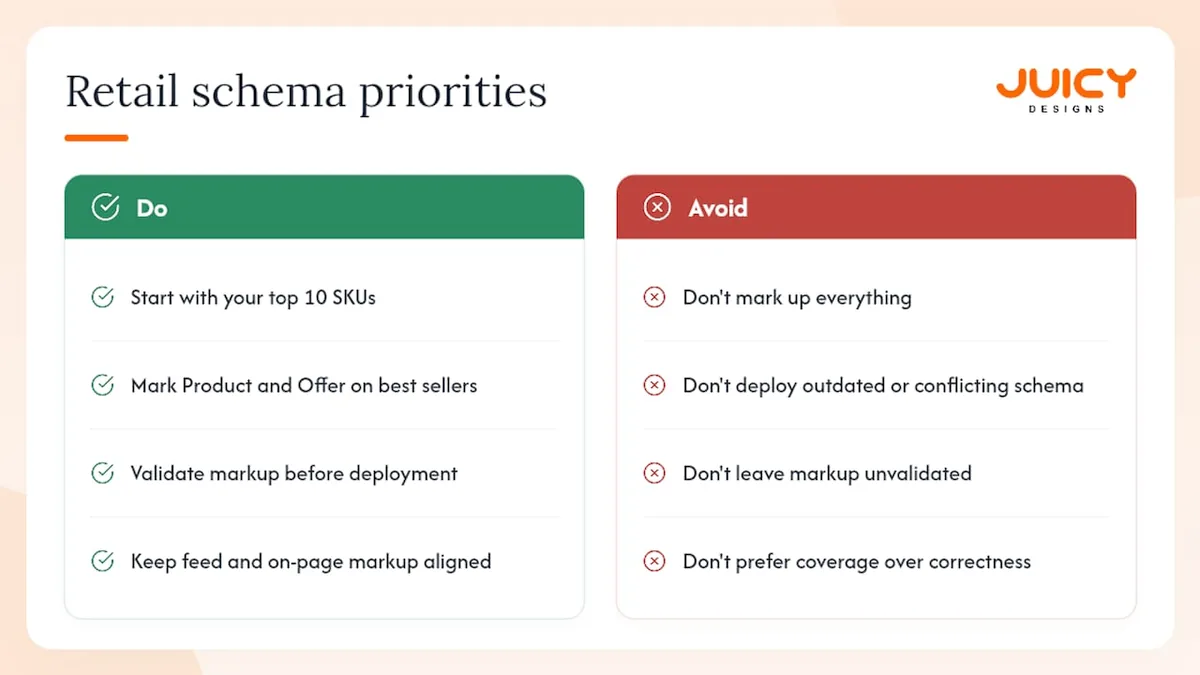
Schema implementation guides tend to focus on completeness, how many types you have, how many fields you fill. That framing leads retailers to mark up everything they can find and then move on. The result is a site with 15 schema types, half of which are outdated, two of which conflict with the Merchant Center feed, and none of which have been validated since the last theme update.
The retailers who actually benefit from structured data are the ones who treat it like inventory management. They start small: Product and Offer on their best-selling pages, Organisation sitewide, BreadcrumbList on every category. They validate before they deploy. They check again after every update. They keep their feed and their on-page markup in agreement.
The 62% failure rate in the ClearsightNow audit is not a story about retailers who ignored schema. Most of those sites had schema. They just had schema that was broken, stale, or mismatched. Correctness beats coverage every time.
If you are starting out, pick your top 10 SKUs and get those right first. A clean, validated Product schema block on 10 pages will do more for your visibility than a half-implemented schema across 500 pages. Build from there, add types as your content warrants them, and set a monthly reminder to check your Search Console Rich Results report.
Juicydesigns handles schema so your team does not have to
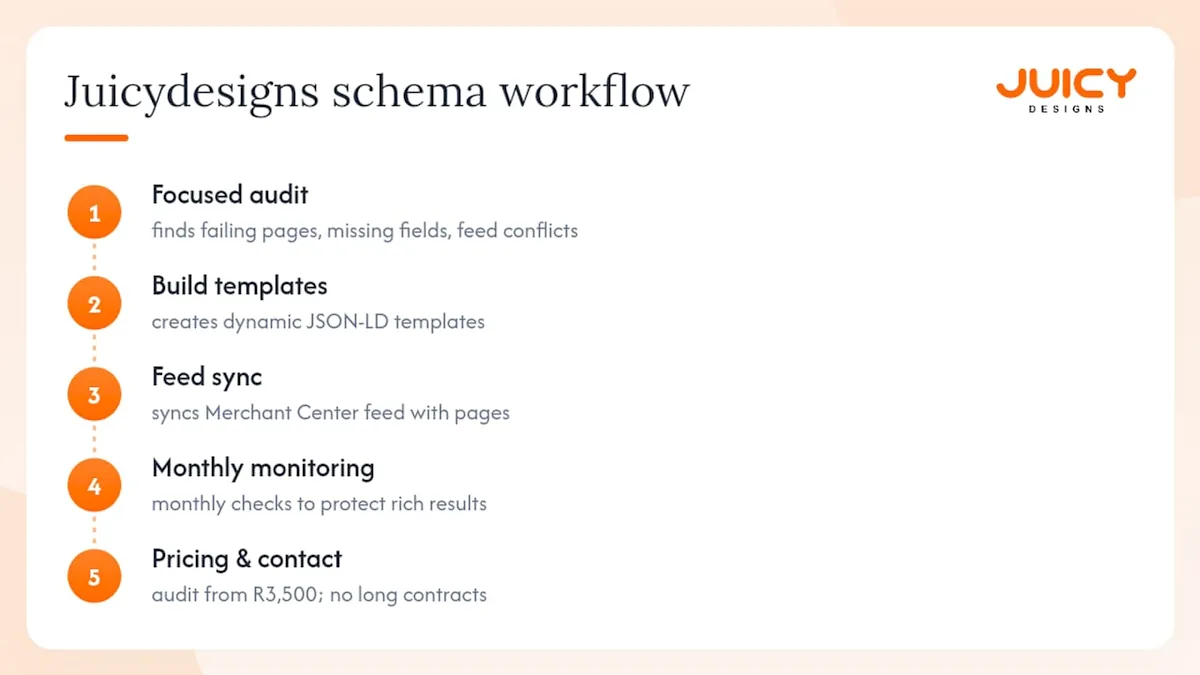
Schema implementation is technical, time-sensitive, and easy to break. Juicydesigns offers South African retailers a focused schema audit that identifies exactly which pages are failing validation, which fields are missing, and where your Merchant Center feed conflicts with your on-page data. From there, the team builds dynamic JSON-LD templates, syncs your feed, and sets up monthly monitoring so you are not caught off guard by a theme update that silently kills your rich results.
Pricing for a schema audit starts from R3,500 for a focused SKU-level review, with full implementation and ongoing monitoring available on a monthly retainer. No long-term contracts. You speak directly with the people doing the work.
To get started, request a schema audit or explore the full range of SEO and digital marketing tools available to South African retailers.
Useful sources and tools
- Structured data for product
- Schemas, schema.org
- Schema Markup Validator
- Structured data for retail: what to mark up and what to skip
- Schema markup for ecommerce brands in the SGE era, what changed, what's required (2026)
- Ecommerce schema: Your structured data guide for 2026 - Shopify
- Schema markup for e-commerce: quick implementation guide (2026) | Rankeo
- Schema markup guide for South Africa | Juicy Designs
FAQ
What is schema markup in simple terms?
Schema markup is code you add to a web page that tells search engines exactly what the content means, for a retail product page, that means the price, availability, and star rating, not just the text. It is the difference between Google guessing at your product details and knowing them with certainty.
How do I know if my site already has schema markup?
Paste any product page URL into the Google Rich Results Test or the Schema Markup Validator. Both tools show you which schema types are present and flag any errors or missing required fields.
Can you show me a retail schema markup example?
The Product JSON-LD block in this article shows a complete example using ZAR pricing, with fields for name, image, SKU, brand, Offer (including priceCurrency: "ZAR"), and AggregateRating. Use the Juicydesigns schema generator to build your own version for any product.
Is schema markup worth the effort for South African retailers?
Yes. Pages with comprehensive schema were cited 3.8 times more often by AI systems in a 2026 audit, and rich results with price and rating badges consistently attract more clicks than plain blue links. The effort is front-loaded; once your templates are correct, maintenance is a monthly check rather than ongoing development work.
Does schema markup directly improve my Google rankings?
Schema markup is not a direct ranking signal. What it does is expand your presence in search results through rich snippets, shopping panels, and AI citations, which drives more qualified traffic to your pages without changing your organic position.
Recommended
- What Is Schema Markup? (Structured Data) | Juicy Designs
- Schema Markup for AEO: A Practical 2026 Guide | Juicy Designs
- Schema Markup Guide for South African Businesses | Juicy Designs
- Schema Markup Generator (JSON-LD) | Free Tool | Juicy Designs