
What is user generated content: a marketer's guide
Discover what is user generated content and how it builds trust, reduces costs, and boosts conversions for South African marketers.
What is user generated content: a marketer's guide ! Marketer reviewing user-generated content on a tablet > TL;DR: > > - User-generated content builds consumer trust and offers cost-effective, scalable marketing assets for South African brands.


TL;DR: Quick Answer
Discover what is user generated content and how it builds trust, reduces costs, and boosts conversions for South African marketers.
Key takeaways
- Very cheap quotes (under R5,000) almost always exclude copywriting, SEO, custom design and post-launch support
- Professional copywriting can represent 20-35% of a total website project cost, and is worth it for search visibility
- On-page SEO built into the website at launch costs a fraction of what it costs to retrofit after the site is live
- Hosting, SSL, domain and maintenance add R3,000-R10,000 per year on top of build cost
- E-commerce adds significant cost due to payment gateway integrations, product data, security requirements and checkout UX
- Timeline and client responsiveness directly affect cost: slow feedback rounds extend agency hours
TL;DR:
- User-generated content builds consumer trust and offers cost-effective, scalable marketing assets for South African brands.
- Juicydesigns provides end-to-end services, including sourcing, rights management, and campaign measurement, to maximise UGC impact.
User-generated content (UGC) is content created by real people rather than brands, photos, videos, reviews, blog posts, comments, and forum posts published by unpaid contributors across social platforms and brand channels. For South African marketers, it functions as high-trust social proof that you can collect, repurpose, and measure alongside your paid and organic channels.
The verdict is straightforward: UGC costs less to produce than brand creative, converts better because audiences trust peers over polished ads, and scales your content output without scaling your budget. With nearly 41 million active social media users in South Africa, the volume of authentic content your audience is already creating is significant.
At a glance:
- Social proof: Reviews and testimonials on Google Reviews, Facebook, and product pages build purchase confidence at the consideration stage.
- Creative scale: Photos and short-form videos from real customers give you a steady stream of ad-ready assets for Instagram, TikTok, and Facebook.
- Organic reach: YouTube tutorials, X posts, and community discussions extend your brand's reach without media spend.
- Ad performance: UGC creative used in paid campaigns often outperforms polished brand creative because it reads as authentic.
What types of user generated content should you know about?
UGC covers a wide range of formats, from a quick Google Review to a 15-minute YouTube unboxing. Knowing which format does what job helps you collect the right assets for each stage of your funnel.
The main formats:
- Reviews and ratings on Google Reviews, Takealot, and Facebook pages
- Social posts and Stories on Instagram and Facebook
- Short-form video (TikTok, Instagram Reels)
- Long-form video (YouTube tutorials, unboxings, hauls)
- Testimonials shared via DM, email, or on-platform
- Forum posts and Q&A on Reddit, community Facebook Groups, and Twitter/X threads
- Blog posts and articles written by customers or fans
- Photos tagged on Instagram or submitted via brand hashtags
Platform notes: Instagram and TikTok favour short-form video and photo content; YouTube is the home of long-form tutorials and unboxings; Facebook Groups generate community discussion and testimonials; X drives real-time commentary and brand mentions; Google Reviews are the most conversion-relevant format for local South African businesses because they directly influence search rankings and purchase decisions.
| Format | Best for | Effort to produce | Legal/rights complexity | How to measure |
|---|---|---|---|---|
| Reviews and ratings | Conversion | Low | Low (platform-owned) | Review volume, star rating, sentiment |
| Social posts and Stories | Awareness | Low | Medium (need permission to repurpose) | Reach, impressions, saves |
| Short-form video (TikTok/Reels) | Awareness and consideration | Medium | Medium | Views, shares, engagement rate |
| Long-form video (YouTube) | Consideration | High | High (music, likeness rights) | Watch time, click-through rate |
| Testimonials | Conversion | Low | Low (with written consent) | Conversion rate lift on pages using them |
| Photos | Awareness and consideration | Low | Medium (photographer rights apply) | Engagement rate, ad CTR |
| Forum posts and Q&A | Consideration | Low | Low | Sentiment, share of voice |

Why does UGC matter for your marketing outcomes?
UGC increases trust and can improve engagement and conversions when measured correctly. The reason is structural: consumers trust content from other consumers more than they trust content from brands, and that trust gap is especially pronounced in South Africa, where audiences actively penalise inauthentic content and respond strongly to creator content that uses local languages and code-switching.

South Africa's approximately 24 million active users creating and consuming social content represent a ready-made content engine for brands willing to engage it deliberately.
Where UGC moves the needle:
- Awareness campaigns: Hashtag challenges and tagged posts extend organic reach without additional media spend.
- Consideration: Testimonials and reviews answer the "can I trust this brand?" question that no amount of brand copy can resolve on its own.
- Conversion: Product demos, review-driven landing pages, and star ratings at the point of purchase reduce friction and lift conversion rates.
- Paid creative: UGC assets used in Meta and TikTok ad campaigns often outperform polished brand creative because the format signals authenticity to the algorithm and the viewer simultaneously.
UGC also acts as a compounding asset. Every authentic piece of consumer content you collect and repurpose adds to a library that keeps working across channels, reducing your cost per creative over time.
Pro Tip: Focus your UGC reporting on engagement rate and sentiment rather than raw follower counts. A nano-influencer in Johannesburg with 3,000 highly engaged followers often delivers stronger trust signals than a macro-influencer with 300,000 passive ones.
How do brands collect and publish user generated content?
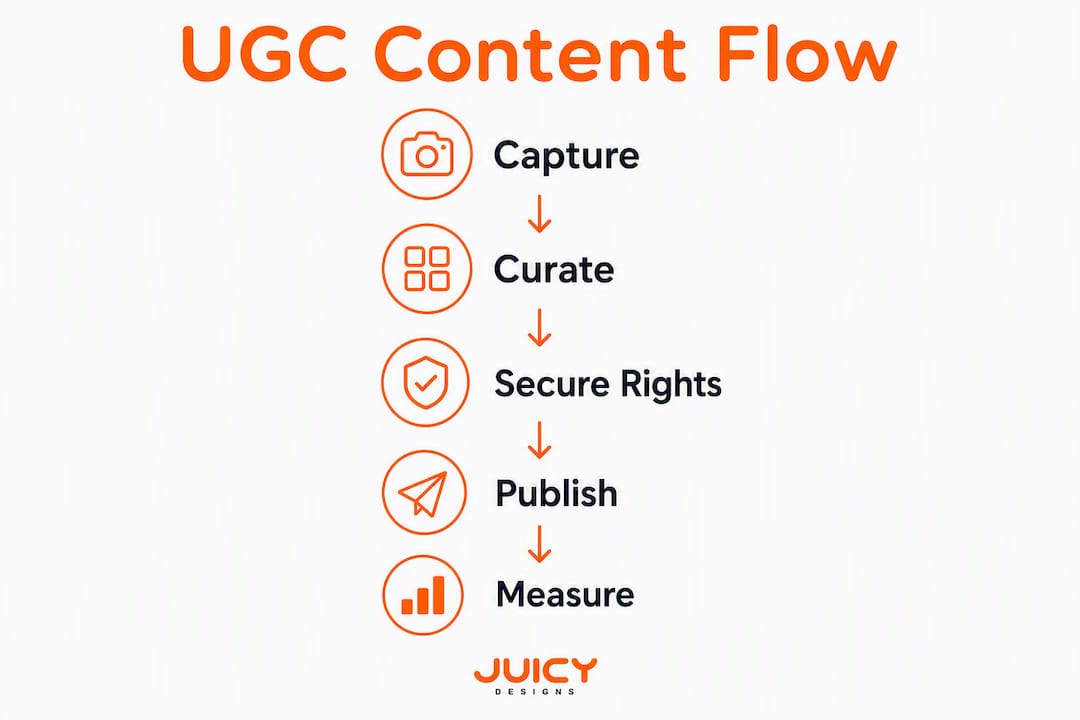
The process runs in five stages: source, request consent, curate, repurpose, and measure. Each stage has practical steps you can build into a repeatable workflow.
Step-by-step sourcing process:
- Monitor organic signals. Set up alerts for your brand name, product names, and relevant hashtags on Instagram, TikTok, Facebook, X, and Google Reviews. Content is already being created, you just need to find it.
- Run a hashtag campaign. Create a branded hashtag and invite customers to post with it. Promote the hashtag in-store, in packaging, and in email sequences.
- Build creator partnerships. Work with micro and nano-influencers who already use your product category. South African micro and nano-influencers often drive stronger engagement and trust-based UGC pipelines than larger accounts.
- Add a UGC submission form. A simple form on your website or a Google Form linked from email lets customers submit photos, videos, or written testimonials directly.
- Ask at the right moment. Post-purchase emails, delivery confirmation messages, and loyalty programme touchpoints are high-intent moments to request a review or photo.
Rights and consent checklist:
- Request explicit written permission before repurposing any content beyond its original platform.
- Capture consent via DM reply (screenshot and save), email confirmation, or a formal licensing form.
- Distinguish between organic UGC (requires permission to repurpose) and paid creator content (governed by your contract).
- Keep a rights log: creator name, content description, date of consent, and permitted uses.
For the curation step, a social listening or content management tool that supports rights tracking will save significant time as your UGC volume grows. A content strategy platform that integrates planning and rights management helps you scale this process without losing track of permissions.
What are the legal and ethical rules for UGC in South Africa?
Obtain clear permission and respect privacy and intellectual property rights before you repurpose any piece of user-generated content. This is not optional, South African law and platform terms of service both carry real consequences for brands that skip this step.
Legal checklist for South African marketers:
- Copyright: The person who created the content (photographer, videographer, writer) owns the copyright by default, even if they tagged your brand. You need their permission to reproduce it.
- Consent for likeness: If a person's face, voice, or identifying features appear in the content, you need their explicit consent to use it in marketing materials.
- Moral rights: Creators retain the right to be attributed and the right not to have their work distorted. Always credit the original creator when repurposing.
- Consumer Protection Act (CPA): South Africa's CPA governs advertising claims. If you repurpose a testimonial, it must be genuine and not misleading.
- Advertising disclosure: If a creator received payment, free product, or any incentive, the content must be disclosed as sponsored under the Advertising Regulatory Board (ARB) guidelines and the Consumer Protection Act.
- Platform terms of service: Each platform has its own rules about what brands can do with content posted on it. Instagram's terms, for example, do not grant brands a licence to repurpose user posts without separate permission.
- POPIA (Protection of Personal Information Act): If you collect personal data (names, email addresses, images) as part of a UGC campaign, you must comply with POPIA, including obtaining informed consent and storing data securely.
Practical documentation steps:
- Create a standard permission request template for DM outreach.
- Follow up DM consent with an email confirmation that includes the permitted uses.
- Use a licensing form for any content you plan to use in paid advertising.
- Store all permissions in a centralised rights log with dates and content descriptions.
Pro Tip: Build your permission trail before you need it, not after. A screenshot of a DM is a start, but a follow-up email with explicit permitted uses is what protects you if a creator later disputes how their content was used.
How do you build a UGC campaign that actually works?
Design for authenticity and reciprocity, not control. The brands that generate the most useful UGC are the ones that make it easy and rewarding for real customers to share, not the ones that script every detail.
Campaign design steps:
- Define a clear objective. Are you building awareness, collecting testimonials for a product page, or sourcing creative for paid ads? The objective shapes every other decision.
- Design the incentive. Recognition (featuring content on your page), discounts, loyalty points, or entry into a competition all work. Match the incentive to the effort you are asking for.
- Set creative boundaries, not scripts. Give contributors a theme or a hashtag, not a word-for-word brief. Authentic content that feels slightly rough outperforms polished content that feels manufactured.
- Make submission easy. A branded hashtag, a simple form, or a WhatsApp number for photo submissions all reduce friction. The harder you make it to submit, the less content you receive.
- Include a simple legal opt-in. Add one sentence to your campaign brief or submission form: "By submitting, you grant [Brand] permission to use your content in marketing materials." Keep it plain and visible.
- Moderate before publishing. Review all submissions for brand safety, accuracy, and legal compliance before repurposing or amplifying.
Repurposing ideas:
- Turn customer photos into carousel posts on Instagram and Facebook.
- Use short-form video testimonials as pre-roll creative on TikTok and YouTube.
- Add review excerpts to product pages and email campaigns.
- Feature UGC in out-of-home (OOH) placements with full creator credit.
For content repurposing across channels, the principle is to adapt the format to the channel rather than simply reposting the same asset everywhere.
Two South Africa-specific campaign ideas:
- Heritage Month storytelling (September): Invite customers to share what your product or service means to their family or community, using their home language. Content in Zulu, Xhosa, Sotho, or Afrikaans consistently outperforms English-only campaigns with local audiences.
- #MyJozi or #CapeTownVibes style localisation: Partner with micro-influencers in specific cities to create hyper-local content that speaks to neighbourhood culture. This approach works particularly well for food and beverage, retail, and entertainment brands.
Pro Tip: Code-switching content (mixing English with Zulu, Afrikaans, or Sotho) resonates strongly with South African audiences and signals cultural authenticity. Brief your creators to speak naturally rather than performing for a brand.
How do you measure whether UGC is working?
Measure UGC against engagement, sentiment, funnel movement, and direct conversions, not vanity metrics like total follower count or raw post volume. The goal is to connect UGC activity to business outcomes.
Metrics that matter:
- Engagement rate: Likes, comments, shares, and saves relative to reach, the primary signal of content resonance.
- Click-through rate (CTR) on UGC ads: How UGC creative performs against brand creative in paid campaigns.
- Conversion rate lift: The difference in conversion rate on pages or campaigns that feature UGC versus those that do not.
- Assisted conversions: UGC touchpoints that appear in the conversion path but are not the last click.
- Sentiment: The tone of comments and mentions, positive, neutral, or negative.
- Share of voice: How much of the conversation in your category your brand's UGC is generating.
| Metric | What it shows | How to collect it | South African benchmark notes |
|---|---|---|---|
| Engagement rate | Content resonance with your audience | Native platform analytics | Micro-influencer posts in SA often see higher rates than macro accounts |
| CTR on UGC ads | Creative effectiveness in paid campaigns | Meta Ads Manager, TikTok Ads Manager | Compare directly against brand creative in the same ad set |
| Conversion rate lift | Revenue impact of UGC on product/landing pages | Google Analytics 4, A/B testing | Test UGC testimonials vs. no testimonials on the same page |
| Sentiment | Brand perception and content quality | Social listening tools, manual review | Heritage and language-aligned content tends to generate more positive sentiment |
| Share of voice | Category presence and UGC volume | Social listening tools | Track branded hashtag volume vs. competitor hashtags |
Measurement checklist:
- A/B test UGC creative against brand creative in the same ad set before scaling spend.
- Tag all UGC-driven links with UTM parameters so you can track traffic and conversions in Google Analytics 4.
- Run lift tests on Meta or TikTok to measure brand awareness impact of UGC campaigns.
- Review sentiment qualitatively every month, numbers alone miss the nuance of what people are actually saying.
What do successful UGC campaigns look like in practice?
Global formats that translate well to South Africa:
- Unboxing videos: A customer films themselves opening a delivery. The format works for e-commerce, beauty, tech, and subscription brands. On YouTube and TikTok, unboxing content drives consideration by showing the product in real hands before purchase.
- Hashtag challenges: A brand creates a challenge mechanic (a dance, a transformation, a before-and-after) and invites participation. TikTok's algorithm amplifies challenge content organically, making it one of the most cost-efficient awareness formats available.
- Testimonial-driven product pages: Pulling real customer reviews and photos onto a product page reduces purchase anxiety. Research from Northwestern University's Spiegel Research Center shows that online reviews significantly influence purchase decisions.
- Review-led landing pages: Aggregating Google Reviews and star ratings on a campaign landing page builds credibility for paid traffic arriving from Google Ads.
South Africa-specific applications:
- A small Johannesburg restaurant could run a "Share your Sunday braai" campaign on Instagram, asking customers to tag the brand and use a branded hashtag. The resulting photos become organic social content and ad creative simultaneously.
- A Pretoria-based beauty brand could partner with three nano-influencers (each under 10,000 followers) to create TikTok tutorials in their home languages. The content costs a fraction of a professional shoot and typically generates higher engagement from local audiences.
- Any local business with a Google Business Profile should actively request Google Reviews from satisfied customers. Google Reviews are the single highest-conversion UGC format for South African businesses because they appear directly in search results and on Google Maps.
For a broader view of how South African brands are using social platforms, the South Africa social media marketing guide covers platform selection and localised execution in detail.
How Juicydesigns uses UGC for South African clients
Juicydesigns has applied UGC-led tactics as part of full-funnel campaigns for South African clients, with measurable results. In one documented case, a UGC-integrated campaign for a local automotive dealership produced a 312% increase in qualified leads, demonstrating that authentic content, when deployed strategically across the right channels, moves real business metrics.
The approach follows a consistent pattern:
- Objective first: Define whether UGC is serving awareness, consideration, or conversion before sourcing any content.
- Channel fit: Match the UGC format to the platform, short-form video for TikTok and Reels, reviews for Google and landing pages, photos for Meta carousel ads.
- Paid amplification: Treat high-performing organic UGC as a signal. The content that earns the most engagement organically is the content most worth putting paid spend behind.
- Measurement: Track UGC creative performance separately in Meta Ads Manager and Google Analytics 4 so you can see exactly what it contributes to the funnel.
Juicydesigns reports an average return on ad spend (ROAS) of 4.8x across client campaigns, with UGC creative contributing meaningfully to that performance by reducing cost per result in paid channels. You can read more about the agency's approach to UGC strategy for South African brands on the Juicydesigns blog.
4.8x average ROAS across Juicydesigns client campaigns, with UGC creative reducing cost per result in paid channels.
Key takeaways
UGC is the most cost-efficient trust asset available to South African marketers, and it performs best when collected with clear consent, matched to the right platform format, and measured against conversion outcomes rather than vanity metrics.
| Point | Details |
|---|---|
| UGC definition | Content created by real people (not brands), reviews, photos, videos, posts, that functions as social proof. |
| South African scale | South Africa has nearly 41 million active social media users, giving brands a large pool of authentic content to work with. |
| Legal must-dos | Always obtain explicit written consent before repurposing UGC; comply with POPIA and the Consumer Protection Act. |
| Measurement priority | Track engagement rate, CTR on UGC ads, and conversion rate lift, not follower counts or raw post volume. |
| Juicydesigns | Juicydesigns integrates UGC into full-funnel campaigns for South African brands, with a documented 4.8x average ROAS. |
UGC is a strategic asset, not a content shortcut
Most brands treat UGC as a way to fill a content calendar. That framing undersells it. The more useful frame is this: UGC is evidence. It is what your customers say about you when you are not in the room, and it carries a credibility that no amount of brand copy can replicate.
What I see consistently in the South African market is that brands invest heavily in polished creative and then wonder why their engagement is flat. The answer is usually that the audience can tell the difference between content made for them and content made to impress them. Authentic content, even when it is slightly rough around the edges, wins that comparison almost every time.
The other thing worth saying plainly: UGC does not replace strategy. It replaces expensive creative production, but only when you have a clear objective, a rights management process, and a measurement framework in place. Without those, you are just collecting content with no way to know if it is working.
South African audiences are particularly sensitive to authenticity signals. Heritage storytelling, local language use, and community-first framing are not nice-to-haves here, they are the difference between content that resonates and content that scrolls past. Brands that understand this and build their UGC programmes around it have a genuine advantage.
Juicydesigns helps South African brands build and scale UGC programmes
Juicydesigns is the direct alternative to building an in-house UGC operation from scratch. You get a full-funnel team that designs the campaign brief, sources creator content, manages rights and consent, deploys UGC across paid and organic channels, and reports on what it actually contributes to your revenue, all on South African pricing with no long-term contract required.
The agency's UGC content service covers everything from sourcing micro-influencer content to integrating UGC creative into Google Ads and Meta campaigns. With a documented average ROAS of 4.8x and a 312% increase in qualified leads for a local dealership, the results are on the record.
To get a tailored quote for your brand, contact Juicydesigns directly or request a proposal for your digital marketing, the team will scope a UGC pilot that fits your budget and objectives.
Useful sources and further reading
- What is User Generated Content?, TechTarget: Clear technical definition of UGC formats and how they are classified.
- User Generated Content, HMS Africa: Africa-relevant overview of UGC formats and platform applications.
- User Generated Content Statistics in South Africa, StateGlobe: South Africa-specific data on social content creation and consumption.
- SA has 41 million social media users, TechNation News: 2026 landscape report covering platform use, AI adoption, and consumer trust in South Africa.
- Why different rules apply to the South African media landscape, Modern Marketing: Practitioner guidance on authenticity, language, and cultural fit in South African content.
- South African creator economy shifts, Noah News: Analysis of micro and nano-influencer value in the South African creator economy.
- How online reviews influence sales, Spiegel Research Center, Northwestern University: Research on the conversion impact of online reviews.
- UGC: What It Is and How SA Brands Use It, Juicydesigns: Juicydesigns' own guidance on UGC strategy for South African brands.
- Digital marketing basics for South African SMEs, Ready Accounting: Practical marketing fundamentals for South African small businesses, including content and UGC basics.
Before repurposing any UGC in your campaigns, check the current platform terms of service for Instagram, TikTok, YouTube, Facebook, and X, and confirm your compliance obligations under POPIA and the Consumer Protection Act with a qualified legal professional.
FAQ
What is meant by user-generated content?
User-generated content (UGC) is any content, photos, videos, reviews, social posts, or comments, created and published by real people rather than brands. It covers everything from a Google Review left by a customer to a TikTok video filmed by a fan.
What is an example of user generated content?
A customer posting an Instagram photo of your product with a branded hashtag, a Google Review rating your service five stars, or a YouTube unboxing video filmed by a buyer are all classic examples of UGC.
What is UGC and how does it work?
UGC works by capturing authentic content from real customers, then collecting, curating, and repurposing it across marketing channels, from product pages and email campaigns to paid social ads. Brands source it through hashtag campaigns, review requests, and creator partnerships, then obtain consent before amplifying it.
What is UGC and why is it important?
UGC is important because consumers trust content from other consumers more than they trust brand-produced advertising. For South African marketers specifically, authentic UGC that reflects local culture and language consistently outperforms polished brand creative in engagement and conversion metrics.
Does Juicydesigns help South African brands with UGC?
Yes. Juicydesigns offers a dedicated UGC content service for South African brands, covering campaign design, creator sourcing, rights management, and paid media integration, with documented outcomes including a 4.8x average ROAS.
Recommended
- UGC: What It Is and How SA Brands Use It | Juicy Designs
- UGC Content Agency South Africa | Creator Content | Juicy Designs
- Content Marketing ROI: How to Measure It | Juicy Designs
- How social media marketing works: 2026 guide | Juicy Designs