
POPIA-ready WhatsApp marketing, South African SMEs: API choices, costs
Playbook for South African SMEs: choose the right WhatsApp Business API path, collect POPIA opt-ins, review real cost examples, and explore managed launch...
Most South African SMEs handling more than 20 conversations a day should move to the WhatsApp Business API through a BSP or a managed agency, not the free Business app.


TL;DR: Quick Answer
Playbook for South African SMEs: choose the right WhatsApp Business API path, collect POPIA opt-ins, review real cost examples, and explore managed launch...
Most South African SMEs handling more than 20 conversations a day should move to the WhatsApp Business API through a BSP or a managed agency, not the free Business app. That path keeps you POPIA-compliant, scales past one phone, and typically goes live within one to three weeks. Meta's message pricing and the record-keeping demands of the 2025 POPIA Regulations make this the practical choice for anyone serious about WhatsApp marketing in South Africa.
TL;DR:
- Businesses handling more than 20 conversations daily should use the WhatsApp Business API through a BSP or agency to remain compliant and scale effectively.
- Approval in South Africa mainly involves paperwork such as verified business registration, a dedicated phone number, and a verified Meta Business Manager; working through a BSP offers faster onboarding.
- POPIA's 2025 regulations require separate, recorded opt-ins for marketing, with clear opt-out options and retention of consent records for audit purposes.
- Costs include Meta's message fees in USD, VAT, and agency retainers typically between R6,000 and R25,000 monthly, depending on automation and integration scope.
- WhatsApp is best used as a retention tool for already engaged customers, complementing search and social strategies rather than serving as the primary acquisition channel.
Which WhatsApp option fits your business
The right setup depends less on your industry and more on three numbers: how many conversations you handle daily, how many people need to reply, and whether you want automation doing the heavy lifting.
The free WhatsApp Business app works for a single owner replying to a handful of customers a day. It has no CRM connection, no broadcast tool, and no way to add a second agent without sharing one phone. Once you cross roughly 20 conversations a day, or need more than one person answering, you've outgrown it.
The WhatsApp Business API through a BSP (Business Solution Provider) suits growing SMEs that want automation, multi-agent inboxes, and CRM syncing without hiring a developer. A Cloud API connection, accessed directly rather than through a BSP, cuts the per-message markup but shifts webhook management, template administration, and dashboard-building onto your own team.
An agency-managed setup handles the technical and compliance layers so you focus on the messages themselves.
Quick decision checklist:
- Fewer than 20 conversations/day, one person replying → free Business app is fine.
- More than 20 conversations/day or multiple agents → BSP-backed API.
- In-house developers and a desire to skip BSP markup → Cloud API direct.
- No engineering capacity and you want ROI tracked → agency-managed API.
Compare the WhatsApp Business app against the full API before committing budget to either route.
How to get WhatsApp Business API approved in South Africa
Getting approved is mostly a paperwork exercise, not a technical one, but the paperwork trips up more businesses than you'd expect.
You'll need a handful of prerequisites lined up before you apply:
- A registered business with valid CIPC documents matching the name you want displayed on WhatsApp.
- A domain-based business email (not a free Gmail or Yahoo address).
- A dedicated phone number in +27 international format that isn't already active on the regular WhatsApp app.
- A verified Meta Business Manager account with accurate business details.
Onboarding through a BSP is the faster route for most SMEs. BSPs typically get businesses live in one to three weeks, handling template submission and Meta verification on your behalf. Going direct through the Cloud API skips BSP fees but usually takes longer, since you're managing verification, webhooks, and template approval yourself with no support layer.
The most common rejection reasons are a display name that doesn't match your CIPC registration, a phone number still linked to a personal WhatsApp account, and vague business descriptions that trigger manual review. Fix all three before you submit and you avoid the resubmission loop that stretches "one week" into a month.
Pro Tip: Before you request API access, message your own new number from a personal WhatsApp account first. If it's already flagged as active on the standard app, Meta will reject the API application outright.
POPIA and WhatsApp: consent, opt-ins, and the 2025 regulation changes
An inbound message from a customer is not marketing consent, no matter how many businesses treat it that way. POPIA requires a separate, recorded, purpose-specific opt-in before you send marketing content, and a customer replying to a delivery notification doesn't count.
The April 2025 POPIA Regulations changed the practical mechanics of consent collection. Businesses can now request consent directly through WhatsApp, telephonic consent must be recorded to carry the same weight as a signed Form 4, and every marketing channel must offer an accessible, working objection channel, WhatsApp included.
What this means operationally:
- Capture consent per purpose: marketing, service updates, and transactional messages each need their own opt-in.
- Record a timestamp and the exact wording the customer agreed to, not just a checkbox.
- Give customers an obvious way to opt out inside the same WhatsApp thread, not buried in a separate system.
- Store consent records for as long as the relationship lasts, plus a buffer for audit purposes.
Practical opt-in wording that works: "Reply YES to receive occasional deals and updates from [Business Name] on WhatsApp. Reply STOP anytime to opt out." Simple, timestamped, and defensible if you're ever asked to produce evidence of consent.
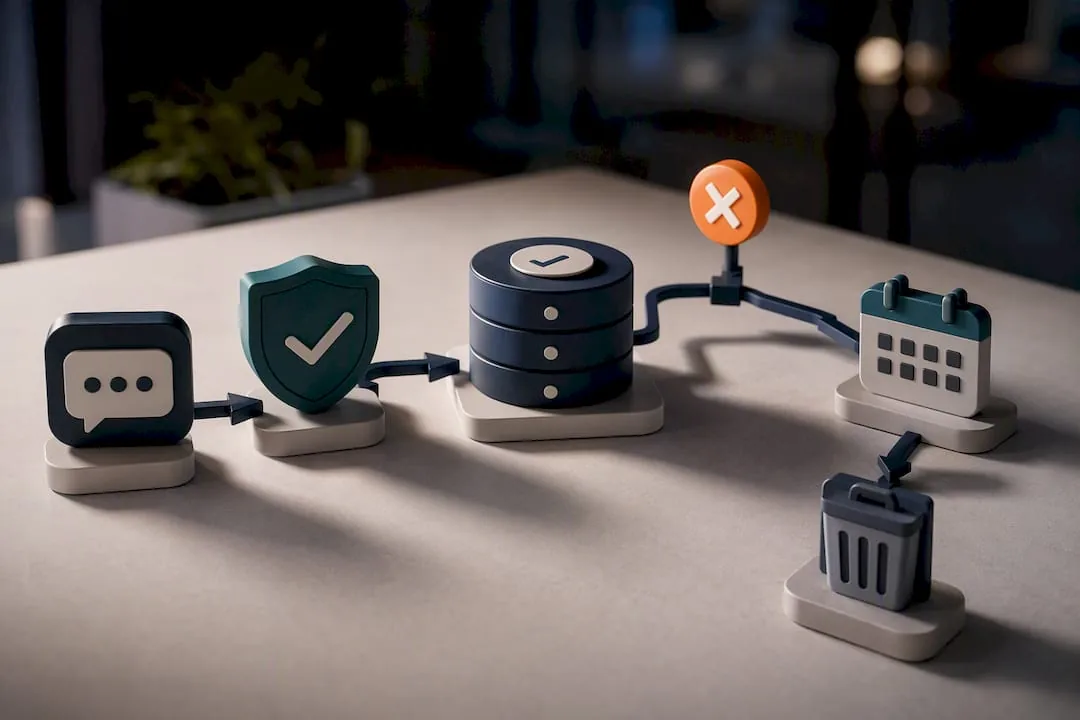
Retention matters too: marketing opt-ins should stay on file until withdrawal plus six months, giving you an audit trail without holding data indefinitely. Businesses conflating a first inbound message with standing marketing permission remain one of the most common compliance gaps South African companies run into.
Pricing and real cost examples for South Africa
Meta bills WhatsApp messages in USD by category, marketing, utility, and authentication, and South African invoices carry 15% VAT on top of whatever a BSP passes through. That combination catches a lot of businesses budgeting only in ZAR from the start.
On top of platform fees, most agencies price managed WhatsApp programmes as a monthly retainer. Retainers for managed WhatsApp services in South Africa commonly run R6,000 to R25,000 a month, depending on how much automation, template design, and CRM integration the scope includes.
Questions worth asking any supplier before you sign:
- Do you mark up Meta's per-message rate, or pass it through at cost?
- Is the 15% VAT already included in your quoted price, or added afterwards?
- What's included in the retainer versus billed as an extra (new templates, campaign builds, reporting)?
- Is there a lock-in period, or can we adjust scope month to month?
Core WhatsApp campaign types and templates that perform in South Africa
Four campaign types consistently deliver measurable return for South African businesses running WhatsApp marketing:
- Cart recovery messages sent within an hour of abandonment, with a direct link back to checkout.
- Appointment reminders for services, clinics, and salons, cutting no-shows without a phone call.
- Delivery and order notifications, which double as a low-friction reason to build an opted-in list.
- Support-to-sale handoffs, where a service query naturally opens the door to a relevant offer.
A template that performs stays short: state the offer or update in the first line, include one clear call to action, and always leave a visible opt-out. Something like "Your order is on its way, arriving Thursday. Reply TRACK for live updates, or STOP to opt out of notifications" does more work than a paragraph of branding copy.
Segment by purchase recency and message frequency rather than blasting the full list every week; cadence fatigue drives up block and report rates faster than message content does. Track opt-out rate, response rate, and conversion-to-sale as your core KPIs, and pull in a broader view of WhatsApp business strategies if you're building out a full campaign calendar.
Implementation checklist: integrations, CRM, and monitoring
Wiring WhatsApp into your existing systems is where compliance either holds up or quietly falls apart.
- Add dedicated CRM fields for consent status, consent timestamp, and consent wording, one set per message purpose.
- Set retention windows deliberately: keep transactional records longer for tax and finance purposes, and hold marketing opt-ins until withdrawal plus six months.
- Request a data processing agreement and sub-processor list from your BSP, along with exportable audit logs you can produce for a data subject request.
- Build a go-live testing step: send your first broadcasts to a small, fully opted-in segment before scaling to the full list.
- Meta monitors complaint rates closely, and a block or report rate above roughly 2% risks throttling or account restriction.
Pro Tip: Run your first three broadcasts to your most engaged 200 to 500 contacts, not your full list. If block/report rates stay low, scale up with confidence instead of finding out the hard way.
For businesses connecting WhatsApp into a broader lead pipeline, pairing it with marketing automation and lead-generation tooling closes the loop between a WhatsApp reply and a tracked sale.
Publisher perspective and client proof
Some agencies run on a founder-led model, meaning the person managing your WhatsApp programme is the same person accountable for its results, not a rotating account manager.
For WhatsApp specifically, that can mean end-to-end delivery: opt-in capture built into your existing touchpoints, BSP onboarding handled without the back-and-forth, templates written to convert rather than just inform, CRM wiring so consent and conversation data sit in one place, and reporting that ties messages sent to revenue generated. This approach aims to elevate WhatsApp from a side channel to a measurable part of your funnel.
Comparative overview of WhatsApp marketing versus other digital channels in South Africa
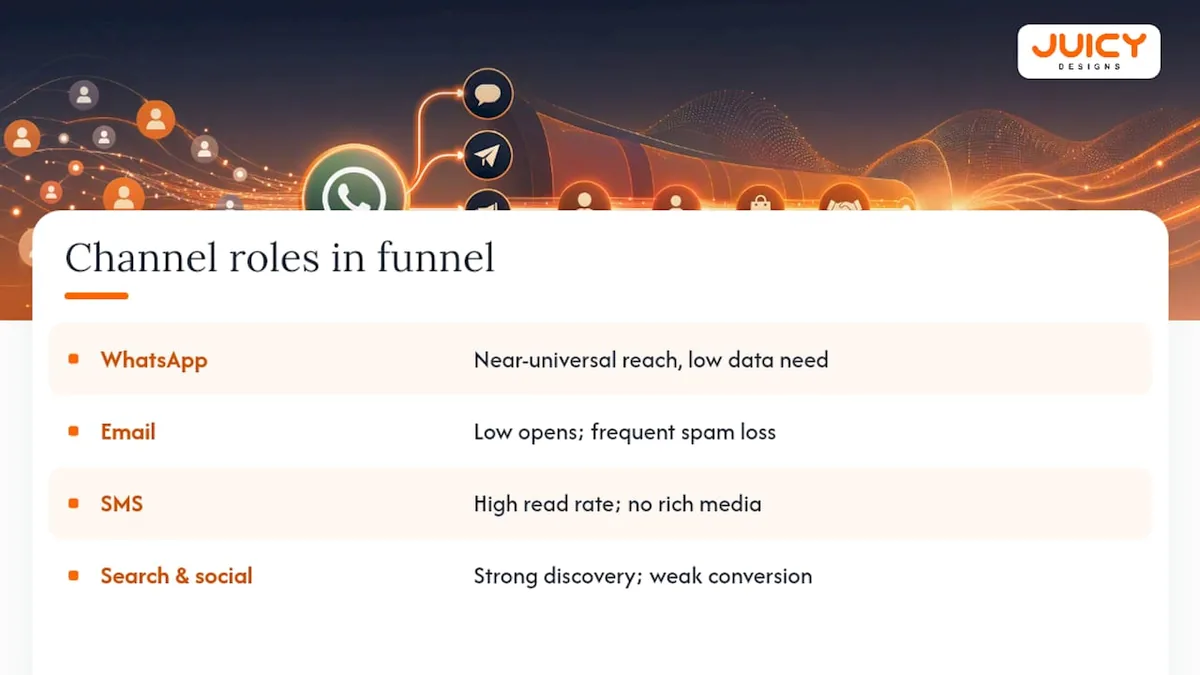
WhatsApp holds one advantage no other channel in South Africa matches: near-universal reach without needing a large data bundle, which matters in a market where data cost still shapes consumer behaviour. Email struggles with low open rates and frequent spam-folder losses. SMS gets read but carries no rich media and feels dated to most under-40 audiences. Social media ads, whether Meta or TikTok, excel at discovery and top-of-funnel reach but rarely close a sale inside the platform itself.
WhatsApp sits in the middle of the funnel, closer to the conversation than the ad. A customer who has opted in already knows your business, which makes WhatsApp messages read more like a personal update than an interruption. That's why cart recovery and appointment reminders perform so well there compared to a retargeting ad trying to achieve the same thing cold.
The trade-off is scale and discovery. WhatsApp doesn't find new customers the way a Google Ads campaign or a social feed does. It's built for retention and conversion among people who already know you, not acquisition among people who don't. The strongest South African digital strategies treat WhatsApp as one leg of a funnel, not the whole thing, using search and social to bring people in and WhatsApp to keep them engaged once they've opted in. Businesses running WhatsApp ads in South Africa alongside search and social tend to see each channel lift the others, rather than competing for the same budget line.
Common challenges and pitfalls in WhatsApp marketing in South Africa
The single biggest pitfall is treating an inbound customer message as blanket permission to market. It isn't, and POPIA's 2025 tightening around consent evidence makes that mistake more expensive to unwind than it used to be.
A second common failure is skipping the testing phase before scaling a broadcast. Businesses that blast their full contact list on day one, without checking block and report rates on a smaller segment first, risk Meta restricting their account before the campaign even proves itself.
Poor segmentation causes a slower, quieter problem: message fatigue. Sending the same broadcast to your entire list weekly regardless of purchase behaviour drives up opt-outs and erodes trust in the channel, even among customers who were genuinely interested at first.
Technical gaps matter too. Businesses that go the Cloud API route without budgeting for engineering time often end up with broken template management or no proper inbox, since direct Cloud API access shifts real maintenance work onto whoever's running it in-house.
Finally, many businesses underestimate the paperwork. A mismatched display name, a phone number still active on the personal app, or a vague CIPC-linked business description are the three reasons most API applications stall, and all three are avoidable with a five-minute check before submission.
Editorial take: what actually moves the needle
The conventional advice on WhatsApp marketing in South Africa treats it as a messaging tactic, something you bolt onto existing campaigns. That framing undersells what's actually happening. WhatsApp is closer to a retention infrastructure decision than a marketing channel decision, and the businesses getting real ROI from it are the ones who built compliance and CRM integration first, then layered creative on top.
Where most guides fall short is pretending POPIA is a checkbox exercise. It isn't. The 2025 Regulations tightened evidence requirements specifically because businesses were treating a reply to a delivery notification as marketing permission. That's not a technicality, it's the difference between a defensible consent record and a liability sitting in your CRM.
If you take one thing from this article, prioritise the opt-in architecture before the campaign calendar. Get consent capture, timestamping, and CRM fields right first. The clever broadcast copy and segmentation strategy matter, but they're worthless if the underlying consent doesn't hold up to scrutiny.
, Cobus
How Juicydesigns can help with your WhatsApp programme
An agency alternative to hiring a full in-house team for WhatsApp marketing in South Africa can provide BSP onboarding, POPIA-aligned opt-in capture, template writing, and CRM wiring, so you do not have to coordinate a developer, a compliance consultant, and a copywriter separately.
Businesses running more than 20 conversations a day, or wanting WhatsApp tied into a measurable funnel, may benefit from a managed engagement. Such engagements often start with a review of your current setup and compliance gaps, followed by BSP onboarding and template approval, then CRM integration and reporting. Managed WhatsApp programmes typically have market-aligned retainers, scoped to automation and integration needs, and often do not require long-term lock-in contracts.
If you want a clear view of where your current setup stands, get in touch with the team for a practical next step, or explore the full WhatsApp marketing service offering to see what a managed programme actually includes.
Sources
For further reading, consult the Protection of Personal Information Act, POPIA's 2025 regulation amendments, WhatsApp API pricing for South Africa, and the WhatsApp Business POPIA compliance guide.
FAQ
Can I earn money by using WhatsApp?
WhatsApp itself isn't a revenue source, but businesses use it to recover abandoned carts, reduce no-shows, and convert support conversations into sales, all of which increase revenue indirectly.
How do I start WhatsApp marketing in South Africa?
Start by choosing between the free Business app and the API based on your conversation volume, then set up POPIA-compliant opt-in capture before sending your first marketing message.
How much does WhatsApp marketing cost in South Africa?
Costs combine Meta's USD per-message rates plus 15% VAT, BSP platform fees of roughly R500 to R10,000+ a month depending on volume, and agency retainers typically ranging from R6,000 to R25,000 a month for a fully managed programme.
How can I become a WhatsApp Business Partner?
Becoming a Meta Business Partner (BSP) requires a formal application to Meta and technical infrastructure most SMEs don't need; most businesses instead work with an existing BSP or a managed agency like Juicydesigns to access the API without becoming a partner themselves.
Recommended
- WhatsApp Business App vs API: Which to Use in SA
- WhatsApp Business Marketing in South Africa
- Build a POPIA-Safe WhatsApp Marketing List
- WhatsApp Marketing South Africa