
Content marketing for retail: what it is and why it works
Content marketing for retail is the practice of publishing useful, non-promotional content that helps shoppers decide what to buy, so a retailer earns attention ahead of the sale rather than paying for it at the point of sale.
Done properly it lifts organic visibility, repeat purchases and average basket size across every channel a retailer sells through.



TL;DR:
- Content marketing in retail involves creating valuable content to engage shoppers and boost sales across channels. It focuses on guiding customers through every buying stage with purposeful, high-quality content. Retailers who adopt this approach see increased trust, better search visibility, and measurable revenue growth.
Content marketing retail is the strategic creation and distribution of valuable, relevant content designed to engage shoppers and drive sales across every channel a retail business uses. Unlike paid advertising, which interrupts, content marketing attracts. It guides customers from the moment they discover a product through to purchase and beyond. Retail content marketing has evolved into a core commercial discipline that connects brand trust, product discovery, and measurable revenue. For South African retail business owners and marketers, understanding this discipline is no longer optional. It is the foundation of a sustainable online presence.
What is content marketing in retail, and how does it work?
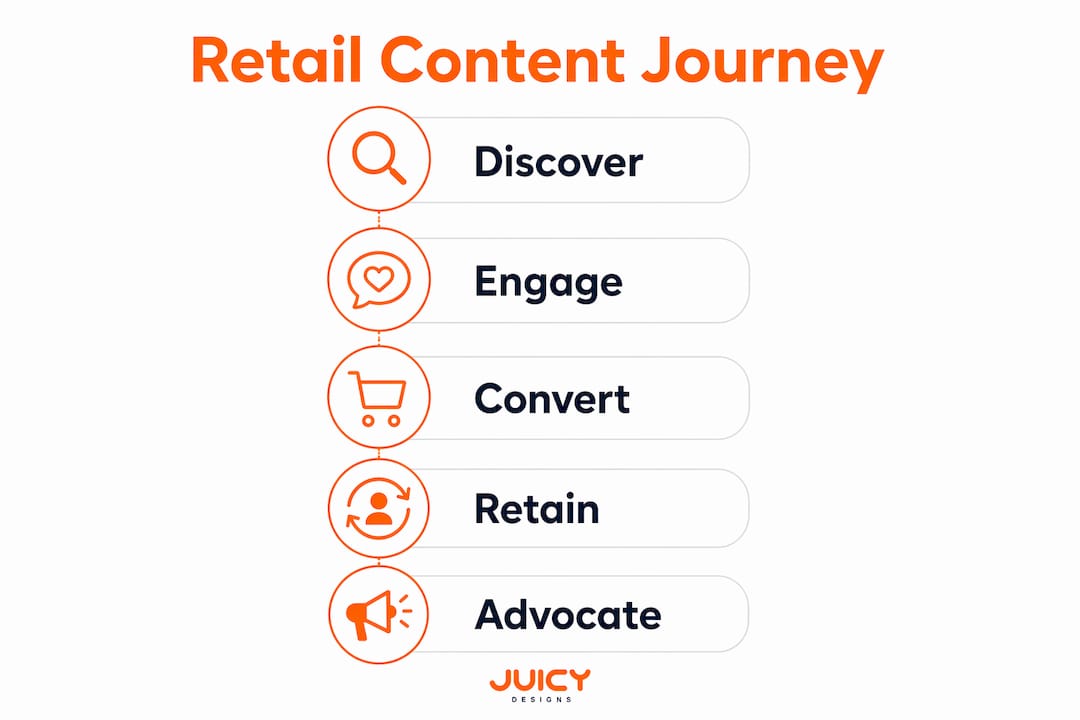
Content marketing in retail, also called retail content strategy, is the practice of creating purposeful content that matches what your customers are thinking, searching for, and feeling at each stage of their buying journey. The marketing funnel maps this journey into four stages: discovery, evaluation, purchase, and post-purchase. Each stage needs different content.

At the discovery stage, a shopper might search “best moisturiser for dry skin in winter.” A blog post or short video answering that question puts your brand in front of them before they even know your store exists. At the evaluation stage, detailed product comparisons, customer reviews, and how-to videos build the confidence they need to choose you over anyone else. At purchase, clear FAQs and trust signals like return policies reduce hesitation. After the sale, care guides, loyalty offers, and community content keep customers coming back.
Intent-focused content significantly outperforms volume-driven approaches. Publishing ten pieces of content that answer real customer questions beats publishing fifty generic posts. The shift from quantity to quality is the single biggest mindset change retail marketers need to make in 2026.
Key content marketing strategies for retail businesses
Effective retail content marketing rests on a few core strategies that work together rather than in isolation.
- Omnichannel consistency: Your brand voice, product information, and messaging must match across your website, social media, in-store signage, and app. Shoppers move between channels constantly, and inconsistency destroys trust.
- High-quality product education: Effective product pages combine educational content with buying confidence elements. This means detailed specifications, demonstration videos, real customer reviews, and answers to common questions, all on one page.
- First-party data personalisation: Responsible use of first-party data enhances decision-making and customer retention. This goes well beyond using a customer’s name in an email. It means recommending products based on past purchases, browsing history, and loyalty tier.
- Creator-led and social proof content: User-generated content, influencer partnerships, and creator campaigns build authenticity that branded content alone cannot achieve.
- Structured content for AI search: Structured data, detailed FAQs, and direct answers improve visibility in AI-driven search environments like Google’s AI Overviews and Perplexity. Retailers who structure their content clearly get found more often.
Pro Tip: Build a simple content calendar that maps one piece of content to each buying journey stage per week. You will cover discovery, evaluation, and retention without spreading your team too thin.
The role of merchandise in marketing also plays into content strategy. Physical branded touchpoints, from packaging to promotional items, create shareable moments that extend your content reach organically.
How content marketing benefits retail: engagement, trust, and sales
The benefits of content marketing in retail are measurable and compound over time. Each piece of quality content you publish continues working for your business long after you create it.
Shoppers increasingly seek experiences that combine emotional connection, sensory immersion, and social participation over mere convenience. Content marketing is the tool that delivers those experiences digitally. A well-produced video series, a community-driven hashtag campaign, or a genuinely useful buying guide all create emotional resonance that a discount code never will.
The concrete benefits include:
- Higher conversion rates: Customers who consume educational content before purchasing are more confident in their decision and less likely to return products.
- Reduced purchase friction: Clear, accurate content answers objections before they become reasons not to buy.
- Stronger customer retention: Post-purchase content, such as care instructions, styling tips, and loyalty rewards, keeps customers engaged between purchases.
- Improved search visibility: Consistent, structured content builds SEO authority over time, reducing your dependence on paid ads.
- Revenue attribution: Retailers that measure content marketing with KPIs linked to conversion rates, customer lifetime value, and revenue attribution see which content actually drives sales.
In 2026, retail content marketing is a core commercial discipline linking brand trust, product discovery, customer retention, and measurable revenue. That is not a trend. It is the new baseline for competitive retail.
Retail content marketing in South Africa: the Takealot House of Beauty example
South Africa has produced one of the most compelling retail content marketing case studies in recent memory. The Takealot House of Beauty campaign fused commerce and culture through creator-led, immersive content experiences. The results were significant.
| Metric | Result |
|---|---|
| Total impressions | Over 8.4 million |
| Users reached | Over 3.1 million |
| Content approach | Creator-led, experiential, real-time social sharing |
| Key outcome | Increased brand relevance and cultural loyalty |
The campaign worked because it treated content as an experience rather than a message. Creators shared real-time moments from an immersive beauty event, and their audiences participated vicariously through social media. The campaign reached over 3.1 million users and generated more than 8.4 million impressions. Those numbers reflect genuine audience engagement, not passive reach.
The lesson for South African retailers of any size is clear. You do not need a Takealot budget to apply the same principles. A local clothing boutique can partner with three micro-influencers for a styling event. A hardware store can host a DIY workshop and document it across social channels. The formula is the same: create an experience, give creators the freedom to share it authentically, and let the content do the heavy lifting.
Pro Tip: When working with creators, brief them on your brand values and key messages, then step back. Audiences trust creators who sound like themselves, not like a brand script.
You can explore more about video and creator-led content strategies specifically built for South African retail brands.
How to implement content marketing for your retail business
Putting a retail content strategy into practice does not require a large team or a big budget. It requires a clear process.
-
Define your customer intent map. List the top five questions your customers ask before buying your products. These questions become your first five pieces of content. Use Google Search Console, your customer service inbox, and social media comments as your research tools.
-
Build a single source of truth. Create one master document that holds your brand voice guidelines, approved product claims, and key messages. Every piece of content, from a product description to a social post, must align with this document. Inconsistency across channels erodes trust faster than any competitor can.
-
Integrate AI tools with human oversight. AI-driven content tools aid speed and scale but require human editorial control to maintain trust, accuracy, and brand consistency. Use AI to draft and ideate, then have a human review every piece before it goes live. This is non-negotiable for compliance-sensitive claims like sustainability or health benefits.
-
Personalise with first-party data. Segment your email list by purchase history and send product recommendations that reflect what each customer actually buys. This is the most direct application of personalisation available to most retailers without enterprise-level technology.
-
Set KPIs tied to revenue. Track content performance using metrics like conversion rate per content piece, revenue attributed to organic search, and customer retention rate. Combining attribution data with A/B testing reveals which content formats and topics actually move the needle. You can read more about measuring content ROI to build a measurement framework that works for your business.
Pro Tip: Start with one channel and do it well before expanding. A retailer who publishes two excellent blog posts per month and promotes them consistently will outperform one who posts daily across five channels with no strategy.
The retail digital marketing best practices for 2026 guide from Juicy Designs covers channel-specific tactics in detail for South African retailers.
Key takeaways
Retail content marketing succeeds when it aligns purposeful content with customer intent at every buying stage, builds trust through consistency, and ties every effort to measurable revenue outcomes.
| Point | Details |
|---|---|
| Intent over volume | Content aligned with buying journey stages outperforms high-volume, generic publishing. |
| Omnichannel consistency | Brand voice and product information must match across all channels to build trust. |
| Creator-led content works | The Takealot House of Beauty campaign reached 3.1 million users through authentic, experiential content. |
| Measure what matters | Track conversion rates, customer lifetime value, and revenue attribution, not just page views. |
| AI needs human oversight | Use AI tools for speed, but apply human editorial review to protect accuracy and brand integrity. |
Why retail content marketing is now a commercial necessity
I have worked with enough retail businesses to know that most of them treat content marketing as a nice-to-have. They post when they have time, write product descriptions as an afterthought, and measure success by likes. That approach leaves serious revenue on the table.
The retailers who grow consistently are the ones who treat content as a commercial asset. They plan it, invest in it, and measure it the same way they measure their buying decisions or their store layout. Content is not decoration. It is the sales floor of your digital presence.
What I find most encouraging about the South African retail market right now is the appetite for cultural relevance. Campaigns like Takealot House of Beauty prove that local audiences respond powerfully when brands speak to them in ways that feel real and participatory. You do not need to copy global trends. You need to understand your specific customer and create content that fits their world.
The retailers I see struggling are the ones chasing platform algorithms instead of customer intent. They pivot every time a new social feature drops, and they never build depth anywhere. The ones winning focus on a clear content strategy, stay consistent, and let the results compound over time. Trust and transparency are not soft values. They are the foundation of every purchase decision your customer makes.
, Cobus
How Juicy Designs helps retail businesses build content that converts
Juicy Designs works with South African retail businesses to build content strategies that connect directly to revenue. As a full-service digital marketing agency based in Pretoria, Juicy Designs offers SEO, content strategy, Google Ads, and social media marketing, all managed by the founders directly. There are no account managers passing messages. You speak to the people doing the work. If you want to understand which content types drive the most qualified traffic for your retail store, or you need a clear plan for 2026, the digital marketing glossary is a useful starting point. Reach out to Juicy Designs to discuss a content strategy built around your specific retail goals and South African market context.
FAQ
What is content marketing in retail?
Content marketing in retail is the strategic creation and distribution of valuable content, such as blog posts, videos, product guides, and social media posts, designed to attract, engage, and convert shoppers at every stage of the buying journey.
What are the main benefits of content marketing for retail businesses?
Content marketing builds brand trust, improves search visibility, reduces purchase friction, and drives customer retention. Retailers who tie content to revenue KPIs see measurable returns through higher conversion rates and increased customer lifetime value.
How does retail content marketing differ from traditional advertising?
Traditional advertising interrupts customers with a message. Content marketing attracts customers by answering their questions and solving their problems, which builds trust before a purchase decision is made.
What content types work best for retail?
Product demonstration videos, detailed buying guides, customer reviews, FAQs, and creator-led social content consistently perform well. The best social content types for retail depend on your audience and the buying stage you are targeting.
How do I measure the success of my retail content marketing?
Measure content success using conversion rates per content piece, revenue attributed to organic search, and customer retention rates. Combining attribution data with A/B testing reveals which content formats drive actual sales rather than just traffic.