
Performance Marketers: DCO Rules to Find Winners in 7-14 Days
Campaign ready DCO playbook for performance marketers: element caps, budget minimums, weekly monitoring, and a 7-14 day learning window to find winners.
Dynamic creative optimisation (DCO) assembles ad components in real time, using data and machine learning to build a personalised version of your ad for each impression.


TL;DR: Quick Answer
Campaign ready DCO playbook for performance marketers: element caps, budget minimums, weekly monitoring, and a 7-14 day learning window to find winners.
Dynamic creative optimisation (DCO) assembles ad components in real time, using data and machine learning to build a personalised version of your ad for each impression. It works when you have enough audience volume, a clear KPI, and a component library of headlines, images, and calls to action ready to feed the system. Without those three, you're better off running a straightforward A/B test.
TL;DR:
- DCO requires a large enough audience volume and clear KPI focus to effectively optimise real-time ad components.
- Proper tagging, a manageable number of creative variations, and sufficient budget are essential for reliable learning.
- Weekly performance monitoring of CTR, conversion rate, and CPA helps identify true winners and avoid premature optimisation biases.
- Weak creative assets and underfunded campaigns can hinder DCO effectiveness, making initial setup and discipline critical.
- Privacy compliance and accurate data feeds are vital, especially under regulations like POPIA, to ensure legal and effective personalisation.
What is dynamic creative optimisation (DCO)?
DCO is an automated system that builds ad creative from a template and a set of interchangeable components rather than a single fixed design. Instead of designing one static banner or one social post, you supply a template plus a library of headlines, images, product shots, and CTAs. The system assembles the winning combination on the fly, optimising impression by impression based on contextual and first-party signals such as device, location, weather, or browsing history.
This is fundamentally different from a static ad or a manual A/B test:
- Static ads show the same creative to everyone, regardless of context or intent.
- A/B testing compares two or three fixed versions and picks a winner manually, usually after the campaign ends.
- DCO tests dozens or hundreds of component combinations continuously, and keeps adjusting delivery as new data comes in.
You'll find DCO in two flavours: platform-native tools like Meta's Dynamic Creative or Google's responsive display ads, and third-party DCO platforms built for programmatic and cross-channel delivery. The terminology varies (some call it dynamic ad personalisation, others creative performance optimisation), but the mechanics are the same: templates plus feeds plus a decisioning engine.
How DCO works: inputs, decisioning and the learning loop
DCO runs on a loop, and understanding each stage tells you what to prepare before launch and what to expect once it's live.
- Data collection. The system pulls first-party feeds (product catalogues, pricing, stock levels), contextual signals (location, device, time of day), and audience data (past purchases, site behaviour).
- Variant creation. Your team supplies the creative atoms: images, video clips, headlines, body copy, CTAs, and logos, each one tagged so the system knows what it is and where it fits.
- Automatic assembly. The engine combines atoms into full ad units and serves them, matching combinations to the audience segment and context most likely to convert.
- Continuous optimisation. Performance data feeds back into the decisioning engine, which shifts delivery weight towards combinations that perform.
Two decisioning approaches exist. Rule-based systems apply fixed logic ("show the red variant to mobile users in Cape Town"). Machine-learning allocation is more common now: the platform tests exposure across combinations and shifts spend towards top performers based on whichever metric you've prioritised, usually click-through rate early on, then conversion rate or cost per acquisition as data matures.
"Winner" doesn't mean permanent. A learning window typically runs 7 to 14 days, and winners can shift as new audiences enter the funnel or seasonality changes behaviour. Treat early results as directional, not final.
Pro Tip: Tag every creative atom with a consistent naming convention before launch (e.g., "HL_summer_discount_v2" for a headline). Retagging mid-campaign breaks the data trail and makes it far harder to see which specific element actually drove performance.
Why DCO matters and which KPIs it moves
The main reason to bother with DCO is that it personalises at a scale no creative team can match manually. Instead of guessing which one headline works best for everyone, the system finds which headline works best for each segment, and adjusts delivery accordingly.
Results vary a lot between campaigns, and the gap comes down to three things: the quality of your data feed, the strength of your creative components, and how clearly your KPI is defined. A DCO campaign built on weak creative atoms will still underperform, no matter how sophisticated the decisioning engine is.
Monitor these metrics weekly, not daily:
- Click-through rate (CTR) as an early signal of creative relevance.
- Conversion rate as the real measure of whether personalisation is driving action.
- CPA or ROAS to confirm the campaign is efficient, not just engaging.
- Frequency to catch fatigue before it erodes performance.
If CTR climbs but conversion rate stays flat, your targeting or landing experience is the problem, not the creative. If all metrics plateau within the first week, you likely don't have enough volume for the system to learn properly.
Creating a DCO campaign: step-by-step checklist and budget rules
Getting DCO right starts before you touch the platform. Here's the sequence that keeps a launch from becoming a budget-draining experiment:
- Define your objective and primary KPI. Prospecting campaigns should optimise for CTR or reach; retargeting and e-commerce campaigns should optimise for conversion rate or ROAS.
- Choose your scope. Decide whether you're running catalogue-level personalisation (e-commerce), offer-level variation (promotions), or geo-targeted messaging (multi-location businesses).
- Build your component library. Aim for 3 to 5 image or video variants, 3 to 5 headline options, and 2 to 3 CTAs as a starting point, in line with Meta's own guidance for its Dynamic Creative feature.
- Set naming and tagging conventions before you upload anything. Every atom needs a consistent, searchable label.
- Cap your combination count. More elements sound better in theory, but each added variable multiplies the number of combinations the system must test. Keep the total manageable relative to your budget.
- Size your audience. DCO needs enough weekly impressions and optimisation events to detect winners; a campaign reaching a few hundred people a week won't generate a usable signal.
- Set your budget floor. Underfunded DCO campaigns spread spend too thin across combinations to ever produce a reliable winner. Scale spend up gradually as data confirms performance rather than launching at full budget on day one.
- Set a reporting cadence. Review element-level performance weekly for the first month, then move to a biweekly cycle once winners stabilise.
Pro Tip: Resist the urge to add a fourth or fifth creative variable "just to see." Every extra headline or image option multiplies your combination count, and that math works against you faster than most marketers expect. For a deeper look at structuring creative tests before scaling into DCO, see how to test Facebook ad creative.
Examples by channel: social, programmatic and e-commerce use cases
DCO shows up differently depending on where you're running it, but the underlying mechanic (templates plus feeds plus decisioning) stays constant.
- Meta prospecting and retargeting: Dynamic Creative tests combinations of your uploaded images, headlines, and CTAs across cold and warm audiences, shifting weight towards whichever mix performs for each segment. Learn more about how social advertising formats work on Meta's ad surfaces.
- Programmatic display and RTB: Catalogue-driven personalisation pulls product or offer data into banner templates in real time, often layered with contextual targeting like weather or location, a pattern also common in programmatic advertising for entertainment brands.
- Dynamic product ads for e-commerce: Inventory feeds populate ad templates automatically, showing viewers the specific products they browsed, with stock and pricing updated live.
- B2B lead generation: Location and offer tokens swap into headline and copy templates, letting one campaign serve region-specific messaging without building separate ad sets.
Challenges and failure modes: what goes wrong and fixes
Most DCO problems trace back to one of four causes, and each has a known fix.
- Signal speed bias. Early click data often looks convincing before conversion data has time to stabilise, which can cause the system to lock into a "winner" prematurely. Compare CTR-led allocations against conversion trends over a longer window, and force temporary equal exposure to under-tested variants to catch this before it narrows your learning too early.
- Combinatorial explosion. Every added element multiplies the number of combinations the system must test, spreading your budget too thin to ever find a real winner. Keep element counts modest and add variables one at a time.
- Budget misalignment. Underfunded campaigns can't generate enough impressions per combination to produce statistically reliable results. Scale spend before scaling creative complexity, not the other way around.
- Brand governance gaps. Automated assembly can produce off-brand or nonsensical combinations if components aren't tagged and rule-constrained. Treating creative assets as structured, governed data (fixed slots, strict naming, enforced brand rules) prevents the engine from pairing a discount headline with an image that contradicts it.
Pro Tip: Set a hard combination ceiling before you brief the design team, not after assets are already uploaded. It's far easier to trim a component library at the planning stage than to untangle a bloated one mid-campaign.
Practitioner checklist and Juicy Designs' proof points
Running DCO reliably comes down to operational discipline, not just clever software. Juicydesigns applies a consistent checklist across paid social and programmatic accounts:
- Asset formats locked in advance: square, vertical, and landscape variants prepared before launch, not added ad hoc.
- Tagging enforced at upload: every atom named by type, campaign, and version to keep the data trail clean.
- Monitoring dashboard reviewed weekly: CTR, conversion rate, CPA, and frequency tracked side by side, not in isolation.
- Element-count discipline: a documented cap on combinations per campaign, agreed before creative production starts.
Case-based results across Juicydesigns' client base support the average return on ad spend of 4.8x the agency reports across managed accounts, nearly double the typical industry benchmark.
Privacy and data compliance considerations in DCO
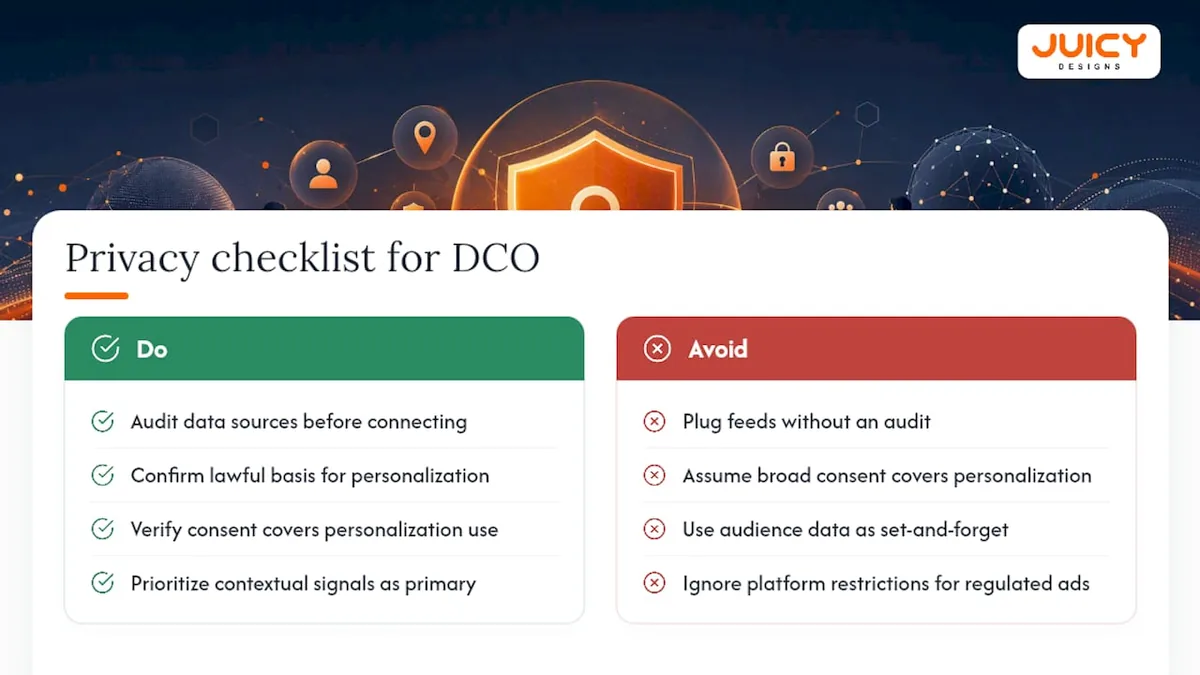
DCO depends on data to work, which means privacy compliance isn't optional; it's built into the setup. The system relies on first-party feeds, contextual signals, and sometimes audience data pulled from a CRM or pixel. Every one of those inputs falls under data protection law, and in South Africa that means the Protection of Personal Information Act (POPIA) governs how you collect, store, and use customer data for ad personalisation.
Practically, this means auditing your data sources before you plug them into a DCO platform. Confirm you have a lawful basis for using customer purchase history or browsing behaviour in ad targeting, and check that your consent mechanisms (cookie banners, opt-in forms) actually cover the personalisation use case, not just general marketing.
Platform-level compliance matters too. Meta and Google both require advertisers to declare special ad categories and restrict certain personalisation tactics for regulated verticals like housing, credit, and employment. If you're running DCO for any of those categories, expect reduced targeting options and stricter creative review.
The safest approach treats contextual signals (device, time, location) as your primary personalisation lever and treats first-party audience data as a secondary layer, reviewed regularly for compliance rather than set once and forgotten. A quarterly audit of your data feeds and consent records is a reasonable minimum cadence for any campaign running continuously.
Integration of DCO with broader marketing technology stacks
DCO doesn't work in isolation. It sits between your creative production tools and your media buying platforms, which means it needs clean handoffs on both sides. Your product feed, whether that's a Shopify catalogue, a CRM export, or a custom API, has to stay synced in near real time, or the ads will show outdated pricing or stock.
On the front end, DCO platforms typically pull from a digital asset management system or a shared component library, so your design team's output needs consistent file naming and metadata from the start. On the back end, performance data needs to flow into whatever reporting or business intelligence tool your team already uses, rather than living only inside the ad platform's native dashboard.
Attribution is the part most teams underestimate. If your DCO campaign runs across Meta, Google, and a third-party programmatic platform simultaneously, you need a consistent way to compare performance across all three, usually through a shared UTM structure or a marketing tag manager. Without that, you'll see three separate "winning" creatives with no way to judge which one actually drove the sale.
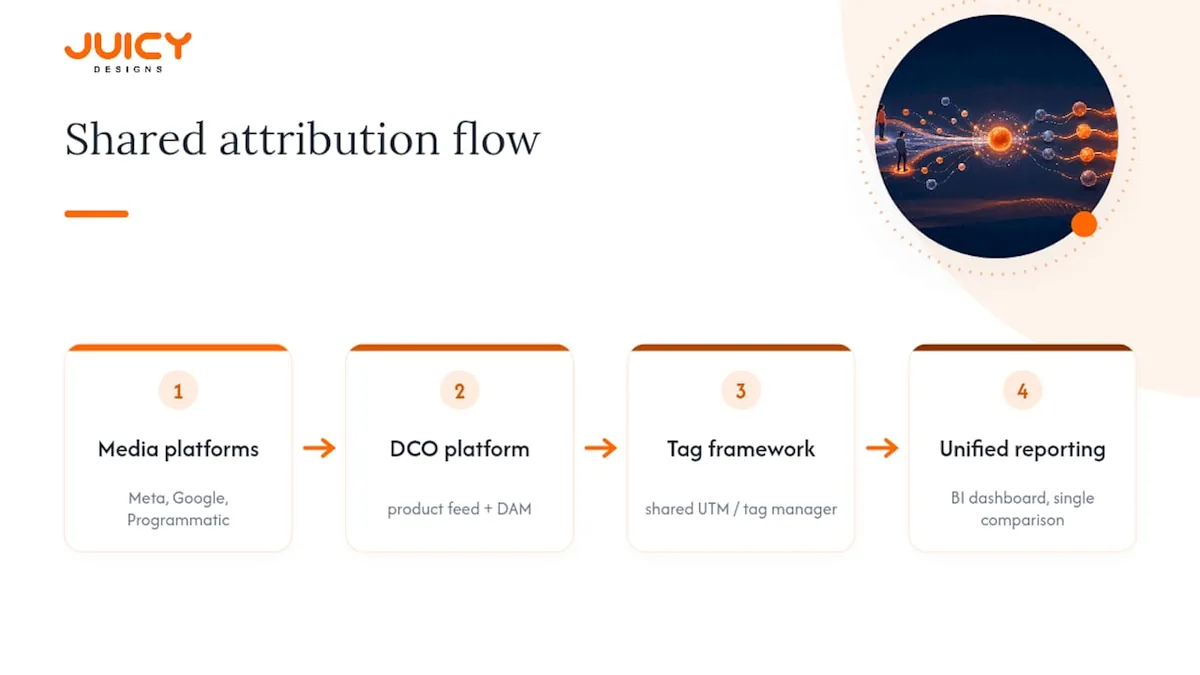
The practical takeaway: before you launch DCO, map exactly where your product data lives, how creative assets get approved and uploaded, and where performance data lands for reporting. Skipping that mapping step is the most common reason a technically sound DCO campaign still produces messy, hard-to-trust results.
Future trends and innovations in dynamic creative optimisation
Generative AI is changing how fast the component library itself gets built. Instead of a design team manually producing 15 image variants, AI-assisted creative tools can generate variations of a base image or headline in minutes, which shortens the production bottleneck that used to limit how ambitious a DCO campaign could be.
Decisioning is also getting smarter about what "context" means. Early DCO leaned on basic signals like device and location; newer systems increasingly factor in real-time intent signals, like recent site behaviour or weather-triggered demand, to personalise creative at a finer grain than before.
Expect closer integration between DCO and first-party data strategies as third-party cookie deprecation continues. Advertisers who've invested in clean CRM data and consented first-party audiences will have a real advantage over those relying on broad contextual targeting alone.
The other shift worth watching: DCO output is increasingly treated as creative intelligence rather than just a delivery mechanism. Element-level performance data (which headline, which image, which CTA won) is feeding back into brand creative strategy, not just media buying decisions. That closes a loop that used to be one-directional.
An editorial take on making DCO actually work
Most DCO advice treats it as a set-it-and-forget-it automation layer, and that's the part I'd push back on hardest. The research is clear that DCO performs best when it optimises within a proven creative concept, not when it's asked to discover one from scratch. Feed it weak, unvalidated creative ideas and it will very efficiently tell you that weak ideas don't work; it won't invent a good one for you.
The conventional advice also underweights budget discipline. Marketers get excited about combination counts and machine learning, then launch with a tenth of the spend needed to generate a reliable signal. That's not a DCO failure; it's a planning failure wearing a DCO label.
If I had to pick the one thing to prioritise first, it's the component library and tagging discipline, not the algorithm. A clean, well-tagged set of five headlines and five images will outperform a sloppy set of fifteen every time, because the system can only optimise what it can clearly distinguish. Treat DCO's element-level output as a feedback loop for your next creative brief, not just a live campaign lever, and you'll get more long-term value out of it than most case studies advertise.
, Cobus
Put DCO to work with a managed campaign partner
Running DCO well means juggling feeds, tagging, budget pacing, and weekly monitoring, on top of everything else on a marketing manager's plate. A managed campaign partner builds the component library, sets the tagging conventions, and manages the decisioning inputs so your campaigns hit a reliable learning window instead of stalling on a thin budget.
A typical DCO pilot through Juicydesigns starts with a scoped audit of your existing creative and feed setup, followed by a phased rollout with weekly reporting during the first month. Pricing depends on scope and channel mix, with flexible terms available and no long-term contracts. If you want a clear read on whether your current campaigns are ready for DCO, start with a free Google Ads audit or explore our managed Google Ads services to see how a founder-led team builds this out in practice.
Sources
- Dynamic creative optimisation - Wikipedia
- Dynamic Creative Optimisation (DCO): The Complete Guide to Programmatic Dynamic Advertising
- Dynamic Creative Optimisation Meta Ads, Full Guide 2026 | Wevion
- Dynamic Creative Optimisation (DCO): In Practice (2026) · Maino AI
FAQ
What is dynamic creative optimisation?
Dynamic creative optimisation is a system that automatically assembles ad creative from a template and a library of components, personalising each impression using contextual and first-party data.
How does DCO work?
It runs on a loop: collecting data, creating creative variants, assembling combinations automatically, and continuously shifting delivery towards the combinations that perform best against your chosen KPI.
Should I use dynamic creative in Meta ads?
If you have enough weekly audience volume and a set of at least 3 image and headline variants, Meta's Dynamic Creative feature is worth testing, particularly for prospecting and retargeting campaigns.
How do I set up dynamic product ads on Facebook?
You connect a product catalogue feed to Meta's ad platform, which then automatically pulls product images, pricing, and availability into ad templates matched to each viewer's browsing behaviour.
How long does DCO need to find a winning combination?
Most learning windows run 7 to 14 days, though this varies with audience size and budget; treat early results as directional rather than final.
Recommended
- How to Run a Remarketing Campaign for People Who Visited Your Site
- CRO Process: How to Run a Conversion Test
- How Long Does a Google Ads Campaign Take to Start Performing?
- AI Marketing Implementation Roadmap: 12-Week Plan
Related reading: Google Ads management, Facebook ads in South Africa, Conversion rate optimisation.