
Fix Low ROAS: A South African Diagnosis Guide
Low ROAS rarely has one cause. Work through tracking, margins, conversion rate, bids and creative in the right order, with rand-based examples for SA advertisers.
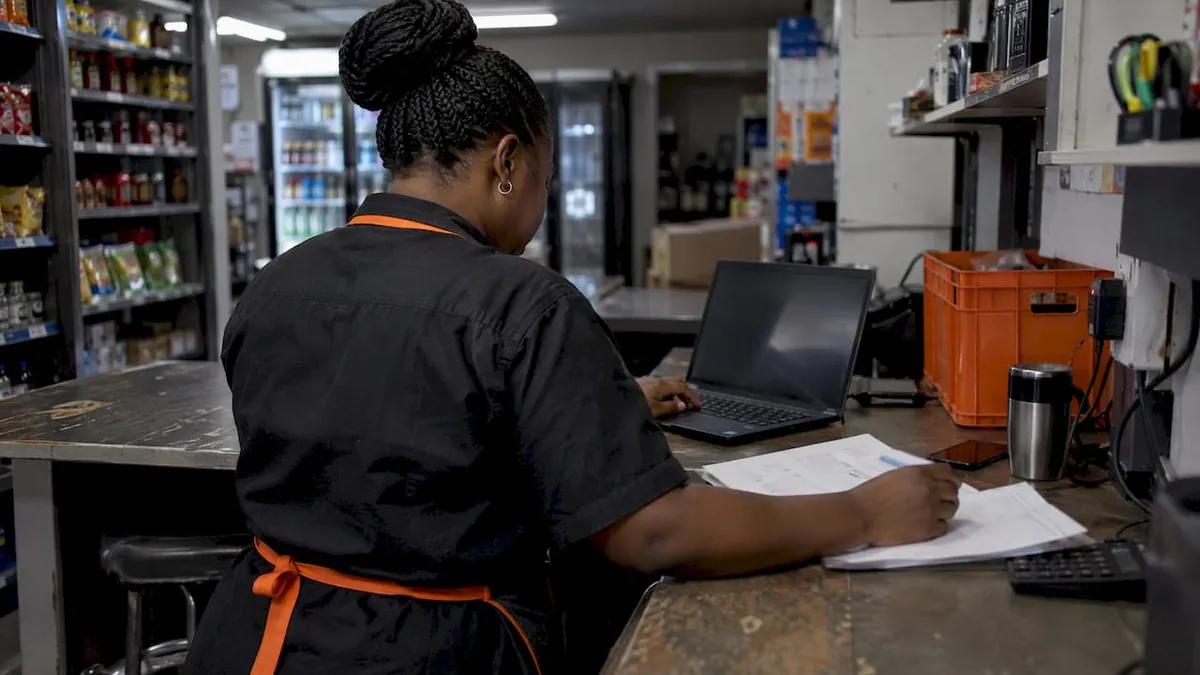
Fix Low ROAS: A South African Diagnosis Guide ! Shop owner reconciling advertising spend and sales To fix low ROAS, work in this order: confirm your tracking measures real revenue, check what ROAS you actually need to break even, then fix the funnel after the click, the campaign structure and the creative.


TL;DR: Quick Answer
Low ROAS rarely has one cause. Work through tracking, margins, conversion rate, bids and creative in the right order, with rand-based examples for SA advertisers.
Key takeaways
- Very cheap quotes (under R5,000) almost always exclude copywriting, SEO, custom design and post-launch support
- On-page SEO built into the website at launch costs a fraction of what it costs to retrofit after the site is live
- Hosting, SSL, domain and maintenance add R3,000-R10,000 per year on top of build cost
- E-commerce adds significant cost due to payment gateway integrations, product data, security requirements and checkout UX
- Timeline and client responsiveness directly affect cost: slow feedback rounds extend agency hours
To fix low ROAS, work in this order: confirm your tracking measures real revenue, check what ROAS you actually need to break even, then fix the funnel after the click, the campaign structure and the creative. Most advertisers do it backwards. They change bids and audiences first, and the real problem sits in the data or on the website.
This guide walks through that order with rand examples, so you can find out which of the five usual causes is costing you money.
TL;DR
- Check tracking first. If conversions and values are wrong, every optimisation decision is built on a bad number.
- Know your break-even ROAS. It is 1 divided by your profit margin. A 25% margin needs 4x just to cover ad spend.
- Fix the page before the ad. Doubling a landing page's conversion rate doubles ROAS without spending an extra rand.
- Change one thing at a time and give smart bidding enough conversion data to learn.
- Cut waste before you scale. Search terms, placements and audiences that never convert should go first.
What low ROAS actually means
ROAS (return on ad spend) is the revenue your ads generate divided by what you spent on them. Spend R20,000 and book R60,000 in sales, and your ROAS is 3x. If you want the basics in more depth, our plain-language guide to ROAS covers the definition and the formula.
The word "low" only means something against your own numbers. A 3x ROAS is excellent for a business with 60% margins and poor for one with 15%. Before you fix anything, work out what you need. Our guide to what counts as a good ROAS for Google Ads explains industry benchmarks, but your break-even point matters more than any benchmark.
Work out your break-even ROAS
Break-even ROAS = 1 ÷ profit margin (before ad spend).
| Gross margin | Break-even ROAS | Revenue needed from R10,000 ad spend |
|---|---|---|
| 60% | 1.7x | R16,700 |
| 40% | 2.5x | R25,000 |
| 25% | 4.0x | R40,000 |
| 15% | 6.7x | R66,700 |
This is straightforward arithmetic, not an industry statistic. Use your margin after cost of goods and delivery, but before advertising and overheads, then compare it to your reported ROAS. If you sit above break-even, you have a scaling question. If you sit below it, you have a repair job. Our article on how to tell whether your Google Ads ROAS is good goes through this check in more detail.
Step 1: Make sure you are measuring the right thing
This is where we start with every account, and it is the step most often skipped. Google's own guidance on value-based bidding says its AI optimises bids towards the value you tell it conversions are worth. If the value signal is noisy or incomplete, the system optimises for the faulty data. Setting a Target ROAS before tracking is accurate is one of the costliest mistakes in paid search.
Check these before touching anything else:
- Are the right actions counted as conversions? Google lets you choose what is valuable, such as a purchase, sign-up or phone call, as explained in its conversion measurement overview. If a page view or a button click counts as a conversion, your ROAS looks healthy while the tills stay quiet.
- Are values real? Conversion values let you see the total business value your ads generated rather than just a count. A flat value on every lead hides the difference between a R500 job and a R50,000 one.
- Is anything double counted? Two tags firing for the same sale inflates results and then collapses when you compare to bank deposits.
- Does ad-platform revenue match your books? Compare a month of reported conversion value with actual invoices. A gap of 20% or more means the tracking needs work.
For lead-based businesses the problem is sharper. A form fill is not revenue. A dealership that counts every enquiry the same sees a ROAS number that tells it nothing about which campaigns sell cars. The fix is to import offline outcomes, such as qualified lead, test drive booked or sale closed, with a rand value attached. We cover this sequence in improving Google Ads ROAS with measurement first.
Keep personal data rules in mind while you rebuild tracking. If you send customer details such as emails or phone numbers to ad platforms, South Africa's POPIA applies, so make sure your privacy notice and consent wording cover that use. Have your attorney or information officer confirm what your site needs.
Step 2: Find where the money leaks
Once the numbers are trustworthy, split the problem into three zones. Each has a different fix.
| Symptom | Likely zone | First place to look |
|---|---|---|
| Low click-through rate, high cost per click | Ad and targeting | Creative, keywords, audience |
| Good clicks, few enquiries or sales | Website and offer | Landing page, speed, price, trust |
| Good conversions, low order value | Merchandising and bidding | Product mix, value rules, bid targets |
Diagnosing before acting saves weeks. Changing three things at once leaves you with no idea which one worked.
Step 3: Fix what happens after the click
The cheapest ROAS gain is usually on your own website. If 1,000 visitors a month arrive and 1% buy, you get 10 sales. At 2% you get 20 sales from the same ad budget. Ad spend stays the same and revenue doubles, so ROAS doubles.
Common post-click problems we see on South African sites:
- Slow mobile pages. Many shoppers browse on phones, often on patchy mobile data. A heavy page loses them before it loads.
- A mismatch between ad and page. The ad promises a specific product or price and the page lands on a generic category or homepage.
- Hidden delivery costs or unclear pricing. Surprise shipping fees at checkout kill otherwise good sessions.
- No easy contact path. For services, dealerships and clinics, a visible WhatsApp button or phone number beats a long form.
- Weak trust signals. Reviews, a physical address, payment badges and clear return terms all lift conversion.
Start with your top three landing pages by spend. Open each on a phone, on mobile data, and try to buy or enquire as a stranger would. Note every point of friction. If the site itself is the bottleneck, a rebuild can pay for itself, and our web design pricing starts from R12,000 once off for the Starter option.
Step 4: Clean up campaign structure and bidding
After tracking and landing pages, look at how the account is built.
Remove obvious waste
Open the search terms report and sort by spend. Anything that has taken real budget and never converted is a candidate for a negative keyword. Common culprits are "free", "jobs", "DIY", competitor brand names you cannot serve and informational queries that bring readers rather than buyers. Check placements on Display and Performance Max for apps and sites that eat budget without value.
Give smart bidding enough data
Google's Target ROAS guidance describes a strategy that uses Smart Bidding to set bids for the conversion value you want. It can only learn from the conversions it sees. Google's dealer guidebook lists too many variables and not enough volume as reasons automated bidding struggles to optimise, which is why small budgets split across many campaigns often underperform.
Practical rules:
- Consolidate. Five campaigns with 8 conversions a month each teach the system less than one campaign with 40.
- Set a realistic target. If you jump from 2x to 6x overnight, delivery can drop sharply because the system cannot find enough traffic at that bar. Step the target up gradually from your actual recent ROAS.
- Start with maximise conversion value if you have little history, then add a target once results stabilise.
- Leave the system alone for a learning period after big changes. Constant tinkering resets it.
Our Google Ads bidding strategies guide for South Africa and the Target ROAS glossary entry explain how to choose between these options.
Separate brand from non-brand
Branded searches almost always convert well and flatter your average. If one campaign mixes them, a decent blended ROAS can hide a non-brand campaign that loses money. Report them separately so you know where growth actually comes from.
Step 5: Improve audiences and creative
Now the parts most guides lead with. They matter, but they work best on a clean foundation.
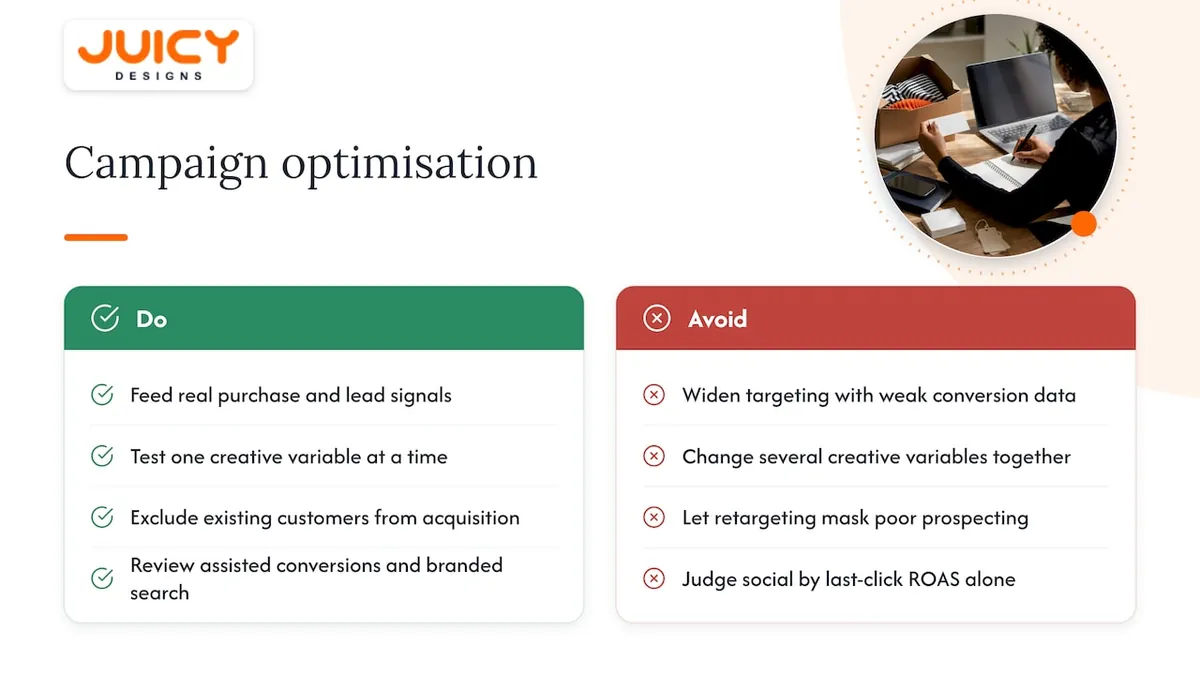
Audience. Broad targeting wastes spend if the system has weak conversion data, because it has nothing to learn from. Feed it real purchase and qualified-lead signals, then widen. On Meta and TikTok, exclude existing customers from acquisition campaigns and keep retargeting to a sensible share of budget so it does not mask poor prospecting.
Creative. Ads are your targeting on social platforms. Test one variable at a time: the hook in the first three seconds, the offer, the proof. Show the product in use, state the price or a clear reason to click, and include a specific next step. Fresh creative also fights ad fatigue, which shows up as rising frequency and falling click-through rate.
Offer. If margins allow, a clear incentive such as free installation, a bundle or a limited-time discount often moves ROAS more than a headline tweak.
Channel fit. Search captures people who already want what you sell. Social creates demand. Judging a social prospecting campaign by last-click ROAS alone will undervalue it, so look at assisted conversions and branded search growth too.
A worked example
Take a hypothetical retailer spending R30,000 a month on Google Ads with a 35% gross margin. Break-even ROAS is 2.9x. Reported ROAS is 2.4x, so the account loses money on paper.
- Tracking audit: two tags double count purchases on one product category. Corrected, true ROAS drops to 2.0x. That hurts, but now the number is honest.
- Search terms: R4,500 of spend went on irrelevant queries. Negatives remove that waste.
- Landing page: the top campaign sends traffic to a category page converting at 1.1%. A tighter product page and clear delivery information lift it to 1.6%.
- Bidding: three small campaigns merge into one, giving the algorithm enough data.
On the same budget, revenue climbs from R60,000 to roughly R93,000 if conversion improves by about 45% and the wasted R4,500 is redeployed. That is about 3.1x, comfortably above break-even. The figures are illustrative, not a promise, but the sequence is how real recoveries are built.
Our perspective
We see the same pattern again and again: businesses blame the platform when the issue is the foundation. Bids and audiences feel like the levers, so people pull them first. In practice, the biggest swings come from the unglamorous work of measuring revenue properly, matching ads to pages and removing spend that was never going to convert.
That is also why we work the way we do. At Juicy Designs you deal directly with the founders, with no account managers between you and the person adjusting your campaigns. Our clients' average ROAS is 4.8x, which we believe is nearly double the industry standard, and a premium Pretoria dealership group saw qualified leads rise 312% from a full-funnel programme across paid search, social, SEO and lead generation (see our portfolio). We also run with no long-term contracts, because if the numbers do not improve, you should be free to walk.
Our advice if your ROAS is low: do not pause everything in a panic and do not pour more budget in hoping scale fixes it. Audit, correct, then grow.
, Cobus
When to get a second pair of eyes
If you have worked through the steps above and results are still flat, an outside audit saves time. Our once-off Google Ads account audit starts from R3,500, and it covers tracking, structure, waste and bidding so you know exactly what to change. If you would rather have us run the account, Google Ads management starts at R6,000 per month on the Local plan, R15,000 on Competitive, and from R9,500 on Growth. A once-off setup starts from R4,500. You can also read about our Google Ads audit before you decide.
A 30-day recovery plan
Week 1: Measure. Audit conversion actions, remove duplicates, assign real values, and reconcile reported revenue with your bank statements. Calculate break-even ROAS.
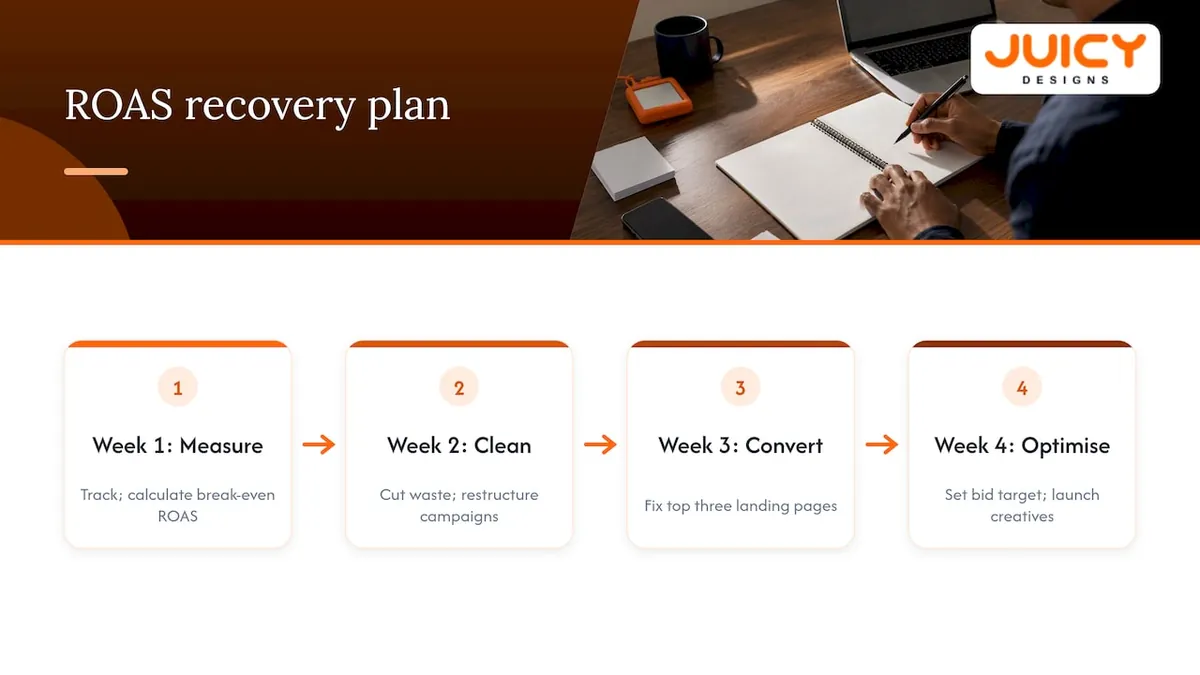
Week 2: Clean. Add negative keywords, exclude poor placements, separate brand from non-brand, and pause campaigns that have had fair spend and no results.
Week 3: Convert. Fix the top three landing pages: speed, message match, trust signals and a clear contact route. Test one change per page.
Week 4: Optimise. Consolidate thin campaigns, set a bid target a small step above your current ROAS, and launch two or three new creative variants. Then leave it alone long enough to read the results.
Repeat monthly. Each cycle should show a clearer picture and a steadier ROAS.
FAQ
Why is my ROAS so low?
The usual causes are inaccurate conversion tracking, a landing page that does not convert, wasted spend on irrelevant searches or placements, and bid targets that do not match your data volume. Check them in that order. Margins matter too: a ROAS that looks low may be fine if your margins are high.
Is a 2.8 ROAS good?
It depends on your margin. With a 35% gross margin, break-even is about 2.9x, so 2.8x loses a little money. With a 50% margin, break-even is 2x and 2.8x is profitable. Work out your own break-even point before judging any figure.
How long does it take to fix low ROAS?
Tracking and waste fixes can show results within two to four weeks. Smart bidding needs a learning period after changes, so give it time before judging. Landing page and creative tests usually need a few weeks of traffic to give a reliable read.
Should I increase my budget to improve ROAS?
Not until you are above break-even. More budget on a leaking account just loses money faster. Fix measurement and conversion first, then scale gradually while watching ROAS at each step.
Can I fix ROAS without an agency?
Yes, if you have time and are comfortable in the ad platforms. The steps above are a workable DIY plan. If tracking or account structure is beyond your comfort zone, a one-off audit is a cheaper starting point than a full retainer.
Sources
- Value-based bidding best practices, Google Ads Help
- About conversion measurement, Google Ads Help
- About conversion values, Google Ads Help
- About Target ROAS bidding, Google Ads Help
- Dealer guidebook, Think with Google
Recommended
- Improve Google Ads ROAS: Measurement First (2026)
- ROAS Explained for Small Business Owners
- What Is ROAS? A Plain-Language Guide for Business Owners
- Conversion Rate Optimisation (CRO): A Guide for SA Businesses