
Frequency Capping: Test 2-4 Weekly Awareness Exposures for Added Reach
Set caps by campaign goal, test awareness at 2-4 exposures a week, and use Added Reach to judge results across platforms with different counting rules.
Frequency Capping: Test 2-4 Weekly Awareness Exposures for Added Reach ! Media buyer adjusting ad frequency settings Set frequency caps by campaign objective, start with a tested range, and judge every cap by the unique reach and attention it adds rather than by a fixed number.


TL;DR: Quick Answer
Set caps by campaign goal, test awareness at 2-4 exposures a week, and use Added Reach to judge results across platforms with different counting rules.
Key takeaways
- Very cheap quotes (under R5,000) almost always exclude copywriting, SEO, custom design and post-launch support
- On-page SEO built into the website at launch costs a fraction of what it costs to retrofit after the site is live
- Hosting, SSL, domain and maintenance add R3,000-R10,000 per year on top of build cost
- E-commerce adds significant cost due to payment gateway integrations, product data, security requirements and checkout UX
- Timeline and client responsiveness directly affect cost: slow feedback rounds extend agency hours

Set frequency caps by campaign objective, start with a tested range, and judge every cap by the unique reach and attention it adds rather than by a fixed number. Keep in mind that viewability counting and identifier gaps change what a platform can actually enforce. Google, Meta and programmatic buys each count exposures differently, so tune your caps per platform.
TL;DR:
- Starting tests often use 2-4 weekly exposures for awareness, 1-3 for prospecting, and 3-8 for retargeting, then validate added reach.
- A small retargeting audience may not support a tight cap; lengthen the window or raise the limit if delivery falls short.
- Google Display counts only viewable impressions, while missing mobile or connected TV identifiers can prevent enforcement and make reported frequency misleading.
- Added Reach reports require a reporting period at least as long as the cap window; without a campaign cap, the widget reports zero.
- Test comparable audiences with creative, budget, and bidding held constant, then run the experiment through at least one full cap window before judging results.
What are the quick frequency capping best practices to apply today?
Use this section as a brief you can paste into a campaign plan. The ranges are starting points to test, not rules.
- Tie caps to the objective. Awareness, prospecting and retargeting each tolerate a different number of exposures.
- Prefer time-windowed caps. A cap per 7 days is easier to reason about than a lifetime cap.
- Rotate creative. A fresh message lets the same person see more ads without tuning out.
- Check viewability and identifiers first. A cap you cannot enforce is only a wish.
- Measure Added Reach before deciding. Never leave a cap in place without evidence that it helps.
Starting ranges to test:
- Awareness: 2-4 exposures per week.
- Prospecting: test a cap that introduces the message without overexposing people.
- Retargeting: test a cap that balances reminders with the risk of overexposure.
Run through these checks in order:
- Confirm the audience is large enough to absorb the cap without starving delivery.
- Watch pacing early, because a tight cap can show up as underspend.
- Relax the cap when added reach is flat and delivery is falling short.
- Tighten it when the same people appear in reports far more often than the plan intended.
What do the key frequency capping terms mean?
Frequency capping limits how many times one user (or device, or household) sees your ad in a set period. Frequency is the average number of exposures per person. Reach is the number of unique people you touch. Raising one tends to squeeze the other when budget is fixed, so a cap is really a decision about how to spread impressions across more people.
Two distinctions trip up many teams. An impression is an ad served. A viewable impression is an ad that had a real chance to be seen. On Google Display line items, only viewable impressions count towards caps, so other reports can show a higher frequency than your cap suggests.
A cool-off period is different from a cap. A cap limits total exposures in a window. A cool-off mandates a minimum gap between valid impressions, which is common in immersive and in-game inventory. Ignoring cool-offs creates gaps between expected and actual delivery.
A short glossary:
- Impression: one ad served to a screen.
- Viewable impression: an impression that met the platform's viewability standard.
- Recency window: the time period a cap applies to, such as a day, week or month.
- Added reach: the extra unique users you reach because a cap redirected impressions away from repeat viewers.
- Cookie: a browser identifier, increasingly limited.
- IFA: the advertising identifier on mobile and connected TV devices.
- PPID: a publisher-provided identifier that lets a publisher recognise a returning user.
If you want a short primer, our glossary entry on frequency capping covers the basics in a few lines.
Why does frequency capping matter for ROI and ad fatigue?
Show someone the same ad too often and attention drops. People start to scroll past it, a pattern often called banner blindness, and click-through and conversion rates slide while your cost per result climbs. The impressions still bill, but they stop doing any work.
The other side of the ledger is wasted reach. If a small group absorbs most of your impressions, large parts of your audience never see the message at all. A cap redistributes spend towards people who have seen the ad less often, which is how a well-set cap improves budget efficiency without adding budget.
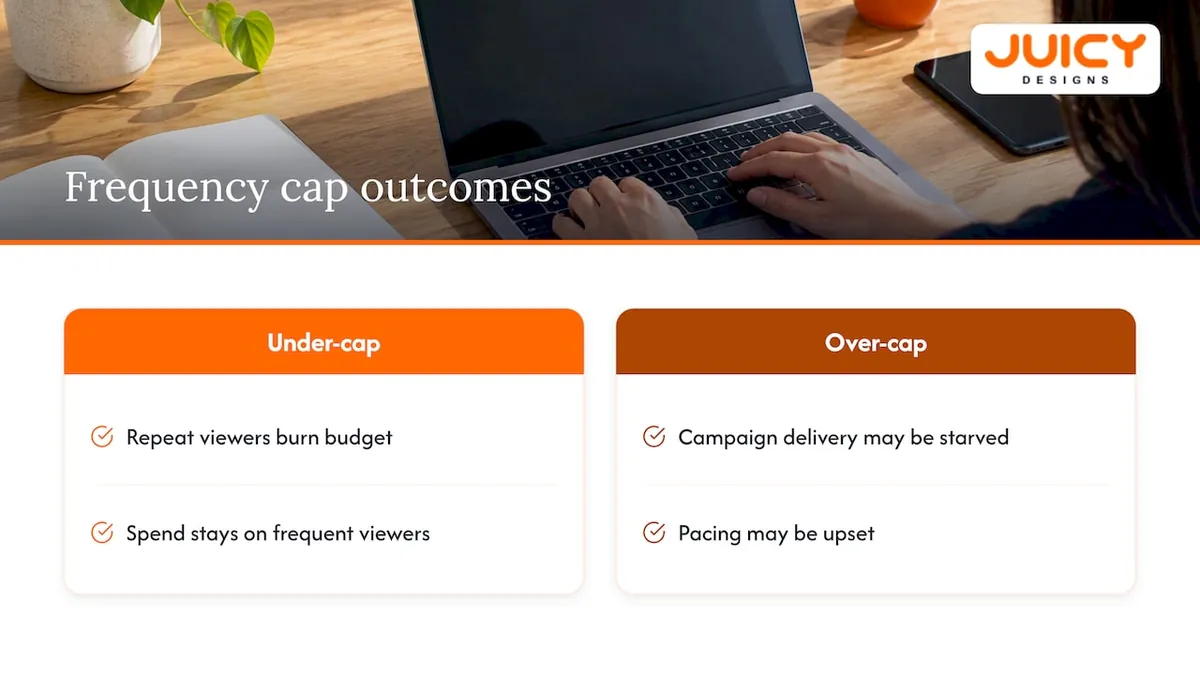
Here is the catch. The aim is balance, not the lowest possible frequency. Under-capping burns money on repeat viewers. Over-capping can starve a campaign of delivery and upset pacing. The industry guidance backs this nuance:
The IAB Attention Measurement Playbook advises using attention as one factor in a broader analysis rather than a binary filter, and warns against rigid thresholds. In practice, that means you read frequency alongside attention and outcome data instead of letting a single number decide.
Brand perception matters too. Repeated, irritating exposure can make a brand feel pushy, and that effect is hard to see in click data. Treat the user experience as a real cost, not a footnote, and tune caps with the person on the other side of the screen in mind.
How do platforms actually enforce frequency caps?
Enforcement is only as good as the signals a platform can read. Knowing the limits helps you set caps the ecosystem can deliver and measure.
- Viewability counting. On Google Display line items, only viewable impressions count towards a cap, as the Display & Video 360 reach and frequency guidance explains. Reports that include non-viewable impressions will show higher frequencies.
- Identifiers. Cookies are increasingly limited. On connected TV and in mobile apps, platforms rely on identifiers such as IFA or PPID. When those identifiers are missing, caps cannot be enforced, and impressions may be excluded or treated as unique.
- Frequency windows. You can usually cap by day, week or month. Display & Video 360 treats a "lifetime" cap as a period of three months. On YouTube, weekly target frequency is limited to 2-7 impressions and monthly to 4-12 impressions, per Google Ads guidance.
- Cross-device and household counting. One person on a phone, laptop and television can look like three people. Without deduplication, caps are applied per device and the real frequency per person runs higher than reported.
- Caching and pre-fetch. Cached or pre-fetched ads can register as separate impressions. Accurate exposure tracking is needed to tell repeat users from cached impressions, otherwise caps lose force and reach reports skew.
The practical lesson: set a cap you can verify. If your inventory is heavy on connected TV or in-app placements with weak identifier coverage, expect some leakage and plan your measurement around it.
How do you choose the right cap values?
Start from the objective, pick a window, then adjust for audience size and creative. Treat every number below as a hypothesis to test.
- Awareness: 2-4 exposures per week. You want broad reach, so keep the cap low and let new people in.
- Prospecting: test a cap that introduces the message without overexposing people. These users do not know you yet, so watch for signs of irritation.
- Retargeting: test a cap that balances reminders with the risk of overexposure. Warm audiences may tolerate more, but use fresh creative and monitor response.
- Retention: a looser cap over a longer window, such as a month, since existing customers respond to occasional reminders rather than a steady drumbeat.
Audience size changes the math. A narrow audience, such as a small remarketing list, cannot support a tight cap because there are not enough people to share the impressions. The campaign will underdeliver. In that case lengthen the window or raise the cap. The IAB cautions that rigid frequency thresholds can limit reach in narrow audiences. When you define who you are reaching, our notes on audience targeting can help you size the pool before you commit to a number.
Creative changes how much frequency is acceptable. A new, simple message can run at a higher frequency than a complex one that people need time to absorb. A familiar creative worn thin wants a lower cap or a swap.
Campaign length matters as well:
- Short promotions: use a tighter daily or weekly cap to cover as many people as possible before the offer ends.
- Evergreen campaigns: use weekly or monthly windows and lean on creative rotation to keep the message fresh over time.
Whatever you choose, write the reasoning down. A cap with a documented rationale is far easier to adjust later than one set by habit.
How do you measure caps and run valid tests?
Measurement is what turns a cap from a guess into a decision. Programmatic buyers consistently advise against setting a cap without active measurement. Added Reach reporting shows whether a cap increases unique reach. If the widget shows little effect, the cap is probably too high or the duration too short.
Pay attention to how the report is built. Added Reach measurement requires the report period to be at least as long as the cap's time period. If no campaign-level frequency is set, the widget reports zero. To improve added reach, reduce exposure limits or lengthen the cap duration.
A clean test follows these steps:
- Define one hypothesis, such as "a 3 per week cap will raise unique reach without hurting conversions."
- Split comparable audiences into a control group with no cap or your current cap, and a test group with the new cap.
- Fix the variables in advance (creative, budget, bid strategy) so you can attribute any change to the cap.
- Run the test long enough to cover at least one full cap window, and longer if volume is low.
- Compare added reach, viewability, CPM, CPA and an attention proxy, then decide.
Resist reading early results. Short tests on small samples throw up false positives, and stopping the moment a number looks good is the surest way to fool yourself.
Pro Tip: Match your reporting window to your cap window before you read any result, or the Added Reach figure will understate what the cap is doing.
Watch pacing as you go. Automation can struggle when a cap is too restrictive, so spend that drops sharply right after a change is a signal to relax the limit. Tie your outcome metrics to real conversions too, and our guide on conversion tracking shows how to set that up so CPA means something.
How do frequency caps differ across Google, Meta and Amazon?
The same cap behaves differently depending on where you set it.
- Google (Display & Video 360 and Google Ads). Display line items count viewable impressions towards caps, and the Added Reach widget reads against your campaign cap window. YouTube target frequency is limited to 2-7 weekly and 4-12 monthly impressions. Our Google Ads guide gives wider context for these settings.
- Meta. Caps behave inside the feed, where creative fatigue shows up quickly. Some practitioners use sequencing and creative-refresh heuristics, but treat them as ideas to test rather than platform rules. Set a cap, watch for rising cost per result and falling click-through, and refresh creative when they move.
- Amazon DSP and programmatic. Look at whether you are capping impressions or views, and use time-capping and dayparting options to spread exposure. Cross-environment buys inherit the identifier limits described earlier.
- Connected TV and in-app. Identifier availability decides what you can enforce. Where identifiers are absent, expect weaker caps and lean on measurement to see the real picture.
Always read the platform's own definition of an impression before you copy a setting from one tool to another.
How does creative rotation reduce the cost of higher frequency?
Good creative strategy lets you run more exposures without wearing people out. The aim is for each exposure to feel new or useful.
- Rotate creative on a schedule. Cycle several versions so the same person rarely sees the same ad twice in a row.
- Sequence the message. Move people from teaser to value to call to action rather than repeating one line.
- Match asset count to the segment. Larger audiences with high frequency need more variants; small, warm audiences can be served with two or three well-built ones.
- Refresh on signals. When click-through slips or cost per result rises, swap the creative instead of only lowering the cap.
Media planning research also points to sequencing formats over time to maximise brand lift, since the strength of a format affects how much frequency a campaign can carry.
Pro Tip: Plan your sequence as three short stories, teaser, then value, then call to action, and refresh each stage when performance signals show fatigue.
What is the step-by-step checklist for setting up caps?
Copy this into your media ops process.
- Validate inventory and identifiers: confirm which placements can enforce a cap, especially connected TV and in-app.
- Size the audience and apply viewability filters before choosing a number.
- Decide where the cap lives (campaign or line item) and choose a window and exposure limit tied to the objective.
- Align your reporting window with the cap window so Added Reach reads correctly.
- Set up a control group and agree a minimum reporting duration.
- Define trigger thresholds, for example a pacing drop or a rising CPA, that prompt a change.
- Monitor pacing, added reach, viewability, CPM and CPA through the first full window.
- Relax or tighten the cap based on the evidence, then log the change and the result for next time.
What have we learned from live campaigns?
Across the accounts we run, the pattern holds: measure before you change anything, and judge a cap by the added reach and attention it produces, not by how tidy the number looks. One possible approach is to loosen an over-tight cap on a narrow retargeting list to help restore delivery. The reverse also happens, when a loose cap on prospecting audiences let a small group soak up impressions. Your settings are worth testing rather than inheriting. If you would like a second pair of eyes on yours, we are glad to run an audit.
, Cobus
Want help testing frequency caps on your own campaigns?
We manage Google Ads and Display campaigns, and we can audit your frequency settings, pacing and reach so you know what your caps are really doing. Our Google Ads pricing page lists our monthly plans, including Growth from R9,500 per month, Local at R6,000 per month and Competitive at R15,000 per month. You can also explore a Google Ads audit and see where your frequency settings stand.
FAQ
What is a good frequency cap?
There is no single number, because the right cap depends on your objective, audience size and creative. As a starting point to test, many teams use 2-4 exposures per week for awareness, 1-3 for prospecting and 3-8 for retargeting. Validate any range with Added Reach reporting before you keep it.
What is the 3-2-2 method of Facebook ads?
Structuring and refreshing Meta creative this way is a practitioner approach, not a platform setting. Definitions vary, so treat it as a framework to test against your own results rather than a rule.
Can you set a frequency cap on Facebook ads?
Frequency control on Meta depends on the campaign objective and buying type, so options differ from one setup to another. Check the controls available in your own account, then watch cost per result and click-through to see when fatigue sets in.
What does frequency cap mean?
A frequency cap limits how many times one user, device or household can see your ad within a set period. It spreads impressions across more people and protects against ad fatigue. On Google Display, only viewable impressions count towards the cap.
Sources
Recommended
- Frequency Capping: Limit Ad Exposure Per User
- Frequency: Ad Exposure Per Person Explained
- Audience Targeting: Reach the Right People With Your Ads
- Email Cadence: Frequency and Timing for SA Campaigns