
Fix Measurement First: Performance Max strategy for South Africa
Improve Performance Max results in South Africa by fixing measurement, supplying diverse high-quality assets, and using patient bidding. Practical agency...
The fastest way to improve Performance Max results is to fix measurement, give the AI diverse high-quality assets, and avoid early aggressive bid or budget changes.


TL;DR: Quick Answer
Improve Performance Max results in South Africa by fixing measurement, supplying diverse high-quality assets, and using patient bidding. Practical agency...

The fastest way to improve Performance Max results is to fix measurement, give the AI diverse high-quality assets, and avoid early aggressive bid or budget changes. These three levers, measurement, creatives, and bidding, determine whether the algorithm learns your business or guesses at it. Expect a genuine learning period of 2 to 6 weeks before you judge results fairly.
TL;DR:
- Before launch, verify conversion tracking, remove duplicate actions, and use Maximise conversions until the primary action records at least 15 conversions in 30 days.
- Organise asset groups by service line or customer intent, and provide varied copy, three image ratios, and a video lasting 15 to 30 seconds.
- Google reports asset groups with Excellent Ad Strength average roughly 6% more conversions; replace weak assets one at a time after a reporting cycle.
- Wait 2 to 6 weeks before major changes, then test one variable at a time and allow two full conversion cycles before judging results.
- Keep final URL expansion on when any relevant page can convert, but turn it off when leads must reach a specific form or booking page.
What a performance-first Performance Max strategy looks like
Performance Max rewards advertisers who feed it clean inputs rather than those who fiddle with knobs. The system pulls from your conversion data, creative assets, and audience signals to bid across Search, Display, YouTube, Discover, Gmail, and Maps simultaneously. When those inputs are weak, no amount of manual adjustment fixes the output.
Your first real decision is the campaign objective: are you chasing lead volume or lead value? That choice shapes your bid strategy from day one. A dealership wanting more enquiries might start with Maximise conversions, while a business with a defined deal value should work towards Maximise conversion value once there is enough data.
Asset groups should mirror how your business actually sells, not how your spreadsheet is organised. A strong structure looks like this:
- One asset group per core service line or product category, not per individual SKU.
- Separate groups when customer intent clearly differs (for example, "emergency plumbing" versus "bathroom renovations").
- A shared group for broad brand assets when your catalogue is too small to split meaningfully.
Feed the right structure and the automation has something real to optimise against.
Pre-launch measurement and account hygiene checklist
Before you spend a single rand on Performance Max, get the plumbing right. Conversion data is the single biggest lever in the system, and best practices for lead generation make accurate tracking the first item on the list, ahead of creative or bidding decisions.
- Verify conversion tracking fires correctly and assign realistic conversion values, using server-side tagging or GA4 where it suits your setup.
- Confirm you have a primary conversion action with enough recent volume before switching to target ROAS; otherwise, run on Maximise conversions.
- Link Google Business Profile or Merchant Center where relevant, and set URL tracking templates at the asset group level so reporting stays clean.
- Remove duplicate or conflicting conversion actions that could confuse the bid strategy.
- Set up call and form tracking if leads come through phone or enquiry forms, not just purchases.
At least 15 conversions on your primary action in the last 30 days is a sensible threshold before moving to target ROAS bidding, as recommended in Google's lead gen best practices; below that, Maximise conversions gives the system a steadier base to learn from.
Skip this checklist and every later optimisation decision rests on shaky data.
Asset group design and creative best practices
Group assets by what a customer is actually trying to do, not by internal product codes. A tyre retailer might run one asset group for "passenger tyres" and another for "fleet and commercial tyres" rather than twenty groups split by brand.
Variety inside each group matters more than polish on any single asset. Google's creative playbook for Performance Max recommends supplying:
- Multiple headlines and descriptions written for different angles (price, speed, trust, urgency).
- Images across 1:1, 1.91:1, and 4:5 ratios so the system can fill Display, Discover, and Gmail inventory properly.
- At least one video between 15 and 30 seconds per asset group, since missing video limits where your ads can show.
- A mix of lifestyle and product-focused imagery rather than one repeated shot.
Aim for an Excellent Ad Strength rating on every asset group. Google reports that advertisers reaching Excellent see roughly 6% more conversions on average compared with weaker ratings, which is a meaningful gap for no extra spend.
Once live, use the asset and combination reports to see which headlines and images actually get served together, then replace the weakest performers rather than the whole group.
Pro Tip: Swap one underperforming asset at a time and wait a full reporting cycle before judging the change.
Practical bidding and budget rules
Start simple. New Performance Max campaigns generally do better on Maximise conversions or Maximise conversion value, with target ROAS or target CPA introduced only once there is sufficient conversion volume and stable performance to support it, a point also covered in our guide to Google Ads bidding strategies. Setting a tight target too early starves the algorithm of room to explore.
If you do move to target ROAS, start loose and tighten gradually over several weeks rather than locking in an ambitious number from day one.
Budget math works the same way it does for any Google Ads campaign, and it is worth understanding before you set a daily figure, as we explain in our piece on setting a Google Ads budget. Google calculates your maximum monthly spend as your average daily budget multiplied by 30.4, and it may spend up to double your daily budget on a strong day, though your monthly total will never exceed that cap.
Which reports to use and how to interpret asset-level metrics
Performance Max gives you three layers of reporting: asset group, individual asset, and asset association (combination) reports. Each shows a different slice of the picture, and conversion metrics are now built into all three.
- Asset group reports show overall performance per group, your best starting point for spotting a weak segment.
- Individual asset reports rate each headline, image, or video on relative performance, but ratings here are directional, not precise CPA figures.
- Combination reports reveal which assets actually got served together and converted, which matters more than any single asset's isolated score.
Judge performance at the campaign level first. An asset showing zero recorded conversions may still be contributing to a winning combination elsewhere, since attribution across assets in Performance Max does not split credit evenly. When you do dig into creative iteration, prioritise conversion value and value per conversion over raw click counts, since those numbers tell you which assets are actually worth the spend.
When and how to run controlled optimisations and experiments
Patience is a strategy, not a lack of one. Ramp-up guidance from Google suggests allowing at least 2 to 6 weeks before making major decisions, stretching towards the longer end for lower-volume accounts where the system needs more time to find patterns.
- Hold off on bid, budget, and targeting changes during the first few weeks; small creative swaps are fine.
- Build any test around a single hypothesis and a single variable, whether that is a new bid strategy, a budget increase, or a creative refresh.
- Size your test for a real result: a 10% budget nudge on a tiny account will not produce a readable signal.
- Use geo holdouts or incrementality tests when you want to measure true lift rather than assumed lift.
- Wait for at least two full conversion cycles after any significant change before reading the outcome, a guideline echoed in Google's smart bidding advice.
Think in terms of marginal return rather than total spend: does the next rand of budget bring in a worthwhile extra conversion, or are you just paying for reach you already had? Changing your bid strategy, budget, and targeting all in the same week makes it impossible to know which change caused what.
Pro Tip: Keep a simple change log with dates, so a dip three weeks later does not get blamed on the wrong adjustment.
Agency perspective: how Juicy Designs implements Performance Max at scale
We run Performance Max the same disciplined way for every client: tracking first, creative diversity second, patient bidding third. Juicy Designs clients average a 4.8x return on ad spend, nearly double the industry standard.
- Our founders handle strategy and bidding decisions directly, with no account manager layer between you and the person making the call.
- A dedicated creative resource builds the asset variety each group needs, from copy angles to video.
- Reporting runs on a fixed cycle so changes are judged against full conversion cycles, not gut feel.
Negative keywords, final URL expansion, and placement exclusions
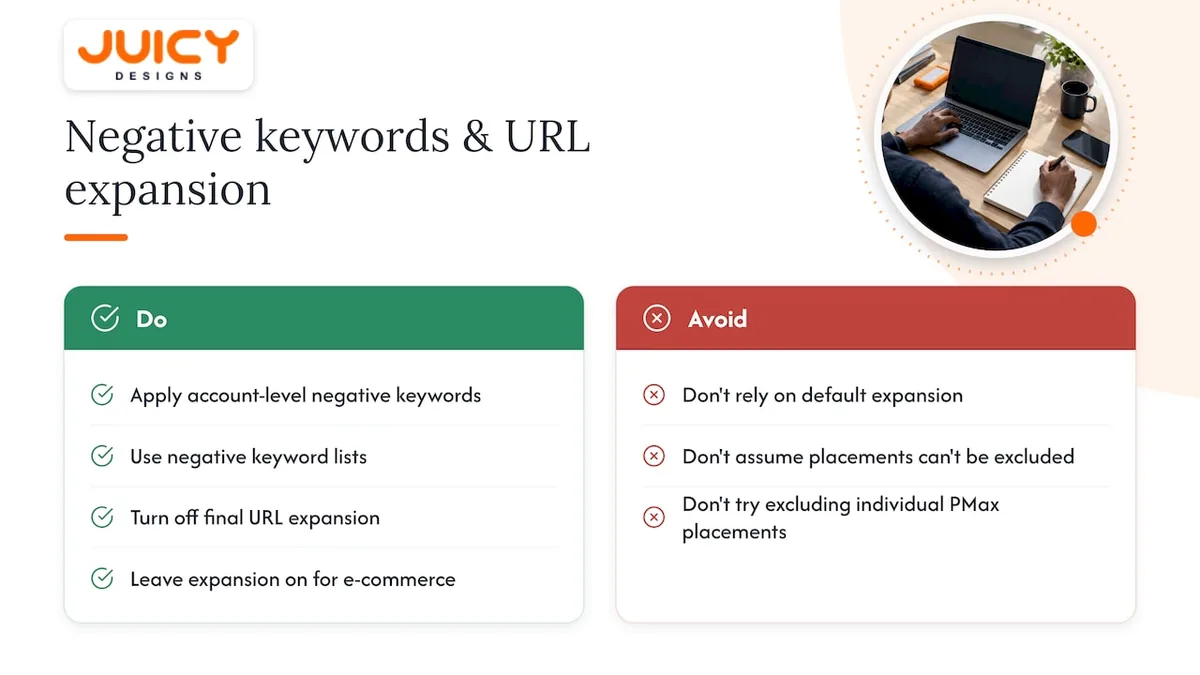
Performance Max gives you less exclusion control than Search campaigns, but you are not flying blind. You can apply account-level negative keywords through a request to your Google representative or via the negative keyword list feature, useful for blocking irrelevant queries that slip through, like a plumbing business avoiding "plumbing courses" traffic.
Final URL expansion lets Google send traffic to any page on your site it judges relevant, even ones outside your specified landing pages. This can genuinely extend reach, but Google itself notes it may also serve ads against pages with weak conversion paths. If landing page relevance matters more to you than raw reach, for example when every enquiry needs to land on a specific quote form, turn expansion off at the asset group level rather than leaving it on by default.
Placement exclusions work differently here than in Display campaigns. You cannot exclude individual placements inside Performance Max the way you can in a standard Display campaign; instead, you manage this through account-level brand safety settings and content exclusions available in campaign settings. If you are seeing your ads on placements that clash with your brand, check these settings before assuming nothing can be done.
A sensible default: leave final URL expansion on for e-commerce or broad lead gen where any relevant page can convert, and switch it off for campaigns built around one specific action, like booking a consultation.
Integration with Google Analytics and audiences
Performance Max performs better when it can see more than just your Google Ads conversion data. Linking Google Analytics (GA4) gives you a second, more detailed view of what happens after the click, useful for spotting whether a conversion action is actually predictive of revenue or just of form fills with no follow-through.
Import GA4 conversions or audiences into Google Ads where your business goal (say, a completed purchase or qualified lead) is tracked more reliably in Analytics than in native Ads tracking. This matters most for businesses with multi-step funnels, where the Ads pixel alone might miss context Analytics captures, like time on site or pages per session before converting.
Audiences built in GA4, whether based on past purchasers, cart abandoners, or high-engagement visitors, can feed into Performance Max as audience signals. This does not restrict who sees your ads; it gives the algorithm a starting hint about the kind of person likely to convert, which speeds up how quickly the system finds a pattern.
If your GA4 setup is still basic, prioritise fixing event tracking there before investing heavily in audience signal strategy. A refined audience signal built on messy underlying data will not outperform a simple one built on clean data.
Best practices for audience signals and audience targeting
Audience signals are a hint, not a filter. Performance Max will still show ads outside your signal if the algorithm finds a converting opportunity there, so treat signals as a head start rather than a restriction.
Good signal sources include:
- Existing customer lists uploaded as customer match audiences.
- Website visitors and past converters pulled from your tracking setup.
- In-market and affinity segments that genuinely match your buyer, not broad demographic guesses.
Keep signals broad enough that the algorithm still has room to find new buyers; an overly narrow signal can act like a soft cap on scale, which Google's lead gen guidance specifically warns against. Layering five highly specific audiences rarely beats one or two well-chosen ones.
Refresh your signals periodically, especially after a few months of live conversion data, since the system will have learned real buyer patterns you can now describe more precisely than you could at launch.
Common pitfalls and troubleshooting tips
Most Performance Max disappointments trace back to one of a handful of repeated mistakes.
Changing settings too early. Adjusting budget, bids, and audience signals in the same week as launch resets the learning process and leaves you with no clean data to judge anything by.
Weak or sparse creative. A single headline variant and one image rarely earns an Excellent Ad Strength rating, and that gap costs conversions, not just ambiance.
Treating tracked clicks as conversions. If your conversion action fires on a thank-you page that loads regardless of whether the enquiry was genuine, the algorithm optimises for noise, not revenue.
Ignoring the combination report. Looking only at asset group totals hides which specific pairings of headline and image are doing the real work.
Panicking during the ramp-up window. A rough first ten days is normal; pulling the plug before 2 to 6 weeks of data denies the system the time it needs to settle.
If performance genuinely stalls past that window, check tracking accuracy first, creative variety second, and bid strategy third, in that order, since fixing the wrong layer first wastes the time you already invested.
Differences between Performance Max and other Google Ads campaign types
Performance Max is not a replacement for every other campaign type, even though it can run across the same inventory. A Search campaign gives you tight control over which keywords trigger your ad and lets you write ad copy for a specific query; Performance Max has no keyword-level control at all, relying instead on signals and automation.
Display and Demand Gen campaigns let you target specific placements or audience segments with more precision than Performance Max allows, useful when brand safety or exact placement matters more than reach. Shopping campaigns, now largely folded into Performance Max for most retailers, still exist in standard form for advertisers who want manual control over product groups and bids rather than full automation.
The practical difference comes down to control versus reach. Choose Search when you need to own specific queries. Choose Performance Max when you want one campaign to find conversions across Search, Display, YouTube, Discover, Gmail, and Maps without managing each channel separately, as we cover in more detail in our breakdown of Search, Display, Performance Max and Shopping campaigns.
Many accounts run both: Performance Max for broad discovery and incremental reach, alongside a tightly controlled Search campaign for branded terms or high-intent keywords the business cannot afford to lose to automation.

Optimisation techniques beyond bid and budget adjustments
Bid and budget changes get most of the attention, but several other levers move performance without touching either one.
Landing page quality is one of the most overlooked factors. A fast, relevant page that matches ad messaging improves conversion rate regardless of how much traffic Performance Max sends it, and tools like session replay and funnel analysis from LiveSession can help you spot exactly where visitors drop off before they convert.
Micro-conversions deserve attention in low-volume accounts. If your primary conversion action (a completed sale, say) does not generate enough volume monthly, consider optimising towards a proxy action first, like an added-to-cart event or a multi-field form start, to give the algorithm usable data sooner, then migrate back to the primary goal once volume allows.
Seasonal asset refreshes keep Ad Strength high and prevent creative fatigue, particularly in accounts running the same images for months. Audience signal refreshes, done quarterly rather than constantly, let the system incorporate newer buyer patterns without destabilising a working campaign.
Finally, review search terms and placement insights (where available) even though Performance Max limits direct exclusions, since the data still tells you whether your signals and assets are attracting the right kind of attention.
When to rely on Performance Max and when to pair it with other channels
Performance Max earns its place when you want scale and cross-channel reach without managing five campaign types separately. Pair it with Search or Demand Gen when you need tight control over specific intent, and consider restricting final URL expansion or adding brand exclusions once your own branded traffic is strong enough to protect.
, Cobus
How Juicy Designs can help: audit and managed options
Getting Performance Max tracking, creative, and bidding right takes real time, which is exactly the gap we close for clients who would rather run their business than their ad account. We offer a free Google Ads audit to review your current setup before committing to anything.
Our Google Ads management packages are founder-led, with no long-term contract and pricing from our Google Ads packages, starting at R6,000 per month for the Local plan. Request an audit and we will show you where your account stands against the practices covered here.
FAQ
Is Performance Max worth it?
Performance Max is worth it when you can supply accurate conversion tracking and varied creative assets, since the system's output depends directly on the quality of those inputs. It tends to underdeliver for advertisers who launch with thin assets or unreliable conversion data and then judge results within days rather than weeks.
How does Performance Max work?
Performance Max uses your conversion data, creative assets, and audience signals to bid and serve ads automatically across Search, Display, YouTube, Discover, Gmail, and Maps from a single campaign. It relies on machine learning rather than manual keyword or placement selection, which is why clean conversion tracking and quality assets matter more here than in traditional campaign types.
What is the 3-3-3 rule for marketing?
Definitions of the 3-3-3 rule vary across marketing disciplines, and it is not a term defined in official Performance Max documentation. For Performance Max specifically, the more relevant guidance is the 2 to 6 week learning period before major evaluation, rather than any fixed 3-3-3 framework.
What is the best practice to follow when creating a Performance Max campaign?
The single most important best practice is setting up accurate conversion tracking before launch, since Google's own lead generation guidance places this ahead of creative and bidding decisions. Pair that with diverse, high-quality assets per group and allow a genuine learning period before making changes.
Sources
- Performance Max best practices for lead generation - Google Ads Help
- Creative in Performance Max playbook (Think with Google)
Recommended
- What Is Performance Max? A Plain Guide for SA Businesses
- How to Measure Digital Marketing ROI and Key Metrics
- How to Measure Social Media ROI in South Africa