
Tools of advertising for small businesses: what to use and when
Discover effective tools of advertising for small businesses. Learn how to choose and use them to reach your audience and boost sales.
Tools of advertising are the platforms, software, and creative systems businesses use to reach audiences, build ads, and convert attention into sales.


TL;DR: Quick Answer
Discover effective tools of advertising for small businesses. Learn how to choose and use them to reach your audience and boost sales.
Tools of advertising are the platforms, software, and creative systems businesses use to reach audiences, build ads, and convert attention into sales. That covers everything from Google Ads to a design app like Canva to the analytics dashboard that tells you what actually worked.
The main categories are:
- Adtech and programmatic (where machines buy and optimise at scale)
If you're starting from zero, run a small pilot: pick one search or social ad platform, pair it with basic analytics, and test before you scale.
Key Takeaways
Effective advertising combines platform spend, creative production, research, and measurement into one connected system rather than isolated tools bought in a vacuum.
| Point | Details |
|---|---|
| Start with a pilot | Test one ad platform plus basic analytics before adding more tools to the stack. |
| Match tools to sales cycle | Short cycles favour social and search; long cycles benefit from an omnichannel mix. |
| Connect leads to CRM | Sync ad conversions into a CRM like HubSpot for accurate cost-per-acquisition tracking. |
| Budget realistically | South African small-business pilots typically run R3,000 to R8,000 per month. |
| Consider expert management | Juicydesigns manages advertising stacks for South African businesses, achieving ROAS results above typical industry benchmarks. |
What each category of advertising tools covers
Each category solves a different problem in the campaign process, and understanding the split helps you avoid buying overlapping software.
- Ad platforms sell you the actual placement, think Google Ads, Meta Ads, or TikTok Ads.
- Creative tools build what goes in that placement, from static banners to short-form video.
- Research and planning tools tell you who to target and what they're searching for.
- Adtech and programmatic platforms automate the buying and bidding process across networks.
- Campaign management tools keep everything scheduled, synced, and reported in one place.
Names you'll meet repeatedly through this guide include Google Ads, Meta Ads, Ahrefs, Canva, The Trade Desk, and GA4. The adtech sector alone is forecast to reach $1,264.39 billion by 2030, growing at roughly 9.8% a year, largely because AI targeting and connected TV are pulling more spend into automated systems. Most businesses add a new tool only once a gap in reporting or targeting starts costing them money, not before.
Which ad platforms should you use to buy placements?
Google Ads remains the strongest option for capturing people who are already searching for a solution, particularly through Search and Performance Max campaigns that automate bidding across formats. Meta Ads (Facebook and Instagram) works best for discovery, where you're introducing a product to someone who wasn't actively looking for it. TikTok Ads suits younger, visually driven audiences, while YouTube and connected TV options extend reach for brand awareness at a larger scale. Retail media networks are worth watching too, particularly if your customers research products before buying on marketplace-style sites.
When choosing between them, look at:
- Audience match, does this platform's user base overlap with your customers?
- Bidding transparency, can you see and adjust cost-per-click or cost-per-action controls?
- Minimum viable budget, some platforms need more daily spend before their algorithms optimise properly.
For a small South African business, a realistic starting budget sits around R3,000 to R8,000 per month per platform, enough to gather meaningful data without overcommitting.
Pro Tip: Run your first two weeks on manual or "maximise clicks" bidding before switching to automated bid strategies. The algorithm needs conversion data to work well, and jumping to automation too early wastes budget while it learns.
Which creative tools speed up ad production?
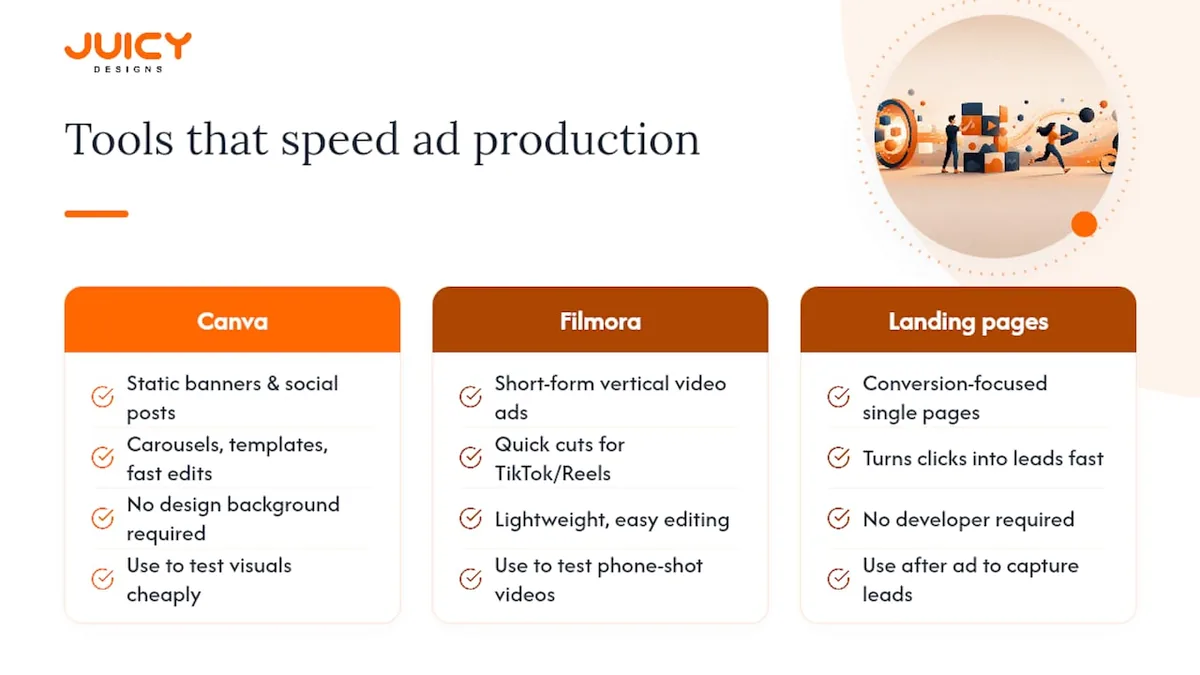
Canva handles static design work well, banner ads, carousel graphics, and social posts, without needing a design background. Filmora and similar lightweight video editors let you cut short-form ads quickly, which matters since platforms like TikTok and Reels favour vertical, fast-paced formats. Landing-page builders speed up the step after the click, turning ad traffic into leads without waiting on a developer.
A few creative rules hold across almost every platform: match the native aspect ratio (usually 9:16 for social video), hook viewers in the first three seconds, and never bury your call to action at the end of a fifteen-second clip.
Custom production still beats templates when brand consistency or a premium product justifies the cost. For everything else, templated tools get you testing faster.
Pro Tip: Before commissioning expensive video, test three cheap variations, a static image, a Canva-built carousel, and a 10-second phone-shot clip, to see which format your audience actually responds to.
What tools help you research and plan campaigns?
Ahrefs and SEMrush handle keyword and competitor research, showing you search volume, competitor ad copy, and gaps in your own targeting. Audience insight tools inside ad platforms themselves, alongside your own first-party analytics, round out the picture of who's actually converting.
A practical planning workflow looks like this:
- Identify keywords and search intent with a tool like Ahrefs.
- Break your audience into two or three segments based on need or buying stage.
- Write creative hooks for each segment separately.
- Assign each segment to the channel where it's most active.
Small budgets mean smaller sample sizes, so test one variable at a time (a headline, an audience, a bid strategy) rather than overhauling a whole campaign at once. Roll out only what a small test has already proven works.
What are DSPs, SSPs, and programmatic platforms?
Adtech is the umbrella term for the software that plans, buys, delivers, and measures digital ads at scale. Demand-side platforms (DSPs) let advertisers buy inventory across many publishers at once; supply-side platforms (SSPs) let publishers sell that inventory; data management platforms (DMPs) organise the audience data behind the targeting. The Trade Desk is a commonly cited example of a DSP, useful as a category reference even if you never touch it directly.
Most small businesses don't need programmatic buying on day one. It earns its place once you're running cross-channel campaigns and need centralised frequency control, or once you want to extend a proven audience to new placements without manually rebuilding campaigns on each platform.
How do you manage and automate advertising campaigns?
Social schedulers keep your organic and paid content calendars in sync, while email platforms like Mailchimp nurture leads that aren't ready to buy yet. CRM tools like HubSpot connect ad clicks to actual sales conversations, which matters more than most advertisers realise.
Online leads go cold fast, research from Harvard Business Review found that response speed dramatically affects conversion rates, so mapping your ad platform's leads directly into a CRM isn't optional if you want accurate cost-per-acquisition numbers. Automation is valuable for repetitive tasks like reporting or lead routing, but it becomes a liability when it masks a genuinely underperforming campaign behind a tidy dashboard.
Which metrics actually tell you if ads are working?
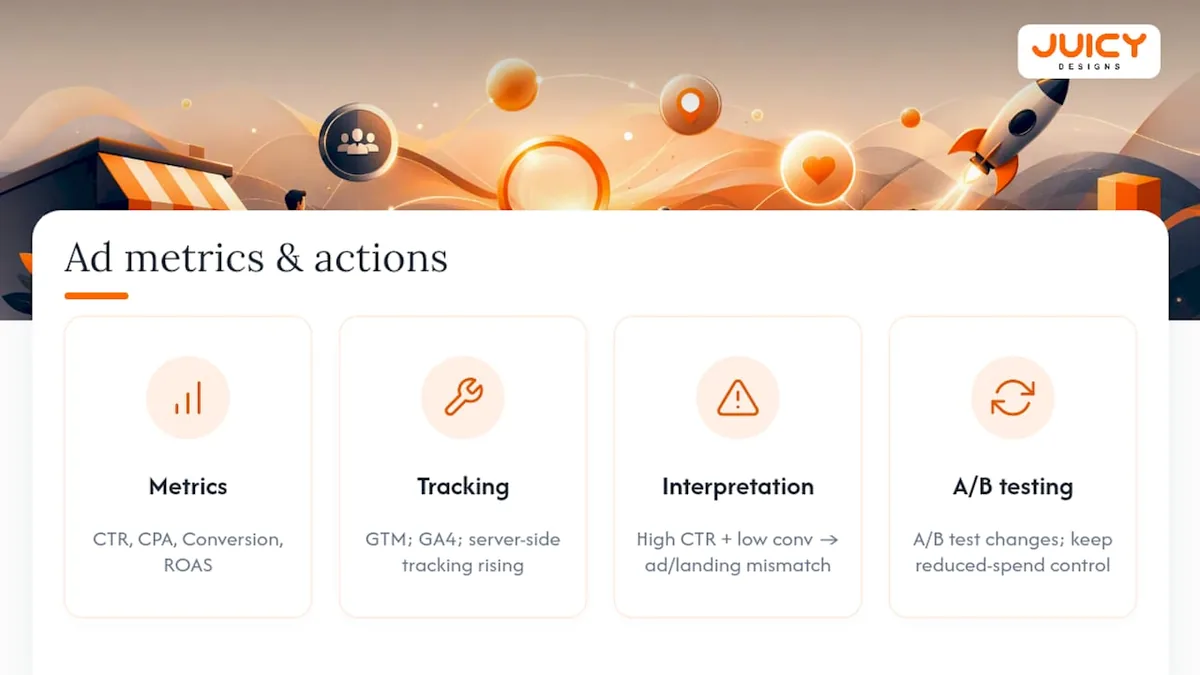
Click-through rate (CTR), cost per acquisition (CPA), conversion rate, and return on ad spend (ROAS) form the core measurement stack. Google Tag Manager handles the technical tracking setup, while GA4 pulls that data into reports you can act on. Server-side tracking is becoming more relevant as browsers restrict third-party cookies, so it's worth understanding even if you're not implementing it yet.
No single metric tells the full story. A high CTR with a low conversion rate usually points to a mismatch between your ad promise and your landing page. A strong ROAS with a shrinking audience pool suggests you're due for creative refresh, not more budget.
AI-automated ad platforms are becoming the default rather than the exception for small businesses. SMB digital ad spend on AI-driven platforms is climbing because these systems let smaller teams optimise for actual conversions instead of guessing at manual bid adjustments.
Pro Tip: Run every meaningful ad change as an A/B test, not a full swap. Keep your control version live at reduced spend so you have a fair comparison instead of guessing whether a dip in performance was the change or just a slow week.
How do you choose the right mix of advertising tools?
Match your tool stack to your business size and sales cycle rather than chasing every new platform. A business with a short sales cycle (retail, food and beverage) usually gets more from social and search platforms with fast creative testing. A business with a longer cycle (professional services, insurance) benefits more from an omnichannel approach, search to capture intent, social to build awareness over time, rather than concentrating spend on one channel.
A simple checklist for choosing tools:
- What's your primary sales cycle length?
- Which platform does your audience already use daily?
- Does the tool integrate with your existing CRM or analytics?
- Is the pricing model (flat fee, percentage of spend, or per-seat) sustainable at your budget?
For a South African small business, a typical pilot budget covers platform spend and tool subscriptions at a moderate monthly level. Run it for 30 to 60 days, pick one primary metric (usually CPA or ROAS), and set a clear rule upfront: scale if the metric beats your target by a defined margin, pause if it doesn't after a full budget cycle.
How do agencies combine these tools for measurable results?
A typical agency workflow runs research, then creative, then launch, then daily bid and budget automation, then weekly optimisation, then monthly reporting back to the client. Clients get founder-level access throughout, with month-to-month contracts and no lock-in periods.
A note from Cobus
I've watched businesses buy five tools when two would've done the job. Start narrow, prove the pilot with real numbers, and only add complexity once a specific gap in reporting or targeting is actually costing you money. That's the same principle we apply with every South African client at Juicydesigns.
How Juicydesigns turns tool choice into campaign results
Picking the right platforms is only half the battle. Juicydesigns runs the research, creative, and optimisation loop for you, so you're not learning Google Ads bidding strategy or GA4 attribution models on the side while running your business. Pricing stays flexible, with no long-term contracts, and every client works directly with the founders rather than through a rotating account team. If you want a Google Ads account built and managed properly from week one, visit the Google Ads management page to see what a founder-led setup looks like and get a quote.
Sources
- Adtech Global Market Report - The Business Research Company
- How adtech platforms are changing the game for small businesses - iPromote
FAQ
What Are the 5 Main Marketing Tools?
The five most commonly cited categories are ad platforms, creative tools, research and planning tools, adtech/programmatic platforms, and analytics tools, each covering a different stage of the advertising process.
What Are the 7 Main Types of Advertising?
Common types include search, social media, display, video, native, out-of-home, and print advertising, though the exact split varies by source and most modern campaigns blend several types together.
What Are the 12 Types of Advertising?
Broader lists expand the seven core types to include email, influencer, programmatic, podcast, connected TV, retail media, and affiliate advertising, though no single universally agreed-upon fixed list exists.
What Counts as a Tool in Marketing?
A marketing tool is any platform or software that helps plan, create, deliver, or measure a campaign, from a design app like Canva to an analytics platform like GA4.
How Do I Know Which Advertising Tools My Business Needs?
Match tools to your sales cycle and budget: short sales cycles favour search and social platforms, while longer cycles benefit from combining channels, and a service like Juicydesigns can manage that mix directly.
Recommended
- Content Marketing or Paid Ads for a Startup With a Small Budget? | Juicy Designs
- Digital Marketing for Small Business: What Works in SA
- Marketing Strategies for Small Businesses in South Africa
- AI Marketing for Small Business in South Africa (2026)