
Website Maintenance Cost in South Africa: What to Budget
What website maintenance costs in South Africa, what a monthly fee should cover, hourly versus retainer pricing, and how to avoid paying for rescue fixes later.
Website Maintenance Cost in South Africa: What to Budget ! Business owner comparing website maintenance costs Website maintenance in South Africa is billed in one of three ways: a monthly care plan, an hourly rate for changes, or a once-off rescue fix after something breaks.


TL;DR: Quick Answer
What website maintenance costs in South Africa, what a monthly fee should cover, hourly versus retainer pricing, and how to avoid paying for rescue fixes later.
Key takeaways
- Very cheap quotes (under R5,000) almost always exclude copywriting, SEO, custom design and post-launch support
- On-page SEO built into the website at launch costs a fraction of what it costs to retrofit after the site is live
- Hosting, SSL, domain and maintenance add R3,000-R10,000 per year on top of build cost
- E-commerce adds significant cost due to payment gateway integrations, product data, security requirements and checkout UX
- Timeline and client responsiveness directly affect cost: slow feedback rounds extend agency hours

Website maintenance in South Africa is billed in one of three ways: a monthly care plan, an hourly rate for changes, or a once-off rescue fix after something breaks. Published monthly plans range from a few hundred rand for basic updates to several thousand rand for busy ecommerce sites. The figure on the invoice matters less than what it buys: how many hours of changes, which security work, and whether hosting is inside the price.
This guide shows you how to read those prices, what to expect for your type of site, and how to budget so you pay for prevention instead of emergencies.
TL;DR
- Maintenance is mostly software management: updates, backups, security checks and uptime monitoring. It is not a design cost.
- Plans differ more in what they include than in headline price. Check the included hours of changes, hosting, backups and reporting before comparing rand amounts.
- Hourly work is the fairest way to compare. Divide the monthly fee by the hours of changes included.
- Neglect costs more. Outdated plugins and an unpatched site lead to rescue fixes, and under POPIA a breach carries reporting duties.
- Budget for domain, hosting and SSL separately unless the provider states they are bundled.
What website maintenance actually covers
Many business owners treat their website like a brochure: build it once, print it, forget it. A modern site is closer to a piece of software. It runs on a content management system, a theme, plugins, a server and a database, and each of those receives updates from its developers to fix bugs and close security holes.
A sensible maintenance plan covers the following:
- Core, theme and plugin updates, tested before they go live so an update does not break your checkout or contact form.
- Backups, ideally stored away from the server your site runs on, with a tested restore process.
- Security monitoring and malware scans, plus firewall and login protection.
- Uptime monitoring, so you hear about downtime from an alert and not from a customer.
- Performance checks, including image weight, caching and page speed.
- Content changes: swapping prices, adding staff, uploading new images, posting to the blog.
- Reporting, a short monthly summary of what was done and what needs attention.
The last two are where plans differ most. Some providers include a block of hours for real edits. Others only keep the engine running and bill every text change separately. Neither is wrong, but you need to know which one you are buying.
What website maintenance costs in South Africa
There is no single price, and anyone quoting you one without looking at your site is guessing. Published packages from South African providers start at a few hundred rand a month for basic update-and-backup plans. Plans with included change time, SEO reporting and priority support sit higher, and complex ecommerce or high-traffic sites can run into several thousand rand a month.
Three things push the number up or down:
- Platform. A WordPress or WooCommerce site with many plugins needs more frequent, more careful updating than a small static site. A hosted builder handles some updates for you but limits what can be done.
- Traffic and transactions. A site that takes payments or stores customer data carries more risk, so it needs tighter monitoring and faster response.
- Included change time. A plan that gives you several hours of edits each month will cost more than one that gives you thirty minutes, but it can still be the cheaper option if you actually use the hours.
A rough guide by site type
Use this as a way to frame your own enquiry, not as a quote.
| Site type | What it usually needs | Where the cost sits |
|---|---|---|
| Small brochure site (5 to 10 pages) | Updates, backups, uptime monitoring | Low: mostly automated checks |
| Business site with a blog and forms | Above, plus content edits and security scans | Medium: change time becomes the variable |
| Ecommerce store | Above, plus payment testing, stock and plugin conflicts, faster response | High: downtime costs you sales directly |
| Custom-built application or portal | Developer support, code-level fixes, staging environment | Highest: often best handled hourly or on a project basis |
Monthly plan or hourly rate?
The cheapest plan is not always the cheapest hour of work. Here is the test we suggest.
Step 1. Write down how many changes you realistically make in a month. Count price updates, new staff, banner swaps, blog posts and form tweaks.
Step 2. Ask each provider how many hours of change time the monthly fee includes. Divide the fee by those hours.
Step 3. Compare that figure against what the same provider charges per hour for ad hoc work.
Worked example. Imagine a plan at R800 a month that includes one hour of edits, and another at R1 800 that includes four hours. The first works out at R800 per hour of change time and the second at R450. If you edit your site twice a month, the larger plan is the better buy. If you edit it twice a year, the smaller plan, or even no plan plus hourly help, wins. The numbers are illustrative, but the arithmetic is the one to run on real quotes.
For reference, our own once-off and hourly rates are published: hourly consulting is R950 per hour, graphic design is R650 per hour and copywriting is R450 per hour. You can see them on our pricing page and on our SEO pricing page.
The costs that sit outside the maintenance fee
A maintenance fee often leaves out items you still pay for. Ask whether each of these is included, and if not, who pays and when.
- Domain renewal. Billed annually, and a lapsed domain can take your site and email offline. Confirm the domain is registered in your business name, not the developer's.
- Hosting. Some providers bundle it into the monthly fee, others charge separately. Our guides on cheap web hosting in South Africa and local versus international hosting explain how to choose.
- SSL certificate. Many hosts include one, but premium certificates for stores are sometimes charged annually.
- Premium plugins and themes. Licences renew yearly, usually in dollars, so the rand cost moves with the exchange rate.
- Email hosting. Often forgotten until staff stop receiving mail.
- Security extras. Advanced firewalls and malware cleanup tools can carry their own subscription.
If you want the hosting side handled in one place, we offer managed website hosting. Ask us for a quote based on your site.
Why skipping maintenance costs more
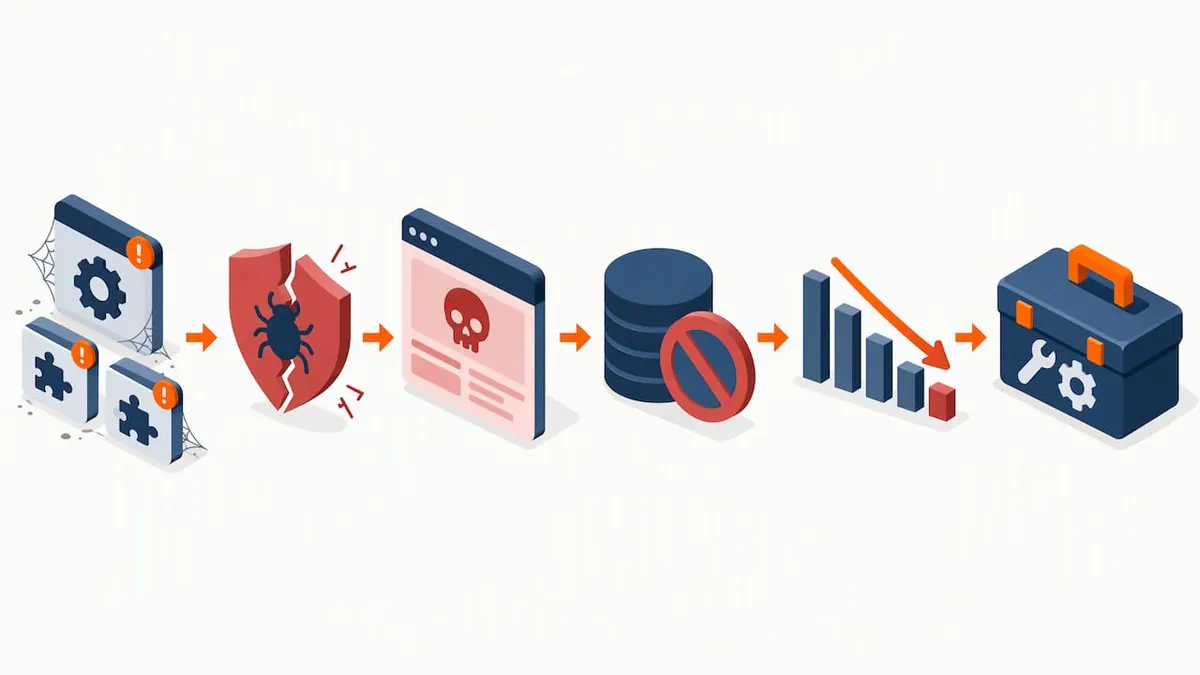
The expensive scenario is rarely a big upgrade. It is neglect. When plugins and the CMS core go months without updates, known vulnerabilities pile up. Attackers scan for exactly those. The result is a hacked site, a blacklisted domain, lost rankings and a rescue fix that takes far longer than monthly updates would have.
There is also a legal side. Under the Protection of Personal Information Act (POPIA), a website that collects names, emails or order details is processing personal information. A public-body POPIA guide hosted on the Karoo Hoogland municipality site summarises the principles: keep information up to date, use it only for its purpose and keep it secure. If personal information is compromised, the responsible party must notify the Information Regulator and the affected people. For a business, routine maintenance is the practical evidence that you took reasonable security steps. For more on this, read our guide to website security, maintenance and legal duties in South Africa. It is general information, not legal advice, so speak to an attorney who handles data protection if you have processed a lot of customer data or have had an incident.
How to choose a maintenance provider
Compare providers on these points, in this order:
- Scope in writing. A clear list of what is done monthly, quarterly and on request.
- Included change time and how unused hours are treated. Rollover is a good sign.
- Backup location and restore time. Ask how long it takes to restore the site and when the last restore test was run.
- Response time. For a store, same-day response matters. For a brochure site, next business day is usually fine.
- Ownership. You should hold the domain, hosting login and admin account.
- Exit terms. Month-to-month with a clear handover is safer than a long lock-in.
- Reporting. You should see what was done, not just receive an invoice.
Treat a very low price with caution. If a plan is priced well below the rest, check whether it includes any real support time or just an automated updater.
Our perspective: maintenance is where a website earns its keep
We see the same pattern with South African businesses. A site is launched with energy, then left alone. A year later it loads slowly, a form has stopped sending leads, and the owner is surprised that Google traffic has dropped. The site did not fail on design. It simply was not looked after.
We work directly with founders and business owners, with no account managers in between, so when something on your site needs attention you speak to the person who will fix it. We keep pricing flexible and do not tie clients to long-term contracts, because maintenance should be earned each month by the work, not by a lock-in clause.
Our advice is practical. Pick a plan whose included hours you will actually use. Own your domain and hosting accounts. Ask for a monthly report. And treat maintenance as part of your marketing budget, because a fast, secure, working site is what your SEO and ad spend send people to. Money spent driving traffic to a broken form is money wasted.
, Cobus
Budgeting for the year
A realistic annual website budget has four layers: the build (once-off), the running costs (domain, hosting, SSL, licences), the maintenance plan (monthly), and a small contingency for larger changes. If you are still at the build stage, our website cost guide and ecommerce website cost breakdown show what to expect. Choosing a platform also affects upkeep, which we cover in Wix versus WordPress for small businesses.
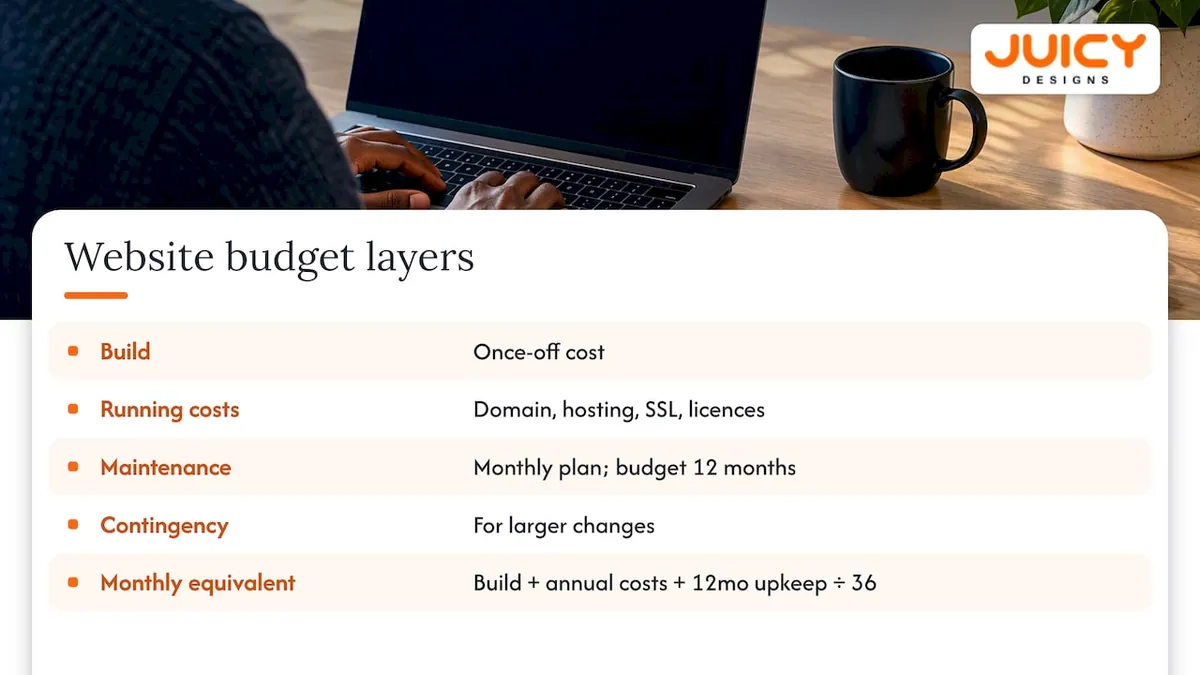
A simple way to plan: add up your build cost, your yearly running costs and twelve months of maintenance, then divide by 36 to see what the site costs you per month over three years. That figure is a fairer basis for deciding whether the site pays for itself than the build quote alone.
Let us look after the site that brings you leads
If you are building a new site or rebuilding an old one, we design and build for South African businesses, with once-off pricing that starts at R12 000 for a Starter site, from R28 000 for a Business site and from R85 000 for custom and ecommerce builds. You can see what each tier includes on our web design pricing page. Already have a site and want to know where it stands? Our once-off SEO audit, from R8 000, reviews the technical health that maintenance is meant to protect. Speak to us from the Juicy Designs homepage and we will tell you honestly what your site needs and what it does not.
FAQ
How much should a small business budget for website maintenance?
A small brochure site can usually be maintained on a modest monthly plan, because most of the work is automated updates and backups. Budget more if you edit content often or run a store. Compare plans by dividing the fee by the hours of changes included.
Is it cheaper to pay hourly instead of monthly?
It can be, if your site rarely changes and is simple. But hourly work does not cover routine updates, backups and monitoring unless you ask for them. Sites that run plugins or take payments are safer on a monthly plan, because updates happen on schedule.
Does maintenance include hosting and the domain?
Not always. Some providers bundle hosting into the monthly fee and others bill it separately, and domain renewals are usually yearly. Ask for the answer in writing so there are no surprises at renewal time.
What happens if I never maintain my website?
Outdated software accumulates known security holes, and the site may slow down or break after a server change. A hacked site costs more to clean up than routine updates cost to prevent. If personal information is exposed, POPIA also requires you to notify the Information Regulator and the people affected.
Can I maintain the site myself?
Yes, if you are comfortable with updates, backups and troubleshooting plugin conflicts. Most business owners find their time is better spent running the business, and a good provider will do the same work faster with tested restore procedures.
Sources
Recommended
- Website Maintenance & Care Plans South Africa
- Website Costs in South Africa: Pricing Guide
- How Much Does a Website Cost in South Africa?
- Website Creation Cost in South Africa: Full Picture