
Why entertainment brands use Google Ads in 2026
Entertainment brands use Google Ads because it reaches people at the moment they search for a show, artist, venue or ticket, at a cost per click that stays low in South Africa relative to other markets.
This guide covers the campaign types that suit entertainment, how to target them, and what to measure.



TL;DR:
- Google Ads offers cost-effective targeting for entertainment brands, with South African CPCs often under R20.
- Using AI-driven campaigns and integrating search, YouTube, and SEO increases overall advertising effectiveness.
Google Ads is defined as a pay-per-click advertising platform that places entertainment brands in front of high-intent audiences at the exact moment they search, stream, or browse. The arts and entertainment sector benefits from some of the lowest cost-per-click rates globally, with South African campaigns running at roughly R5 to R20 per click. That is 5x to 10x cheaper than legal or finance sectors, which means entertainment marketers get far more reach per rand spent. Add the structural decline of linear TV and the rapid growth of YouTube and Connected TV, and the case for Google Ads becomes difficult to ignore. Brands that understand why entertainment brands use Google Ads are already pulling ahead of those still planning around legacy media.
Why entertainment brands use Google Ads for cost-effective targeting
The financial case for Google Ads in entertainment is straightforward. Arts and entertainment CPCs sit between R5 and R20 in South Africa, making it one of the most budget-friendly sectors on the platform. That low entry point lets smaller entertainment brands compete alongside major studios without burning through their entire quarterly budget in a week.
Cost efficiency alone does not explain the full picture. Google Ads also rewards relevance through its Quality Score system. A higher Quality Score lowers your effective cost per click and improves your ad position. Entertainment brands that align their ad copy, keywords, and landing pages tightly can reduce their actual spend while increasing visibility.
Audience targeting is where Google Ads truly separates itself from traditional media. Search campaigns reach people actively looking for “where to watch” a specific film or “best live events near me.” YouTube campaigns reach viewers already in an entertainment mindset. Both formats capture intent that a billboard or radio spot simply cannot.
- Search campaigns connect with high-intent audiences ready to act, not just browse.
- YouTube pre-roll and mid-roll ads place your content in front of viewers already engaged with related entertainment.
- Audience segmentation lets you target by interest, viewing behaviour, device type, and geographic location within South Africa.
- Budget flexibility means you can scale spend up during a film release or event launch, then pull back immediately after.
Pro Tip: Set separate campaigns for Search and YouTube rather than combining them. Each format attracts a different stage of the audience journey, and separate budgets give you cleaner performance data to act on.
What audience shifts are driving entertainment brands towards Google Ads?
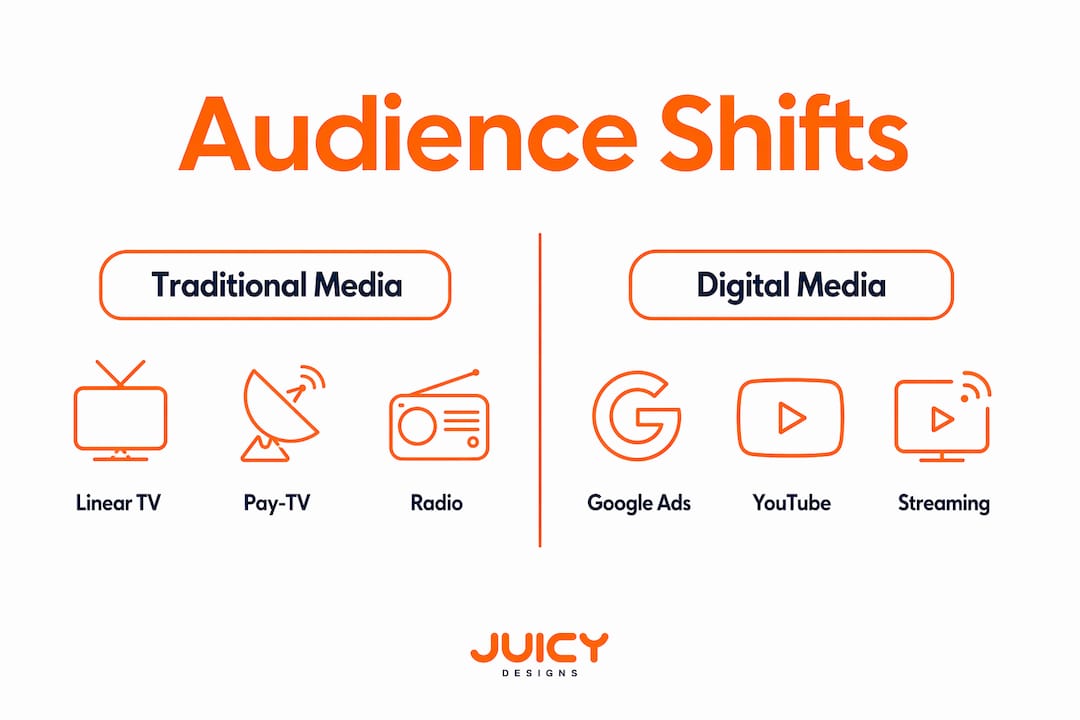
Linear TV is losing ground fast in South Africa. Pay-TV dropped 9.6% in a single year, and linear TV reach has capped at 60 to 63% of the population. Beyond that ceiling, brands hit frequency waste rather than new audiences. That structural shift forces entertainment marketers to find audiences where they have actually moved.
YouTube now reaches over 25 million monthly users in South Africa. Connected TV watch time grew 16% and now accounts for 32.6% of total YouTube watch time in the country. That is a significant and growing audience watching long-form content on large screens, which is exactly the environment entertainment brands need.
Audience fragmentation makes this more complex. Viewers no longer follow a single channel or schedule. They move between streaming platforms, YouTube, social media, and short-form video based on mood and moment. A scattergun approach to media buying misses most of them.
“The challenge for South African entertainment brands is not a lack of audience interest. The challenge is misalignment between where brands advertise and where audiences actually spend their time. Google Ads closes that gap by placing content discovery directly in the path of active digital behaviour.”
The table below shows how the South African media environment has shifted and what that means for entertainment advertising strategy.
| Media channel | Trend in South Africa | Implication for entertainment brands |
|---|---|---|
| Linear TV | Reach capped at 60 to 63%, pay-TV down 9.6% | Frequency waste beyond current reach ceiling |
| YouTube | 25M+ monthly users, CTV watch time at 32.6% | High-intent, large-screen audience available now |
| Connected TV | 16% growth in watch time | Premium viewing context for entertainment ads |
| Streaming platforms | Fragmented, selective viewing behaviour | Requires precise targeting, not broad reach |
Google Ads also addresses a specific problem identified in the NFVF Audience Report: traditional promotion has lost its influence over viewing decisions. Audiences now discover content through digital pathways. Google Ads creates direct “where-to-watch” links that convert awareness into immediate viewing action, removing the friction that legacy marketing leaves in place.
How AI and campaign management are reshaping Google Ads for entertainment
AI has changed how entertainment brands build and run Google Ads campaigns. Static ads with fixed copy and a single creative are being replaced by dynamic campaign models that adapt in real time based on performance signals. Google’s own AI tools adjust bids, rotate creative assets, and shift budget towards the best-performing combinations automatically.

Agentic workflows take this further. These are AI-driven systems that generate thousands of ad variations tailored by geography, device type, and viewer behaviour. An entertainment brand launching a new series can have localised ad variants for Cape Town, Johannesburg, and Durban running simultaneously, each adapted to local cultural context, without waiting weeks for a traditional creative approval cycle.
Performance Max campaigns reflect this shift at scale. PMax now runs on 71% of Google Ads accounts and beats Search-only return on ad spend in 58% of those accounts. Entertainment brands using PMax get automatic placement across Search, YouTube, Display, and Gmail from a single campaign structure.
Here is how to build an AI-ready Google Ads campaign for an entertainment brand:
- Set clear conversion goals first. Define whether you want ticket sales, streaming sign-ups, or trailer views. AI optimisation only works well when it has a clear target to chase.
- Upload multiple creative assets. Provide at least 5 headlines, 4 descriptions, and several image or video variants. The AI needs material to test and rotate.
- Use audience signals. Feed the campaign data from your existing fans, website visitors, and YouTube subscribers. This gives the AI a starting point rather than learning from scratch.
- Enable responsive search ads. These let Google test headline and description combinations automatically and surface the best-performing mix.
- Connect to AI-driven optimisation tools for real-time performance feedback. Platforms built for this purpose can surface insights faster than manual reporting cycles.
- Integrate with your SEO and GEO strategy. Generative engine optimisation ensures your brand appears in AI-generated search results, which now influence how audiences discover entertainment content.
Pro Tip: Do not pause a Performance Max campaign in its first two weeks. The AI needs time to gather data and exit the learning phase. Pausing early resets that process and wastes the budget already spent on learning.
What practical steps maximise Google Ads results for entertainment brands?
The brands getting the best results from Google Ads in entertainment are not simply spending more. They are spending more precisely. Integrated paid search and video combined with SEO outperforms siloed media planning consistently. Treating Search, YouTube, and organic discovery as separate channels leaves money on the table.
Creator-driven content amplifies this further. Combining creator assets with branded Google Ads campaigns produces 8% higher conversions, 20% higher conversion value, and a 41% boost in watch time. That is not a marginal improvement. It reflects how South African audiences respond to authentic voices over polished brand messaging alone.
Here are the practical steps that make the biggest difference:
- Target long-tail keywords like “where to watch [film title] in South Africa” or “best live comedy shows Johannesburg 2026.” These phrases have lower competition and higher purchase intent than broad genre terms.
- Align landing pages with ad copy. If your ad promotes a specific show, the landing page must feature that show immediately. Mismatched pages kill Quality Score and raise your CPC.
- Build “where-to-watch” pathways into every campaign. Include direct links to streaming platforms, ticketing pages, or subscription sign-ups. Remove every step between the ad click and the viewing action.
- Combine paid search and paid social in a shared budget framework. Search captures intent; social builds awareness. Both feed each other when planned together.
- Review search term reports weekly. Entertainment audiences use specific, seasonal language. Catching new search patterns early lets you add keywords before competitors do.
Key takeaways
Entertainment brands that combine Google Ads with creator content, long-tail keyword targeting, and AI-driven campaign management consistently outperform those relying on linear TV or siloed digital budgets.
| Point | Details |
|---|---|
| Low CPC advantage | Arts and entertainment CPCs in South Africa run R5-R20, far below most other sectors. |
| Linear TV is declining | Pay-TV dropped 9.6% in one year; Google Ads reaches audiences where they have actually moved. |
| AI drives better results | Performance Max beats Search-only ROAS in 58% of accounts by automating creative and bid decisions. |
| Creator content multiplies impact | Combining creator and branded assets lifts conversions by 8% and watch time by 41%. |
| Integration beats isolation | Brands that connect Search, YouTube, and SEO in one strategy outperform those running each channel separately. |
What I have learned watching South African entertainment brands advertise
The entertainment brands I see struggling with Google Ads share one pattern: they treat it like a TV buy. They set a budget, pick broad keywords, and wait for results. That approach worked in 2018. It does not work now.
The brands gaining ground are the ones treating Google Ads as a live system. They check search term reports. They test creator content against polished brand videos. They build campaigns around specific release dates and pull back immediately after. They connect their paid search data to their SEO strategy so each channel informs the other.
South Africa’s entertainment market has a genuine audience. The NFVF data confirms that clearly. The problem is not that people do not want to watch local content. The problem is that most brands are still advertising in places their audience has left. Google Ads, used well, puts your message exactly where the audience is right now.
The other mistake I see regularly is ignoring the “where-to-watch” gap. A brand runs a beautiful YouTube pre-roll, the viewer wants to watch the full film, and then there is no clear path to do so. The ad creates desire and then abandons the viewer. Every campaign needs a direct conversion pathway built in from day one.
My honest advice: stop planning your Google Ads budget in isolation from your SEO and social spend. The brands winning in 2026 are the ones where every channel feeds the next. Google Ads is not a standalone tactic. It is the connective tissue of a full-funnel entertainment marketing strategy.
, Cobus
How Juicy Designs supports entertainment brands on Google Ads
Juicy Designs is a Pretoria-based digital marketing agency that builds and manages Google Ads campaigns for brands that need measurable results, not guesswork. The team works directly with founders and decision-makers, which means your campaign strategy is built by the people accountable for its performance. Juicy Designs delivers an average ROAS of 4.8x across its client base, nearly double the industry standard. For entertainment brands ready to move beyond legacy media planning, Juicy Designs offers full-funnel Google Ads management aligned with AI-driven campaign structures and integrated SEO. Request a free Google Ads proposal and get a strategy built around your specific audience and release calendar.
FAQ
Why do entertainment brands choose Google Ads over traditional TV advertising?
Linear TV reach in South Africa has capped at 60 to 63% and pay-TV dropped 9.6% in one year. Google Ads reaches audiences on YouTube and Connected TV where they have actually moved, at a fraction of the cost.
What is the average cost per click for entertainment brands on Google Ads?
Arts and entertainment CPCs in South Africa typically run between R5 and R20 per click. That makes it one of the most cost-efficient sectors on the platform compared to legal or finance categories.
How does AI improve Google Ads performance for entertainment marketers?
Performance Max campaigns use AI to automatically rotate creative assets, adjust bids, and allocate budget across Search, YouTube, and Display. PMax beats Search-only ROAS in 58% of accounts, making it a strong default for entertainment campaigns.
What is a “where-to-watch” pathway and why does it matter?
A “where-to-watch” pathway is a direct link from an ad to the platform where audiences can immediately view the content. Without it, brands create awareness but lose the conversion because the viewer has no clear next step.
Should entertainment brands combine Google Ads with SEO?
Combining paid search, YouTube advertising, and SEO into one integrated strategy consistently outperforms running each channel separately. Siloed media planning leaves brands behind in the current South African entertainment market.