
Performance Max for Lead Gen in South Africa: 3 Moves Past Form Fills
Train Performance Max on qualified leads, not raw form fills, with CRM imports, enhanced conversions, campaign checks, and hands on setup from Juicy Designs.
Performance Max for Lead Gen in South Africa: 3 Moves Past Form Fills ! Founder reviewing CRM lead outcomes Performance Max can deliver high-quality leads when you optimise for deep-funnel conversions and feed the system accurate offline conversion data.


TL;DR: Quick Answer
Train Performance Max on qualified leads, not raw form fills, with CRM imports, enhanced conversions, campaign checks, and hands on setup from Juicy Designs.
Key takeaways
- Very cheap quotes (under R5,000) almost always exclude copywriting, SEO, custom design and post-launch support
- On-page SEO built into the website at launch costs a fraction of what it costs to retrofit after the site is live
- Hosting, SSL, domain and maintenance add R3,000-R10,000 per year on top of build cost
- E-commerce adds significant cost due to payment gateway integrations, product data, security requirements and checkout UX
- Timeline and client responsiveness directly affect cost: slow feedback rounds extend agency hours

Performance Max can deliver high-quality leads when you optimise for deep-funnel conversions and feed the system accurate offline conversion data. Start with three moves: pick a conversion action such as "Qualified lead", switch on enhanced conversions for leads, and connect your CRM so Google learns which leads become customers. Advertisers who lift Ad Strength to "Excellent" see 6% more conversions on average, and we can set it all up with you.
TL;DR:
- Daily uploads should include every conversion, available GCLIDs, and consent fields; since June 15, 2026, imports use the Data Manager API.
- Use Maximise conversions while history is thin; apply a ROAS target only after the chosen conversion action records at least 15 conversions in 30 days.
- Set daily spend at least three times your target CPA, and assess results at campaign level because Google shifts spend across channels.
- Treat audience signals and search themes as starting cues, not limits, and pair search themes with URL exclusions when final URL expansion is enabled.
- Add at least one video to each asset group; Google reports advertisers doing so saw a 12% average increase in incremental conversions.
How do you build the measurement foundation Performance Max needs?
Performance Max follows the signal you give it. If the goal is a raw form submission, it will find cheap form fillers. If the goal is a qualified lead, it hunts for people like the ones your sales team actually wants.
Google's own guidance is to optimise towards deep-funnel actions such as "Qualified Lead", "Converted Lead", "Book Appointment" or "Request Quote" rather than top-of-funnel submissions. Using these conversion categories also triggers built-in protections against invalid traffic, which matters when bots love to lead forms.
Here is how we set it up:
- Define the actions that matter. Choose one to three conversions that reflect sales intent, such as a booked appointment or a quote request.
- Mark them "for bidding". Only conversion actions flagged for bidding steer the campaign, so remove everything else from the goal.
- Use the right category. Assign the category that matches the action, so the invalid traffic protections apply.
- Name them clearly. Use plain names like "Qualified lead (CRM)" and keep them consistent at account and manager level, so no one double counts.
- Set a value where you can. Even a rough rand value per lead type lets you move to value-based bidding later.
Our guide on measuring first with Performance Max goes deeper on this sequence.
Why should you connect your CRM and use enhanced conversions for leads?
A form fill tells Google that someone was interested. Your CRM tells it who actually bought. Google's lead generation playbook recommends integrating your CRM with Google Ads and uploading offline conversion data, so the system can bid harder for the users who turn into customers.
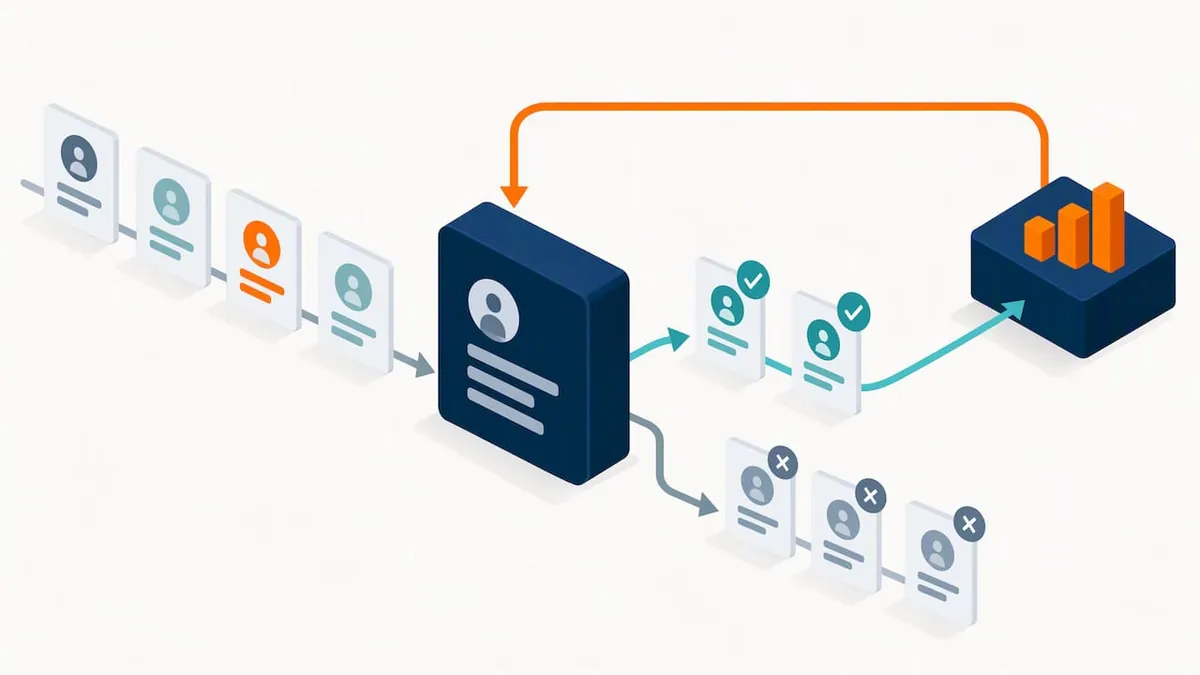
Enhanced conversions for leads sends hashed first-party data, which improves attribution and bidding. Google's developer documentation says to implement it through the Google tag or Google Tag Manager and to pass as many identifiers as you can. You can also upload through the Data Manager or the API, as covered in our offline conversion tracking explainer.
The operational checklist:
- Capture the GCLID on every lead when it is available, and store it in your CRM.
- Populate the consent field, because events without it can be ignored by bidding. As of June 15, 2026, imports moved to the Data Manager API.
- Upload daily, and do not backfill old data, as the implementation checklist advises.
- Upload every conversion for the event, not only the wins.
Pro Tip: Automate the daily upload from your CRM through the Data Manager so a missed day never starves the algorithm.
How do audience signals and search themes speed up learning?
Audience signals tell Performance Max where to start looking. They do not fence it in. Google describes them as guidance for the AI, and its guidance on getting the most from Performance Max points to first-party data as the strongest input. Search themes work the same way: they nudge the system towards queries you care about, and Google suggests pairing them with URL exclusions when final URL expansion is on.
What to include in each asset group:
- Customer Match lists of past clients and, ideally, only the qualified leads from your CRM.
- Lifecycle lists such as recent enquirers who never booked, and past customers who are due to return.
- In-market and interest segments that mirror your best buyers.
- Authored search themes written in the words customers use when they are ready to enquire, not broad category terms.
Resist the urge to stack ten narrow filters. If the signal is too tight, the system cannot explore, and learning slows. Treat signals as a starting hint and let results refine them.
What assets and asset groups do you need, and why does Ad Strength matter?
Build asset groups around a buyer type and a landing page, not around a product catalogue. A homeowner enquiry and a commercial enquiry need different headlines, images and proof, so give each its own group.
For each asset group we upload:
- A full set of varied headlines and descriptions that speak to one need.
- Quality images in several formats, plus your logo.
- At least one video, and ideally several aspect ratios and orientations.
- A clear landing page that matches the promise in the ad.
Video earns its place. Google reports that advertisers who added at least one video saw a 12% average increase in incremental conversions, and extra aspect ratios help on YouTube.
Moving Ad Strength to "Excellent" lifts conversions by 6% on average. Complete, varied assets give the system more combinations to test.
Check asset-level reporting regularly and replace the weakest performers instead of waiting for them to drag down the group.
Which bidding strategy and budget should you start with?
Pick the strategy that matches the data you have. If you can assign a value to each lead type, value-based bidding such as Maximise conversion value or target ROAS lets Google chase the leads worth the most. If not, begin with Maximise conversions and move across once the numbers justify it. Our bidding strategies guide compares the options in more detail.
- Start simple. Use Maximise conversions while your conversion history is thin.
- Wait for volume. Before applying a ROAS target, choose a conversion action with at least 15 conversions in 30 days.
- Size the budget for learning. Set a daily budget of at least three times your target CPA, and expect Google to spend up to twice the daily budget on busy days.
- Judge the campaign as a whole. Spend shifts across channels, so evaluate at campaign level rather than chasing one placement.
Pro Tip: Do not squeeze the budget in the first weeks. A starved campaign learns slowly and then looks like a failure it never had a chance to avoid.
How do you keep low-quality traffic out of your leads?
Automation needs boundaries. These are the controls we apply, in the order we usually reach for them:
- Add negative keywords pulled from search terms insights, at campaign or account level depending on how widely they apply.
- Apply placement and URL exclusions at account or manager level, so poor inventory is blocked everywhere at once.
- Review final URL expansion. If ads land on blog posts, careers pages or other non-commercial pages, add exclusions or switch expansion off.
- Exclude your brand terms where you want the campaign to find new demand instead of recycling people who already know you.
- Tighten location settings to presence-based targeting, so you stop paying for enquiries from outside your service area.
Review these weekly at first. Our walkthrough on getting more qualified leads from Google Ads shows how this fits into a wider qualification process.
How do lead form assets and landing pages cut spam?
Lead form assets let people enquire inside the ad. Google requires at least one personal identifier, an email or a phone number, and supports qualifying responses, conditional answers and webhook delivery to your CRM. The best practices add that fast follow-up wins leads.
- Ask qualifying questions such as budget range, timeline or service type, so low-intent people filter themselves out.
- Verify phone numbers with a one-time password where it is supported.
- Deliver leads instantly to your CRM by webhook, so sales can respond within minutes.
- Include a privacy policy link and the required fields.
- Add server-side validation and reCAPTCHA to block bots, as Google's practitioner guidance recommends.
Clean data also lifts your offline match rate, which makes enhanced conversions work better.
Pro Tip: A double opt-in email or SMS confirmation filters fake submissions and gives you one more verified identifier to upload.
How long should you let Performance Max learn?
Expect a learning period that varies with the setup and volume. Google advises conservative, incremental testing rather than an overnight switch. Our test order:
- Fix measurement and offline imports first.
- Add audience signals and search themes.
- Refresh creative and assets.
- Adjust bidding and budget last.
Keep your existing campaigns running at first, compare results side by side, and shift budget to Performance Max gradually as it proves itself.
What should you monitor each day and week?
Reports tell you what to change, so build a rhythm around them:
- Daily: conversion delivery, enhanced conversion diagnostics and Data Manager logs. A broken upload is the fastest way to ruin lead quality.
- Weekly: search terms insights and placement reports, feeding new negatives and exclusions.
- Asset group reports: read asset performance and Ad Strength together. Weak assets with low strength are your first refresh candidates.
- Quarterly: a full creative refresh, using asset audience insights to see which messages resonate with which segments.
What does a practical lead gen checklist look like?
Here is a five-step checklist: set a deep-funnel goal, enable enhanced conversions, connect the CRM with daily uploads, add audience signals, and upload video assets. Most struggling campaigns fail on step one or two, not on bidding. Our founders work hands-on with every client account, so we see the same pattern repeatedly. Run your own account against the list today and note where it falls short.
, Cobus
How can we help you set this up?
You can do all of this yourself, but it takes careful measurement work and steady attention. We handle the heavy lifting directly, with the founders involved and no account managers in between.
What an engagement with us includes:
- Measurement-first kickoff: conversion actions, enhanced conversions for leads and consent settings.
- CRM integration: daily uploads so Google sees which leads close.
- Asset and audience setup: signals, search themes and asset groups built around your buyers.
- Ongoing optimisation: exclusions, creative refreshes and bidding changes on a set cadence.
Our Google Ads management plans are listed on our pricing page, and current account audit prices are on our website. Ask for our free Google Ads audit and we will review your account against this checklist.
FAQ
Is Performance Max worth it for lead generation?
It can be, when you optimise for qualified conversions and import CRM data. Without accurate measurement, it tends to chase cheap, low-quality form fills. Google's guidance on Performance Max positions it as a goal-based campaign for cross-channel reach.
When should you use Performance Max?
Use it when you have a clear conversion goal and want reach across Google's channels. It suits accounts with solid measurement and enough conversion data for Smart Bidding to learn from. If your tracking is weak, fix that first.
How much should you pay for lead generation?
It depends on your industry, margins and lead value, so there is no single fair price. Set your budget from your target cost per lead, aiming for a daily budget of at least three times your target CPA. Our managed plans are listed on our pricing page.
What is the best lead generation approach?
The best approach pairs strong targeting with fast follow-up and clean measurement. Capturing leads is half the job: nurturing them matters just as much, and this lead nurturing guide covers what to do after the enquiry.
Sources
Recommended
- Lead Generation Companies in South Africa: How to Pick One
- Lead Magnets That Generate Leads (SA Guide)
- Property Lead Generation in South Africa: A Guide
- Lead Generation in Cape Town: A Local Guide